Thank you for visiting SNEWPapers!
Sign up free
The Daily Advertiser ; Political, Historical, And Commercial
New York, New York County, New York
What is this article about?
On September 21, 1787, the Continental Congress passed resolutions continuing the Board of Treasury commissioners Samuel Osgood, Walter Livingston, and Arthur Lee until November 10, 1789, and abolishing the offices of comptroller and auditor effective November 1, transferring their duties, books, and papers to the board, which could employ an accountant and up to two clerks.
Clipping
OCR Quality
Full Text
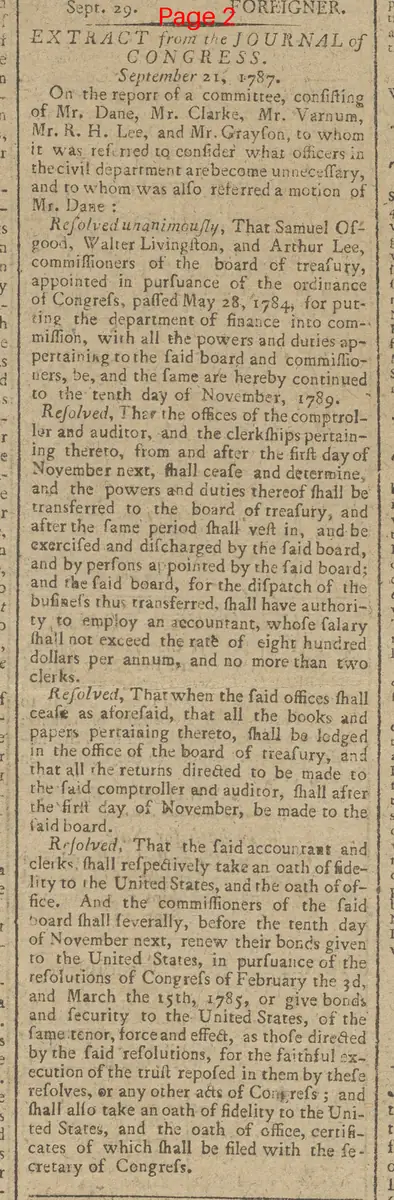
September 21, 1787.
On the report of a committee, consisting of Mr. Dane, Mr. Clarke, Mr. Varnum, Mr. R. H. Lee, and Mr. Grayson, to whom it was referred to consider what officers in the civil department are become unnecessary, and to whom was also referred a motion of Mr. Dane:
Resolved unanimously, That Samuel Osgood, Walter Livingston, and Arthur Lee, commissioners of the board of treasury, appointed in pursuance of the ordinance of Congress, passed May 28, 1784, for putting the department of finance into commission, with all the powers and duties appertaining to the said board and commissioners, be, and the same are hereby continued to the tenth day of November, 1789.
Resolved, That the offices of the comptroller and auditor, and the clerkships pertaining thereto, from and after the first day of November next, shall cease and determine, and the powers and duties thereof shall be transferred to the board of treasury, and after the same period shall vest in, and be exercised and discharged by the said board, and by persons appointed by the said board; and the said board, for the dispatch of the business thus transferred, shall have authority to employ an accountant, whose salary shall not exceed the rate of eight hundred dollars per annum, and no more than two clerks.
Resolved, That when the said offices shall cease as aforesaid, that all the books and papers pertaining thereto, shall be lodged in the office of the board of treasury, and that all the returns directed to be made to the said comptroller and auditor, shall after the first day of November, be made to the said board.
Resolved, That the said accountant and clerks, shall respectively take an oath of fidelity to the United States, and the oath of office. And the commissioners of the said board shall severally, before the tenth day of November next, renew their bonds given to the United States, in pursuance of the resolutions of Congress of February the 3d, and March the 15th, 1785, or give bonds and security to the United States, of the same tenor, force and effect, as those directed by the said resolutions, for the faithful execution of the trust reposed in them by these resolves, or any other acts of Congress; and shall also take an oath of fidelity to the United States, and the oath of office, certificates of which shall be filed with the secretary of Congress.
What sub-type of article is it?
What keywords are associated?
What entities or persons were involved?
Domestic News Details
Event Date
September 21, 1787
Key Persons
Outcome
board of treasury commissioners continued until november 10, 1789; offices of comptroller and auditor cease november 1, 1787, with duties transferred to the board; board authorized to employ accountant (salary up to $800/year) and up to two clerks; oaths and bonds required.
Event Details
Congress, on report of committee including Mr. Dane et al., unanimously resolved to continue the commissioners of the Board of Treasury (appointed 1784) with their powers and duties until November 10, 1789; abolish comptroller and auditor offices and clerkships from November 1, 1787, transferring powers, duties, books, and papers to the board; require oaths for new staff and renewal of bonds by commissioners.