Thank you for visiting SNEWPapers!
Sign up free
Literary
January 10, 1944
Henderson Daily Dispatch
Henderson, Vance County, North Carolina
What is this article about?
In Tamazunchale, Mexico, during WWII, Mallory Baker bids farewell to the suspicious Smith brothers, obtains John's address, mentions friends in Mexico City and Taxco, and drives off in a car once owned by Dr. Courvier. She hides to observe if they follow in their black sedan.
Merged-components note: Merged sequential parts of the serialized story 'Yankee Senorita' into a single literary component.
Clipping
OCR Quality
95%
Excellent
Full Text
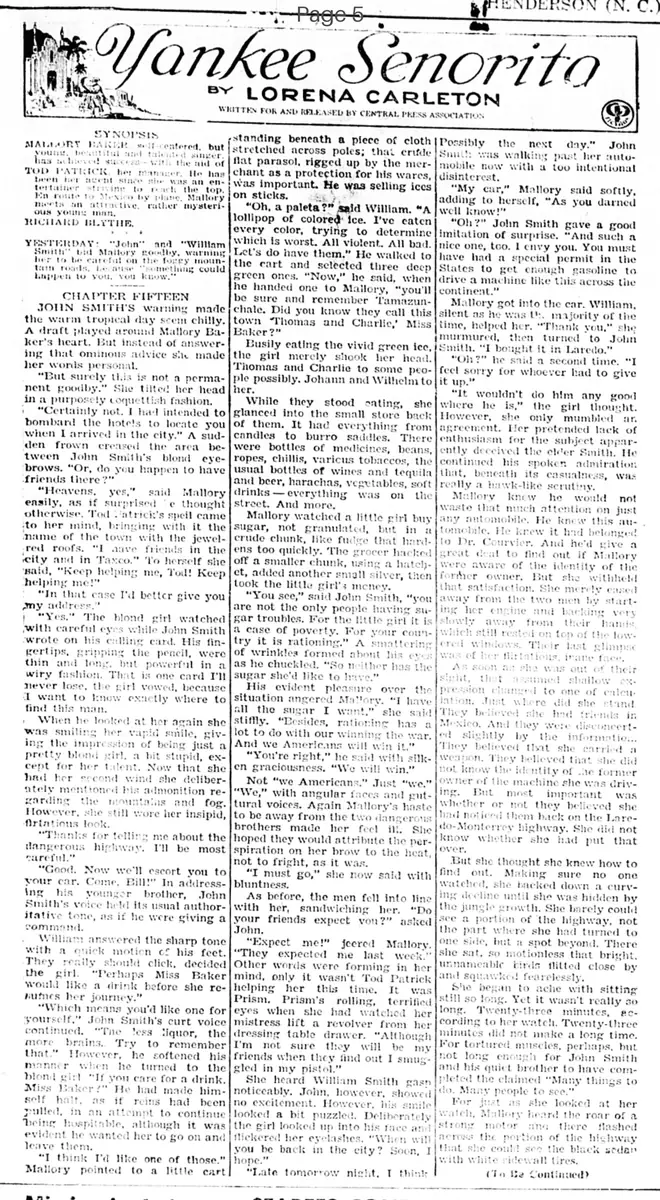
Yankee
By
Lorena Carleton
Senorita
WRITTEN FOR AP RELEASE
YESTERDAY: "John" and "William Smith" bid Mallory goodbye, warning her to be careful on the foggy mountain roads, teasing "something could happen to you, you know."
CHAPTER FIFTEEN
John Smith's warning made the warm tropical day seem chilly. A draft played around Mallory Baker's heart. But instead of answering that ominous advice she made her words personal.
"But surely this is not a permanent goodbye." She tilted her head in a purposely coquettish fashion.
"Certainly not. I had intended to bombard the hotels to locate you when I arrived in the city." A sudden frown creased the area between John Smith's blond eyebrows. "Or, do you happen to have friends there?"
"Heavens, yes," said Mallory easily, as if surprised he thought otherwise. Tod Patrick's spiel came to her mind, bringing with it the name of the town with the jewel-red roofs. "I have friends in the city and in Taxco." To herself she said, "Keep helping me, Tod! Keep helping me!"
"In that case I'd better give you my address."
"Yes." The blond girl watched with careful eyes while John Smith wrote on his calling card. His fingertips, gripping the pencil, were thin and long, but powerful in a wiry fashion. That is one card I'll never lose, the girl vowed, because I want to know exactly where to find this man.
When he looked at her again she was smiling her vapid smile, giving the impression of being just a pretty blond girl, a bit stupid, except for her talent. Now that she had her second wind she deliberately mentioned his admonition regarding the mountains and fog.
However, she still wore her insipid, flirtatious look.
"Thanks for telling me about the dangerous highway. I'll be most careful."
"Good. Now we'll escort you to your car. Come, Bill!" In addressing his younger brother, John Smith's voice held its usual authoritative tone, as if he were giving a command.
William answered the sharp tone with a quick motion of his feet.
They really should click, decided the girl. "Perhaps Miss Baker would like a drink before she resumes her journey."
"Which means you'd like one for yourself." John Smith's curt voice continued. "The less liquor, the more brains. Try to remember that." However, he softened his manner when he turned to the blond girl. "If you care for a drink, Miss Baker?" He had made himself halt, as if reins had been pulled, in an attempt to continue being hospitable, although it was evident he wanted her to go on and leave them.
"I think I'd like one of those." Mallory pointed to a little cart standing beneath a piece of cloth stretched across poles; that crude flat parasol, rigged up by the merchant as a protection for his wares, was important. He was selling ices on sticks.
"Oh, a paleta?" said William. "A lollipop of colored ice. I've eaten every color, trying to determine which is worst. All violent. All bad. Let's do have them." He walked to the cart and selected three deep green ones. "Now," he said, when he handed one to Mallory, "you'll be sure and remember Tamazunchale. Did you know they call this town Thomas and Charlie, Miss Baker?"
Busily eating the vivid green ice, the girl merely shook her head.
Thomas and Charlie to some people possibly. Johann and Wilhelm to her.
While they stood eating, she glanced into the small store back of them. It had everything from candles to burro saddles. There were bottles of medicines, beans, ropes, chillis, various tobaccos, the usual bottles of wines and tequila and beer, sarapes, vegetables, soft drinks—everything was on the street. And more.
Mallory watched a little girl buy sugar, not granulated, but in a crude chunk, like fudge that hardens too quickly. The grocer hacked off a smaller chunk, using a hatchet, added another small silver, then took the little girl's money.
"You see," said John Smith, "you are not the only people having sugar troubles. For the little girl it is a case of poverty. For your country it is rationing." A smattering of wrinkles formed about his eyes as he chuckled. "So neither has the sugar she'd like to have."
His evident pleasure over the situation angered Mallory. "I have all the sugar I want," she said stiffly. "Besides, rationing has a lot to do with our winning the war. And we Americans will win it."
"You're right," he said with silken graciousness. "We will win."
Not "we Americans." Just "we."
"We," with angular faces and guttural voices. Again Mallory's haste to be away from the two languorous brothers made her feel ill. She hoped they would attribute the perspiration on her brow to the heat, not to fright, as it was.
"I must go," she now said with bluntness.
As before, the men fell into line with her, sandwiching her. "Do your friends expect you?" asked John.
"Expect me!" jeered Mallory. "They expected me last week."
Other words were forming in her mind, only it wasn't Tod Patrick helping her this time. It was Prism. Prism's rolling, terrified eyes when she had watched her mistress lift a revolver from her dressing table drawer. "Although I'm not sure they will be my friends when they find out I smuggled in my pistol."
She heard William Smith gasp noticeably. John, however, showed no excitement. However, his smile looked a bit puzzled. Deliberately the girl looked up into his face and flickered her eyelashes. "When will you be back in the city? Soon, I hope."
"Late tomorrow night, I think. Possibly the next day." John Smith was walking past her automobile now with a too intentional disinterest.
"My car," Mallory said softly, adding to herself, "As you darned well know!"
"Oh?" John Smith gave a good imitation of surprise. "And such a nice one, too. I envy you. You must have had a special permit in the States to get enough gasoline to drive a machine like this across the continent."
Mallory got into the car. William, silent as he was the majority of the time, helped her. "Thank you," she murmured, then turned to John Smith. "I bought it in Laredo."
"Oh?" he said a second time. "I feel sorry for whoever had to give it up."
"It wouldn't do him any good where he is," the girl thought. However, she only mumbled an agreement. Her pretended lack of enthusiasm for the subject apparently deceived the elder Smith. He continued his spoken admiration that, beneath its casualness, was really a hawk-like scrutiny.
Mallory knew he would not waste that much attention on just any automobile. He knew this automobile. He knew it had belonged to Dr. Courvier. And he'd give a great deal to find out if Mallory were aware of the identity of the former owner. But she withheld that satisfaction. She merely eased away from the two men by starting her engine and backing very slowly away from their hands which still rested on top of the low-cut windows. Their last glimpse was of her haughty, rare face.
As soon as she was out of their sight, that assumed shallow expression changed to one of calculation. Just where did she stand? They believed she had friends in Mexico. And they were disconcerted slightly by the information. They believed that she carried a weapon. They believed that she did not know the identity of the former owner of the machine she was driving. But most important was whether or not they believed she had noticed them back on the Laredo-Monterrey highway. She did not know whether she had put that over.
But she thought she knew how to find out. Making sure no one watched, she backed down a curving decline until she was hidden by the jungle growth. She barely could see a portion of the highway, not the part where she had turned to one side, but a spot beyond. There she sat, so motionless that bright, unnamable birds flitted close by and squeaked fearlessly.
She began to ache with sitting still so long. Yet it wasn't really so long. Twenty-three minutes, according to her watch. Twenty-three minutes did not make a long time. For tortured muscles, perhaps, but not long enough for John Smith and his quiet brother to have completed the claimed "Many things to do. Many people to see."
For just as she looked at her watch, Mallory heard the roar of a strong motor and there flashed across the portion of the highway that she could see the black sedan with white sidewall tires.
By
Lorena Carleton
Senorita
WRITTEN FOR AP RELEASE
YESTERDAY: "John" and "William Smith" bid Mallory goodbye, warning her to be careful on the foggy mountain roads, teasing "something could happen to you, you know."
CHAPTER FIFTEEN
John Smith's warning made the warm tropical day seem chilly. A draft played around Mallory Baker's heart. But instead of answering that ominous advice she made her words personal.
"But surely this is not a permanent goodbye." She tilted her head in a purposely coquettish fashion.
"Certainly not. I had intended to bombard the hotels to locate you when I arrived in the city." A sudden frown creased the area between John Smith's blond eyebrows. "Or, do you happen to have friends there?"
"Heavens, yes," said Mallory easily, as if surprised he thought otherwise. Tod Patrick's spiel came to her mind, bringing with it the name of the town with the jewel-red roofs. "I have friends in the city and in Taxco." To herself she said, "Keep helping me, Tod! Keep helping me!"
"In that case I'd better give you my address."
"Yes." The blond girl watched with careful eyes while John Smith wrote on his calling card. His fingertips, gripping the pencil, were thin and long, but powerful in a wiry fashion. That is one card I'll never lose, the girl vowed, because I want to know exactly where to find this man.
When he looked at her again she was smiling her vapid smile, giving the impression of being just a pretty blond girl, a bit stupid, except for her talent. Now that she had her second wind she deliberately mentioned his admonition regarding the mountains and fog.
However, she still wore her insipid, flirtatious look.
"Thanks for telling me about the dangerous highway. I'll be most careful."
"Good. Now we'll escort you to your car. Come, Bill!" In addressing his younger brother, John Smith's voice held its usual authoritative tone, as if he were giving a command.
William answered the sharp tone with a quick motion of his feet.
They really should click, decided the girl. "Perhaps Miss Baker would like a drink before she resumes her journey."
"Which means you'd like one for yourself." John Smith's curt voice continued. "The less liquor, the more brains. Try to remember that." However, he softened his manner when he turned to the blond girl. "If you care for a drink, Miss Baker?" He had made himself halt, as if reins had been pulled, in an attempt to continue being hospitable, although it was evident he wanted her to go on and leave them.
"I think I'd like one of those." Mallory pointed to a little cart standing beneath a piece of cloth stretched across poles; that crude flat parasol, rigged up by the merchant as a protection for his wares, was important. He was selling ices on sticks.
"Oh, a paleta?" said William. "A lollipop of colored ice. I've eaten every color, trying to determine which is worst. All violent. All bad. Let's do have them." He walked to the cart and selected three deep green ones. "Now," he said, when he handed one to Mallory, "you'll be sure and remember Tamazunchale. Did you know they call this town Thomas and Charlie, Miss Baker?"
Busily eating the vivid green ice, the girl merely shook her head.
Thomas and Charlie to some people possibly. Johann and Wilhelm to her.
While they stood eating, she glanced into the small store back of them. It had everything from candles to burro saddles. There were bottles of medicines, beans, ropes, chillis, various tobaccos, the usual bottles of wines and tequila and beer, sarapes, vegetables, soft drinks—everything was on the street. And more.
Mallory watched a little girl buy sugar, not granulated, but in a crude chunk, like fudge that hardens too quickly. The grocer hacked off a smaller chunk, using a hatchet, added another small silver, then took the little girl's money.
"You see," said John Smith, "you are not the only people having sugar troubles. For the little girl it is a case of poverty. For your country it is rationing." A smattering of wrinkles formed about his eyes as he chuckled. "So neither has the sugar she'd like to have."
His evident pleasure over the situation angered Mallory. "I have all the sugar I want," she said stiffly. "Besides, rationing has a lot to do with our winning the war. And we Americans will win it."
"You're right," he said with silken graciousness. "We will win."
Not "we Americans." Just "we."
"We," with angular faces and guttural voices. Again Mallory's haste to be away from the two languorous brothers made her feel ill. She hoped they would attribute the perspiration on her brow to the heat, not to fright, as it was.
"I must go," she now said with bluntness.
As before, the men fell into line with her, sandwiching her. "Do your friends expect you?" asked John.
"Expect me!" jeered Mallory. "They expected me last week."
Other words were forming in her mind, only it wasn't Tod Patrick helping her this time. It was Prism. Prism's rolling, terrified eyes when she had watched her mistress lift a revolver from her dressing table drawer. "Although I'm not sure they will be my friends when they find out I smuggled in my pistol."
She heard William Smith gasp noticeably. John, however, showed no excitement. However, his smile looked a bit puzzled. Deliberately the girl looked up into his face and flickered her eyelashes. "When will you be back in the city? Soon, I hope."
"Late tomorrow night, I think. Possibly the next day." John Smith was walking past her automobile now with a too intentional disinterest.
"My car," Mallory said softly, adding to herself, "As you darned well know!"
"Oh?" John Smith gave a good imitation of surprise. "And such a nice one, too. I envy you. You must have had a special permit in the States to get enough gasoline to drive a machine like this across the continent."
Mallory got into the car. William, silent as he was the majority of the time, helped her. "Thank you," she murmured, then turned to John Smith. "I bought it in Laredo."
"Oh?" he said a second time. "I feel sorry for whoever had to give it up."
"It wouldn't do him any good where he is," the girl thought. However, she only mumbled an agreement. Her pretended lack of enthusiasm for the subject apparently deceived the elder Smith. He continued his spoken admiration that, beneath its casualness, was really a hawk-like scrutiny.
Mallory knew he would not waste that much attention on just any automobile. He knew this automobile. He knew it had belonged to Dr. Courvier. And he'd give a great deal to find out if Mallory were aware of the identity of the former owner. But she withheld that satisfaction. She merely eased away from the two men by starting her engine and backing very slowly away from their hands which still rested on top of the low-cut windows. Their last glimpse was of her haughty, rare face.
As soon as she was out of their sight, that assumed shallow expression changed to one of calculation. Just where did she stand? They believed she had friends in Mexico. And they were disconcerted slightly by the information. They believed that she carried a weapon. They believed that she did not know the identity of the former owner of the machine she was driving. But most important was whether or not they believed she had noticed them back on the Laredo-Monterrey highway. She did not know whether she had put that over.
But she thought she knew how to find out. Making sure no one watched, she backed down a curving decline until she was hidden by the jungle growth. She barely could see a portion of the highway, not the part where she had turned to one side, but a spot beyond. There she sat, so motionless that bright, unnamable birds flitted close by and squeaked fearlessly.
She began to ache with sitting still so long. Yet it wasn't really so long. Twenty-three minutes, according to her watch. Twenty-three minutes did not make a long time. For tortured muscles, perhaps, but not long enough for John Smith and his quiet brother to have completed the claimed "Many things to do. Many people to see."
For just as she looked at her watch, Mallory heard the roar of a strong motor and there flashed across the portion of the highway that she could see the black sedan with white sidewall tires.
What sub-type of article is it?
Prose Fiction
What themes does it cover?
War Peace
Political
What keywords are associated?
Mexico Adventure
Espionage Thriller
Wwii Context
Mallory Baker
Smith Brothers
Taxco
Tamazunchale
What entities or persons were involved?
Lorena Carleton
Literary Details
Title
Chapter Fifteen
Author
Lorena Carleton
Key Lines
"But Surely This Is Not A Permanent Goodbye." She Tilted Her Head In A Purposely Coquettish Fashion.
"We Will Win."
"Although I'm Not Sure They Will Be My Friends When They Find Out I Smuggled In My Pistol."
She Knew This Automobile. He Knew It Had Belonged To Dr. Courvier.