Thank you for visiting SNEWPapers!
Sign up free
The New Hampshire Gazette And Republican Union
Portsmouth, Rockingham County, New Hampshire
What is this article about?
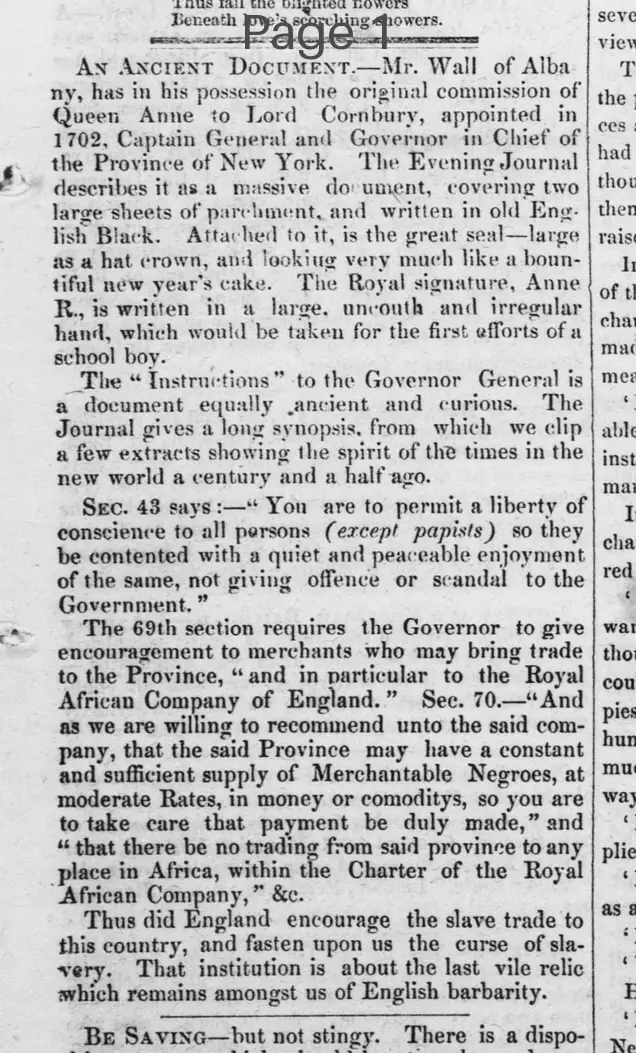
Mr. Wall of Albany possesses Queen Anne's 1702 commission to Lord Cornbury as Governor of New York, a large parchment document with royal seal. Excerpts from instructions highlight religious tolerance (except papists), trade encouragement, and support for the Royal African Company's slave trade, critiqued as England's legacy of slavery.
Clipping
OCR Quality
Full Text
The "Instructions" to the Governor General is a document equally ancient and curious. The Journal gives a long synopsis, from which we clip a few extracts showing the spirit of the times in the new world a century and a half ago.
Sec. 43 says:—“You are to permit a liberty of conscience to all persons (except papists) so they be contented with a quiet and peaceable enjoyment of the same, not giving offence or scandal to the Government.”
The 69th section requires the Governor to give encouragement to merchants who may bring trade to the Province, "and in particular to the Royal African Company of England." Sec. 70.—"And as we are willing to recommend unto the said company, that the said Province may have a constant and sufficient supply of Merchantable Negroes, at moderate Rates, in money or commodities, so you are to take care that payment be duly made," and "that there be no trading from said province to any place in Africa, within the Charter of the Royal African Company," &c.
Thus did England encourage the slave trade to this country, and fasten upon us the curse of slavery. That institution is about the last vile relic which remains amongst us of English barbarity.
What sub-type of article is it?
What themes does it cover?
What keywords are associated?
What entities or persons were involved?
Where did it happen?
Story Details
Key Persons
Location
Albany, Province Of New York
Event Date
1702
Story Details
Description of Queen Anne's 1702 commission to Lord Cornbury as Governor of New York, including physical details and excerpts from instructions on religious tolerance, trade encouragement, and support for the Royal African Company's slave trade, with commentary on England's role in introducing slavery.