Thank you for visiting SNEWPapers!
Sign up free
Story
November 1, 1898
The Anaconda Standard
Anaconda, Deer Lodge County, Montana
What is this article about?
Humorous account of a war correspondent's frustrating experience getting a poorly made suit from a Porto Rican tailor during the Spanish-American War, highlighting cultural differences in fashion and service, and his relief upon returning to New York.
Clipping
OCR Quality
95%
Excellent
Full Text
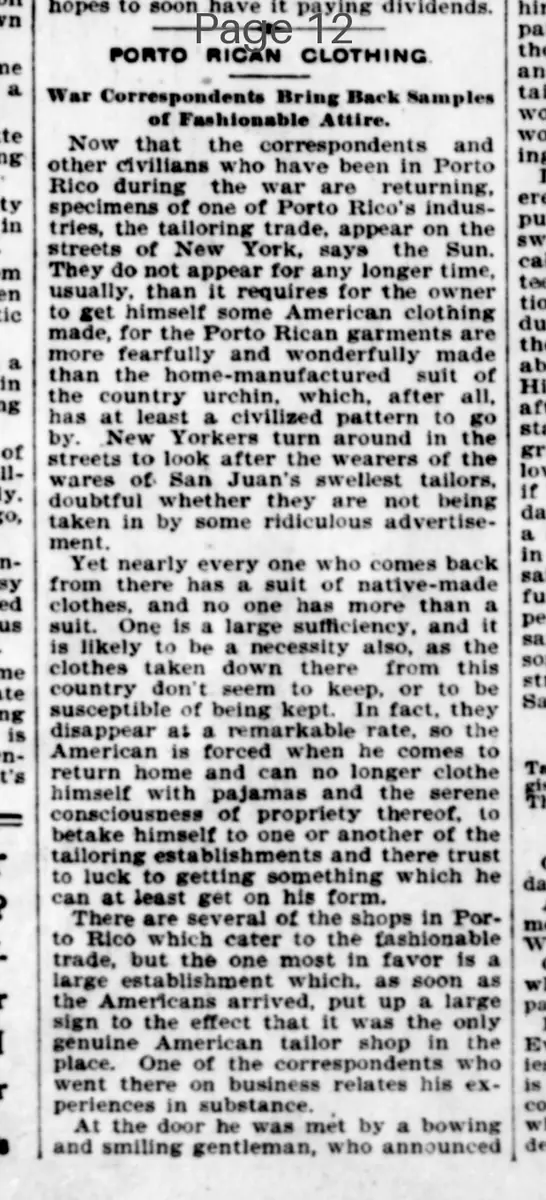
PORTO RICAN CLOTHING
War Correspondents Bring Back Samples of Fashionable Attire.
Now that the correspondents and other civilians who have been in Porto Rico during the war are returning, specimens of one of Porto Rico's industries, the tailoring trade, appear on the streets of New York, says the Sun. They do not appear for any longer time, usually, than it requires for the owner to get himself some American clothing made, for the Porto Rican garments are more fearfully and wonderfully made than the home-manufactured suit of the country urchin, which, after all, has at least a civilized pattern to go by. New Yorkers turn around in the streets to look after the wearers of the wares of San Juan's swellest tailors, doubtful whether they are not being taken in by some ridiculous advertisement.
Yet nearly every one who comes back from there has a suit of native-made clothes, and no one has more than a suit. One is a large sufficiency, and it is likely to be a necessity also, as the clothes taken down there from this country don't seem to keep, or to be susceptible of being kept. In fact, they disappear at a remarkable rate, so the American is forced when he comes to return home and can no longer clothe himself with pajamas and the serene consciousness of propriety thereof, to betake himself to one or another of the tailoring establishments and there trust to luck to getting something which he can at least get on his form.
There are several of the shops in Porto Rico which cater to the fashionable trade, but the one most in favor is a large establishment which, as soon as the Americans arrived, put up a large sign to the effect that it was the only genuine American tailor shop in the place. One of the correspondents who went there on business relates his experiences in substance.
At the door he was met by a bowing and smiling gentleman, who announced himself as being able to "spik Americano mutsa." The following colloquy ensued:
"I want a suit of clothes made in a hurry."
"Which of color, senor?"
"Oh, some shade of gray, I guess."
"It is of great regret," (the Porto Rican loves ceremonious words and expressions), "it departs from the fashion style."
"I don't care about that. Let me see some of the cloth."
"We procure it not," said the merchant, sadly shrugging his shoulders. "It proceeds out of the run."
"Well, have you got any good brown cloth?"
"It is most extreme sorrow and grief that is likewise not of the fashion style."
"Oh, confound your fashion-style. What have you got?"
"That of the most sublime exalted blue and black. For your money you pick choice."
This remarkable apothegm the tailor delivered with as much unction and pride as if it were some bit of the classics of America, which he doubtless considered it to be. After puttering over a small pile of serges and diagonals, which appeared to be the entire stock of the establishment, outside of the cotton and linen goods, the American picked out a piece which gave some promise of wearing qualities and asked the price. The tailor picked up the goods, examined it minutely, tested it by stretching, and said enthusiastically:
"The Americano senor recognizes the excelling garmenture with the experting eye. This," tapping it reverently, "is the best my house affords."
"Well, how much will you charge for a suit of that?"
"To so contrive you such a suit of fashion, style and gracefulness as it shall be an honor to wear it—that, senor, is to value at 40 pesos."
But the American had been advised as to his dealings with the native tradesman, and was not to be caught so easily.
"Nonsense," he exclaimed. "Why, the shop down the street wouldn't charge me half that."
An expression of melancholy fitted over the benign features of the tailor as he observed wearily that the establishment mentioned did not "class itself equitable," by which he probably meant to impart the idea that it was not in his class. The visitor offered 25 pesos for the suit, and they finally compromised on 32, the purchaser insisting on paying at once, as the rate of exchange, which alters from day to day, was at that particular time in his favor. He paid for the clothing about $16 in our money. That was Tuesday.
It was distinctly agreed between the party of the first part and the party of the second part that the garments should be finished and delivered at the hotel on the following Friday. They did not arrive on that day. The purchaser went around to the shop on the following morning to see about it, wearing a suit which he had borrowed for the occasion, being rather short of clothes. The proprietor expressed bland surprise. Next week, he said. In vain the American recalled the solemn agreement. A saint's day had intervened, said the tailor. Surely, the pious Americano senor would not have his so elegant garments worked on on a saint's day.
Dismay appeared in the face of the tailor as the pious American consigned the saints to a bad place. Here, plainly, was a blasphemous infidel who might perhaps turn violent. Something must be done. The clothes should be finished on the morrow, he promised. Of course, they did not come on the morrow. Equally, of course, the shop was closed all day, it being Sunday. The Porto Rican never works when there is any escape from it. To that characteristic is attributed the number of their saints, each of whom must have his day religiously observed. Another of them celebrated vicariously on Monday. On Tuesday the purchaser, now thoroughly enraged, entered the shop just in time to see a vanishing coat tail at the rear door. The head cutter explained, in fearful English and with many deprecatory bows, that the master had been taken violently ill and that all work had been put back a day on that account. Between pantomime and strange oaths the visitor succeeded in impressing the head cutter with the probability of the wreckage of the entire place if his suit was not forthcoming on the next day.
He finally got it on Thursday, which he afterward learned was surprisingly prompt delivery, and then had a chance to regret that he had ever got it at all. It alternated between agonizing tightness in the seams and billowy bulges everywhere else. Having forced himself into it with considerable violence to his feelings he sat down in a chair to rest. A crackling sound followed and he immediately began to protrude from the suit at various points. Back to the shop he took it and explained with more particularity than mildness some of its shortcomings and excesses.
The tailor said that there was a regular tariff for repairs. The American said that unless the tailor wanted to find himself in a condition calling for repairs as extensive as those needed by the suit he would do the work promptly and without hope of payment. The tailor said that it was a pleasure to work for the Americano senor and he would not think for a moment of charging him anything.
In all that suit was repaired and altered four times, its maker assuring the purchaser each time that it was "the swall arteecl." Then the American was called home and wore the "swall arteecl" back after some painful hesitation between it and an outfit of white duck. As he arrived only a week ago the duck seemed a little too unseasonable, so he decided on the blue serge.
His course was not a triumphant one after he reached this city. People stared at him on street cars and grinned in his face. Small boys followed him in the streets and asked him if he had mowed his pumpkins yet. One day was enough of it. He hied him to a store and bought a ready-made suit in which he felt like a prince, so he said. The other suit he has packed carefully away as the most noteworthy experience of his war experiences, and he says that there is a wide opening for some enterprising spirit from Baxter street to start a clothing business in San Juan de Porto Rico.
War Correspondents Bring Back Samples of Fashionable Attire.
Now that the correspondents and other civilians who have been in Porto Rico during the war are returning, specimens of one of Porto Rico's industries, the tailoring trade, appear on the streets of New York, says the Sun. They do not appear for any longer time, usually, than it requires for the owner to get himself some American clothing made, for the Porto Rican garments are more fearfully and wonderfully made than the home-manufactured suit of the country urchin, which, after all, has at least a civilized pattern to go by. New Yorkers turn around in the streets to look after the wearers of the wares of San Juan's swellest tailors, doubtful whether they are not being taken in by some ridiculous advertisement.
Yet nearly every one who comes back from there has a suit of native-made clothes, and no one has more than a suit. One is a large sufficiency, and it is likely to be a necessity also, as the clothes taken down there from this country don't seem to keep, or to be susceptible of being kept. In fact, they disappear at a remarkable rate, so the American is forced when he comes to return home and can no longer clothe himself with pajamas and the serene consciousness of propriety thereof, to betake himself to one or another of the tailoring establishments and there trust to luck to getting something which he can at least get on his form.
There are several of the shops in Porto Rico which cater to the fashionable trade, but the one most in favor is a large establishment which, as soon as the Americans arrived, put up a large sign to the effect that it was the only genuine American tailor shop in the place. One of the correspondents who went there on business relates his experiences in substance.
At the door he was met by a bowing and smiling gentleman, who announced himself as being able to "spik Americano mutsa." The following colloquy ensued:
"I want a suit of clothes made in a hurry."
"Which of color, senor?"
"Oh, some shade of gray, I guess."
"It is of great regret," (the Porto Rican loves ceremonious words and expressions), "it departs from the fashion style."
"I don't care about that. Let me see some of the cloth."
"We procure it not," said the merchant, sadly shrugging his shoulders. "It proceeds out of the run."
"Well, have you got any good brown cloth?"
"It is most extreme sorrow and grief that is likewise not of the fashion style."
"Oh, confound your fashion-style. What have you got?"
"That of the most sublime exalted blue and black. For your money you pick choice."
This remarkable apothegm the tailor delivered with as much unction and pride as if it were some bit of the classics of America, which he doubtless considered it to be. After puttering over a small pile of serges and diagonals, which appeared to be the entire stock of the establishment, outside of the cotton and linen goods, the American picked out a piece which gave some promise of wearing qualities and asked the price. The tailor picked up the goods, examined it minutely, tested it by stretching, and said enthusiastically:
"The Americano senor recognizes the excelling garmenture with the experting eye. This," tapping it reverently, "is the best my house affords."
"Well, how much will you charge for a suit of that?"
"To so contrive you such a suit of fashion, style and gracefulness as it shall be an honor to wear it—that, senor, is to value at 40 pesos."
But the American had been advised as to his dealings with the native tradesman, and was not to be caught so easily.
"Nonsense," he exclaimed. "Why, the shop down the street wouldn't charge me half that."
An expression of melancholy fitted over the benign features of the tailor as he observed wearily that the establishment mentioned did not "class itself equitable," by which he probably meant to impart the idea that it was not in his class. The visitor offered 25 pesos for the suit, and they finally compromised on 32, the purchaser insisting on paying at once, as the rate of exchange, which alters from day to day, was at that particular time in his favor. He paid for the clothing about $16 in our money. That was Tuesday.
It was distinctly agreed between the party of the first part and the party of the second part that the garments should be finished and delivered at the hotel on the following Friday. They did not arrive on that day. The purchaser went around to the shop on the following morning to see about it, wearing a suit which he had borrowed for the occasion, being rather short of clothes. The proprietor expressed bland surprise. Next week, he said. In vain the American recalled the solemn agreement. A saint's day had intervened, said the tailor. Surely, the pious Americano senor would not have his so elegant garments worked on on a saint's day.
Dismay appeared in the face of the tailor as the pious American consigned the saints to a bad place. Here, plainly, was a blasphemous infidel who might perhaps turn violent. Something must be done. The clothes should be finished on the morrow, he promised. Of course, they did not come on the morrow. Equally, of course, the shop was closed all day, it being Sunday. The Porto Rican never works when there is any escape from it. To that characteristic is attributed the number of their saints, each of whom must have his day religiously observed. Another of them celebrated vicariously on Monday. On Tuesday the purchaser, now thoroughly enraged, entered the shop just in time to see a vanishing coat tail at the rear door. The head cutter explained, in fearful English and with many deprecatory bows, that the master had been taken violently ill and that all work had been put back a day on that account. Between pantomime and strange oaths the visitor succeeded in impressing the head cutter with the probability of the wreckage of the entire place if his suit was not forthcoming on the next day.
He finally got it on Thursday, which he afterward learned was surprisingly prompt delivery, and then had a chance to regret that he had ever got it at all. It alternated between agonizing tightness in the seams and billowy bulges everywhere else. Having forced himself into it with considerable violence to his feelings he sat down in a chair to rest. A crackling sound followed and he immediately began to protrude from the suit at various points. Back to the shop he took it and explained with more particularity than mildness some of its shortcomings and excesses.
The tailor said that there was a regular tariff for repairs. The American said that unless the tailor wanted to find himself in a condition calling for repairs as extensive as those needed by the suit he would do the work promptly and without hope of payment. The tailor said that it was a pleasure to work for the Americano senor and he would not think for a moment of charging him anything.
In all that suit was repaired and altered four times, its maker assuring the purchaser each time that it was "the swall arteecl." Then the American was called home and wore the "swall arteecl" back after some painful hesitation between it and an outfit of white duck. As he arrived only a week ago the duck seemed a little too unseasonable, so he decided on the blue serge.
His course was not a triumphant one after he reached this city. People stared at him on street cars and grinned in his face. Small boys followed him in the streets and asked him if he had mowed his pumpkins yet. One day was enough of it. He hied him to a store and bought a ready-made suit in which he felt like a prince, so he said. The other suit he has packed carefully away as the most noteworthy experience of his war experiences, and he says that there is a wide opening for some enterprising spirit from Baxter street to start a clothing business in San Juan de Porto Rico.
What sub-type of article is it?
Curiosity
Biography
What themes does it cover?
Misfortune
Social Manners
What keywords are associated?
Porto Rican Clothing
Tailor Experience
War Correspondent
San Juan Fashion
Suit Mishap
What entities or persons were involved?
American Correspondent
Porto Rican Tailor
Where did it happen?
San Juan, Porto Rico; New York
Story Details
Key Persons
American Correspondent
Porto Rican Tailor
Location
San Juan, Porto Rico; New York
Event Date
During The War In Porto Rico
Story Details
An American war correspondent in Porto Rico gets a suit made by a local tailor, faces delays due to saints' days and excuses, receives a poorly fitted garment that falls apart, and upon returning to New York, replaces it immediately while keeping the suit as a souvenir.