Thank you for visiting SNEWPapers!
Sign up free
Editorial
October 1, 1842
The Port Gibson Correspondent
Port Gibson, Claiborne County, Mississippi
What is this article about?
This 1842 editorial criticizes Whig party excesses during the 1840 election, highlighting a plot by Virginia Whig leader John H. Pleasants to abduct Martin Van Buren if he won via alleged Virginia election fraud. It reprints Pleasants' letter defending the scheme and advocating impeachment of President John Tyler as the proper constitutional response.
Clipping
OCR Quality
95%
Excellent
Full Text
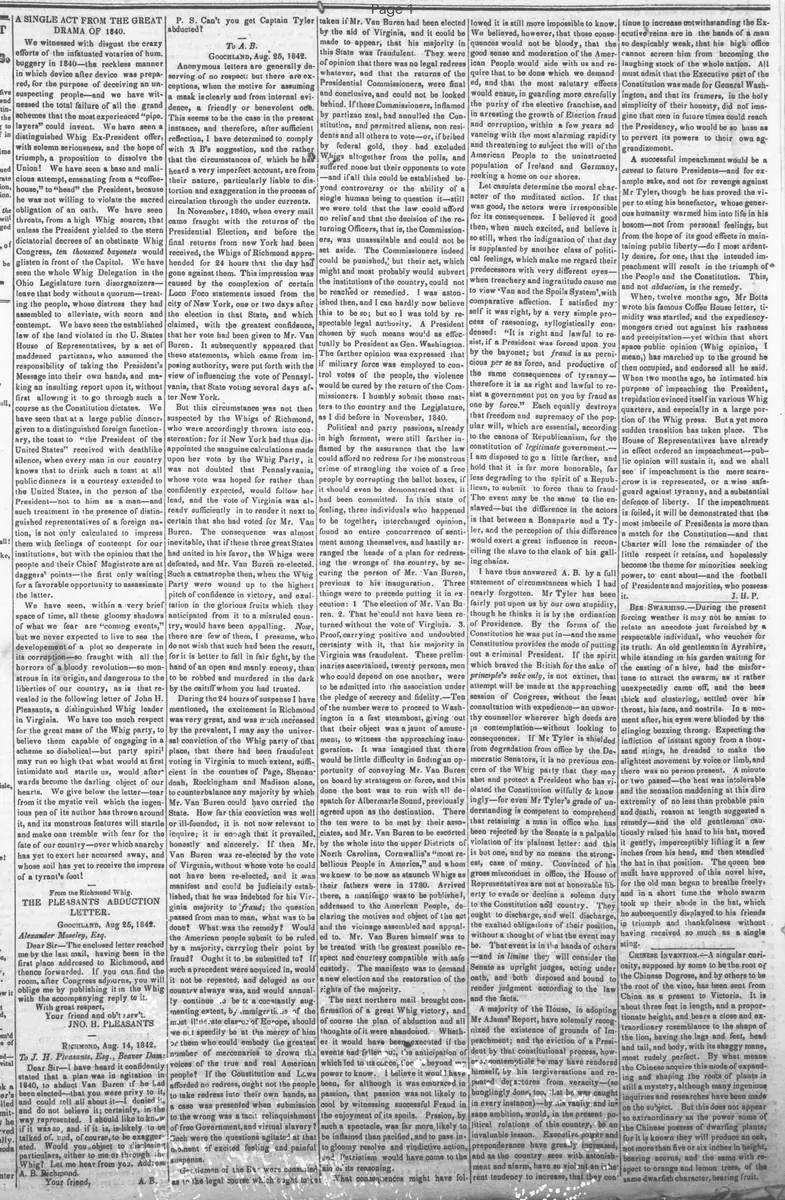
A SINGLE ACT FROM THE GREAT
DRAMA OF 1840.
We witnessed with disgust the crazy
efforts of the infatuated votaries of humbuggery in 1840—the reckless manner
in which device after device was prepared, for the purpose of deceiving an unsuspecting people—and we have witnessed the total failure of all the grand
schemes that the most experienced "pipe-layers" could invent. We have seen a
distinguished Whig Ex-President offer,
with solemn seriousness, and the hope of
triumph, a proposition to dissolve the
Union! We have seen a base and malicious attempt, emanating from a "coffee-house," to "head" the President, because
he was not willing to violate the sacred
obligation of an oath. We have seen
threats, from a high Whig source, that
unless the President yielded to the stern
dictatorial decrees of an obstinate Whig
Congress, ten thousand bayonets would
glisten in front of the Capitol. We have seen the whole Whig Delegation in the
Ohio Legislature turn disorganizers—
leave that body without a quorum—treating the people, whose distress they had
assembled to alleviate, with scorn and
contempt. We have seen the established
law of the land violated in the U. States
House of Representatives, by a set of
maddened partisans, who assumed the
responsibility of taking the President's
Message into their own hands, and making an insulting report upon it, without
first allowing it to go through such a
course as the Constitution dictates. We
have seen that at a large public dinner
given to a distinguished foreign functionary, the toast to "the President of the
United States" received with deathlike
silence, when every man in our country
knows that to drink such a toast at all
public dinners is a courtesy extended to
the United States, in the person of the
President—not to him as a man—and
such treatment in the presence of distinguished representatives of a foreign nation, is not only calculated to impress
them with feelings of contempt for our
institutions, but with the opinion that the
people and their Chief Magistrate are at
daggers' points—the first only waiting
for a favorable opportunity to assassinate
the latter.
We have seen, within a very brief
space of time, all these gloomy shadows
of what we fear are "coming events,"
but we never expected to live to see the
development of a plot so desperate in
its corruption—so fraught with all the
horrors of a bloody revolution—so monstrous in its origin, and dangerous to the
liberties of our country, as is that revealed in the following letter of John H.
Pleasants, a distinguished Whig leader
in Virginia. We have too much respect
for the great mass of the Whig party, to
believe them capable of engaging in a
scheme so diabolical—but party spirit
may run so high that what would at first
intimidate and startle us, would afterwards become the darling object of our
hearts. We give below the letter—tear
from it the mystic veil which the ingenious pen of its author has thrown around
it, and its monstrous features will startle
and make one tremble with fear for the
fate of our country—over which anarchy
has yet to exert her accursed sway, and
whose soil has yet to receive the impress
of a tyrant's foot!
From the Richmond Whig.
THE PLEASANTS ABDUCTION
LETTER.
GOOCHLAND, Aug 25, 1842.
Alexander Moseley, Esq.
Dear Sir—The enclosed letter reached
me by the last mail, having been in the
first place addressed to Richmond, and
thence forwarded. If you can find the
room, after Congress adjourns, you will
oblige me by publishing it in the Whig
with the accompanying reply to it.
With great respect,
Your friend and ob't serv't.
JNO. H. PLEASANTS
RICHMOND, Aug. 14, 1842.
To J. H. Pleasants, Esq., Beaver Dam:
Dear Sir—I have heard it confidently
stated that a plan was in agitation in
1840, to abduct Van Buren if he had
been elected—that you were privy to it,
and could tell all about it—I denied it,
and do not believe it; certainly, in the
way represented. I should like to know
if it was so, and if it is likely to be
talked of, and, of course, to be exaggerated. Would you object to disclosing
particulars, either to me or through the
Whig? Let me hear from you. Address
A. B. Richmond.
Your friend,
A. B.
P. S. Can't you get Captain Tyler
abducted?
To A. B.
GOOCHLAND, Aug, 25, 1842.
Anonymous letters are generally deserving of no respect: but there are exceptions, when the motive for assuming
a mask is clearly and from internal evidence, a friendly or benevolent one.
'This seems to be the case in the present
instance, and therefore, after sufficient
reflection, I have determined to comply
with A B's suggestion, and the rather
that the circumstances of which he has
heard a very imperfect account, are from
their nature, particularly liable to distortion and exaggeration in the process of
circulation through the under currents.
In November, 1840, when every mail
came fraught with the returns of the
Presidential Election, and before the
final returns from New York had been
received, the Whigs of Richmond apprehended for 24 hours that the day had
gone against them. This impression was
caused by the complexion of certain
Loco Foco statements issued from the
city of New York, one or two days after
the election in that State, and which
claimed, with the greatest confidence,
that her vote had been given to Mr. Van
Buren. It subsequently appeared that
these statements, which came from imposing authority, were put forth with the
view of influencing the vote of Pennsylvania, that State voting several days after New York.
But this circumstance was not then
suspected by the Whigs of Richmond,
who were accordingly thrown into consternation: for if New York had thus disappointed the sanguine calculations made
upon her vote by the Whig Party, it
was not doubted that Pennsylvania,
whose vote was hoped for rather than
confidently expected, would follow her
lead, and the vote of Virginia was already sufficiently in to render it next to
certain that she had voted for Mr. Van
Buren. The consequence was almost
inevitable, that if these three great States
had united in his favor, the Whigs were
defeated, and Mr. Van Buren re-elected.
Such a catastrophe then, when the Whig
Party were wound up to the highest
pitch of confidence in victory, and exultation in the glorious fruits which they
anticipated from it to a misruled country, would have been appalling. Now,
there are few of them, I presume, who
do not wish that such had been the result,
for it is better to fall in fair fight, by the
hand of an open and manly enemy, than
to be robbed and murdered in the dark
by the caitiff whom you had trusted.
During the 24 hours of suspense I have
mentioned, the excitement in Richmond
was very great, and was much increased
by the prevalent, I may say the universal conviction of the Whig party of that
place, that there had been fraudulent
voting in Virginia to much extent, sufficient in the counties of Page, Shenandoah, Rockingham and Madison alone,
to counterbalance any majority by which
Mr. Van Buren could have carried the
State. How far this conviction was well
or ill-founded, it is not now relevant to
inquire; it is enough that it prevailed,
honestly and sincerely. If, then Mr.
Van Buren was re-elected by the vote
of Virginia, without whose vote he could
not have been re-elected, and it was
manifest and could be judicially established, that he was indebted for his Virginia majority to fraud; the question
passed from man to man, what was to be
done? What was the remedy? Would
the American people submit to be ruled
by a majority, carrying their point by
fraud? Ought it to be submitted to? If
such a precedent were acquiesced in, would
it not be repeated, and deluged as our
country always was, and would annually continue to be to a constantly augmenting extent, by immigration of the
most illiterate classes of Europe, should
we not speedily be at the mercy of him
or them who could embody the greatest
number of mercenaries to drown the
voices of the true and real American
people? If the Constitution and Laws
afforded no redress, ought not the people
to take redress into their own hands, as
a case was presented when submission
to the wrong was a tacit relinquishment
of free Government, and virtual slavery?
Such were the questions agitated at that
moment of excited feeling and painful
suspense.
Gentlemen of the Bar were consulted
as to the legal course which ought to be
taken if Mr. Van Buren had been elected
by the aid of Virginia, and it could be
made to appear, that his majority in
this State was fraudulent. They were
of opinion that there was no legal redress
whatever, and that the returns of the
Presidential Commissioners, were final
and conclusive, and could not be looked
behind. If these Commissioners, inflamed
by partisan zeal, had annulled the Constitution, and permitted aliens, non residents and all others to vote—or, if bribed
by federal gold, they had excluded
Whigs altogether from the polls, and
suffered none but their opponents to vote
—and if all this could be established beyond controversy or the ability of a
single human being to question it—still
we were told that the law could afford
no relief and that the decision of the returning Officers, that is, the Commissioners, was unassailable and could not be
set aside. The Commissioners indeed
could be punished, but their act, which
might and most probably would subvert
the institutions of the country, could not
be reached or remedied. I was astonished then, and I can hardly now believe
this to be so; but so I was told by respectable legal authority. A President
chosen by such means would as effectively be President as Gen. Washington.
The farther opinion was expressed that
if military force was employed to control votes of the people, the violence
would be cured by the return of the Commissioners. I humbly submit these matters to the country and the Legislature,
as I did before in November, 1840.
Political and party passions, already
in high ferment, were still farther inflamed by the assurance that the law
could afford no redress for the monstrous
crime of strangling the voice of a free
people by corrupting the ballot boxes, if
it should even be demonstrated that it
had been committed. In this state of
feeling, three individuals who happened
to be together, interchanged opinion,
found an entire concurrence of sentiment among themselves, and hastily arranged the heads of a plan for redressing the wrongs of the country, by securing the person of Mr. Van Buren,
previous to his inauguration. Three
things were to precede putting it in execution: 1 The election of Mr. Van Buren. 2. That he could not have been returned without the vote of Virginia. 3.
Proof, carrying positive and undoubted
certainty with it, that his majority in
Virginia was fraudulent. These preliminaries ascertained, twenty persons, men
who could depend on one another, were
to be admitted into the association under
the pledge of secrecy and fidelity. Ten
of the number were to proceed to Washington in a fast steamboat, giving out
that their object was a jaunt of amusement, to witness the approaching inauguration. It was imagined that there
would be little difficulty in finding an opportunity of conveying Mr. Van Buren
on board by stratagem or force, and this
done the boat was to run with all despatch for Albermarle Sound, previously
agreed upon as the destination. There
the ten were to be met by their associates, and Mr. Van Buren to be escorted
by the whole into the upper Districts of
North Carolina, Cornwallis's "most rebellious People in America," and whom
we knew to be now as staunch Whigs as
their fathers were in 1780. Arrived
there, a manifesto was to be published.
addressed to the American People, declaring the motives and object of the act
and the vicinage assembled and appealed
to. Mr. Van Buren himself was to
be treated with the greatest possible respect and courtesy compatible with safe
custody. The manifesto was to demand
a new election and the restoration of the
rights of the majority.
The next northern mail brought confirmation of a great Whig victory, and
of course the plan of abduction and all
thoughts of it were abandoned. Whether it would have been executed if the
events had fallen out, the anticipation of
which led to its conception beyond my
power to know. I believe it would have
been, for although it was embraced in
passion, that passion was not likely to
cool by witnessing successful Fraud in
the enjoyment of its spoils. Passion, by
such a spectacle, was far more likely to
be inflamed than pacified, and to pass into gloomy resolve and vindictive action,
and Patriotism would have come to the aid of its reasoning
What consequences might have followed it is still more impossible to know.
We believed, however, that those consequences would not be bloody, that the
good sense and moderation of the American People would side with us and require that to be done which we demanded, and that the most salutary effects
would ensue, in guarding more carefully
the purity of the elective franchise, and
in arresting the growth of Election fraud
and corruption, within a few years advancing with the most alarming rapidity
and threatening to subject the will of the
American People to the uninstructed
population of Ireland and Germany,
seeking a home on our shores.
Let casuists determine the moral character of the meditated action. If that
was good, the actors were irresponsible
for its consequences. I believed it good
then, when much excited, and believe it
so still, when the indignation of that day
is supplanted by another class of political feelings, which make me regard their
predecessors with very different eyes—
when treachery and ingratitude cause me
to view 'Van and the Spoils System' with
comparative affection. I satisfied myself it was right, by a very simple process of reasoning, syllogistically condensed: "It is right and lawful to resist, if a President was forced upon you
by the bayonet; but fraud is as pernicious per se as force, and productive of
the same consequences of tyranny—
therefore it is as right and lawful to resist a government put on you by fraud as
one by force." Each equally destroys
that freedom and supremacy of the popular will, which are essential, according
to the canons of Republicanism, for the
constitution of legitimate government.
I am disposed to go a little further, and
hold that it is far more honorable, far
less degrading to the Spirit of a Republican, to submit to force than to fraud
'The event may be the same to the enslaved—but the difference in the actors
is that between a Bonaparte and a Tyler, and the perception of this difference
would exert a great influence in reconciling the slave to the clank of his galling chains.
I have thus answered A. B. by a full
statement of circumstances which I had
nearly forgotten. Mr Tyler has been
fairly put upon us by our own stupidity.
though he thinks it is by the ordination
of Providence. By the forms of the
Constitution he was put in—and the same
Constitution provides the mode of putting out a criminal President. If the spirit
which braved the British for the sake of
principle's sake only, is not extinct, that
attempt will be made at the approaching
session of Congress, without the least
consultation with expedience—an unworthy counsellor wherever high deeds are
in contemplation—without looking to
consequences. If Mr Tyler is shielded
from degradation from office by the Democratic Senators, it is no previous concern of the Whig party that they may
abet and protect a President who has violated the Constitution wilfully & knowingly—for even Mr Tyler's grade of understanding is competent to comprehend
that retaining a man in office who has
been rejected by the Senate is a palpable
violation of its plainest letter: and this
is but one, and by no means the strongest, case of many. Convinced of his
gross misconduct in office, the House of
Representatives are not at honorable liberty to evade or decline a solemn duty
to the Constitution and country. They
ought to discharge, and will discharge,
the exalted obligations of their position,
without a thought of what the event may
be. That event is in the hands of others
—and in limine they will consider the
Senate as upright judges, acting under
oath, and both disposed and bound to
render judgment according to the law
and the facts.
A majority of the House, in adopting
Mr Adams' Report, have solemnly recognized the existence of grounds of Impeachment; and the eviction of a President by that constitutional process, however contemptible he may have rendered
himself, by his tergiversations and repeated departures from veracity—(so
bunglingly done, too, that he was caught
in every instance)—by his vanity and insane ambition, would, in the present political relations of this country, be an
invaluable lesson. Executive power and
preponderance have greatly increased,
and as the country sees with astonishment and alarm, have so violent an inherent tendency to increase, that they continue to increase notwithstanding the Executive reins are in the hands of a man
so despicably weak, that his high office
cannot screen him from becoming the
laughing stock of the whole nation. All
must admit that the Executive part of the
Constitution was made for General Washington, and that its framers, in the holy
simplicity of their honesty, did not imagine that men in future times could reach
the Presidency, who would be so base as
to pervert its powers to their own aggrandizement.
A successful impeachment would be a
caveat to future Presidents and for example sake, and not for revenge against
Mr Tyler, though he has proved the viper to sting his benefactor, whose generous humanity warmed him into life in his
bosom—not from personal feelings, but
from the hope of its good effects in maintaining public liberty—do I most ardently desire, for one, that the intended impeachment will result in the triumph of
the People and the Constitution. This,
and not abduction, is the remedy.
When, twelve months ago, Mr Botts
wrote his famous Coffee House letter, timidity was startled, and the expediency
mongers cried out against his rashness
and precipitation—yet within that short
space public opinion (Whig opinion, I
mean,) has marched up to the ground he
then occupied, and endorsed all he said.
When two months ago, he intimated his
purpose of impeaching the President,
trepidation evinced itself in various Whig
quarters, and especially in a large portion of the Whig press. But a yet more
sudden transition has taken place. The
House of Representatives have already
in effect ordered an impeachment—public opinion will sustain it, and we shall
see if impeachment is the mere scarecrow it is represented, or a wise safeguard against tyranny, and a substantial
defence of liberty. If the impeachment
is foiled, it will be demonstrated that the
most imbecile of Presidents is more than
a match for the Constitution—and that
Charter will lose the remainder of the
little respect it retains, and hopelessly
become the theme for minorities seeking
power, to cant about—and the football
of Presidents and majorities, who possess
it.
J. H. P.
DRAMA OF 1840.
We witnessed with disgust the crazy
efforts of the infatuated votaries of humbuggery in 1840—the reckless manner
in which device after device was prepared, for the purpose of deceiving an unsuspecting people—and we have witnessed the total failure of all the grand
schemes that the most experienced "pipe-layers" could invent. We have seen a
distinguished Whig Ex-President offer,
with solemn seriousness, and the hope of
triumph, a proposition to dissolve the
Union! We have seen a base and malicious attempt, emanating from a "coffee-house," to "head" the President, because
he was not willing to violate the sacred
obligation of an oath. We have seen
threats, from a high Whig source, that
unless the President yielded to the stern
dictatorial decrees of an obstinate Whig
Congress, ten thousand bayonets would
glisten in front of the Capitol. We have seen the whole Whig Delegation in the
Ohio Legislature turn disorganizers—
leave that body without a quorum—treating the people, whose distress they had
assembled to alleviate, with scorn and
contempt. We have seen the established
law of the land violated in the U. States
House of Representatives, by a set of
maddened partisans, who assumed the
responsibility of taking the President's
Message into their own hands, and making an insulting report upon it, without
first allowing it to go through such a
course as the Constitution dictates. We
have seen that at a large public dinner
given to a distinguished foreign functionary, the toast to "the President of the
United States" received with deathlike
silence, when every man in our country
knows that to drink such a toast at all
public dinners is a courtesy extended to
the United States, in the person of the
President—not to him as a man—and
such treatment in the presence of distinguished representatives of a foreign nation, is not only calculated to impress
them with feelings of contempt for our
institutions, but with the opinion that the
people and their Chief Magistrate are at
daggers' points—the first only waiting
for a favorable opportunity to assassinate
the latter.
We have seen, within a very brief
space of time, all these gloomy shadows
of what we fear are "coming events,"
but we never expected to live to see the
development of a plot so desperate in
its corruption—so fraught with all the
horrors of a bloody revolution—so monstrous in its origin, and dangerous to the
liberties of our country, as is that revealed in the following letter of John H.
Pleasants, a distinguished Whig leader
in Virginia. We have too much respect
for the great mass of the Whig party, to
believe them capable of engaging in a
scheme so diabolical—but party spirit
may run so high that what would at first
intimidate and startle us, would afterwards become the darling object of our
hearts. We give below the letter—tear
from it the mystic veil which the ingenious pen of its author has thrown around
it, and its monstrous features will startle
and make one tremble with fear for the
fate of our country—over which anarchy
has yet to exert her accursed sway, and
whose soil has yet to receive the impress
of a tyrant's foot!
From the Richmond Whig.
THE PLEASANTS ABDUCTION
LETTER.
GOOCHLAND, Aug 25, 1842.
Alexander Moseley, Esq.
Dear Sir—The enclosed letter reached
me by the last mail, having been in the
first place addressed to Richmond, and
thence forwarded. If you can find the
room, after Congress adjourns, you will
oblige me by publishing it in the Whig
with the accompanying reply to it.
With great respect,
Your friend and ob't serv't.
JNO. H. PLEASANTS
RICHMOND, Aug. 14, 1842.
To J. H. Pleasants, Esq., Beaver Dam:
Dear Sir—I have heard it confidently
stated that a plan was in agitation in
1840, to abduct Van Buren if he had
been elected—that you were privy to it,
and could tell all about it—I denied it,
and do not believe it; certainly, in the
way represented. I should like to know
if it was so, and if it is likely to be
talked of, and, of course, to be exaggerated. Would you object to disclosing
particulars, either to me or through the
Whig? Let me hear from you. Address
A. B. Richmond.
Your friend,
A. B.
P. S. Can't you get Captain Tyler
abducted?
To A. B.
GOOCHLAND, Aug, 25, 1842.
Anonymous letters are generally deserving of no respect: but there are exceptions, when the motive for assuming
a mask is clearly and from internal evidence, a friendly or benevolent one.
'This seems to be the case in the present
instance, and therefore, after sufficient
reflection, I have determined to comply
with A B's suggestion, and the rather
that the circumstances of which he has
heard a very imperfect account, are from
their nature, particularly liable to distortion and exaggeration in the process of
circulation through the under currents.
In November, 1840, when every mail
came fraught with the returns of the
Presidential Election, and before the
final returns from New York had been
received, the Whigs of Richmond apprehended for 24 hours that the day had
gone against them. This impression was
caused by the complexion of certain
Loco Foco statements issued from the
city of New York, one or two days after
the election in that State, and which
claimed, with the greatest confidence,
that her vote had been given to Mr. Van
Buren. It subsequently appeared that
these statements, which came from imposing authority, were put forth with the
view of influencing the vote of Pennsylvania, that State voting several days after New York.
But this circumstance was not then
suspected by the Whigs of Richmond,
who were accordingly thrown into consternation: for if New York had thus disappointed the sanguine calculations made
upon her vote by the Whig Party, it
was not doubted that Pennsylvania,
whose vote was hoped for rather than
confidently expected, would follow her
lead, and the vote of Virginia was already sufficiently in to render it next to
certain that she had voted for Mr. Van
Buren. The consequence was almost
inevitable, that if these three great States
had united in his favor, the Whigs were
defeated, and Mr. Van Buren re-elected.
Such a catastrophe then, when the Whig
Party were wound up to the highest
pitch of confidence in victory, and exultation in the glorious fruits which they
anticipated from it to a misruled country, would have been appalling. Now,
there are few of them, I presume, who
do not wish that such had been the result,
for it is better to fall in fair fight, by the
hand of an open and manly enemy, than
to be robbed and murdered in the dark
by the caitiff whom you had trusted.
During the 24 hours of suspense I have
mentioned, the excitement in Richmond
was very great, and was much increased
by the prevalent, I may say the universal conviction of the Whig party of that
place, that there had been fraudulent
voting in Virginia to much extent, sufficient in the counties of Page, Shenandoah, Rockingham and Madison alone,
to counterbalance any majority by which
Mr. Van Buren could have carried the
State. How far this conviction was well
or ill-founded, it is not now relevant to
inquire; it is enough that it prevailed,
honestly and sincerely. If, then Mr.
Van Buren was re-elected by the vote
of Virginia, without whose vote he could
not have been re-elected, and it was
manifest and could be judicially established, that he was indebted for his Virginia majority to fraud; the question
passed from man to man, what was to be
done? What was the remedy? Would
the American people submit to be ruled
by a majority, carrying their point by
fraud? Ought it to be submitted to? If
such a precedent were acquiesced in, would
it not be repeated, and deluged as our
country always was, and would annually continue to be to a constantly augmenting extent, by immigration of the
most illiterate classes of Europe, should
we not speedily be at the mercy of him
or them who could embody the greatest
number of mercenaries to drown the
voices of the true and real American
people? If the Constitution and Laws
afforded no redress, ought not the people
to take redress into their own hands, as
a case was presented when submission
to the wrong was a tacit relinquishment
of free Government, and virtual slavery?
Such were the questions agitated at that
moment of excited feeling and painful
suspense.
Gentlemen of the Bar were consulted
as to the legal course which ought to be
taken if Mr. Van Buren had been elected
by the aid of Virginia, and it could be
made to appear, that his majority in
this State was fraudulent. They were
of opinion that there was no legal redress
whatever, and that the returns of the
Presidential Commissioners, were final
and conclusive, and could not be looked
behind. If these Commissioners, inflamed
by partisan zeal, had annulled the Constitution, and permitted aliens, non residents and all others to vote—or, if bribed
by federal gold, they had excluded
Whigs altogether from the polls, and
suffered none but their opponents to vote
—and if all this could be established beyond controversy or the ability of a
single human being to question it—still
we were told that the law could afford
no relief and that the decision of the returning Officers, that is, the Commissioners, was unassailable and could not be
set aside. The Commissioners indeed
could be punished, but their act, which
might and most probably would subvert
the institutions of the country, could not
be reached or remedied. I was astonished then, and I can hardly now believe
this to be so; but so I was told by respectable legal authority. A President
chosen by such means would as effectively be President as Gen. Washington.
The farther opinion was expressed that
if military force was employed to control votes of the people, the violence
would be cured by the return of the Commissioners. I humbly submit these matters to the country and the Legislature,
as I did before in November, 1840.
Political and party passions, already
in high ferment, were still farther inflamed by the assurance that the law
could afford no redress for the monstrous
crime of strangling the voice of a free
people by corrupting the ballot boxes, if
it should even be demonstrated that it
had been committed. In this state of
feeling, three individuals who happened
to be together, interchanged opinion,
found an entire concurrence of sentiment among themselves, and hastily arranged the heads of a plan for redressing the wrongs of the country, by securing the person of Mr. Van Buren,
previous to his inauguration. Three
things were to precede putting it in execution: 1 The election of Mr. Van Buren. 2. That he could not have been returned without the vote of Virginia. 3.
Proof, carrying positive and undoubted
certainty with it, that his majority in
Virginia was fraudulent. These preliminaries ascertained, twenty persons, men
who could depend on one another, were
to be admitted into the association under
the pledge of secrecy and fidelity. Ten
of the number were to proceed to Washington in a fast steamboat, giving out
that their object was a jaunt of amusement, to witness the approaching inauguration. It was imagined that there
would be little difficulty in finding an opportunity of conveying Mr. Van Buren
on board by stratagem or force, and this
done the boat was to run with all despatch for Albermarle Sound, previously
agreed upon as the destination. There
the ten were to be met by their associates, and Mr. Van Buren to be escorted
by the whole into the upper Districts of
North Carolina, Cornwallis's "most rebellious People in America," and whom
we knew to be now as staunch Whigs as
their fathers were in 1780. Arrived
there, a manifesto was to be published.
addressed to the American People, declaring the motives and object of the act
and the vicinage assembled and appealed
to. Mr. Van Buren himself was to
be treated with the greatest possible respect and courtesy compatible with safe
custody. The manifesto was to demand
a new election and the restoration of the
rights of the majority.
The next northern mail brought confirmation of a great Whig victory, and
of course the plan of abduction and all
thoughts of it were abandoned. Whether it would have been executed if the
events had fallen out, the anticipation of
which led to its conception beyond my
power to know. I believe it would have
been, for although it was embraced in
passion, that passion was not likely to
cool by witnessing successful Fraud in
the enjoyment of its spoils. Passion, by
such a spectacle, was far more likely to
be inflamed than pacified, and to pass into gloomy resolve and vindictive action,
and Patriotism would have come to the aid of its reasoning
What consequences might have followed it is still more impossible to know.
We believed, however, that those consequences would not be bloody, that the
good sense and moderation of the American People would side with us and require that to be done which we demanded, and that the most salutary effects
would ensue, in guarding more carefully
the purity of the elective franchise, and
in arresting the growth of Election fraud
and corruption, within a few years advancing with the most alarming rapidity
and threatening to subject the will of the
American People to the uninstructed
population of Ireland and Germany,
seeking a home on our shores.
Let casuists determine the moral character of the meditated action. If that
was good, the actors were irresponsible
for its consequences. I believed it good
then, when much excited, and believe it
so still, when the indignation of that day
is supplanted by another class of political feelings, which make me regard their
predecessors with very different eyes—
when treachery and ingratitude cause me
to view 'Van and the Spoils System' with
comparative affection. I satisfied myself it was right, by a very simple process of reasoning, syllogistically condensed: "It is right and lawful to resist, if a President was forced upon you
by the bayonet; but fraud is as pernicious per se as force, and productive of
the same consequences of tyranny—
therefore it is as right and lawful to resist a government put on you by fraud as
one by force." Each equally destroys
that freedom and supremacy of the popular will, which are essential, according
to the canons of Republicanism, for the
constitution of legitimate government.
I am disposed to go a little further, and
hold that it is far more honorable, far
less degrading to the Spirit of a Republican, to submit to force than to fraud
'The event may be the same to the enslaved—but the difference in the actors
is that between a Bonaparte and a Tyler, and the perception of this difference
would exert a great influence in reconciling the slave to the clank of his galling chains.
I have thus answered A. B. by a full
statement of circumstances which I had
nearly forgotten. Mr Tyler has been
fairly put upon us by our own stupidity.
though he thinks it is by the ordination
of Providence. By the forms of the
Constitution he was put in—and the same
Constitution provides the mode of putting out a criminal President. If the spirit
which braved the British for the sake of
principle's sake only, is not extinct, that
attempt will be made at the approaching
session of Congress, without the least
consultation with expedience—an unworthy counsellor wherever high deeds are
in contemplation—without looking to
consequences. If Mr Tyler is shielded
from degradation from office by the Democratic Senators, it is no previous concern of the Whig party that they may
abet and protect a President who has violated the Constitution wilfully & knowingly—for even Mr Tyler's grade of understanding is competent to comprehend
that retaining a man in office who has
been rejected by the Senate is a palpable
violation of its plainest letter: and this
is but one, and by no means the strongest, case of many. Convinced of his
gross misconduct in office, the House of
Representatives are not at honorable liberty to evade or decline a solemn duty
to the Constitution and country. They
ought to discharge, and will discharge,
the exalted obligations of their position,
without a thought of what the event may
be. That event is in the hands of others
—and in limine they will consider the
Senate as upright judges, acting under
oath, and both disposed and bound to
render judgment according to the law
and the facts.
A majority of the House, in adopting
Mr Adams' Report, have solemnly recognized the existence of grounds of Impeachment; and the eviction of a President by that constitutional process, however contemptible he may have rendered
himself, by his tergiversations and repeated departures from veracity—(so
bunglingly done, too, that he was caught
in every instance)—by his vanity and insane ambition, would, in the present political relations of this country, be an
invaluable lesson. Executive power and
preponderance have greatly increased,
and as the country sees with astonishment and alarm, have so violent an inherent tendency to increase, that they continue to increase notwithstanding the Executive reins are in the hands of a man
so despicably weak, that his high office
cannot screen him from becoming the
laughing stock of the whole nation. All
must admit that the Executive part of the
Constitution was made for General Washington, and that its framers, in the holy
simplicity of their honesty, did not imagine that men in future times could reach
the Presidency, who would be so base as
to pervert its powers to their own aggrandizement.
A successful impeachment would be a
caveat to future Presidents and for example sake, and not for revenge against
Mr Tyler, though he has proved the viper to sting his benefactor, whose generous humanity warmed him into life in his
bosom—not from personal feelings, but
from the hope of its good effects in maintaining public liberty—do I most ardently desire, for one, that the intended impeachment will result in the triumph of
the People and the Constitution. This,
and not abduction, is the remedy.
When, twelve months ago, Mr Botts
wrote his famous Coffee House letter, timidity was startled, and the expediency
mongers cried out against his rashness
and precipitation—yet within that short
space public opinion (Whig opinion, I
mean,) has marched up to the ground he
then occupied, and endorsed all he said.
When two months ago, he intimated his
purpose of impeaching the President,
trepidation evinced itself in various Whig
quarters, and especially in a large portion of the Whig press. But a yet more
sudden transition has taken place. The
House of Representatives have already
in effect ordered an impeachment—public opinion will sustain it, and we shall
see if impeachment is the mere scarecrow it is represented, or a wise safeguard against tyranny, and a substantial
defence of liberty. If the impeachment
is foiled, it will be demonstrated that the
most imbecile of Presidents is more than
a match for the Constitution—and that
Charter will lose the remainder of the
little respect it retains, and hopelessly
become the theme for minorities seeking
power, to cant about—and the football
of Presidents and majorities, who possess
it.
J. H. P.
What sub-type of article is it?
Partisan Politics
Constitutional
Legal Reform
What keywords are associated?
Whig Plot
Van Buren Abduction
Election Fraud
Tyler Impeachment
Constitutional Remedy
Partisan Extremism
1840 Election
What entities or persons were involved?
John H. Pleasants
Martin Van Buren
John Tyler
Whig Party
Richmond Whigs
U.S. Congress
Democratic Senators
Editorial Details
Primary Topic
Whig Plot To Abduct Van Buren Over Election Fraud And Advocacy For Tyler Impeachment
Stance / Tone
Critical Of Whig Extremism, Supportive Of Constitutional Impeachment Over Radical Measures
Key Figures
John H. Pleasants
Martin Van Buren
John Tyler
Whig Party
Richmond Whigs
U.S. Congress
Democratic Senators
Key Arguments
Whig Efforts In 1840 Were Deceptive And Extreme, Including Threats Of Dissolution And Violence.
A Plot To Abduct Van Buren Was Conceived If He Won Via Fraudulent Virginia Votes, Due To Lack Of Legal Redress.
The Abduction Plan Involved Seizing Van Buren, Detaining Him In North Carolina, And Demanding A New Election.
Impeachment Of Tyler Is The Proper Constitutional Remedy For His Misconduct, Not Abduction.
Election Fraud Threatens Republican Government, Justifying Resistance Similar To Against Force.
Successful Impeachment Would Check Executive Overreach And Protect Liberties.