Thank you for visiting SNEWPapers!
Sign up free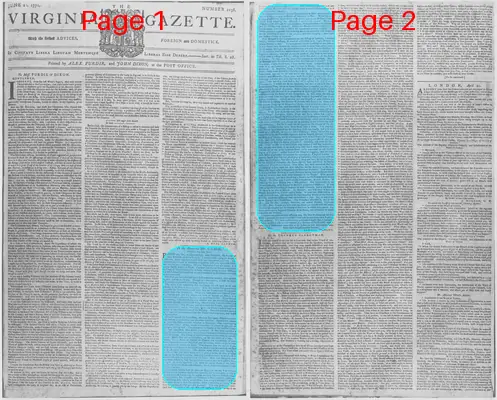
The Virginia Gazette
Richmond, Williamsburg, Richmond County, Virginia
What is this article about?
Samuel Henley replies to Rev. Mr. Camm's critique of a clerical Protest opposing an American Episcopate and related convention actions, defending the protesters' language, colonial rights, and church governance while questioning Camm's inconsistencies on episcopal aims and jurisdiction in Virginia and other colonies.
Merged-components note: These two components form a single letter to the Reverend Mr. Camm, with the second continuing directly from the first across pages, as indicated by the incomplete sentence at the end of the first and the starting phrase 'A continuation' in the second.
Clippings
1 of 2
OCR Quality
Full Text
Veneficia mea hæc urt.
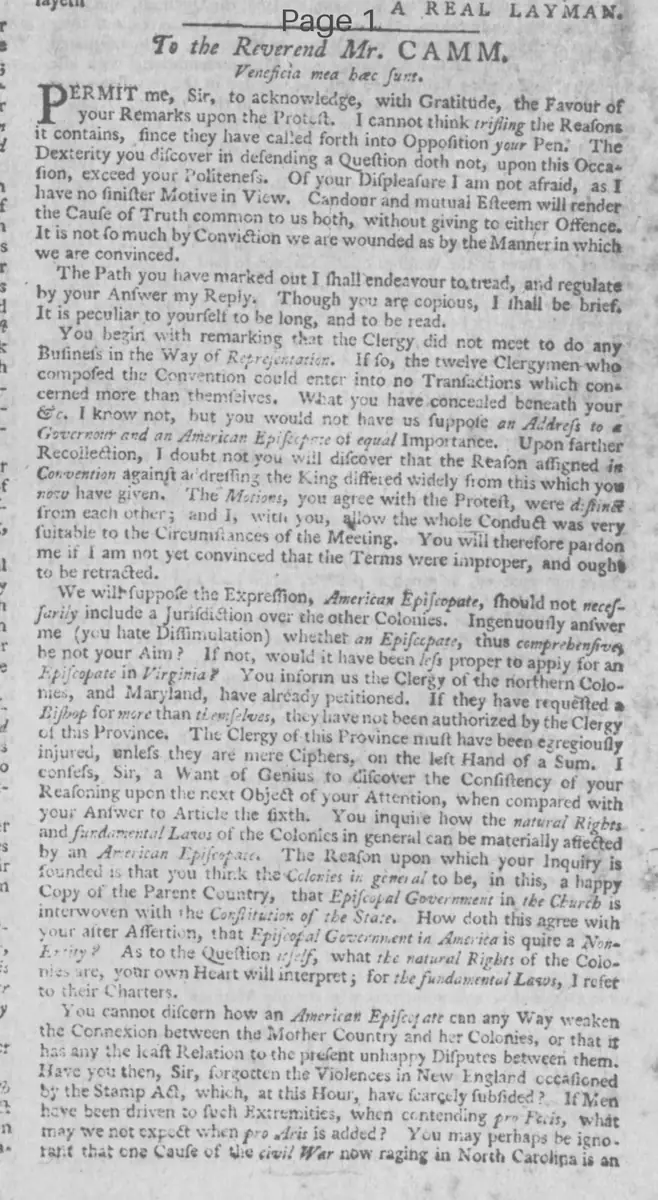
Permit me, Sir, to acknowledge, with Gratitude, the Favour of your Remarks upon the Protest. I cannot think trifling the Reasons it contains, since they have called forth into Opposition your Pen. The Dexterity you discover in defending a Question doth not, upon this Occasion, exceed your Politeness. Of your Displeasure I am not afraid, as I have no sinister Motive in View. Candour and mutual Esteem will render the Cause of Truth common to us both, without giving to either Offence.
It is not so much by Conviction we are wounded as by the Manner in which we are convinced.
The Path you have marked out I shall endeavour to tread, and regulate by your Answer my Reply. Though you are copious, I shall be brief.
It is peculiar to yourself to be long, and to be read.
You begin with remarking that the Clergy did not meet to do any Business in the Way of Representation. If so, the twelve Clergymen who composed the Convention could enter into no Transactions which concerned more than themselves. What you have concealed beneath your &c. I know not, but you would not have us suppose an Address to Governor and an American Episcopate of equal Importance. Upon farther Recollection, I doubt not you will discover that the Reason assigned in Convention against addressing the King differed widely from this which you now have given. The Motions, you agree with the Protest, were distinct from each other; and I, with you, allow the whole Conduct was very suitable to the Circumstances of the Meeting. You will therefore pardon me if I am not yet convinced that the Terms were improper, and ought to be retracted.
We will suppose the Expression, American Episcopate, should not necessarily include a Jurisdiction over the other Colonies. Ingenuously answer me (you hate Dissimulation) whether an Episcopate, thus comprehensive be not your Aim? If not, would it have been less proper to apply for an Episcopate in Virginia? You inform us the Clergy of the northern Colonies, and Maryland, have already petitioned. If they have requested a Bishop for more than themselves, they have not been authorized by the Clergy of this Province. The Clergy of this Province must have been egregiously injured, unless they are mere Ciphers, on the left Hand of a Sum. I confess, Sir, a Want of Genius to discover the Consistency of your Reasoning upon the next Object of your Attention, when compared with your Answer to Article the sixth. You inquire how the natural Rights and fundamental Laws of the Colonies in general can be materially affected by an American Episcopate. The Reason upon which your Inquiry is founded is that you think the Colonies in general to be, in this, a happy Copy of the Parent Country, that Episcopal Government in the Church is interwoven with the Constitution of the State. How doth this agree with your later Assertion, that Episcopal Government in America is quite a Non-Entity? As to the Question itself, what the natural Rights of the Colonies are, your own Heart will interpret; for the fundamental Laws, I refer to their Charters.
You cannot discern how an American Episcopate can any Way weaken the Connexion between the Mother Country and her Colonies, or that has any the least Relation to the present unhappy Disputes between them.
Have you then, Sir, forgotten the Violences in New England occasioned by the Stamp Act, which, at this Hour, have scarcely subsided? If Men have been driven to such Extremities, when contending pro Deis, what may we not expect when pro Aris is added? You may perhaps be ignorant that one Cause of the civil War now raging in North Carolina is an
A continuation of Ecclesiastical Establishment. The liberal Compliment you pay to the feeble Disparagers will be received with as much Complacency as it merits with Sincerity.
One Reason why the Measure of Convention was ruled extremely indecent, and an Usurpation upon the Rights of Mankind, is this: When the Commissary proposed an Application to the Legislature for their Concurrence, you yourself, Sir, affirmed it could never succeed. Upon the Delivery of an Assertion so truly oracular, the Convention was convinced, and the Motion was quashed. Should the Words of the Protest still want Justification, I am ready to dissect the Arguments in your Answer. The Desire you have expressed that Nothing should be concealed will exculpate me for disclosing so much of our Arcana, and thus dragging into Light the hidden Things of Darkness.
With Respect to the Compliment on the Bishop of London, I confess myself, without blushing, so much of a Christian as to "give Honour to whom Honour is due." To have proved that his Lordship did not deserve it you should have showed his Administration to have been either inequitable, unjust, or partial; for notwithstanding you now deny the Existence of his Government you before acknowledged that an Episcopal Government does exist in the Colonies, and you afterwards speak of your Plan as not inconsistent with a suffragan Bishop, acting under the Authority of the Bishop of London. To this, you say, your Plan contains no Objection. May I be indulged with the Information where this Plan can be found? I have seen none, I have heard none, I have known none. I requested the Favour of it, in Convention, if any such was in Being; but no Plan was produced. If, since that Time, a Plan hath been formed, I own your Answer hath re-awakened my Curiosity to see it. From History, and past Experience, you tell us we may know that Episcopal Government in the Church, and Monarchical Government in the State, fell together in the Mother Country and that their joint Fall led the Nation into a long Variety of Confusion, under which it could find no Rest till it restored both these Forms of Government. I would not be too sanguine, but does it not look like the Intent of your Plan, whatever some Persons have pretended, to establish America this Species of Episcopate, which a long Course of uninterrupted Experience hath Showed to be productive of such blessed Effects? What confirms me in the Belief of this Conjecture, is, that when the Bishops were extruded from the Upper House they were not deprived of their Ecclesiastical Functions. Assure me that the real Objects of your Scheme are the Title of Lordship the Revenue of Baronies and Palatinates, along with the gorgeous Trappings of Hierarchical Pomp, I will forthwith make a public penitent Retraction, and henceforth become a zealous Convert to so Holy a Cause: Deus nobis haec Otia fecit. But to return to your suffragan Bishop. If the Law Books say true, how could he restrain the Enormities of the Clergy? Godolphin, Gibson, Wood, and Burn, affirm that a suffragan Bishop may supply the Place of his Principal in Matters of Orders, but not of Jurisdiction. Those Enormities of the Clergy, which you so devoutly wish were corrected, you charge me as painting at the Convention with high colouring. Far be it from me to aggravate the Crimes of the unhappy; I would rather turn from them with a Tear. You yourself, Sir, would have blamed me for touching them too faintly, had you ever heard of a LUNAN, or a BRUNSKILL! From whence did you discover it to be the Protesters Opinion that the English Bishops, including the Bishops of London, are in a Conspiracy with several Bodies of Clergymen, and with Bishops and others who have left Legacies for an American Episcopate, to trip the Bishop of London? Certainly, not from the Protest. How far Mr. Grogan's Faith may extend I will not determine; but, for my own Part, I can most truly aver that I never did believe the Sulldbugs of the good facetious Dean (who was wont to call himself Bishop of Virginia) existed beyond the Island of Luggnag, and yet some such Belief is necessary to account for contemporary Bishops of London. I, indeed, knew that the late Archbishop of Canterbury was pregnant with an American Episcopate; but after a Labour, long and sore, as any his Grace, in his obstetrical Pamphlet De Partu difficiles, hath described, he fatally miscarried of a still-born Foetus. You seem, Sir, well convinced that his Grace suppressed the Maryland Petition? Have you heard why he suppressed the Maryland Petition? And whence is it that we hear Nothing of those Petitions having been presented which you tell us were sent from other Colonies in the North? With perfect good Humour, you have found out a Motive for the Compliment in the Protest. To what may I attribute the Compliment, in your Answer, of exalting the same Bishop into a Metropolitan? Our Sentiments by no Means coincide, with Regard to the Oath of Canonical Obedience. It was offered by the Protesters in Defence of their Conduct, but is too keen a Weapon to be used in Attack. If, however, you will force it into my Hand, keen as it is, I must urge it home. In your next Observation, as well as in a former, you mention the high sounding Words of the Protest. For this Sublimity of Sound they are indebted to you, Sir, it was silent as an Epitaph on a Tombstone. The Protesters addressed it, not to the Ear, but the Eye. Accept, however, our united Thanks, Euphonia Gratia. But, though you give with one Hand you retract with the other, Having disembodied our Reasoning of the Form in which it appeared, you have substituted a haggard Phantom in its Room, not a Feature of which resembles the Original.
I cannot conclude without assuring you, Sir, that Nothing but the Respect I entertain for your Character could have drawn from me a Reply to your Answer. If I have inadvertently overlooked aught that it contains, I flatter myself it will not be omitted in a Defence of the Protest, undertaken by a Gentleman more able to do Justice to your Arguments than,
Reverend Sir,
Your most obliged humble Servant,
SAMUEL HENLEY.
What sub-type of article is it?
What themes does it cover?
What keywords are associated?
What entities or persons were involved?
Letter to Editor Details
Author
Samuel Henley
Recipient
To The Reverend Mr. Camm
Main Argument
samuel henley defends the clerical protest against the convention's decisions on addressing the king and establishing an american episcopate, arguing that the terms were appropriate, questioning the aim of comprehensive episcopal jurisdiction, and highlighting inconsistencies in camm's reasoning regarding colonial rights and church governance.
Notable Details