Thank you for visiting SNEWPapers!
Sign up free
Lynchburg Daily Virginian
Lynchburg, Virginia
What is this article about?
Diplomatic tensions escalate over the Black Warrior affair as US Minister Soule demands $300,000 indemnity and dismissal of Cuban officials from Spain, which responds firmly, refusing terms amid suspicions of US designs on Cuba. Reported from Madrid, April 17-20, 1854.
Clipping
OCR Quality
Full Text
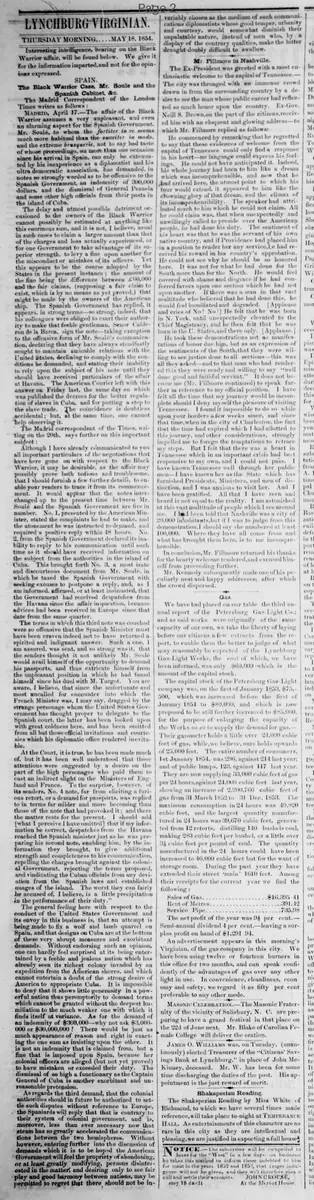
THURSDAY MORNING, MAY 18, 1854.
Interesting intelligence, bearing on the Black Warrior affair, will be found below. We give it for the information imparted, and not for the opinions expressed.
SPAIN.
The Black Warrior Case. Mr. Soule and the Spanish Cabinet, &c.
The Madrid Correspondent of the London Times writes as follows:
MADRID, April 17.--The affair of the Black Warrior assumes a very unpleasant, and even an alarming aspect for the Spanish Government. Mr. Soulé, to whom the fortiter in re seems much more habitual than the suaviter in modo, and the extreme brusquerie, not to say bad taste, of whose proceedings, on more than one occasion since his arrival in Spain, can only be extenuated by his inexperience as a diplomatist and his ultra democratic associations, has demanded, in notes so strongly worded as to be offensive to the Spanish Government, an indemnity of 300,000 dollars, and the dismissal of General Pezuela and some other high officials from their posts in the island of Cuba.
The delay and utmost possible detriment occasioned to the owners of the Black Warrior cannot possibly be estimated at anything like this enormous sum, and it is not, I believe, usual in such cases to claim a larger amount than that of the charges and loss actually experienced, or for one Government to take advantage of its superior strength, to levy a fine upon another for the misconduct or mistakes of its officers. Yet this appears to be the course adopted by the States in the present instance; the amount of the fine being the difference between $60,000 and the fair claims, (supposing a fair claim to exist, which is by no means as yet proved,) that might be made by the owners of the American ship. The Spanish Government has replied, it appears, in strong terms—so strong, indeed, that his colleagues were obliged to exert their authority to make that feeble gentleman, Señor Calderon de la Barca, sign the note—taking exception to the offensive form of Mr. Soulé's communication, declaring that they have always steadfastly sought to maintain amicable relations with the United States, declining to comply with the conditions he demanded, and stating their inability to reply upon the subject of his note until they should have received particulars of the affair at Havana. The American Courier left with this answer on Friday last, the same day on which was published the decrees for the better regulation of slaves in Cuba, and for putting a stop to the slave trade. The coincidence is doubtless accidental: but, at the same time, one cannot help observing it.
The Madrid correspondent of the Times, writing on the 20th, says further on this important subject:
Although I have already communicated to you all important particulars of the negotiations that have here gone on with respect to the Black Warrior, it may be desirable, as the affair may possibly prove both tedious and troublesome, that I should furnish a few further details, to enable your readers to trace it from its commencement. It would appear that the notes interchanged up to the present time between Mr. Soulé and the Spanish Government are five in number. No. 1, presented by the American Minister, stated the complaints he had to make, and the atonement he was instructed to demand, and required a positive reply within 48 hours. No. 2 from the Spanish Government declared its inability to reply to his communication until such time as it should have received information on the subject from the authorities in the island of Cuba. This brought forth No. 3, a most irate and discourteous document from Mr. Soule, in which he taxed the Spanish Government with seeking excuses to postpone a reply, and, as I am informed, affirmed, or at least insinuated, that the Government had received despatches from the Havana since the affair in question, because advices had been received in Europe since that date from the same quarter.
The terms in which this third note was couched were so offensive that the Spanish Minister must have been craven indeed not to have returned a spirited and indignant answer. Such a one, I am assured, was sent, and so strong was it, that the senders thought it not unlikely Mr. Soule would avail himself of the opportunity to demand his passports, and thus extricate himself from the unpleasant position in which he had found himself since his duel with M. Turgot. You are aware, I believe, that since the unfortunate and most uncalled for encounter into which the French Minister was, I may say, dragged by the strange personage whom the United States Government has thought proper to delegate to the Spanish court, the latter has been looked upon with great coldness here, and has been omitted from all but those official invitations and courtesies which his diplomatic office rendered inevitable.
At the Court, it is true, he has been made much of, but it has been well understood that those attentions were suggested by a desire on the part of the high personages who paid them to cast an indirect slight on the Ministers of England and France. To the surprise, however, of its senders, No. 4 note, far from eliciting a furious retort, or a demand for passports, was replied to in terms far milder and more becoming than those of the note that had provoked it: and there the matter rests for the present. I should add [what I perceive I have omitted] that if my information be correct, despatches from the Havana reached the Spanish minister just as he was preparing his second note, enabling him, by the information they brought, to give additional strength and completeness to his communication, repelling the charges brought against the colonial Government, rejecting the terms proposed, and vindicating the Cuban officials from any deviation from the Spanish laws and established usages of the island. The worst they can fairly be accused of, I believe, is a little precipitation in the performance of their duty."
The general feeling here with respect to the conduct of the United States Government and its envoy in this business is, that an attempt is being made to fix a wolf and lamb quarrel on Spain, and that designs on Cuba are at the bottom of these very abrupt measures and exorbitant demands. Without endorsing such an opinion, one can hardly feel surprised at its being entertained by a feeble and jealous nation which has already seen its richest colony invaded by an expedition from the American shores, and which cannot entertain a doubt of the strong desire of America to appropriate Cuba. It is impossible to deny that it shows little generosity in a powerful nation thus peremptorily to demand terms which cannot be granted without the deepest humiliation to the much weaker one with which it finds itself at variance. As for the demand of an indemnity of $300,000—why not ask $3,000,000 or $30,000,000? There would be just as much appearance of reason and right in exacting the one sum as insisting upon the other. It is not an indemnity that is claimed from, but a fine that is imposed upon Spain, because her colonial officers are alleged (but not yet proved) to have mistaken or exceeded their duty. The dismissal of so high a functionary as the Captain General of Cuba is another exorbitant and unreasonable pretension.
As regards the third demand, that the colonial authorities should in future be authorized to settle such disputes without reference to Europe, the Spaniards will reply that that is contrary to their system of colonial government, and is, moreover, less than ever necessary now that steam has so greatly accelerated the communications between the two hemispheres. Without, however, entering further into the discussion of demands which it is to be hoped the American Government will feel the propriety of abandoning, or at least greatly modifying, persons disinterested in the matter, and desiring only to see fair play and good harmony between nations, may be permitted to regret that there should not be invariably chosen as the medium of such communications diplomatists whose good temper, urbanity and courtesy, would somewhat diminish their unpalatable nature, instead of men who, by a display of the contrary qualities, make the bitter draught doubly difficult to swallow.
What sub-type of article is it?
What keywords are associated?
What entities or persons were involved?
Where did it happen?
Foreign News Details
Primary Location
Madrid
Event Date
April 17, 1854 And April 20, 1854
Key Persons
Outcome
spanish government declines us demands for $300,000 indemnity and dismissals, responds strongly to offensive notes, negotiations ongoing with no resolution; suspicions of us designs on cuba.
Event Details
US Minister Soule demands indemnity and dismissals over Black Warrior seizure in Cuba via strongly worded notes; Spanish Government replies firmly, citing need for Havana details, rejects terms, and defends officials; five notes exchanged, with escalating then de-escalating tones; background of Soule's strained relations post-duel.