Thank you for visiting SNEWPapers!
Sign up free
Editorial
May 11, 1844
Arkansas Intelligencer
Van Buren, Crawford County, Arkansas
What is this article about?
Editorial from the Union criticizes New England Whigs for hypocrisy in reviving Andrew Jackson's past duels to defend Henry Clay, ignoring Clay's own dueling and moral flaws, especially since Jackson is no longer a candidate.
Clipping
OCR Quality
82%
Good
Full Text
From the Union.
HYPOCRISY OF NEW ENGLAND.
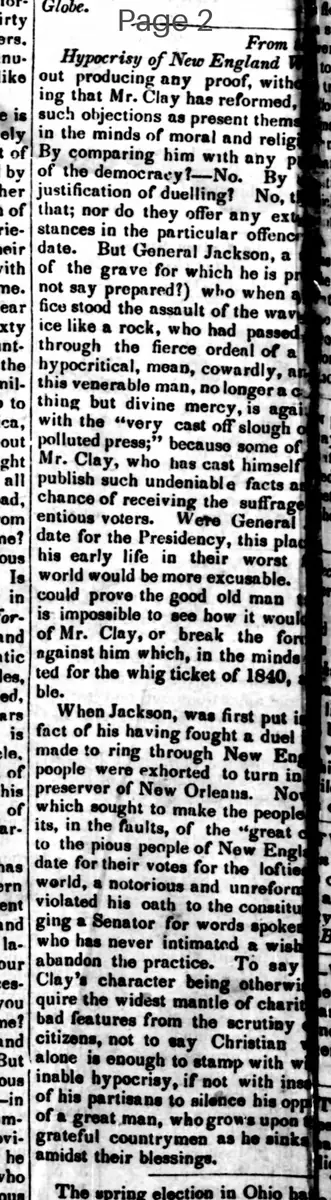
Without producing any proof, without saying that Mr. Clay has reformed, such objections as present themselves in the minds of moral and religious men. By comparing him with any public man of the democracy?—No. By his justification of duelling? No, that; nor do they offer any extenuating circumstances in the particular offence they charge. But General Jackson, a man on the verge of the grave for which he is prepared?) who when a private stood the assault of the waves of prejudice like a rock, who had passed through the fierce ordeal of a hypocritical, mean, cowardly, and polluted press; this venerable man, no longer a candidate for anything but divine mercy, is again assailed with the "very cast off slough of that polluted press;" because some of his friends, who have cast himself into the breach to publish such undeniable facts as would endanger the chance of receiving the suffrages of the conscientious voters. Were General Jackson a candidate for the Presidency, this plundering of his early life in their worst colors, by the polluted press of the world would be more excusable. But to attempt to prove the good old man a duellist now, is impossible to see how it would injure the prospects of Mr. Clay, or break the force of the charges against him which, in the minds of all, contributed to the whig ticket of 1840, falling through.
When Jackson was first put in nomination the fact of his having fought a duel was made to ring through New England; the people were exhorted to turn in disgust from the hero and preserver of New Orleans. No one then thought of inquiring into the provocations which sought to make the people forget its, in the faults, of the "great captain," and to appeal to the pious people of New England to withhold their votes for the loftiest station in the world, a notorious and unreformed duellist, who had violated his oath to the constitution by turning a Senator out of his seat for words spoken in debate, who has never intimated a wish to abandon the practice. To say nothing of Mr. Clay's character being otherwise impeachable, would require the widest mantle of charity to cover his bad features from the scrutiny of American citizens, not to say Christian men. The attempt alone is enough to stamp with unparalleled hypocrisy, if not with insanity, the conduct of his partisans to silence his opponents by raking up the memory of a great man, who grows upon the love of his grateful countrymen as he sinks amidst their blessings.
HYPOCRISY OF NEW ENGLAND.
Without producing any proof, without saying that Mr. Clay has reformed, such objections as present themselves in the minds of moral and religious men. By comparing him with any public man of the democracy?—No. By his justification of duelling? No, that; nor do they offer any extenuating circumstances in the particular offence they charge. But General Jackson, a man on the verge of the grave for which he is prepared?) who when a private stood the assault of the waves of prejudice like a rock, who had passed through the fierce ordeal of a hypocritical, mean, cowardly, and polluted press; this venerable man, no longer a candidate for anything but divine mercy, is again assailed with the "very cast off slough of that polluted press;" because some of his friends, who have cast himself into the breach to publish such undeniable facts as would endanger the chance of receiving the suffrages of the conscientious voters. Were General Jackson a candidate for the Presidency, this plundering of his early life in their worst colors, by the polluted press of the world would be more excusable. But to attempt to prove the good old man a duellist now, is impossible to see how it would injure the prospects of Mr. Clay, or break the force of the charges against him which, in the minds of all, contributed to the whig ticket of 1840, falling through.
When Jackson was first put in nomination the fact of his having fought a duel was made to ring through New England; the people were exhorted to turn in disgust from the hero and preserver of New Orleans. No one then thought of inquiring into the provocations which sought to make the people forget its, in the faults, of the "great captain," and to appeal to the pious people of New England to withhold their votes for the loftiest station in the world, a notorious and unreformed duellist, who had violated his oath to the constitution by turning a Senator out of his seat for words spoken in debate, who has never intimated a wish to abandon the practice. To say nothing of Mr. Clay's character being otherwise impeachable, would require the widest mantle of charity to cover his bad features from the scrutiny of American citizens, not to say Christian men. The attempt alone is enough to stamp with unparalleled hypocrisy, if not with insanity, the conduct of his partisans to silence his opponents by raking up the memory of a great man, who grows upon the love of his grateful countrymen as he sinks amidst their blessings.
What sub-type of article is it?
Partisan Politics
Moral Or Religious
What keywords are associated?
Hypocrisy
New England
Jackson
Clay
Dueling
Whig Ticket
1840 Election
What entities or persons were involved?
General Jackson
Mr. Clay
New England
Whig Ticket
Editorial Details
Primary Topic
Hypocrisy Of New England In Attacking Jackson's Dueling To Defend Clay
Stance / Tone
Strongly Pro Jackson, Anti Whig Hypocrisy
Key Figures
General Jackson
Mr. Clay
New England
Whig Ticket
Key Arguments
New Englanders Hypocritically Revive Jackson's Old Duels Without Evidence Of Clay's Reform
Jackson Is No Longer A Candidate, Making Attacks Irrelevant
Clay Justified Dueling And Expelled A Senator, Showing Worse Character
Attacks On Jackson Contributed To Whig Defeat In 1840
Such Tactics Reveal Unparalleled Hypocrisy In Clay's Partisans