Thank you for visiting SNEWPapers!
Sign up free
Story
February 6, 1800
The Kentucky Gazette
Lexington, Fayette County, Kentucky
What is this article about?
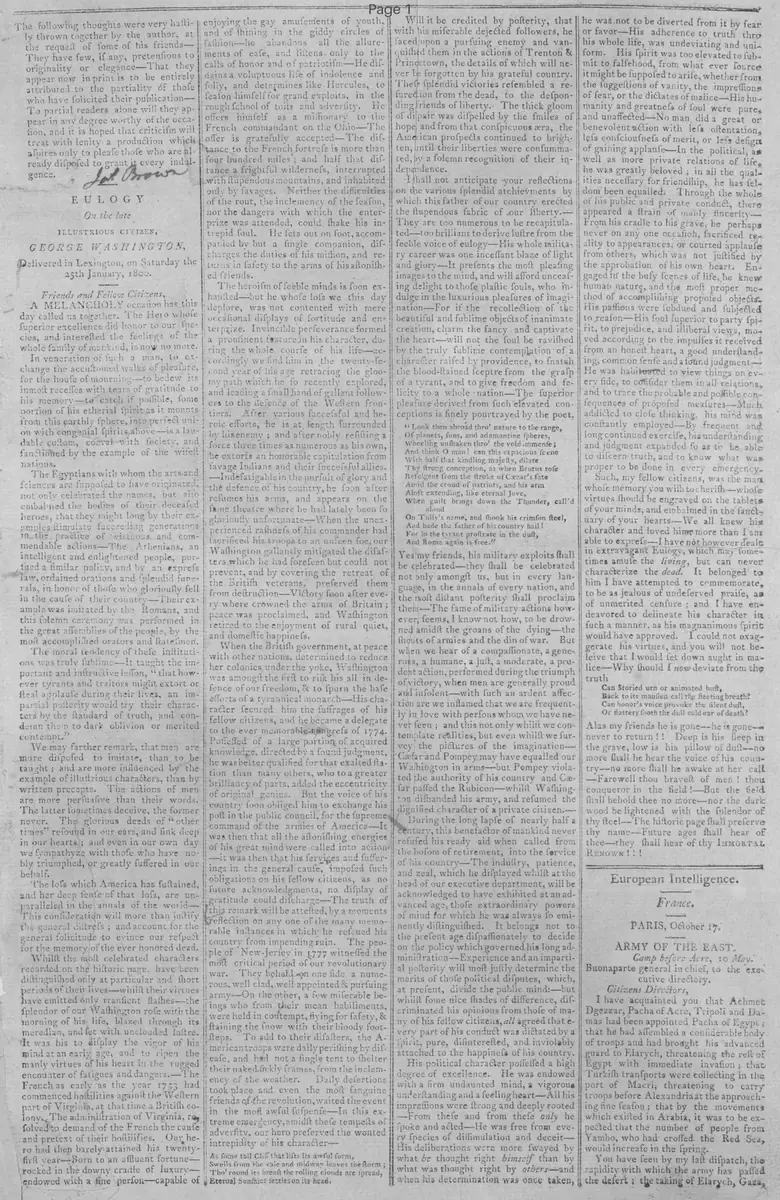
Eulogy delivered in Lexington on January 25, 1800, honoring George Washington after his death. It recounts his early heroism in 1753-1755, Revolutionary War leadership including victories at Trenton and Princeton, post-war service, and praises his virtues of integrity, bravery, and patriotism.
Clipping
OCR Quality
98%
Excellent
Full Text
The following thoughts were very hastily thrown together by the author, at the request of some of his friends—
They have few, if any, pretensions to originality or elegance—That they appear now in print is to be entirely attributed to the partiality of those who have solicited their publication—
To partial readers alone will they appear in any degree worthy of the occasion, and it is hoped that criticism will treat with lenity a production which aspires only to please those who are already disposed to grant it every indulgence.
EULOGY
On the late
ILLUSTRIOUS CITIZEN,
GEORGE WASHINGTON.
Delivered in Lexington, on Saturday the 25th January, 1800.
Friends and Fellow Citizens,
A MELANCHOLY occasion has this day called us together. The Hero whose superior excellence did honor to our species, and interested the feelings of the whole family of mankind, is now no more.
In veneration of such a man, to exchange the accustomed walks of pleasure, for the house of mourning—to bedew its inmost recesses with tears of gratitude to his memory—to catch if possible, some portion of his ethereal spirit as it mounts from this earthly sphere, into perfect union with congenial spirits above—is a laudable custom, coeval with society, and sanctioned by the example of the wisest nations.
The Egyptians with whom the arts and sciences are supposed to have originated, not only celebrated the names, but also embalmed the bodies of their deceased heroes, that they might long by their examples stimulate succeeding generations in the practice of virtuous and commendable actions—The Athenians, an intelligent and enlightened people, pursued a similar policy, and by an express law, ordained orations and splendid funerals, in honor of those who gloriously fell in the cause of their country—Their example was imitated by the Romans, and this solemn ceremony was performed in the great assemblies of the people, by the most accomplished orators and statesmen.
The moral tendency of these institutions was truly sublime—It taught the important and instructive lesson, "that however tyrants and traitors might extort or steal applause during their lives, an impartial posterity would try their characters by the standard of truth, and condemn them to dark oblivion or merited contempt."
We may farther remark, that men are more disposed to imitate, than to be taught; and are more influenced by the example of illustrious characters, than by written precepts. The actions of men are more persuasive than their words. The latter sometimes deceive, the former never. The glorious deeds of "other times" resound in our ears, and sink deep in our hearts; and even in our own day we sympathize with those who have nobly triumphed, or greatly suffered in our behalf.
The loss which America has sustained, and her deep sense of that loss, are unparalleled in the annals of the world— This consideration will more than justify the general distress; and account for the general solicitude to evince our respect for the memory of the ever honored dead.
Whilst the most celebrated characters recorded on the historic page, have been distinguished only at particular and short periods of their lives—whilst their virtues have emitted only transient flashes—the splendor of our Washington rose with the morning of his life, blazed through its meridian, and set with unclouded lustre.
It was his to display the vigor of his mind at an early age, and to ripen the manly virtues of his heart in the rugged encounter of fatigues and dangers.—The French as early as the year 1753 had commenced hostilities against the Western part of Virginia, at that time a British colony. The administration of Virginia, resolved to demand of the French the cause and pretext of their hostilities. Our hero had then barely attained his twenty-first year—Born to an affluent fortune—rocked in the downy cradle of luxury—endowed with a fine person—capable of enjoying the gay amusements of youth, and of shining in the giddy circles of fashion—he abandons all the allurements of ease, and listens only to the calls of honor and of patriotism—He disdains a voluptuous life of indolence and folly, and determines like Hercules, to season himself for grand exploits, in the rough school of toils and adversity. He offers himself as a missionary to the French commandant on the Ohio—The offer is gratefully accepted—The distance to the French fortress is more than four hundred miles; and half that distance a frightful wilderness, interrupted with stupendous mountains, and inhabited only by savages. Neither the difficulties of the rout, the inclemency of the season, nor the dangers with which the enterprise was attended, could shake his intrepid soul. He sets out on foot, accompanied by but a single companion, discharges the duties of his mission, and returns in safety to the arms of his astonished friends.
The heroism of feeble minds is soon exhausted—but he whose loss we this day deplore, was not contented with mere occasional displays of fortitude and enterprise. Invincible perseverance formed a prominent feature in his character, during the whole course of his life—accordingly we find him in the twenty-second year of his age retracing the gloomy path which he so recently explored, and leading a small band of gallant followers to the defence of the Western frontiers. After various successful and heroic efforts, he is at length surrounded by the enemy; and after nobly resisting a force three times as numerous as his own, he extorts an honorable capitulation from savage Indians and their successful allies.—Indefatigable in the pursuit of glory and the defence of his country, he soon after resumes his arms, and appears on the same theatre where he had lately been so gloriously unfortunate—When the inexperienced rashness of his commander had sacrificed his troops to an unseen foe, our Washington gallantly mitigated the disasters which he had foreseen but could not prevent, and by covering the retreat of the British veterans, preserved them from destruction—Victory soon after everywhere crowned the arms of Britain; peace was proclaimed, and Washington retired to the enjoyment of rural quiet, and domestic happiness.
When the British government, at peace with other nations, determined to reduce her colonies under the yoke, Washington was amongst the first to risk his all in defence of our freedom, & to spurn the base efforts of a tyrannical monarch—His character secured him the suffrages of his fellow citizens, and he became a delegate to the ever memorable congress of 1774.
Possessed of a large portion of acquired knowledge, directed by a sound judgment, he was better qualified for that exalted station than many others, who to a greater brilliancy of parts, added the eccentricity of original genius. But the voice of his country soon obliged him to exchange his post in the public council, for the supreme command of the armies of America—It was then that all the astonishing energies of his great mind were called into action—it was then that his services and sufferings in the general cause, imposed such obligations on his fellow citizens, as no future acknowledgments, no display of gratitude could discharge—The truth of this remark will be attested, by a moment's reflection on any one of the many memorable instances in which he rescued his country from impending ruin. The people of New-Jersey in 1777 witnessed the most critical period of our revolutionary war. They beheld—on one side a numerous, well clad, well appointed & pursuing army—On the other, a few miserable beings who from their mean habiliments, were held in contempt, flying for safety, & staining the snow with their bloody footsteps. To add to their disasters, the American troops were daily perishing by disease, and had not a single tent to shelter their naked sickly frames from the inclemency of the weather. Daily desertions took place and even the most sanguine friends of the revolution, waited the event in the most awful suspense—In this extreme emergency, amidst these tempests of adversity, our hero preserved the wonted intrepidity of his character—
As some tall Cliff that lifts its awful form,
Swells from the vale and midway leaves the storm;
Tho' round its breast the rolling clouds are spread,
Eternal Sunshine settles on its head.
Will it be credited by posterity, that with his miserable dejected followers, he faced upon a pursuing enemy and vanquished them in the actions of Trenton & Princeton, the details of which will never be forgotten by his grateful country.
These splendid victories resembled a resurrection from the dead, to the desponding friends of liberty. The thick gloom of despair was dispelled by the smiles of hope and from that conspicuous era, the American prospects continued to brighten, until their liberties were consummated, by a solemn recognition of their independence.
I shall not anticipate your reflections on the various splendid achievements by which this father of our country erected the stupendous fabric of our liberty.— They are too numerous to be recapitulated—too brilliant to derive lustre from the feeble voice of eulogy—His whole military career was one incessant blaze of light and glory—It presents the most pleasing images to the mind, and will afford unceasing delight to those plastic souls, who indulge in the luxurious pleasures of imagination—For if the recollection of the beautiful and sublime objects of inanimate creation, charm the fancy and captivate the heart—will not the soul be ravished by the truly sublime contemplation of a character raised by providence, to snatch the blood-stained sceptre from the grasp of a tyrant, and to give freedom and felicity to a whole nation—The superior pleasure derived from such elevated conceptions is finely pourtrayed by the poet,
"Look then abroad thro' Nature to the range,
Of planets, suns, and adamantine spheres,
Wheeling unshaken thro' the void immense;
And think O man! can this capacious scene
With half that kindling majesty, dilate
Thy strong conception, as when Brutus rose
Refulgent from the stroke of Cæsar's fate
Amid the crowd of patriots, and his arm
Aloft extending, like eternal Jove,
When guilt brings down the Thunder, call'd
aloud
On Tully's name, and shook his crimson steel,
And bade the father of his country hail!
For lo the tyrant prostrate in the dust,
And Rome again is free."
Yes my friends, his military exploits shall be celebrated—they shall be celebrated not only amongst us, but in every language, in the annals of every nation, and the most distant posterity shall proclaim them—The fame of military actions however, seems, I know not how, to be drowned amidst the groans of the dying—the shouts of armies and the din of war. But when we hear of a compassionate, a generous, a humane, a just, a moderate, a prudent action, performed during the triumph of victory, when men are generally proud and insolent—with such an ardent affection are we inflamed that we are frequently in love with persons whom we have never seen; and this not only whilst we contemplate realities, but even whilst we survey the pictures of the imagination— Cæsar and Pompey may have equalled our Washington in arms—but Pompey violated the authority of his country and Cæsar passed the Rubicon—whilst Washington disbanded his army, and resumed the dignified character of a private citizen.— During the long lapse of nearly half a century, this benefactor of mankind never refused his ready aid when called from the bosom of retirement, into the service of his country—The industry, patience, and zeal, which he displayed whilst at the head of our executive department, will be acknowledged to have exhibited at an advanced age, those extraordinary powers of mind for which he was always so eminently distinguished. It belongs not to the present age dispassionately to decide on the policy which governed his long administration—Experience and an impartial posterity will most justly determine the merits of those political disputes, which, at present, divide the public mind:—but whilst some nice shades of difference, discriminated his opinions from those of many of his fellow citizens, all agreed that every part of his conduct was dictated by a spirit, pure, disinterested, and inviolably attached to the happiness of his country.
His political character possessed a high degree of excellence. He was endowed with a firm undaunted mind, a vigorous understanding and a feeling heart—All his impressions were strong and deeply rooted
From thee and from thee only he spoke and acted—He was free from every species of dissimulation and deceit— His deliberations were more swayed by what he thought right himself than by what was thought right by others—and when his determination was once taken, he was not to be diverted from it by fear or favor—His adherence to truth thro his whole life, was undeviating and uniform. His spirit was too elevated to submit to falsehood, from whatever source it might be supposed to arise, whether from the suggestions of vanity, the impressions of fear, or the dictates of malice—His humanity and greatness of soul were pure, and unaffected—No man did a great or benevolent action with less ostentation, less consciousness of merit, or less design of gaining applause—In the political, as well as more private relations of life, he was greatly beloved; in all the qualities necessary for friendship, he has seldom been equalled. Through the whole of his public and private conduct, there appeared a train of manly sincerity— From his cradle to his grave, he perhaps never on any one occasion, sacrificed reality to appearances, or courted applause from others, which was not justified by the approbation of his own heart. Engaged in the busy scenes of life, he knew human nature, and the most proper method of accomplishing proposed objects.
His passions were subdued and subjected to reason—His soul superior to party spirit, to prejudice, and illiberal views, moved according to the impulses it received from an honest heart, a good understanding, common sense and a sound judgment— He was habituated to view things on every side, to consider them in all relations, and to trace the probable and possible consequences of proposed measures—Much addicted to close thinking, his mind was constantly employed—By frequent and long continued exercise, his understanding and judgment expanded so as to be able to discern truth, and to know what was proper to be done in every emergency.
Such, my fellow citizens, was the man whose memory you wish to cherish—whose virtues should be engraved on the tablets of your minds, and embalmed in the sanctuary of your hearts—We all knew his character and loved him, more than I am able to express—I have not however dealt in extravagant Eulogy, which may sometimes amuse the living, but can never characterize the dead. It belonged to him I have attempted to commemorate, to be as jealous of undeserved praise, as of unmerited censure; and I have endeavored to delineate his character in such a manner, as his magnanimous spirit would have approved. I could not exaggerate his virtues, and you will not believe that I would set down aught in malice—Why should I now deviate from the truth
Can Storied urn or animated bust.
Back to its mansion call the fleeting breath?
Can honor's voice provoke the silent dust,
Or flattery sooth the dull cold ear of death?
Alas my friends he is gone—he is gone— never to return!! Deep is his sleep in the grave, low is his pillow of dust—no more shall he hear the voice of his country—no more shall he awake at her call —Farewell thou bravest of men! thou conqueror in the field! But the field shall behold thee no more—nor the dark wood be lightened with the splendor of thy steel—The historic page shall preserve thy name—Future ages shall hear of thee—they shall hear of thy IMMORTAL RENOWN!!!
They have few, if any, pretensions to originality or elegance—That they appear now in print is to be entirely attributed to the partiality of those who have solicited their publication—
To partial readers alone will they appear in any degree worthy of the occasion, and it is hoped that criticism will treat with lenity a production which aspires only to please those who are already disposed to grant it every indulgence.
EULOGY
On the late
ILLUSTRIOUS CITIZEN,
GEORGE WASHINGTON.
Delivered in Lexington, on Saturday the 25th January, 1800.
Friends and Fellow Citizens,
A MELANCHOLY occasion has this day called us together. The Hero whose superior excellence did honor to our species, and interested the feelings of the whole family of mankind, is now no more.
In veneration of such a man, to exchange the accustomed walks of pleasure, for the house of mourning—to bedew its inmost recesses with tears of gratitude to his memory—to catch if possible, some portion of his ethereal spirit as it mounts from this earthly sphere, into perfect union with congenial spirits above—is a laudable custom, coeval with society, and sanctioned by the example of the wisest nations.
The Egyptians with whom the arts and sciences are supposed to have originated, not only celebrated the names, but also embalmed the bodies of their deceased heroes, that they might long by their examples stimulate succeeding generations in the practice of virtuous and commendable actions—The Athenians, an intelligent and enlightened people, pursued a similar policy, and by an express law, ordained orations and splendid funerals, in honor of those who gloriously fell in the cause of their country—Their example was imitated by the Romans, and this solemn ceremony was performed in the great assemblies of the people, by the most accomplished orators and statesmen.
The moral tendency of these institutions was truly sublime—It taught the important and instructive lesson, "that however tyrants and traitors might extort or steal applause during their lives, an impartial posterity would try their characters by the standard of truth, and condemn them to dark oblivion or merited contempt."
We may farther remark, that men are more disposed to imitate, than to be taught; and are more influenced by the example of illustrious characters, than by written precepts. The actions of men are more persuasive than their words. The latter sometimes deceive, the former never. The glorious deeds of "other times" resound in our ears, and sink deep in our hearts; and even in our own day we sympathize with those who have nobly triumphed, or greatly suffered in our behalf.
The loss which America has sustained, and her deep sense of that loss, are unparalleled in the annals of the world— This consideration will more than justify the general distress; and account for the general solicitude to evince our respect for the memory of the ever honored dead.
Whilst the most celebrated characters recorded on the historic page, have been distinguished only at particular and short periods of their lives—whilst their virtues have emitted only transient flashes—the splendor of our Washington rose with the morning of his life, blazed through its meridian, and set with unclouded lustre.
It was his to display the vigor of his mind at an early age, and to ripen the manly virtues of his heart in the rugged encounter of fatigues and dangers.—The French as early as the year 1753 had commenced hostilities against the Western part of Virginia, at that time a British colony. The administration of Virginia, resolved to demand of the French the cause and pretext of their hostilities. Our hero had then barely attained his twenty-first year—Born to an affluent fortune—rocked in the downy cradle of luxury—endowed with a fine person—capable of enjoying the gay amusements of youth, and of shining in the giddy circles of fashion—he abandons all the allurements of ease, and listens only to the calls of honor and of patriotism—He disdains a voluptuous life of indolence and folly, and determines like Hercules, to season himself for grand exploits, in the rough school of toils and adversity. He offers himself as a missionary to the French commandant on the Ohio—The offer is gratefully accepted—The distance to the French fortress is more than four hundred miles; and half that distance a frightful wilderness, interrupted with stupendous mountains, and inhabited only by savages. Neither the difficulties of the rout, the inclemency of the season, nor the dangers with which the enterprise was attended, could shake his intrepid soul. He sets out on foot, accompanied by but a single companion, discharges the duties of his mission, and returns in safety to the arms of his astonished friends.
The heroism of feeble minds is soon exhausted—but he whose loss we this day deplore, was not contented with mere occasional displays of fortitude and enterprise. Invincible perseverance formed a prominent feature in his character, during the whole course of his life—accordingly we find him in the twenty-second year of his age retracing the gloomy path which he so recently explored, and leading a small band of gallant followers to the defence of the Western frontiers. After various successful and heroic efforts, he is at length surrounded by the enemy; and after nobly resisting a force three times as numerous as his own, he extorts an honorable capitulation from savage Indians and their successful allies.—Indefatigable in the pursuit of glory and the defence of his country, he soon after resumes his arms, and appears on the same theatre where he had lately been so gloriously unfortunate—When the inexperienced rashness of his commander had sacrificed his troops to an unseen foe, our Washington gallantly mitigated the disasters which he had foreseen but could not prevent, and by covering the retreat of the British veterans, preserved them from destruction—Victory soon after everywhere crowned the arms of Britain; peace was proclaimed, and Washington retired to the enjoyment of rural quiet, and domestic happiness.
When the British government, at peace with other nations, determined to reduce her colonies under the yoke, Washington was amongst the first to risk his all in defence of our freedom, & to spurn the base efforts of a tyrannical monarch—His character secured him the suffrages of his fellow citizens, and he became a delegate to the ever memorable congress of 1774.
Possessed of a large portion of acquired knowledge, directed by a sound judgment, he was better qualified for that exalted station than many others, who to a greater brilliancy of parts, added the eccentricity of original genius. But the voice of his country soon obliged him to exchange his post in the public council, for the supreme command of the armies of America—It was then that all the astonishing energies of his great mind were called into action—it was then that his services and sufferings in the general cause, imposed such obligations on his fellow citizens, as no future acknowledgments, no display of gratitude could discharge—The truth of this remark will be attested, by a moment's reflection on any one of the many memorable instances in which he rescued his country from impending ruin. The people of New-Jersey in 1777 witnessed the most critical period of our revolutionary war. They beheld—on one side a numerous, well clad, well appointed & pursuing army—On the other, a few miserable beings who from their mean habiliments, were held in contempt, flying for safety, & staining the snow with their bloody footsteps. To add to their disasters, the American troops were daily perishing by disease, and had not a single tent to shelter their naked sickly frames from the inclemency of the weather. Daily desertions took place and even the most sanguine friends of the revolution, waited the event in the most awful suspense—In this extreme emergency, amidst these tempests of adversity, our hero preserved the wonted intrepidity of his character—
As some tall Cliff that lifts its awful form,
Swells from the vale and midway leaves the storm;
Tho' round its breast the rolling clouds are spread,
Eternal Sunshine settles on its head.
Will it be credited by posterity, that with his miserable dejected followers, he faced upon a pursuing enemy and vanquished them in the actions of Trenton & Princeton, the details of which will never be forgotten by his grateful country.
These splendid victories resembled a resurrection from the dead, to the desponding friends of liberty. The thick gloom of despair was dispelled by the smiles of hope and from that conspicuous era, the American prospects continued to brighten, until their liberties were consummated, by a solemn recognition of their independence.
I shall not anticipate your reflections on the various splendid achievements by which this father of our country erected the stupendous fabric of our liberty.— They are too numerous to be recapitulated—too brilliant to derive lustre from the feeble voice of eulogy—His whole military career was one incessant blaze of light and glory—It presents the most pleasing images to the mind, and will afford unceasing delight to those plastic souls, who indulge in the luxurious pleasures of imagination—For if the recollection of the beautiful and sublime objects of inanimate creation, charm the fancy and captivate the heart—will not the soul be ravished by the truly sublime contemplation of a character raised by providence, to snatch the blood-stained sceptre from the grasp of a tyrant, and to give freedom and felicity to a whole nation—The superior pleasure derived from such elevated conceptions is finely pourtrayed by the poet,
"Look then abroad thro' Nature to the range,
Of planets, suns, and adamantine spheres,
Wheeling unshaken thro' the void immense;
And think O man! can this capacious scene
With half that kindling majesty, dilate
Thy strong conception, as when Brutus rose
Refulgent from the stroke of Cæsar's fate
Amid the crowd of patriots, and his arm
Aloft extending, like eternal Jove,
When guilt brings down the Thunder, call'd
aloud
On Tully's name, and shook his crimson steel,
And bade the father of his country hail!
For lo the tyrant prostrate in the dust,
And Rome again is free."
Yes my friends, his military exploits shall be celebrated—they shall be celebrated not only amongst us, but in every language, in the annals of every nation, and the most distant posterity shall proclaim them—The fame of military actions however, seems, I know not how, to be drowned amidst the groans of the dying—the shouts of armies and the din of war. But when we hear of a compassionate, a generous, a humane, a just, a moderate, a prudent action, performed during the triumph of victory, when men are generally proud and insolent—with such an ardent affection are we inflamed that we are frequently in love with persons whom we have never seen; and this not only whilst we contemplate realities, but even whilst we survey the pictures of the imagination— Cæsar and Pompey may have equalled our Washington in arms—but Pompey violated the authority of his country and Cæsar passed the Rubicon—whilst Washington disbanded his army, and resumed the dignified character of a private citizen.— During the long lapse of nearly half a century, this benefactor of mankind never refused his ready aid when called from the bosom of retirement, into the service of his country—The industry, patience, and zeal, which he displayed whilst at the head of our executive department, will be acknowledged to have exhibited at an advanced age, those extraordinary powers of mind for which he was always so eminently distinguished. It belongs not to the present age dispassionately to decide on the policy which governed his long administration—Experience and an impartial posterity will most justly determine the merits of those political disputes, which, at present, divide the public mind:—but whilst some nice shades of difference, discriminated his opinions from those of many of his fellow citizens, all agreed that every part of his conduct was dictated by a spirit, pure, disinterested, and inviolably attached to the happiness of his country.
His political character possessed a high degree of excellence. He was endowed with a firm undaunted mind, a vigorous understanding and a feeling heart—All his impressions were strong and deeply rooted
From thee and from thee only he spoke and acted—He was free from every species of dissimulation and deceit— His deliberations were more swayed by what he thought right himself than by what was thought right by others—and when his determination was once taken, he was not to be diverted from it by fear or favor—His adherence to truth thro his whole life, was undeviating and uniform. His spirit was too elevated to submit to falsehood, from whatever source it might be supposed to arise, whether from the suggestions of vanity, the impressions of fear, or the dictates of malice—His humanity and greatness of soul were pure, and unaffected—No man did a great or benevolent action with less ostentation, less consciousness of merit, or less design of gaining applause—In the political, as well as more private relations of life, he was greatly beloved; in all the qualities necessary for friendship, he has seldom been equalled. Through the whole of his public and private conduct, there appeared a train of manly sincerity— From his cradle to his grave, he perhaps never on any one occasion, sacrificed reality to appearances, or courted applause from others, which was not justified by the approbation of his own heart. Engaged in the busy scenes of life, he knew human nature, and the most proper method of accomplishing proposed objects.
His passions were subdued and subjected to reason—His soul superior to party spirit, to prejudice, and illiberal views, moved according to the impulses it received from an honest heart, a good understanding, common sense and a sound judgment— He was habituated to view things on every side, to consider them in all relations, and to trace the probable and possible consequences of proposed measures—Much addicted to close thinking, his mind was constantly employed—By frequent and long continued exercise, his understanding and judgment expanded so as to be able to discern truth, and to know what was proper to be done in every emergency.
Such, my fellow citizens, was the man whose memory you wish to cherish—whose virtues should be engraved on the tablets of your minds, and embalmed in the sanctuary of your hearts—We all knew his character and loved him, more than I am able to express—I have not however dealt in extravagant Eulogy, which may sometimes amuse the living, but can never characterize the dead. It belonged to him I have attempted to commemorate, to be as jealous of undeserved praise, as of unmerited censure; and I have endeavored to delineate his character in such a manner, as his magnanimous spirit would have approved. I could not exaggerate his virtues, and you will not believe that I would set down aught in malice—Why should I now deviate from the truth
Can Storied urn or animated bust.
Back to its mansion call the fleeting breath?
Can honor's voice provoke the silent dust,
Or flattery sooth the dull cold ear of death?
Alas my friends he is gone—he is gone— never to return!! Deep is his sleep in the grave, low is his pillow of dust—no more shall he hear the voice of his country—no more shall he awake at her call —Farewell thou bravest of men! thou conqueror in the field! But the field shall behold thee no more—nor the dark wood be lightened with the splendor of thy steel—The historic page shall preserve thy name—Future ages shall hear of thee—they shall hear of thy IMMORTAL RENOWN!!!
What sub-type of article is it?
Biography
Historical Event
Heroic Act
What themes does it cover?
Bravery Heroism
Triumph
Moral Virtue
What keywords are associated?
George Washington
Eulogy
Revolutionary War
Trenton Battle
Princeton Battle
American Hero
Patriotism
Leadership
What entities or persons were involved?
George Washington
Where did it happen?
Lexington
Story Details
Key Persons
George Washington
Location
Lexington
Event Date
1800 01 25
Story Details
Eulogy praising Washington's early missions in 1753-1755, leadership in the Revolutionary War including Trenton and Princeton victories in 1776-1777, post-war public service, and personal virtues of integrity and patriotism.