Thank you for visiting SNEWPapers!
Sign up free
Marietta Daily Leader
Marietta, Washington County, Ohio
What is this article about?
Delegates arrive in Indianapolis for the Sound Money Convention on Sept. 1, with support for Gen. Buckner of Kentucky as Vice Presidential nominee. Booms emerge for Henry Watterson, Gen. Bragg, Senator Vilas, and a push by Hugh Wallace for President Cleveland's nomination. Platform to focus on sound money and gold standard.
Clipping
OCR Quality
Full Text
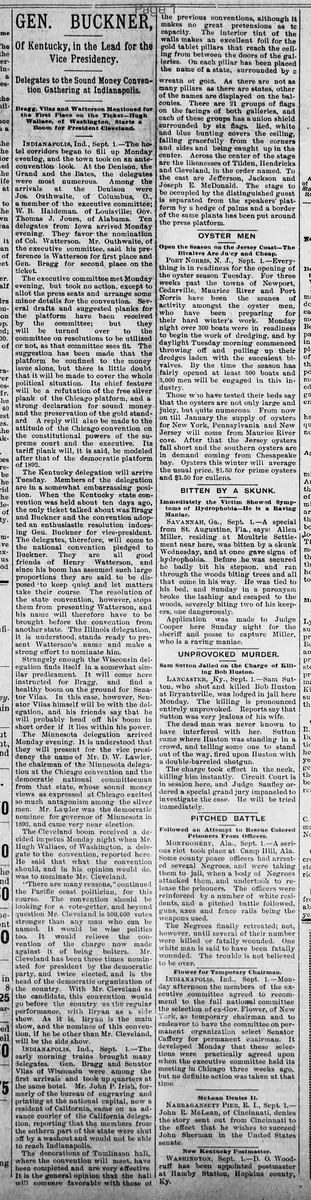
Of Kentucky, in the Lead for the Vice Presidency.
Delegates to the Sound Money Convention Gathering at Indianapolis.
Bragg, Vilas and Watterson Mentioned for the First Place on the Ticket—Hugh Wallace, of Washington, Starts a Boom for President Cleveland.
INDIANAPOLIS, Ind., Sept. 1.—The hotel corridors began to fill up Monday evening, and the town took on an ante-convention look. At the Denison, the Grand and the Bates, the delegates were most numerous.
Among the arrivals at the Denison were Jos. Outhwaite, of Columbus, O., a member of the executive committee; W. B. Haldeman, of Louisville; Gov. Thomas J. Jones, of Alabama. Ten delegates from Iowa arrived Monday evening. They favor the nomination of Col. Watterson. Mr. Outhwaite, of the executive committee, said his preference is Watterson for first place and Gen. Bragg for second place on the ticket.
The executive committee met Monday evening, but took no action, except to allot the press seats and arrange some minor details for the convention. Several drafts and suggested planks for the platform have been received by the committee; but they will be turned over to the committee on resolutions to be utilized or not, as that committee sees fit. The suggestion has been made that the platform be confined to the money issue alone, but there is little doubt that it will be made to cover the whole political situation. Its chief feature will be a refutation of the free silver plank of the Chicago platform, and a strong declaration for sound money and the preservation of the gold standard. A reply will also be made to the attitude of the Chicago convention on the constitutional powers of the supreme court and the executive. Its tariff plank will, it is said, be modeled after that of the democratic platform of 1892.
The Kentucky delegation will arrive Tuesday. Members of the delegation are in a somewhat embarrassing position. When the Kentucky state convention was held about ten days ago, the only ticket talked about was Bragg and Buckner and the convention adopted an enthusiastic resolution indorsing Gen. Buckner for vice-president.
The delegates, therefore, will come to the national convention pledged to Buckner. They are all good friends of Henry Watterson, and since his boom has assumed such large proportions they are said to be disposed to keep quiet and let matters take their course. The resolution of the state convention, however, stops them from presenting Watterson, and his name will therefore have to be brought before the convention from another state. The Illinois delegation, it is understood, stands ready to present Watterson's name and make a strong effort to nominate him.
Strangely enough the Wisconsin delegation finds itself in a somewhat similar predicament. It will come here instructed for Bragg, and find a healthy boom on the ground for Senator Vilas. In this case, however, Senator Vilas himself will be with the delegation, and his friends say that he will probably head off his boom in short order if it lies within his power.
The Minnesota delegation arrived Monday evening. It is understood that they will present for the vice presidency the name of Mr. D. W. Lawler, the chairman of the Minnesota delegation at the Chicago convention and the democratic national committeeman from that state, whose sound money views as expressed at Chicago excited so much antagonism among the silver men. Mr. Lawler was the democratic nominee for governor of Minnesota in 1893, and came very near election.
The Cleveland boom received a decided impetus Monday night when Mr. Hugh Wallace, of Washington, a delegate to the convention, reported here. He said that what the convention should, and in his opinion would do, was to nominate Mr. Cleveland.
“There are many reasons,” continued the Pacific coast politician, for this course.
The convention should be looking for a vote-getter, and beyond question Mr. Cleveland is 500,000 votes stronger than any man who can be named. It would be wise politics too. It would relieve the convention of the charge now made against it of being bolters.
Mr. Cleveland has been three times nominated for president by the democratic party, and twice elected, and is the head of the democratic organization of the country. With Mr. Cleveland as the candidate, this convention would go before the country as the regular performance, with Bryan as a side show. As it is, Bryan is the main show, and the nominee of this convention, if he be other than Mr. Cleveland, will be the side show.
INDIANAPOLIS, Ind., Sept. 1.—The early morning trains brought many delegates. Gen. Bragg and Senator Vilas of Wisconsin were among the first arrivals and took up quarters at the same hotel. Mr. John P. Irish, formerly of the bureau of engraving and printing at the national capital, now a resident of California, came on as advance courier of the California delegation, reporting that the members from the southern part of the state were shut off by a washout and would not be able to reach Indianapolis.
The decorations of Tomlinson hall, where the convention will meet, have been completed and are very effective. It is the general opinion that the hall will compare favorably with those of the previous conventions, although it makes no great pretensions as to capacity. The interior tint of the walls makes an excellent foil for the gold tablet pillars that reach the ceiling from between the doors of the galleries. On each pillar has been placed the name of a state, surrounded by a wreath of gold. As there are not as many pillars as there are states, other of the names are displayed on the balconies. There are 21 groups of flags on the facings of both galleries, and each of these groups has a union shield surrounded by six flags. Red, white and blue bunting covers the ceiling, falling gracefully from the corners and sides and being caught up in the center. Across the center of the stage are the likenesses of Tilden, Hendricks and Cleveland, in the order named. To the east are Jefferson, Jackson and Joseph E. McDonald. The stage to be occupied by the distinguished guests is separated from the speakers' platform by a hedge of palms and a border of the same plants has been put around the press platform.
What sub-type of article is it?
What keywords are associated?
What entities or persons were involved?
Where did it happen?
Domestic News Details
Primary Location
Indianapolis, Ind.
Event Date
Sept. 1
Key Persons
Outcome
delegations arrive supporting various candidates; platform to emphasize sound money and gold standard; convention preparations complete with hall decorations.
Event Details
Delegates from multiple states arrive in Indianapolis for the Sound Money Convention, favoring nominations of Gen. Buckner for Vice President, Henry Watterson, Gen. Bragg, Senator Vilas, and D. W. Lawler. Hugh Wallace promotes President Cleveland for nomination. Executive committee handles preparations; platform drafts focus on refuting free silver and supporting gold standard.