Thank you for visiting SNEWPapers!
Sign up free
Cincinnati Daily Press
Cincinnati, Hamilton County, Ohio
What is this article about?
The California ocean mail service is disrupted after Commodore Vanderbilt's contract expires without renewal provision from Congress, leading him to refuse service at postage-only rates and demand $400,000 annually, resulting in reliance on transient vessels and criticism of Congressional delay affecting overland alternatives and passenger competition.
Clipping
OCR Quality
Full Text
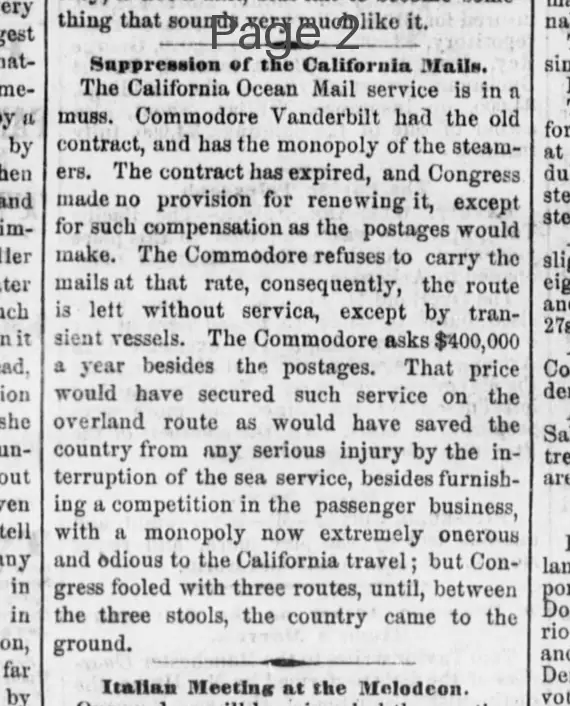
The California Ocean Mail service is in a muss. Commodore Vanderbilt had the old contract, and has the monopoly of the steamers. The contract has expired, and Congress made no provision for renewing it, except for such compensation as the postages would make. The Commodore refuses to carry the mails at that rate, consequently, the route is left without service, except by transient vessels. The Commodore asks $400,000 a year besides the postages. That price would have secured such service on the overland route as would have saved the country from any serious injury by the interruption of the sea service, besides furnishing a competition in the passenger business with a monopoly now extremely onerous and odious to the California travel; but Congress fooled with three routes, until, between the three stools, the country came to the ground.
What sub-type of article is it?
What themes does it cover?
What keywords are associated?
What entities or persons were involved?
Where did it happen?
Story Details
Key Persons
Location
California Ocean Mail Service
Story Details
California ocean mail service disrupted after Vanderbilt's contract expires; he refuses postage-only compensation and demands $400,000 yearly, leaving route to transient vessels; Congress's indecision on routes causes national hardship and fails to counter onerous monopoly.