Thank you for visiting SNEWPapers!
Sign up free
Literary
October 12, 1927
Keowee Courier
Walhalla, Pickens, Oconee County, Pickens County, South Carolina
What is this article about?
Synopsis of a detective serial: Dr. Ronald McAlister investigates the murder of recluse Henry Morgan in Oak Ridge, uncovering links to New Zealand, a Maori girl Jane Perkins under hypnosis, and headwaiter Wilkins as Josiah Haines seeking pirate treasure via a hidden map. Involves psychological tests proving guilt.
Clipping
OCR Quality
95%
Excellent
Full Text
THE STORY
CHAPTER I—Dr. Ronald McAlister, famous in his special work—applied psychology—employs his leisure time in the elucidation of crime mysteries. As the narrative opens he is interested in the murder, in the small town of Oak Ridge, of a recluse, Henry Morgan. With a young friend, who tells the story, and Ashton, assistant district attorney, who is working on the case, he outlines the tragedy while at dinner in The Meredith hotel.
CHAPTER II.—The murdered man, his papers reveal, had been in New Zealand, where Doctor McAlister had lived in his youth. A young man, Will Harvey, has testified he saw a woman in the Morgan home the night of the murder, and makes special mention of a green cloak she was wearing. Doctor Reinhardt, friend of McAlister, telephones he has a queer case in his hospital and invites McAlister to see the patient. With his two friends the doctor goes to the hospital. On the way he tells of a notorious pirate, Bully Franklin, who had operated in New Zealand waters. Doctor Reinhardt's patient proves to be a young woman, who in unconsciousness mutters in a language Reinhardt does not understand. McAlister apparently does, later telling his friends the girl is a South Sea islander and her muttering was in the Maori tongue. He has noted a peculiar tattoo mark on her arm. The doctor sees a possible connection between the murdered New Zealander and the girl.
CHAPTER III.—Doctor McAlister and his friend go through Morgan's papers. An immense collection of maps interests them. The doctor finds a noose and a pipe, used as a tourniquet, the instruments of the killing. The method of the murder tells him the crime undoubtedly was committed by one familiar with savage customs. The two men find a carefully hidden map of a headland, painstakingly marked, but without latitude or longitude, and the significance of the many maps is clear to them. The dead man had been seeking the headland's location by latitude and longitude. A gust of wind blows out the light and the investigators are disturbed by the stealthy entrance of a girl. Seemingly sensing their presence in the darkness, she escapes by the window. The doctor's assistant, with a detective from the district attorney's office, stationed in the house, take up the pursuit at once, but the girl outruns them. Giving up the chase, one of the pursuers stumbles over a cloak lying in the road and recognizes it as the garment young Harvey had described as worn by the woman he claimed to have seen the night of the murder.
CHAPTER IV.—Discovery of the cloak convinces Ashton the girl was the slayer of Morgan and Harvey an accessory to the crime. McAlister arranges to make a scientific test of the guilt or innocence of Harvey. The district attorney, though openly skeptical of the value of any such test, agrees to allow the doctor to make the experiment.
CHAPTER V.—McAlister's test proves to the doctor that Harvey is innocent, but the investigation brings into the case the name of Jane Perkins, who by deduction the doctor assumes is a housemaid or other domestic assistant living in the vicinity of The Meredith. McAlister appears confident he has a clue leading to the murderer of Morgan.
CHAPTER VI.—In response to an advertisement of the finding of the cloak a young woman giving the name of Jane Perkins and her position as housemaid in The Meredith hotel, claims the garment. McAlister takes two of his laboratory instruments to The Meredith, for an undisclosed purpose. From the headwaiter at The Meredith, Wilkins, they learn there is a Jane Perkins employed as a chambermaid in the hotel. In an interview, by a ruse the girl's arm is revealed, showing the peculiar tattoo mark which had been on the arm of the girl at the hospital.
CHAPTER VII.—The discovery seems to prove that Jane Perkins, the girl at the hospital, and, this by intuition, the girl who had eluded them at Oak Ridge, are identical. McAlister hypnotizes the girl, and in that state she admits the killing of Morgan, asserting her mother, dying, had sworn her to vengeance on the man, murderer of the girl's father. She has the skill of the aboriginal "tracker," that of recognizing a person by scent. The doctor subjects Wilkins—at his own request, as a friend of the girl—and Jane Perkins, to a peculiar test, at the end of which McAlister reveals it really was Wilkins he was subjecting to examination.
CHAPTER VIII.—McAlister explains to Ashton his reasons for the experiments, and his conviction that Wilkins is really Josiah Haines, member of Bully Franklin's pirate crew. Morgan had slain his commander and escaped when the band was broken up. The map McAlister had found was a key to Franklin's hidden treasure. The doctor's tests have proved to him Wilkins' connection with the killing of Morgan, through his hypnotic influence over Jane. He had sent her to Oak Ridge to steal the map, which he believed Morgan had.
The doctor shrugged his shoulders impatiently. "Why can't you be reasonable?" he asked. "If a thing's impossible, it can't happen. If it's true that a wild creature can't go at large in this community for twenty-four hours without being apprehended, and if it's also true that in twenty-four hours no such creature has been apprehended, then there is only one logical conclusion to come to, namely, that she has ceased to be a wild creature, gibbering in an outlandish language, and has become a much more inconspicuous member of society."
Ashton opened his eyes wide. "What do you mean?"
"Psychology," said the doctor; "hocus-pocus and any of your other names for it that you choose to apply. Didn't you hear me tell Reinhardt at the hospital that that girl was in a hypnotic or subjective state? When a person is in such a state, they can come out of it, and when they come out, they're likely to be altogether different from what they were when they were in that state."
Ashton sprang to his feet. "Do you know where she is?" he demanded. "Or can you describe her so that I and my men can find her?"
"I don't know where she is at this moment," said the doctor quietly. "She was in this room half an hour ago."
In that moment my chief had his revenge for all the flippancies, tolerant contempt, and good-natured sneers with which Ashton had belabored the profession and science which was dearest to his heart. For once the lawyer was beyond the power of speech.
The doctor, too, kept silent for a while to let the momentous nature of the astounding fact which he had just disclosed sink in. Then he began to explain to the astonished attorney.
"I want you to understand very clearly, in the first place, that it has been by my own methods, with the addition, I'll admit, of a little plain, unmerited good luck, that I've solved this mystery. Harvey's testimony at the inquest was my clue. In my examination of him, which I conducted without asking him a single question, without once referring directly to the crime that was committed at Oak Ridge, I proved him innocent as convincingly as the strongest alibi would have proved him innocent, more convincingly, in fact, because the real criminal in this case could prove an alibi, too. And in my further examination of him I discovered Jane Perkins, and without learning her exact address, I ascertained the neighborhood in which she lived. She was the woman with whom the profile on the window shade in the Morgan house associated itself in his mind. Only by a very extraordinary coincidence could this woman, with the same sort of profile, the same colored hair and the same kind of cloak, have been any other than the one whose hands strangled old Morgan.
"The telephone conversation which you held in my laboratory with one of your subordinates settled her identity almost beyond a doubt. The fact that her name was Jane Perkins and that she was a perfectly conventional type of English chambermaid didn't throw me off the track for a moment, because I knew, as you might have known, that the strange, wild personality of the girl we found in the hospital was fugitive, and possibly accidental.
"I'll confess that when she first came into this room my belief in her physical identity with the woman I had seen in Henry Morgan's study was shaken for an instant, for her whole appearance, not only of face, but the articulation and poise of body was strikingly different. But with the second look, the resemblance began to shape itself. When I saw the tattoo mark on her arm, that, of course, reduced the case to a certainty.
"It took only a dozen questions to convince me that in the person of Jane Perkins she was totally ignorant of the crime, which was exactly what I expected. I then hypnotized her, and succeeded in fishing up her other personality, from whom I got not only the admission that she had strangled Henry Morgan, but a considerable part of the story which I have just been telling you of the events which led up to the commission of the crime. She did not recover the personality of Jane Perkins until I called her out from the inner room to begin the examination."
By that time Ashton began to come out of his daze, had recovered again the powers of speech and motion.
He walked across the room to the telephone.
"She mustn't be at large another minute," he said.
"Wait," commanded the doctor. "There's plenty of time. You haven't got the whole story yet, and you may spoil everything if you move without it. The girl's part of the crime is only half of it, and the least important part at that. She was hardly more than a passive instrument. The party you want, the important one to get, is the man who sent her on that fatal errand to the lonely house in Oak Ridge that night. The man you want is Josiah Haines."
At that a smoldering spark of incredulity in Ashton's mind was fanned into a flame.
"Come," he said; "you have told me that the wild South Sea island girl of this story is really Jane Perkins; but you aren't going to tell me that Josiah Haines is a submerged and secondary consciousness beneath the urbane exterior of our friend Wilkins. That would be drawing it a bit too strong, wouldn't it?"
Without making any answer, the doctor turned back to his instrument, replaced upon it the megaphone which had been there during the conduct of the examination, and made some trifling adjustments in the instrument. And then, once more, addressed the attorney.
"You thought I was joking," he said, "when I told Wilkins that this instrument was a phonopneumosphygmograph. The name, perhaps, is a bit clumsy. It is rather a description of the instrument, rather than a handy name for it. It is three instruments in one. A phonograph first, by which sounds are recorded upon a moving cylinder in such manner that they can be reproduced. In exactly the same manner the pulse of a person on whose wrist this little instrument is strapped is recorded in the wax of the cylinder. So it is also a recording sphygmograph. And thirdly, and last of all, the elastic strap which I fastened around Wilkins' chest had its two ends connected by a little instrument which registered, very scientifically and very truly, every movement of his respiration. Everything, from the slightest, most faintly drawn breath to a gasp, will be indicated by that little instrument and recorded along with a pulse beat on the same cylinder which records the sounds. The long thin tube there that looks like a thermometer will show, when I start this instrument going, exactly how the man I was examining breathed: when he held his breath, when he caught it, when he expelled it. And the bulb which you see, half filled with the red liquid, will show you the way his heart was beating."
Ashton turned away. "It's hideous," he said; "it's inhuman, I can't look at it;" and as he spoke, he walked away to the other side of the room.
But he came back and stood beside us when the phonograph began again reporting the questions the doctor had asked the girl about Will Harvey, and her answers to them.
"What's this part of the examination for?" Ashton asked. "You know all about it; and you'd sprung your mine on Wilkins."
"There's another mine of a different sort a little further along," said the doctor. "I wanted to give him time to recover his self-possession, to persuade himself that that, too, was all a false alarm; that my mention of the names of Haines and Franklin was just a coincidence.
"You see," he concluded, "I had two people to reckon with—himself and you."
"Me?" Ashton questioned.
"Yes, you and your incredulity. I knew that if I concluded the examination there, that long before I could make this demonstration to you, Wilkins would have made good his escape; and a man like that, once he got away, is cunning enough to be hard to find. So I wanted not only to calm his fears, but to provide him with a positive incentive for staying around."
Ashton would have spoken, but at that moment, with a suddenly upraised hand, the doctor motioned him to silence and to renewed attention.
I had had my eye upon the instrument all the time the doctor had been talking, and had seen that by now the doctor's questions concerning Harvey had had the effect he wanted. Wilkins' pulse and respiration were back almost to normal again.
"—would ever take us very close to old Henry Morgan with his maps and his mysteries."
The word "map" caused a throb and a flutter both in the tube and the bulb, much as the word "New Zealand" had done at the beginning of the examination. The recovery was immediate, however, and during the silence which followed, the condition in the tube and the bulb became more nearly normal than it had been since the beginning of the examination.
At the end of the silence, the phonograph began reporting the doctor's apparently irrelevant aside to Ashton, in which he had told him of the discovery of the one queer map which the detectives had overlooked, a large scale map which showed neither latitude nor longitude. As he began to talk about it, both pulse and breathing, as the instrument revealed them, began to tell another story, not a story of terror this time, but of excitement. The pulse quickened, but it grew stronger, too, steadily stronger, and steadily more rapid, until it was leaping like the heart of a man who, in the midst of battle, catches a gleam of victory. And the column of liquid in the respiration tube rose clear to the top of it, and then fell to the bottom. The man had been drawing great long, steady breaths of triumph.
"—and I brought it here with me this morning," the phonograph was saying in the doctor's voice, "and I'll show it to you directly if you care to look at it."
There was a little silence after that, and then, still from the megaphone of the instrument, there came another voice, a voice which it had not recorded before, the voice of Wilkins, the polite, imperturbable, the obsequious.
"I beg your pardon, sir. I wonder if you could spare me now. I'm supposed to be in the dining room at this hour."
"He'll be back," said the doctor grimly. "That map has been the focal point of his life for a good many years. He would run a bigger risk than he could possibly think lay in breaking into this apartment, to get it. He's on duty in the dining room until twelve, and I imagine he'll stay there, but as far as we're concerned it's only a question of putting out our lights and waiting."
Ashton nodded. "By the way," he said, "I'd like to see that map. It must be something of a curiosity."
"If you'll come out to Oak Ridge with me tomorrow," said the doctor, "I'll take pleasure in showing it to you. There's nothing in the envelope. It was only necessary to make Wilkins think there was."
"But where's the envelope itself?" Ashton asked. "Didn't you say it was here on the table? I don't see it."
The doctor whirled round as if something had stung him. Never before, think, in all the years I have known him had I seen him so completely taken aback as he was at that moment.
"It must be somewhere," said I. It was lying in plain sight when the doctor spoke to you about it.
But it was all in vain that we rummaged among the littered papers upon the table top. The big manila envelope was gone.
CHAPTER IX
For a moment we stood gazing blankly into each other's faces, stupidly trying to realize, to the full, what the disappearance of that big, empty manila envelope meant. Ashton was the first to recover himself. He shot a quick question at me.
"Do you remember, Phelps, whether or not, when Wilkins spoke of the ventilator being foul, you glanced in the direction of it?"
"Yes," I admitted I did.
"You?" questioned Ashton, turning to the doctor.
"Oh, yes," said Doctor McAlister. "There's no fool like an old fool."
"Well, I did, too," said Ashton, "and that's when Wilkins took the envelope."
He pulled out his watch, frowned at it, snapped it shut and put it back into his pocket.
"I didn't realize this demonstration had taken so long," said he. "He's had nearly an hour. He probably ripped open the envelope the moment he closed the door behind him, and finding it empty, would know, of course, that the thing had been merely a trap to catch him."
"And it's my fault, Ashton," said the doctor contritely. "I was guilty of an absurd piece of over-confidence. I knew he'd want the map, and no other way of his getting it occurred to me, than that he should come back here when he supposed we were all asleep, and let himself in with a pass key and steal it."
But the man he spoke to was already the other side of the room, standing before the telephone and shaking up and down the little hook which supports the receiver.
"Give me the dining room, please," we heard him say.
"The dining room? This is Mr. Ashton, I'd like to speak with Wilkins."
It was easy to guess the nature of the reply he got to that request, from the question or two which he interjected into it and from his attitude as he turned away and hung up the receiver.
"It's as I thought. He's not been in the dining room since he went off duty.
(To be Continued.)
CHAPTER I—Dr. Ronald McAlister, famous in his special work—applied psychology—employs his leisure time in the elucidation of crime mysteries. As the narrative opens he is interested in the murder, in the small town of Oak Ridge, of a recluse, Henry Morgan. With a young friend, who tells the story, and Ashton, assistant district attorney, who is working on the case, he outlines the tragedy while at dinner in The Meredith hotel.
CHAPTER II.—The murdered man, his papers reveal, had been in New Zealand, where Doctor McAlister had lived in his youth. A young man, Will Harvey, has testified he saw a woman in the Morgan home the night of the murder, and makes special mention of a green cloak she was wearing. Doctor Reinhardt, friend of McAlister, telephones he has a queer case in his hospital and invites McAlister to see the patient. With his two friends the doctor goes to the hospital. On the way he tells of a notorious pirate, Bully Franklin, who had operated in New Zealand waters. Doctor Reinhardt's patient proves to be a young woman, who in unconsciousness mutters in a language Reinhardt does not understand. McAlister apparently does, later telling his friends the girl is a South Sea islander and her muttering was in the Maori tongue. He has noted a peculiar tattoo mark on her arm. The doctor sees a possible connection between the murdered New Zealander and the girl.
CHAPTER III.—Doctor McAlister and his friend go through Morgan's papers. An immense collection of maps interests them. The doctor finds a noose and a pipe, used as a tourniquet, the instruments of the killing. The method of the murder tells him the crime undoubtedly was committed by one familiar with savage customs. The two men find a carefully hidden map of a headland, painstakingly marked, but without latitude or longitude, and the significance of the many maps is clear to them. The dead man had been seeking the headland's location by latitude and longitude. A gust of wind blows out the light and the investigators are disturbed by the stealthy entrance of a girl. Seemingly sensing their presence in the darkness, she escapes by the window. The doctor's assistant, with a detective from the district attorney's office, stationed in the house, take up the pursuit at once, but the girl outruns them. Giving up the chase, one of the pursuers stumbles over a cloak lying in the road and recognizes it as the garment young Harvey had described as worn by the woman he claimed to have seen the night of the murder.
CHAPTER IV.—Discovery of the cloak convinces Ashton the girl was the slayer of Morgan and Harvey an accessory to the crime. McAlister arranges to make a scientific test of the guilt or innocence of Harvey. The district attorney, though openly skeptical of the value of any such test, agrees to allow the doctor to make the experiment.
CHAPTER V.—McAlister's test proves to the doctor that Harvey is innocent, but the investigation brings into the case the name of Jane Perkins, who by deduction the doctor assumes is a housemaid or other domestic assistant living in the vicinity of The Meredith. McAlister appears confident he has a clue leading to the murderer of Morgan.
CHAPTER VI.—In response to an advertisement of the finding of the cloak a young woman giving the name of Jane Perkins and her position as housemaid in The Meredith hotel, claims the garment. McAlister takes two of his laboratory instruments to The Meredith, for an undisclosed purpose. From the headwaiter at The Meredith, Wilkins, they learn there is a Jane Perkins employed as a chambermaid in the hotel. In an interview, by a ruse the girl's arm is revealed, showing the peculiar tattoo mark which had been on the arm of the girl at the hospital.
CHAPTER VII.—The discovery seems to prove that Jane Perkins, the girl at the hospital, and, this by intuition, the girl who had eluded them at Oak Ridge, are identical. McAlister hypnotizes the girl, and in that state she admits the killing of Morgan, asserting her mother, dying, had sworn her to vengeance on the man, murderer of the girl's father. She has the skill of the aboriginal "tracker," that of recognizing a person by scent. The doctor subjects Wilkins—at his own request, as a friend of the girl—and Jane Perkins, to a peculiar test, at the end of which McAlister reveals it really was Wilkins he was subjecting to examination.
CHAPTER VIII.—McAlister explains to Ashton his reasons for the experiments, and his conviction that Wilkins is really Josiah Haines, member of Bully Franklin's pirate crew. Morgan had slain his commander and escaped when the band was broken up. The map McAlister had found was a key to Franklin's hidden treasure. The doctor's tests have proved to him Wilkins' connection with the killing of Morgan, through his hypnotic influence over Jane. He had sent her to Oak Ridge to steal the map, which he believed Morgan had.
The doctor shrugged his shoulders impatiently. "Why can't you be reasonable?" he asked. "If a thing's impossible, it can't happen. If it's true that a wild creature can't go at large in this community for twenty-four hours without being apprehended, and if it's also true that in twenty-four hours no such creature has been apprehended, then there is only one logical conclusion to come to, namely, that she has ceased to be a wild creature, gibbering in an outlandish language, and has become a much more inconspicuous member of society."
Ashton opened his eyes wide. "What do you mean?"
"Psychology," said the doctor; "hocus-pocus and any of your other names for it that you choose to apply. Didn't you hear me tell Reinhardt at the hospital that that girl was in a hypnotic or subjective state? When a person is in such a state, they can come out of it, and when they come out, they're likely to be altogether different from what they were when they were in that state."
Ashton sprang to his feet. "Do you know where she is?" he demanded. "Or can you describe her so that I and my men can find her?"
"I don't know where she is at this moment," said the doctor quietly. "She was in this room half an hour ago."
In that moment my chief had his revenge for all the flippancies, tolerant contempt, and good-natured sneers with which Ashton had belabored the profession and science which was dearest to his heart. For once the lawyer was beyond the power of speech.
The doctor, too, kept silent for a while to let the momentous nature of the astounding fact which he had just disclosed sink in. Then he began to explain to the astonished attorney.
"I want you to understand very clearly, in the first place, that it has been by my own methods, with the addition, I'll admit, of a little plain, unmerited good luck, that I've solved this mystery. Harvey's testimony at the inquest was my clue. In my examination of him, which I conducted without asking him a single question, without once referring directly to the crime that was committed at Oak Ridge, I proved him innocent as convincingly as the strongest alibi would have proved him innocent, more convincingly, in fact, because the real criminal in this case could prove an alibi, too. And in my further examination of him I discovered Jane Perkins, and without learning her exact address, I ascertained the neighborhood in which she lived. She was the woman with whom the profile on the window shade in the Morgan house associated itself in his mind. Only by a very extraordinary coincidence could this woman, with the same sort of profile, the same colored hair and the same kind of cloak, have been any other than the one whose hands strangled old Morgan.
"The telephone conversation which you held in my laboratory with one of your subordinates settled her identity almost beyond a doubt. The fact that her name was Jane Perkins and that she was a perfectly conventional type of English chambermaid didn't throw me off the track for a moment, because I knew, as you might have known, that the strange, wild personality of the girl we found in the hospital was fugitive, and possibly accidental.
"I'll confess that when she first came into this room my belief in her physical identity with the woman I had seen in Henry Morgan's study was shaken for an instant, for her whole appearance, not only of face, but the articulation and poise of body was strikingly different. But with the second look, the resemblance began to shape itself. When I saw the tattoo mark on her arm, that, of course, reduced the case to a certainty.
"It took only a dozen questions to convince me that in the person of Jane Perkins she was totally ignorant of the crime, which was exactly what I expected. I then hypnotized her, and succeeded in fishing up her other personality, from whom I got not only the admission that she had strangled Henry Morgan, but a considerable part of the story which I have just been telling you of the events which led up to the commission of the crime. She did not recover the personality of Jane Perkins until I called her out from the inner room to begin the examination."
By that time Ashton began to come out of his daze, had recovered again the powers of speech and motion.
He walked across the room to the telephone.
"She mustn't be at large another minute," he said.
"Wait," commanded the doctor. "There's plenty of time. You haven't got the whole story yet, and you may spoil everything if you move without it. The girl's part of the crime is only half of it, and the least important part at that. She was hardly more than a passive instrument. The party you want, the important one to get, is the man who sent her on that fatal errand to the lonely house in Oak Ridge that night. The man you want is Josiah Haines."
At that a smoldering spark of incredulity in Ashton's mind was fanned into a flame.
"Come," he said; "you have told me that the wild South Sea island girl of this story is really Jane Perkins; but you aren't going to tell me that Josiah Haines is a submerged and secondary consciousness beneath the urbane exterior of our friend Wilkins. That would be drawing it a bit too strong, wouldn't it?"
Without making any answer, the doctor turned back to his instrument, replaced upon it the megaphone which had been there during the conduct of the examination, and made some trifling adjustments in the instrument. And then, once more, addressed the attorney.
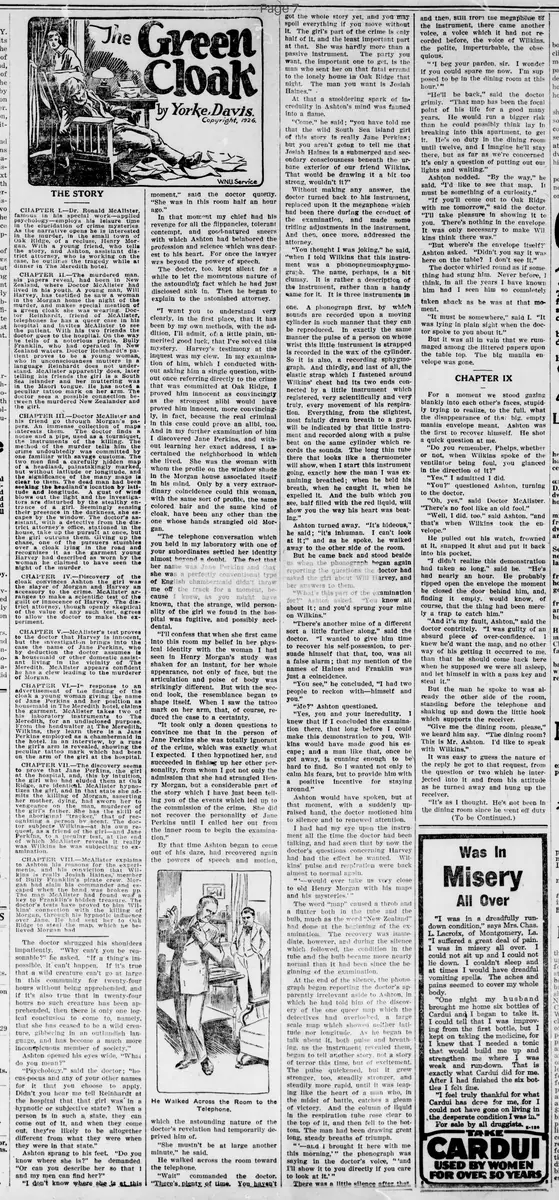
"You thought I was joking," he said, "when I told Wilkins that this instrument was a phonopneumosphygmograph. The name, perhaps, is a bit clumsy. It is rather a description of the instrument, rather than a handy name for it. It is three instruments in one. A phonograph first, by which sounds are recorded upon a moving cylinder in such manner that they can be reproduced. In exactly the same manner the pulse of a person on whose wrist this little instrument is strapped is recorded in the wax of the cylinder. So it is also a recording sphygmograph. And thirdly, and last of all, the elastic strap which I fastened around Wilkins' chest had its two ends connected by a little instrument which registered, very scientifically and very truly, every movement of his respiration. Everything, from the slightest, most faintly drawn breath to a gasp, will be indicated by that little instrument and recorded along with a pulse beat on the same cylinder which records the sounds. The long thin tube there that looks like a thermometer will show, when I start this instrument going, exactly how the man I was examining breathed: when he held his breath, when he caught it, when he expelled it. And the bulb which you see, half filled with the red liquid, will show you the way his heart was beating."
Ashton turned away. "It's hideous," he said; "it's inhuman, I can't look at it;" and as he spoke, he walked away to the other side of the room.
But he came back and stood beside us when the phonograph began again reporting the questions the doctor had asked the girl about Will Harvey, and her answers to them.
"What's this part of the examination for?" Ashton asked. "You know all about it; and you'd sprung your mine on Wilkins."
"There's another mine of a different sort a little further along," said the doctor. "I wanted to give him time to recover his self-possession, to persuade himself that that, too, was all a false alarm; that my mention of the names of Haines and Franklin was just a coincidence.
"You see," he concluded, "I had two people to reckon with—himself and you."
"Me?" Ashton questioned.
"Yes, you and your incredulity. I knew that if I concluded the examination there, that long before I could make this demonstration to you, Wilkins would have made good his escape; and a man like that, once he got away, is cunning enough to be hard to find. So I wanted not only to calm his fears, but to provide him with a positive incentive for staying around."
Ashton would have spoken, but at that moment, with a suddenly upraised hand, the doctor motioned him to silence and to renewed attention.
I had had my eye upon the instrument all the time the doctor had been talking, and had seen that by now the doctor's questions concerning Harvey had had the effect he wanted. Wilkins' pulse and respiration were back almost to normal again.
"—would ever take us very close to old Henry Morgan with his maps and his mysteries."
The word "map" caused a throb and a flutter both in the tube and the bulb, much as the word "New Zealand" had done at the beginning of the examination. The recovery was immediate, however, and during the silence which followed, the condition in the tube and the bulb became more nearly normal than it had been since the beginning of the examination.
At the end of the silence, the phonograph began reporting the doctor's apparently irrelevant aside to Ashton, in which he had told him of the discovery of the one queer map which the detectives had overlooked, a large scale map which showed neither latitude nor longitude. As he began to talk about it, both pulse and breathing, as the instrument revealed them, began to tell another story, not a story of terror this time, but of excitement. The pulse quickened, but it grew stronger, too, steadily stronger, and steadily more rapid, until it was leaping like the heart of a man who, in the midst of battle, catches a gleam of victory. And the column of liquid in the respiration tube rose clear to the top of it, and then fell to the bottom. The man had been drawing great long, steady breaths of triumph.
"—and I brought it here with me this morning," the phonograph was saying in the doctor's voice, "and I'll show it to you directly if you care to look at it."
There was a little silence after that, and then, still from the megaphone of the instrument, there came another voice, a voice which it had not recorded before, the voice of Wilkins, the polite, imperturbable, the obsequious.
"I beg your pardon, sir. I wonder if you could spare me now. I'm supposed to be in the dining room at this hour."
"He'll be back," said the doctor grimly. "That map has been the focal point of his life for a good many years. He would run a bigger risk than he could possibly think lay in breaking into this apartment, to get it. He's on duty in the dining room until twelve, and I imagine he'll stay there, but as far as we're concerned it's only a question of putting out our lights and waiting."
Ashton nodded. "By the way," he said, "I'd like to see that map. It must be something of a curiosity."
"If you'll come out to Oak Ridge with me tomorrow," said the doctor, "I'll take pleasure in showing it to you. There's nothing in the envelope. It was only necessary to make Wilkins think there was."
"But where's the envelope itself?" Ashton asked. "Didn't you say it was here on the table? I don't see it."
The doctor whirled round as if something had stung him. Never before, think, in all the years I have known him had I seen him so completely taken aback as he was at that moment.
"It must be somewhere," said I. It was lying in plain sight when the doctor spoke to you about it.
But it was all in vain that we rummaged among the littered papers upon the table top. The big manila envelope was gone.
CHAPTER IX
For a moment we stood gazing blankly into each other's faces, stupidly trying to realize, to the full, what the disappearance of that big, empty manila envelope meant. Ashton was the first to recover himself. He shot a quick question at me.
"Do you remember, Phelps, whether or not, when Wilkins spoke of the ventilator being foul, you glanced in the direction of it?"
"Yes," I admitted I did.
"You?" questioned Ashton, turning to the doctor.
"Oh, yes," said Doctor McAlister. "There's no fool like an old fool."
"Well, I did, too," said Ashton, "and that's when Wilkins took the envelope."
He pulled out his watch, frowned at it, snapped it shut and put it back into his pocket.
"I didn't realize this demonstration had taken so long," said he. "He's had nearly an hour. He probably ripped open the envelope the moment he closed the door behind him, and finding it empty, would know, of course, that the thing had been merely a trap to catch him."
"And it's my fault, Ashton," said the doctor contritely. "I was guilty of an absurd piece of over-confidence. I knew he'd want the map, and no other way of his getting it occurred to me, than that he should come back here when he supposed we were all asleep, and let himself in with a pass key and steal it."
But the man he spoke to was already the other side of the room, standing before the telephone and shaking up and down the little hook which supports the receiver.
"Give me the dining room, please," we heard him say.
"The dining room? This is Mr. Ashton, I'd like to speak with Wilkins."
It was easy to guess the nature of the reply he got to that request, from the question or two which he interjected into it and from his attitude as he turned away and hung up the receiver.
"It's as I thought. He's not been in the dining room since he went off duty.
(To be Continued.)
What sub-type of article is it?
Prose Fiction
What themes does it cover?
Moral Virtue
What keywords are associated?
Detective Story
Murder Mystery
Applied Psychology
Hypnosis
Pirate Treasure
Maori Girl
Treasure Map
Serial Fiction
Literary Details
Title
The Story
Form / Style
Detective Serial Chapter Summary And Excerpt
Key Lines
"Psychology," Said The Doctor; "Hocus Pocus And Any Of Your Other Names For It That You Choose To Apply."
"I Don't Know Where She Is At This Moment," Said The Doctor Quietly. "She Was In This Room Half An Hour Ago."
"The Man You Want Is Josiah Haines."
"It's Hideous," He Said; "It's Inhuman, I Can't Look At It;"
"He'll Be Back," Said The Doctor Grimly. "That Map Has Been The Focal Point Of His Life For A Good Many Years."