Thank you for visiting SNEWPapers!
Sign up free
Story
July 14, 1884
Alexandria Gazette
Alexandria, Alexandria County, District Of Columbia
What is this article about?
At a Democratic ratification meeting in Indianapolis, Thomas A. Hendricks delivers a speech endorsing Grover Cleveland for president, emphasizing government reform, honesty, and reduced expenditures. Senator McDonald also supports the ticket.
Clipping
OCR Quality
95%
Excellent
Full Text
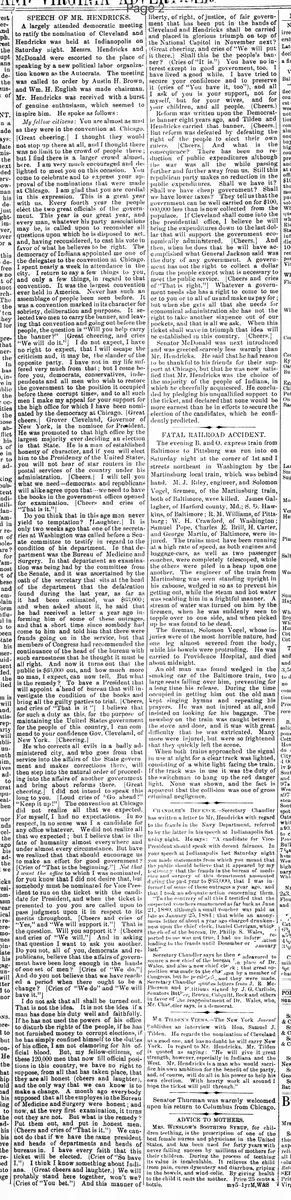
SPEECH OF MR. HENDRICKS.
A largely attended democratic meeting to ratify the nomination of Cleveland and Hendricks was held at Indianapolis on Saturday night. Messrs. Hendricks and McDonald were escorted to the place of speaking by a new political labor organization known as the Autocrats. The meeting was called to order by Austin H. Brown, and Wm. H. English was made chairman.
Mr. Hendricks was received with a burst of genuine enthusiasm, which seemed to inspire him. He spoke as follows:
My fellow citizens: You are almost as mad as they were in the convention at Chicago. [Great cheering.] I thought they would not stop up there at all, and I thought there was no limit to the crowd of people there; but I find there is a larger crowd almost here. I am very much encouraged and delighted to meet you on this occasion. You come to celebrate and to express your approval of the nominations that were made at Chicago. I am glad that you are cordial in this expression. This is a great year with us. Every fourth year the people elect the two great officials of the government. This year is our great year, and every man, whatever his party associations may be, is called upon to reconsider all questions upon which he is disposed to act, and, having reconsidered, to cast his vote in favor of what he believes to be right. The democracy of Indiana appointed me one of the delegates to the convention at Chicago. I spent nearly a week in attendance in the city. I return to say a few things to you, and only a few things, in regard to that convention. It was the largest convention ever held in America. Never has such an assemblage of people been seen before. It was a convention marked in its character for sobriety, deliberation and purposes. It selected two men to carry the banner, and leaving that convention and going out before the people, the question is "Will you help carry the banner?" Great cheering, and cries "We will do it." I do not expect, I have no right to expect, that I will escape the criticism and, it may be, the slander of the opposite party. I have not in my life suffered very much from that; but I come before you, democrats, conservatives, independents and all men who wish to restore the government to the position it occupied before these corrupt times, and to all such men I make my appeal for your support for the high office for which I have been nominated by the democracy at Chicago. [Great cheers.]
Grover Cleveland, Governor of New York, is the nominee for President. He was promoted to that high office by the largest majority ever deciding an election in that State. He is a man of established honesty of character, and if you will elect him to the Presidency of the United States, you will not hear of star rout ers in the postal services of the country under his administration. [Cheers.] I will tell you what we need—democrats and republicans will alike agree upon that.—we need to have the books in the government offices opened for examination. [Cheers and cries of "That is it."]
Do you think that in this age man never yields to temptation? [Laughter.] It is only two weeks ago that one of the secretaries at Washington was called before a Senate committee to testify in regard to the condition of his department. In that department was the Bureau of Medicine and Surgery. In that department an examination was being had by the committee from the Senate, and it was ascertained by the oath of the secretary that sits at the head of the department that the defalcation found during the last year, as far as it had been estimated, was $63,000; and when asked about it, he said that he had received a letter a year ago informing him of some of these outrages, and that a short time since somebody had come to him and told him that there were frauds going on in the service, but that members of Congress had recommended the continuance of the head of the bureau with such earnestness that he thought it must be all right. And now it turns out that the public is $63,000 out, and how much more no man, I expect, can now tell. But what is the remedy? To have a President that will appoint a head of bureau that will investigate the condition of the books and bring all the guilty parties to trial. [Cheers, and cries of "That is it."] I believe that for such a duty as this, for the purpose of maintaining the United States government for the people of this country, I can commend to your confidence Gov. Cleveland, of New York. [Cheering.]
He who corrects all evils in a badly administered city, and who goes from that service into the affairs of the State government and makes corrections there, will then step into the natural order of proceeding into the affairs of another government and bring about reforms there. Great cheering. I did not intend to speak this long to you. [Loud cries of "Go ahead!" "Keep it up!"]
The convention at Chicago did not realize all that we expected. For myself, I had no expectations. In no respect, in no sense was I a candidate for any office whatever. We did not realize all that we expected; but I believe that is the fate of humanity almost everywhere and under almost every circumstance. But have we realized that that should encourage us to make an effort for good government? [Cries of "That is the beginning."] Not that I want the office to which I was nominated, for you know that I did not desire that, but somebody must be nominated for Vice President to run on the ticket with the candidate for President, and when the ticket is presented to you you are called upon to pass judgment upon it in respect to its merits throughout. [Cheers and cries of "Yes," and "We will support it."] That is the question. Will you support it? [Cheers and cries of "We will."] And in asking that question I want to ask you another. Do you not, all of you, democrats and republicans, believe that the affairs of government have been long enough in the hands of one set of men? [Cries of "We do."] And do you not believe that we have reached a period when there ought to be a change? [Cries of "We do" and "We will have it."]
I do not ask that all shall be turned out. That is not the idea. It is not the idea if a man has done his duty well and faithfully. If he has not used the powers of his office to disturb the rights of the people, if he has not furnished money to corrupt elections, if he has simply confined himself to the duties of his office, I am not clamoring for his official blood. But, my fellow-citizens, of these 120,000 men that now fill official positions in this country, we have no right to suppose, from all that has taken place, that they are all honest (cheers and laughter), and the only way that we can know is to make a change. A month ago everybody supposed that all the employes in the Bureau of Medicine and Surgery were honest; and now, at the very first examination, it turns out they are not. But what is the remedy? Put them out, and put in honest men. [Cheers and cries of "That is it."] We cannot do that if we have the same president and heads of departments and heads of bureaus in. I have every faith that this ticket will be elected. [Cries of "So have I."] I think I know something about Indiana. [Great cheers and laughter.] We will probably stand here together, won't we? [Cries of "You bet."] And this manner of liberty, of right, of justice, of fair government that has been put in the hands of Cleveland and Hendricks shall be carried and placed in glorious triumph on top of the National Capitol in November next? [Great cheering, and cries of "We will put it there."] Shall this be the people's banner? [Cries of "It is."] You have no interest except in good government, too. I have lived a good while. I have tried to secure your confidence and to preserve it [cries of "You have it, too"], and all I ask of you is your support, not for myself, but for your wives, and for your children, and all people. [Cheers.]
Reform was written upon the Democratic banner eight years ago, and Tilden and Hendricks carried that banner. [Cheers.] But reform was defeated by defeating the right of the people to elect their own rulers. [Cheers.] And what is the consequence? There has been no reduction of public expenditures although the war was all the while passing further and further away from us. Still this republican party makes no reduction in the public expenditures. Shall we have it? Shall we have cheap government? Shall we have lower taxes? They tell us that the government can be well carried on for $100,000,000 less than is now collected from the populace. If Cleveland shall come into the presidential office, I believe he will bring the expenditures down to the last dollar that will support the government economically administered. [Cheers.] And then, when he does that he will have accomplished what General Jackson said was the duty of any government. A government has not the right to collect a dollar from the people except what is necessary to meet the public service. [Cheers and cries of "That is right."] Whatever a government needs she has a right to come to me or to you or to all of us and make us pay for; but when she gets all that she needs for economical administration she has not the right to take another sixpence out of our pockets, and that is all we ask. When this ticket shall wave in triumph that idea will be established in this country. [Cheers.]
Senator McDonald was next introduced and was greeted scarcely less warmly than Mr. Hendricks. He said that he had reason to be thankful to his friends for their support at Chicago, but that he was now satisfied that Mr. Hendricks was the choice of the majority of the people of Indiana, in which he cheerfully acquiesced. He concluded by pledging his unqualified support to the ticket, and declared that none would be more earnest than he in efforts to secure the election of the candidates, which he confidently predicted.
A largely attended democratic meeting to ratify the nomination of Cleveland and Hendricks was held at Indianapolis on Saturday night. Messrs. Hendricks and McDonald were escorted to the place of speaking by a new political labor organization known as the Autocrats. The meeting was called to order by Austin H. Brown, and Wm. H. English was made chairman.
Mr. Hendricks was received with a burst of genuine enthusiasm, which seemed to inspire him. He spoke as follows:
My fellow citizens: You are almost as mad as they were in the convention at Chicago. [Great cheering.] I thought they would not stop up there at all, and I thought there was no limit to the crowd of people there; but I find there is a larger crowd almost here. I am very much encouraged and delighted to meet you on this occasion. You come to celebrate and to express your approval of the nominations that were made at Chicago. I am glad that you are cordial in this expression. This is a great year with us. Every fourth year the people elect the two great officials of the government. This year is our great year, and every man, whatever his party associations may be, is called upon to reconsider all questions upon which he is disposed to act, and, having reconsidered, to cast his vote in favor of what he believes to be right. The democracy of Indiana appointed me one of the delegates to the convention at Chicago. I spent nearly a week in attendance in the city. I return to say a few things to you, and only a few things, in regard to that convention. It was the largest convention ever held in America. Never has such an assemblage of people been seen before. It was a convention marked in its character for sobriety, deliberation and purposes. It selected two men to carry the banner, and leaving that convention and going out before the people, the question is "Will you help carry the banner?" Great cheering, and cries "We will do it." I do not expect, I have no right to expect, that I will escape the criticism and, it may be, the slander of the opposite party. I have not in my life suffered very much from that; but I come before you, democrats, conservatives, independents and all men who wish to restore the government to the position it occupied before these corrupt times, and to all such men I make my appeal for your support for the high office for which I have been nominated by the democracy at Chicago. [Great cheers.]
Grover Cleveland, Governor of New York, is the nominee for President. He was promoted to that high office by the largest majority ever deciding an election in that State. He is a man of established honesty of character, and if you will elect him to the Presidency of the United States, you will not hear of star rout ers in the postal services of the country under his administration. [Cheers.] I will tell you what we need—democrats and republicans will alike agree upon that.—we need to have the books in the government offices opened for examination. [Cheers and cries of "That is it."]
Do you think that in this age man never yields to temptation? [Laughter.] It is only two weeks ago that one of the secretaries at Washington was called before a Senate committee to testify in regard to the condition of his department. In that department was the Bureau of Medicine and Surgery. In that department an examination was being had by the committee from the Senate, and it was ascertained by the oath of the secretary that sits at the head of the department that the defalcation found during the last year, as far as it had been estimated, was $63,000; and when asked about it, he said that he had received a letter a year ago informing him of some of these outrages, and that a short time since somebody had come to him and told him that there were frauds going on in the service, but that members of Congress had recommended the continuance of the head of the bureau with such earnestness that he thought it must be all right. And now it turns out that the public is $63,000 out, and how much more no man, I expect, can now tell. But what is the remedy? To have a President that will appoint a head of bureau that will investigate the condition of the books and bring all the guilty parties to trial. [Cheers, and cries of "That is it."] I believe that for such a duty as this, for the purpose of maintaining the United States government for the people of this country, I can commend to your confidence Gov. Cleveland, of New York. [Cheering.]
He who corrects all evils in a badly administered city, and who goes from that service into the affairs of the State government and makes corrections there, will then step into the natural order of proceeding into the affairs of another government and bring about reforms there. Great cheering. I did not intend to speak this long to you. [Loud cries of "Go ahead!" "Keep it up!"]
The convention at Chicago did not realize all that we expected. For myself, I had no expectations. In no respect, in no sense was I a candidate for any office whatever. We did not realize all that we expected; but I believe that is the fate of humanity almost everywhere and under almost every circumstance. But have we realized that that should encourage us to make an effort for good government? [Cries of "That is the beginning."] Not that I want the office to which I was nominated, for you know that I did not desire that, but somebody must be nominated for Vice President to run on the ticket with the candidate for President, and when the ticket is presented to you you are called upon to pass judgment upon it in respect to its merits throughout. [Cheers and cries of "Yes," and "We will support it."] That is the question. Will you support it? [Cheers and cries of "We will."] And in asking that question I want to ask you another. Do you not, all of you, democrats and republicans, believe that the affairs of government have been long enough in the hands of one set of men? [Cries of "We do."] And do you not believe that we have reached a period when there ought to be a change? [Cries of "We do" and "We will have it."]
I do not ask that all shall be turned out. That is not the idea. It is not the idea if a man has done his duty well and faithfully. If he has not used the powers of his office to disturb the rights of the people, if he has not furnished money to corrupt elections, if he has simply confined himself to the duties of his office, I am not clamoring for his official blood. But, my fellow-citizens, of these 120,000 men that now fill official positions in this country, we have no right to suppose, from all that has taken place, that they are all honest (cheers and laughter), and the only way that we can know is to make a change. A month ago everybody supposed that all the employes in the Bureau of Medicine and Surgery were honest; and now, at the very first examination, it turns out they are not. But what is the remedy? Put them out, and put in honest men. [Cheers and cries of "That is it."] We cannot do that if we have the same president and heads of departments and heads of bureaus in. I have every faith that this ticket will be elected. [Cries of "So have I."] I think I know something about Indiana. [Great cheers and laughter.] We will probably stand here together, won't we? [Cries of "You bet."] And this manner of liberty, of right, of justice, of fair government that has been put in the hands of Cleveland and Hendricks shall be carried and placed in glorious triumph on top of the National Capitol in November next? [Great cheering, and cries of "We will put it there."] Shall this be the people's banner? [Cries of "It is."] You have no interest except in good government, too. I have lived a good while. I have tried to secure your confidence and to preserve it [cries of "You have it, too"], and all I ask of you is your support, not for myself, but for your wives, and for your children, and all people. [Cheers.]
Reform was written upon the Democratic banner eight years ago, and Tilden and Hendricks carried that banner. [Cheers.] But reform was defeated by defeating the right of the people to elect their own rulers. [Cheers.] And what is the consequence? There has been no reduction of public expenditures although the war was all the while passing further and further away from us. Still this republican party makes no reduction in the public expenditures. Shall we have it? Shall we have cheap government? Shall we have lower taxes? They tell us that the government can be well carried on for $100,000,000 less than is now collected from the populace. If Cleveland shall come into the presidential office, I believe he will bring the expenditures down to the last dollar that will support the government economically administered. [Cheers.] And then, when he does that he will have accomplished what General Jackson said was the duty of any government. A government has not the right to collect a dollar from the people except what is necessary to meet the public service. [Cheers and cries of "That is right."] Whatever a government needs she has a right to come to me or to you or to all of us and make us pay for; but when she gets all that she needs for economical administration she has not the right to take another sixpence out of our pockets, and that is all we ask. When this ticket shall wave in triumph that idea will be established in this country. [Cheers.]
Senator McDonald was next introduced and was greeted scarcely less warmly than Mr. Hendricks. He said that he had reason to be thankful to his friends for their support at Chicago, but that he was now satisfied that Mr. Hendricks was the choice of the majority of the people of Indiana, in which he cheerfully acquiesced. He concluded by pledging his unqualified support to the ticket, and declared that none would be more earnest than he in efforts to secure the election of the candidates, which he confidently predicted.
What sub-type of article is it?
Historical Event
What themes does it cover?
Justice
Moral Virtue
Triumph
What keywords are associated?
Democratic Meeting
Cleveland Nomination
Hendricks Speech
Government Reform
Political Corruption
Honest Administration
Presidential Election
What entities or persons were involved?
Mr. Hendricks
Grover Cleveland
Senator Mcdonald
Wm. H. English
Austin H. Brown
Tilden
General Jackson
Where did it happen?
Indianapolis
Story Details
Key Persons
Mr. Hendricks
Grover Cleveland
Senator Mcdonald
Wm. H. English
Austin H. Brown
Tilden
General Jackson
Location
Indianapolis
Event Date
Saturday Night
Story Details
Thomas A. Hendricks speaks at a Democratic meeting ratifying the Cleveland-Hendricks nomination, praising Cleveland's honesty, calling for government reform, investigation of corruption, reduced expenditures, and a change in administration. Senator McDonald endorses the ticket.