Thank you for visiting SNEWPapers!
Sign up free
The Nome Nugget
Nome, Nome County, Alaska
What is this article about?
US Air Force B-52 bombers completed a 24,325-mile globe-circling flight in 45 hours, demonstrating global H-bomb delivery capability to Russia and Congress. Refueling by KC-97 tankers was essential, highlighting reliance on overseas bases in Denmark, Morocco, England, Germany, Saudi Arabia, Philippines, and Japan. Pilots interviewed post-flight noted jet tankers could shorten time.
Clipping
OCR Quality
Full Text
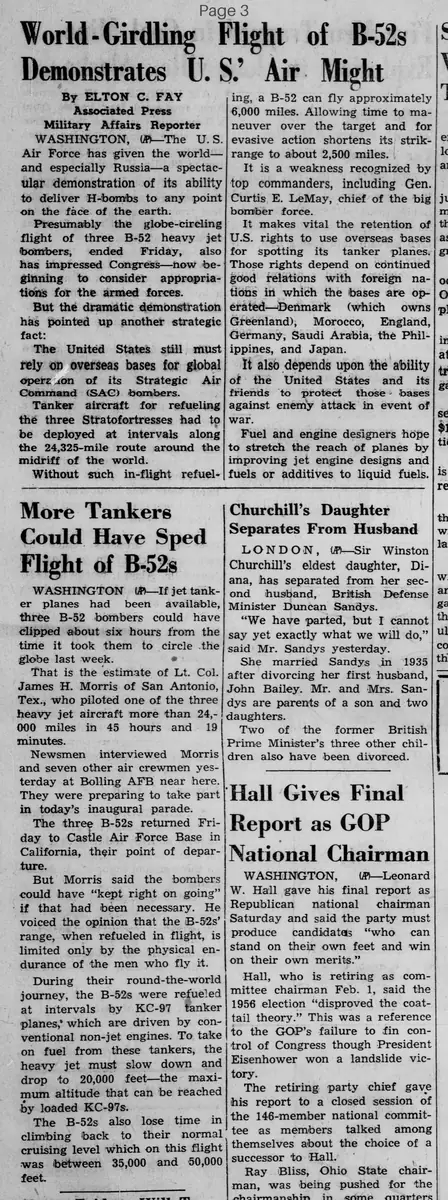
By ELTON C. FAY
Associated Press Military Affairs Reporter
WASHINGTON (AP)—The U.S. Air Force has given the world—and especially Russia—a spectacular demonstration of its ability to deliver H-bombs to any point on the face of the earth.
Presumably the globe-circling flight of three B-52 heavy jet bombers, ended Friday, also has impressed Congress—now beginning to consider appropriations for the armed forces.
But the dramatic demonstration has pointed up another strategic fact:
The United States still must rely on overseas bases for global operation of its Strategic Air Command (SAC) bombers.
Tanker aircraft for refueling the three Stratofortresses had to be deployed at intervals along the 24,325-mile route around the midriff of the world.
Without such in-flight refueling, a B-52 can fly approximately 6,000 miles. Allowing time to maneuver over the target and for evasive action shortens its strike range to about 2,500 miles.
It is a weakness recognized by top commanders, including Gen. Curtis E. LeMay, chief of the big bomber force.
It makes vital the retention of U.S. rights to use overseas bases for spotting its tanker planes.
Those rights depend on continued good relations with foreign nations in which the bases are operated: Denmark (which owns Greenland); Morocco, England, Germany, Saudi Arabia, the Philippines, and Japan.
It also depends upon the ability of the United States and its friends to protect those bases against enemy attack in event of war.
Fuel and engine designers hope to stretch the reach of planes by improving jet engine designs and fuels or additives to liquid fuels.
More Tankers Could Have Sped Flight of B-52s
WASHINGTON (AP)—If jet tanker planes had been available, three B-52 bombers could have clipped about six hours from the time it took them to circle the globe last week.
That is the estimate of Lt. Col. James H. Morris of San Antonio, Tex., who piloted one of the three heavy jet aircraft more than 24,000 miles in 45 hours and 19 minutes.
Newsmen interviewed Morris and seven other air crewmen yesterday at Bolling AFB near here.
They were preparing to take part in today's inaugural parade.
The three B-52s returned Friday to Castle Air Force Base in California, their point of departure.
But Morris said the bombers could have "kept right on going" if that had been necessary. He voiced the opinion that the B-52s' range, when refueled in flight, is limited only by the physical endurance of the men who fly it.
During their round-the-world journey, the B-52s were refueled at intervals by KC-97 tanker planes, which are driven by conventional non-jet engines. To take on fuel from these tankers, the heavy jet must slow down and drop to 20,000 feet—the maximum altitude that can be reached by loaded KC-97s.
The B-52s also lose time in climbing back to their normal cruising level which on this flight was between 35,000 and 50,000 feet.
What sub-type of article is it?
What themes does it cover?
What keywords are associated?
What entities or persons were involved?
Where did it happen?
Story Details
Key Persons
Location
Washington, Global Route, Castle Air Force Base In California, Bolling Afb
Event Date
Ended Friday, Last Week
Story Details
Three B-52 bombers completed a 24,325-mile globe-circling flight in 45 hours and 19 minutes, refueled by KC-97 tankers, demonstrating US global strike capability and reliance on overseas bases. Pilots noted jet tankers could reduce flight time by six hours; range limited by crew endurance.