Thank you for visiting SNEWPapers!
Sign up free
Literary
June 17, 1807
Virginia Argus
Richmond, Virginia
What is this article about?
Thomas Paine's letter to Henry Laurens classifies useful citizens in a new representative government: farmers as first necessity, manufacturers/mechanics for accommodations, and merchants/shopkeepers as convenient exchangers. Paine calls himself a 'farmer of thoughts.'
Clipping
OCR Quality
98%
Excellent
Full Text
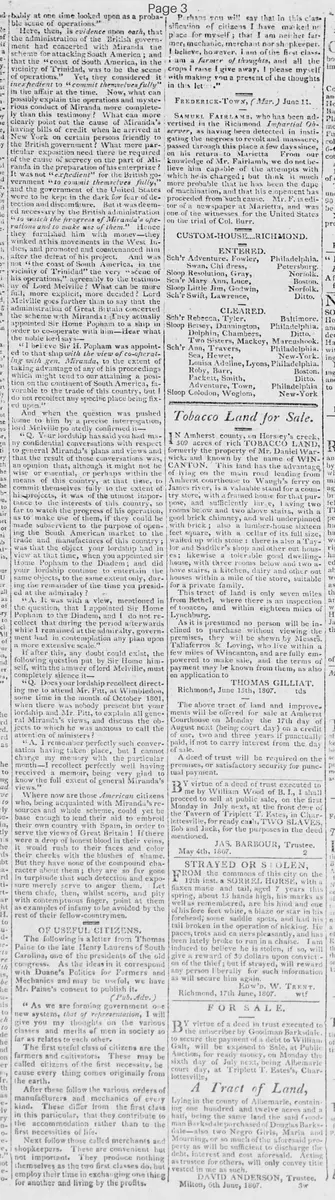
OF USEFUL CITIZENS.
The following is a letter from Thomas Paine to the late Henry Laurens of South Carolina, one of the presidents of the old congress. As the ideas in it correspond with Duane's Politics for Farmers and Mechanics and may be useful, we have Mr. Paine's consent to publish it.
(Pub. Adv.)
"As we are forming government on a new system, that of representation, I will give you my thoughts on the various classes and merits of men in society so far as relates to each other.
The first useful class of citizens are the farmers and cultivators. These may be called citizens of the first necessity, because every thing comes originally from the earth.
After these follow the various orders of manufacturers and mechanics of every kind. These differ from the first class in this particular, that they contribute to the accommodation rather than to the first necessities of life.
Next follow those called merchants and shopkeepers. These are convenient but not important. They produce nothing themselves as the two first classes do, but employ their time in exchanging one thing for another and living by the profits.
Perhaps you will say that in this classification of citizens I have marked no place for myself: that I am neither farmer, mechanic, merchant nor shopkeeper. I believe, however, I am of the first class. I am a farmer of thoughts, and all the crops I raise I give away, I please myself with making you a present of the thoughts in this letter."
The following is a letter from Thomas Paine to the late Henry Laurens of South Carolina, one of the presidents of the old congress. As the ideas in it correspond with Duane's Politics for Farmers and Mechanics and may be useful, we have Mr. Paine's consent to publish it.
(Pub. Adv.)
"As we are forming government on a new system, that of representation, I will give you my thoughts on the various classes and merits of men in society so far as relates to each other.
The first useful class of citizens are the farmers and cultivators. These may be called citizens of the first necessity, because every thing comes originally from the earth.
After these follow the various orders of manufacturers and mechanics of every kind. These differ from the first class in this particular, that they contribute to the accommodation rather than to the first necessities of life.
Next follow those called merchants and shopkeepers. These are convenient but not important. They produce nothing themselves as the two first classes do, but employ their time in exchanging one thing for another and living by the profits.
Perhaps you will say that in this classification of citizens I have marked no place for myself: that I am neither farmer, mechanic, merchant nor shopkeeper. I believe, however, I am of the first class. I am a farmer of thoughts, and all the crops I raise I give away, I please myself with making you a present of the thoughts in this letter."
What sub-type of article is it?
Epistolary
Essay
What themes does it cover?
Agriculture Rural
Commerce Trade
Political
What keywords are associated?
Useful Citizens
Farmers
Mechanics
Merchants
Representation
Thomas Paine
Henry Laurens
What entities or persons were involved?
Thomas Paine
Literary Details
Title
Of Useful Citizens.
Author
Thomas Paine
Subject
Thoughts On The Various Classes And Merits Of Men In Society
Key Lines
The First Useful Class Of Citizens Are The Farmers And Cultivators. These May Be Called Citizens Of The First Necessity, Because Every Thing Comes Originally From The Earth.
I Am A Farmer Of Thoughts, And All The Crops I Raise I Give Away, I Please Myself With Making You A Present Of The Thoughts In This Letter.