Thank you for visiting SNEWPapers!
Sign up free
Letter to Editor
June 6, 1845
The Liberator
Boston, Suffolk County, Massachusetts
What is this article about?
Henry C. Wright's journal continuation details his travel from Landeck over the Arlberg Pass to Feldkirch in Tyrol, describing wild scenery, encounters with English travelers, historical sites, Tyrolese independence, and sharp critiques of Catholic priestly rituals and superstitions contrasted with true Christianity.
Clipping
OCR Quality
98%
Excellent
Full Text
OUR COUNTRY IS THE WORLD—OUR COUNTRYMEN ARE ALL MANKIND.
THE LIBERATOR.
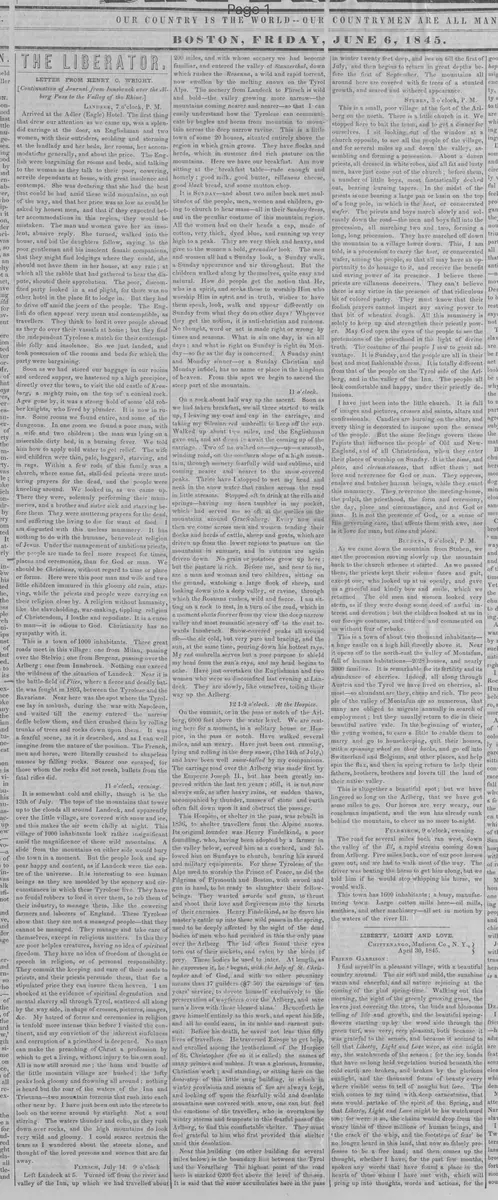
LETTER FROM HENRY C. WRIGHT.
[Continuation of Journal from Innsbruck over the Arlberg Pass to the Valley of the Rhine.]
Landeck, 7 o'clock, P. M.
Arrived at the Adler (Eagle) Hotel. The first thing that drew our attention as we came up, was a splendid carriage at the door, an Englishman and two women, with their outriders, scolding and storming at the landlady and her beds, her rooms, her accommodations generally, and about the price. The English were bargaining for rooms and beds, and talking to the woman as they talk to their poor, cowering servile dependants at home, with great insolence and contempt. She was declaring that she had the best that could be had amid these wild mountains, so out of the way, and that her price was as low as could be asked by honest men, and that if they expected better accommodations in this region, they would be mistaken. The man and women gave her an insolent, abusive reply. She turned, walked into the house, and bid the daughters follow, saying to the poor gentleman and his insolent female companions, that they might find lodgings where they could, she should not have them in her house, at any rate; at which all the rabble that had gathered to hear the dispute, shouted their approbation. The poor, discomfited party looked in a sad plight, for there was no other hotel in the place fit to lodge in. But they had to drive off amid the jeers of the people. The English do often appear very mean and contemptible, as travellers. They think to lord it over people abroad as they do over their vassals at home; but they find the independent Tyrolese a match for their contemptible folly and insolence. So we just landed, and took possession of the rooms and beds for which the party were bargaining.
Soon as we had stored our baggage in our rooms and ordered supper, we hastened up a high precipice, directly over the town, to visit the old castle of Kronburg, a mighty ruin, on the top of a conical rock. Ages gone by, it was a strong hold of some old robber knights, who lived by plunder. It is now in ruins. Some rooms we found entire, and some of the dungeons. In one room we found a poor man, with a wife and two children; the man was lying on a miserable dirty bed, in a burning fever. We told him how to apply cold water to get relief. The wife and children were thin, pale, haggard, starving, and in rags. Within a few rods of this family was a church, where some fat, stall-fed priests were muttering prayers for the dead, and the people were kneeling around. We looked in, as we came up. There they were, solemnly performing their mummeries, and a brother and sister sick and starving before them. They were muttering prayers for the dead, and suffering the living to die for want of food. I am disgusted with this useless mummery. It has nothing to do with the humane, benevolent religion of Jesus. Under the management of ambitious priests, the people are made to feel more respect for times, places and ceremonies, than for God or man. We should be Christians, without regard to time or place or forms. Here were this poor man and wife and two little children immured in this gloomy old ruin, starving, while the priests and people were carrying on their religion close by. A religion without humanity, like the slaveholding, war-making, tippling religion of Christendom, I loathe and repudiate. It is a curse to man—it is odious to God. Christianity has no sympathy with it.
This is a town of 1000 inhabitants. Three great roads meet in this village: one from Milan, passing over the Stelvio; one from Bregenz, passing over the Arlberg; one from Innsbruck. Nothing can exceed the wildness of the situation of Landeck. Near it is the battle-field of Fliss, where a fierce and deadly battle was fought in 1809, between the Tyrolese and the Bavarians. Near here was the spot where the Tyrolese lay in ambush, during the war with Napoleon, and waited till the enemy entered the narrow defile below them, and then crushed them by rolling trunks of trees and rocks down upon them. It was a fearful scene, as it is described, and as I can well imagine from the nature of the position. The French, men and horse, were literally crushed to shapeless masses by falling rocks. Scarce one escaped, for those whom the rocks did not reach, bullets from the fatal rifles did.
11 o'clock, evening.
It is somewhat cold and chilly, though it be the 13th of July. The tops of the mountains that tower up to the clouds all around Landeck, and apparently over the little village, are covered with snow and ice, and this makes the air seem chilly at night. This village of 1000 inhabitants look rather insignificant amid the magnificence of these wild mountains. A slide from the mountains on either side would bury the town in a moment. But the people look and appear happy and content, as if Landeck were the centre of the universe. It is interesting to see human beings as they are moulded by the scenery and circumstances in which these Tyrolese live. They have no feudal robbers to lord it over them, to rob them of their industry, to manage them, like the cowering farmers and laborers of England. These Tyrolese show that they are not a managed people—that they cannot be managed. They manage and take care of themselves, except in religious matters. In this they are poor helpless creatures, having no idea of spiritual freedom. They have no idea of freedom of thought or speech in religion, or of personal responsibility. They commit the keeping and care of their souls to priests, and their priests persuade them, that for a stipulated price they can insure them heaven. I am shocked at the evidence of spiritual degradation and mental slavery all through Tyrol, scattered all along by the way side, in shape of crosses, pictures, images, &c. My hatred of forms and ceremonies in religion is tenfold more intense than before I visited the continent, and my conviction of the inherent sinfulness and corruption of a priesthood is deepened. No man can make the preaching of Christ a profession by which to get a living, without injury to his own soul.
All is now still around me: the hum and bustle of the little mountain village are hushed; the lofty peaks look gloomy and frowning all around; nothing is heard but the roar of the waters of the Inn and Trisanna—two mountain torrents that rush into each other near by. I have just been out into the streets to look on the scene around by starlight. Not a soul stirring. The waters thunder and echo, as they rush down over rocks, and the high mountains do look very wild and gloomy. I could scarce restrain the tears as I wandered about the streets alone, and thought of the loved persons and scenes that are far away.
FLIRSCH, July 14. 9 o'clock
Left Landeck at 5. Turned off from the river and valley of the Inn, up which we had travelled about 200 miles, and with whose scenery we had become familiar, and entered the valley of Stanzerthal, down which rushes the Rosanna, a wild and rapid torrent, now swollen by the melting snows on the Tyrol Alps. The scenery from Landeck to Flirsch is wild and bold—the valley growing more narrow—the mountains coming nearer and nearer—so that I can easily understand how the Tyrolese can communicate by bugles and horns from mountain to mountain across the deep narrow ravine. This is a little town of some 20 houses, situated entirely above the region in which grain grows. They have flocks and herds, which in summer find rich pasture on the mountains. Here we have our breakfast. Am now sitting at the breakfast table—rude enough and homely; good milk, good butter, villanous cheese, good black bread, and some mutton chop.
It is Sunday—and about two miles back met multitudes of the people, men, women and children, going to church to hear mass—all in their Sunday dress, and in the peculiar costume of this mountain region. All the women had on their heads a cap, made of cotton, very thick, dyed blue, and running up very high to a peak. They are very thick and heavy, and give to the women a bold, grenadier look. The men and women all had a Sunday look, a Sunday walk, a Sunday appearance and air throughout. But the children walked along by themselves, quite easy and natural. How do people get the notion that He, who is a spirit, and seeks those to worship Him who worship Him in spirit and in truth, wishes to have them speak, look, walk and appear differently on Sunday from what they do on other days? Wherever they get the notion, it is anti-christian and ruinous. No thought, word or act is made right or wrong by times and seasons. What is sin one day, is sin all days; and what is right on Sunday is right on Monday—so far as the day is concerned. A Sunday saint and Monday sinner—or a Sunday Christian and Monday infidel, has no name or place in the kingdom of heaven. From this spot we begin to ascend the steep part of the mountain.
11 o'clock.
On a rock about half way up the ascent. Soon as we had taken breakfast, we all three started to walk up, I leaving my coat and cap in the carriage, and taking my Silesian red umbrella to keep off the sun. Walked up about two miles, and the Englishman gave out, and sat down to await the coming up of the carriage. Two of us walked on—up—up—a smooth winding road, on the southern slope of a high mountain, through scenery fearfully wild and sublime, and coming nearer and nearer to the snow-covered peaks. Thrice have I stopped to wet my head and neck in the snow water that rushes across the road in little streams. Stopped oft to drink at the rills and springs—having my horn tumbler in my pocket, which had served me so oft at the quellen on the mountains around Graefenberg. Every now and then we come across men and women tending their flocks and herds of cattle, sheep and goats, which are driven up from the lower regions to pasture on the mountains in summer, and in autumn are again driven down. No grain or potatoes grow up here; but the pasture is rich. Before me, and near to me, are a man and woman and two children, sitting on the ground, watching a large flock of sheep, and looking down into a deep valley, or ravine, through which the Rosanna rushes, wild and fierce. I am sitting on a rock to rest, in a turn of the road, which in a moment shuts forever from my view the deep narrow valley and most romantic scenery off to the east towards Innsbruck. Snow-covered peaks all around me—the air cold, but very pure and bracing, and the sun, at the same time, pouring down his hottest rays. My red umbrella serves but a poor purpose to shield my head from the sun's rays, and my head begins to ache. Have just overtaken the Englishman and two women who were so discomfited last evening at Landeck. They are slowly, like ourselves, toiling their way up the Arlberg
12 1-2 o'clock. At the Hospice.
On the summit, or in the pass or notch of the Arlberg, 6000 feet above the water level. We are resting here for a moment, in a solitary house or Hospice, in the pass or notch. Have walked several miles, and am weary. Have just been out running, lying and rolling in the deep snow, (the 14th of July,) and have been well snow-balled by my companions. The carriage road over the Arlberg was made first by the Emperor Joseph II., but has been greatly improved within the last ten years; still, it is not now always safe, as after heavy rains, or sudden thaws, accompanied by thunder, masses of stone and earth often fall down upon it and obstruct the passage. This Hospice, or shelter in the pass, was rebuilt in 1836, to shelter travellers from the Alpine snows. Its original founder was Henry Findelkind, a poor foundling, who, having been adopted by a farmer in the valley below, served him as a cowherd, and followed him on Sundays to church, bearing his sword and military equipments. For these Tyrolese of the Alps used to worship the Prince of Peace, as did the Pilgrims of Plymouth and Boston, with sword and gun in hand, to be ready to slaughter their fellow-beings. They wanted swords and guns, to thrust and shoot their love and forgiveness into the hearts of their enemies. Henry Findelkind, as he drove his master's cattle up into these wild passes in the spring, used to be deeply affected by the sight of the dead bodies of men who had perished in this the only pass over the Arlberg. The lad often found their eyes torn out of their sockets, and eaten by the birds of prey. These bodies he used to inter. At length, as he expresses it, he 'began, with the help of St. Christopher and of God, and with no other pecuniary means than 17 guilders ($7 50) the earnings of ten years' service, to devote himself exclusively to the preservation of wayfarers over the Arlberg, and save men's lives with these blessed alms.' Henceforth he gave himself entirely to this work, and spent his life, and all he could earn, in its noble and earnest pursuit. Before his death, he saved not less than fifty lives of travellers. He traversed Europe to get help, and enrolled among the brotherhood of the Hospice of St. Christopher (for so it is called) the names of many princes and nobles. It was a glorious, humane, Christian work; and standing, or sitting here on the door-step of this little snug building, in which in winter provisions and means of fire are always kept, and looking off upon the fearfully wild and desolate mountains now covered with snow, one can but feel the emotions of the traveller, who is overtaken by wintry storms and tempests in this fearful pass of the Arlberg, to find this comfortable shelter. They must feel grateful to him who first provided this shelter amid this desolation.
Near this building (no other building for several miles below) is the boundary line between the Tyrol and the Vorarlberg. The highest point of the road here is marked 6200 feet above the level of the sea. It is said that the snow accumulates here in the pass in winter twenty feet deep, and lies on till the first of July, and then begins to return in great depths before the first of September. The mountains all around here are covered with fir trees of a stunted growth, and seared and withered appearance.
STUBEN, 3 o'clock, P. M.
This is a small, poor village at the foot of the Arlberg on the north. There is a little church in it. We stopped here to bait the team, and to get a dinner for ourselves. I sit looking out of the window at a church opposite, to see all the people of the village, and for several miles up and down the valley, assembling and forming a procession. About a dozen priests, all dressed in white robes, and all fat and lusty men, have just come out of the church; before them, a number of little boys, most fantastically decked out, bearing burning tapers. In the midst of the priests is one bearing a large pan or basin on the top of a long pole, in which is the host, or consecrated wafer. The priests and boys march slowly and solemnly down the road—the men and boys fall into the procession, all marching two and two, forming a long, long procession. They have marched off down the mountain to a village lower down. This, I am told, is a procession to carry the host, or consecrated wafer, among the people, so that all may have an opportunity to do homage to it, and receive the benefit and saving power of its presence. I believe these priests are villanous deceivers. They can't believe there is any virtue in the presence of that ridiculous bit of colored pastry. They must know that their foolish prayers cannot impart any saving power to that bit of wheaten dough. All this mummery is solely to keep up and strengthen their priestly power. May God open the eyes of the people to see the pretensions of the priesthood in the light of divine truth. The costume of the people I saw to great advantage. It is Sunday, and the people are all in their best and most fashionable dress. It is totally different from that of the people on the Tyrol side of the Arlberg, and in the valley of the Inn. The people all look comfortable and happy, under their priestly delusions.
I have just been into the little church. It is full of images and pictures, crosses and saints, altars and confessionals. Candles are burning on the altar, and every thing is decorated to impose upon the senses of the people. But the same feelings govern these Papists that influence the people of Old and New-England, and of all Christendom, when they enter their places of worship on Sunday. It is the time, and place, and circumstances, that affect them; not love and reverence for God or man. They oppress, enslave and butcher human beings, while they enact this mummery. They reverence the meeting-house, the pulpit, the priesthood, the form and ceremony, the day, place and circumstance, and not God or man. It is not the presence of God, or a sense of His governing care, that affects them with awe, nor is it love for man, but time and place.
BLUDENZ, 5 o'clock, P. M.
As we came down the mountain from Stuben, we met the procession moving slowly up the mountain back to the church whence it started. As we passed them, the priests kept their solemn faces and gait, except one, who looked up at us openly, and gave us a graceful and kindly bow and smile, which we returned. The old men and women looked very stern, as if they were doing some deed of awful interest and devotion; but the children looked at us in our foreign costume, and tittered and commented on us without fear of rebuke.
This is a town of about two thousand inhabitants—a huge castle on a high hill directly above it. Near it opens off to the north-east the valley of Montafon, full of human habitations—2028 houses, and nearly 3000 families. It is remarkable for its fertility and its abundance of cherries. Indeed, all along through Austria and the Tyrol we have lived on cherries, almost—so abundant are they, cheap and rich. The people of the valley of Montafon are so numerous, that many are obliged to migrate annually in search of employment: but they usually return to die in their beautiful native vale. In the beginning of winter, the young women, to earn a little to enable them to marry and go to housekeeping, quit their homes, with a spinning wheel on their backs, and go off into Switzerland and Belgium, and other places, and help spin the flax, and then in spring return to help their fathers, brothers, sisters and lovers till the land of their native valley.
This is altogether a beautiful spot; but we have lingered so long on the Arlberg, that we have got some miles to go. Our horses are very weary, our coachman impatient, and the sun has already sunk behind the mountain, to cheer us no more to-night.
FELDKIRCH, 9 o'clock, evening.
The road for several miles back ran west, down the valley of the Ill, a rapid stream coming down from Arlberg. Five miles back, one of our poor horses gave out, and we had to walk most of the way. The driver was beating the horse to get him along, but we told him if he would stop whipping his horse, we would walk.
This town has 1600 inhabitants; a busy, manufacturing town. Large cotton mills here—oil mills, smithies, and other machinery—all set in motion by the waters of the river Ill.
THE LIBERATOR.
LETTER FROM HENRY C. WRIGHT.
[Continuation of Journal from Innsbruck over the Arlberg Pass to the Valley of the Rhine.]
Landeck, 7 o'clock, P. M.
Arrived at the Adler (Eagle) Hotel. The first thing that drew our attention as we came up, was a splendid carriage at the door, an Englishman and two women, with their outriders, scolding and storming at the landlady and her beds, her rooms, her accommodations generally, and about the price. The English were bargaining for rooms and beds, and talking to the woman as they talk to their poor, cowering servile dependants at home, with great insolence and contempt. She was declaring that she had the best that could be had amid these wild mountains, so out of the way, and that her price was as low as could be asked by honest men, and that if they expected better accommodations in this region, they would be mistaken. The man and women gave her an insolent, abusive reply. She turned, walked into the house, and bid the daughters follow, saying to the poor gentleman and his insolent female companions, that they might find lodgings where they could, she should not have them in her house, at any rate; at which all the rabble that had gathered to hear the dispute, shouted their approbation. The poor, discomfited party looked in a sad plight, for there was no other hotel in the place fit to lodge in. But they had to drive off amid the jeers of the people. The English do often appear very mean and contemptible, as travellers. They think to lord it over people abroad as they do over their vassals at home; but they find the independent Tyrolese a match for their contemptible folly and insolence. So we just landed, and took possession of the rooms and beds for which the party were bargaining.
Soon as we had stored our baggage in our rooms and ordered supper, we hastened up a high precipice, directly over the town, to visit the old castle of Kronburg, a mighty ruin, on the top of a conical rock. Ages gone by, it was a strong hold of some old robber knights, who lived by plunder. It is now in ruins. Some rooms we found entire, and some of the dungeons. In one room we found a poor man, with a wife and two children; the man was lying on a miserable dirty bed, in a burning fever. We told him how to apply cold water to get relief. The wife and children were thin, pale, haggard, starving, and in rags. Within a few rods of this family was a church, where some fat, stall-fed priests were muttering prayers for the dead, and the people were kneeling around. We looked in, as we came up. There they were, solemnly performing their mummeries, and a brother and sister sick and starving before them. They were muttering prayers for the dead, and suffering the living to die for want of food. I am disgusted with this useless mummery. It has nothing to do with the humane, benevolent religion of Jesus. Under the management of ambitious priests, the people are made to feel more respect for times, places and ceremonies, than for God or man. We should be Christians, without regard to time or place or forms. Here were this poor man and wife and two little children immured in this gloomy old ruin, starving, while the priests and people were carrying on their religion close by. A religion without humanity, like the slaveholding, war-making, tippling religion of Christendom, I loathe and repudiate. It is a curse to man—it is odious to God. Christianity has no sympathy with it.
This is a town of 1000 inhabitants. Three great roads meet in this village: one from Milan, passing over the Stelvio; one from Bregenz, passing over the Arlberg; one from Innsbruck. Nothing can exceed the wildness of the situation of Landeck. Near it is the battle-field of Fliss, where a fierce and deadly battle was fought in 1809, between the Tyrolese and the Bavarians. Near here was the spot where the Tyrolese lay in ambush, during the war with Napoleon, and waited till the enemy entered the narrow defile below them, and then crushed them by rolling trunks of trees and rocks down upon them. It was a fearful scene, as it is described, and as I can well imagine from the nature of the position. The French, men and horse, were literally crushed to shapeless masses by falling rocks. Scarce one escaped, for those whom the rocks did not reach, bullets from the fatal rifles did.
11 o'clock, evening.
It is somewhat cold and chilly, though it be the 13th of July. The tops of the mountains that tower up to the clouds all around Landeck, and apparently over the little village, are covered with snow and ice, and this makes the air seem chilly at night. This village of 1000 inhabitants look rather insignificant amid the magnificence of these wild mountains. A slide from the mountains on either side would bury the town in a moment. But the people look and appear happy and content, as if Landeck were the centre of the universe. It is interesting to see human beings as they are moulded by the scenery and circumstances in which these Tyrolese live. They have no feudal robbers to lord it over them, to rob them of their industry, to manage them, like the cowering farmers and laborers of England. These Tyrolese show that they are not a managed people—that they cannot be managed. They manage and take care of themselves, except in religious matters. In this they are poor helpless creatures, having no idea of spiritual freedom. They have no idea of freedom of thought or speech in religion, or of personal responsibility. They commit the keeping and care of their souls to priests, and their priests persuade them, that for a stipulated price they can insure them heaven. I am shocked at the evidence of spiritual degradation and mental slavery all through Tyrol, scattered all along by the way side, in shape of crosses, pictures, images, &c. My hatred of forms and ceremonies in religion is tenfold more intense than before I visited the continent, and my conviction of the inherent sinfulness and corruption of a priesthood is deepened. No man can make the preaching of Christ a profession by which to get a living, without injury to his own soul.
All is now still around me: the hum and bustle of the little mountain village are hushed; the lofty peaks look gloomy and frowning all around; nothing is heard but the roar of the waters of the Inn and Trisanna—two mountain torrents that rush into each other near by. I have just been out into the streets to look on the scene around by starlight. Not a soul stirring. The waters thunder and echo, as they rush down over rocks, and the high mountains do look very wild and gloomy. I could scarce restrain the tears as I wandered about the streets alone, and thought of the loved persons and scenes that are far away.
FLIRSCH, July 14. 9 o'clock
Left Landeck at 5. Turned off from the river and valley of the Inn, up which we had travelled about 200 miles, and with whose scenery we had become familiar, and entered the valley of Stanzerthal, down which rushes the Rosanna, a wild and rapid torrent, now swollen by the melting snows on the Tyrol Alps. The scenery from Landeck to Flirsch is wild and bold—the valley growing more narrow—the mountains coming nearer and nearer—so that I can easily understand how the Tyrolese can communicate by bugles and horns from mountain to mountain across the deep narrow ravine. This is a little town of some 20 houses, situated entirely above the region in which grain grows. They have flocks and herds, which in summer find rich pasture on the mountains. Here we have our breakfast. Am now sitting at the breakfast table—rude enough and homely; good milk, good butter, villanous cheese, good black bread, and some mutton chop.
It is Sunday—and about two miles back met multitudes of the people, men, women and children, going to church to hear mass—all in their Sunday dress, and in the peculiar costume of this mountain region. All the women had on their heads a cap, made of cotton, very thick, dyed blue, and running up very high to a peak. They are very thick and heavy, and give to the women a bold, grenadier look. The men and women all had a Sunday look, a Sunday walk, a Sunday appearance and air throughout. But the children walked along by themselves, quite easy and natural. How do people get the notion that He, who is a spirit, and seeks those to worship Him who worship Him in spirit and in truth, wishes to have them speak, look, walk and appear differently on Sunday from what they do on other days? Wherever they get the notion, it is anti-christian and ruinous. No thought, word or act is made right or wrong by times and seasons. What is sin one day, is sin all days; and what is right on Sunday is right on Monday—so far as the day is concerned. A Sunday saint and Monday sinner—or a Sunday Christian and Monday infidel, has no name or place in the kingdom of heaven. From this spot we begin to ascend the steep part of the mountain.
11 o'clock.
On a rock about half way up the ascent. Soon as we had taken breakfast, we all three started to walk up, I leaving my coat and cap in the carriage, and taking my Silesian red umbrella to keep off the sun. Walked up about two miles, and the Englishman gave out, and sat down to await the coming up of the carriage. Two of us walked on—up—up—a smooth winding road, on the southern slope of a high mountain, through scenery fearfully wild and sublime, and coming nearer and nearer to the snow-covered peaks. Thrice have I stopped to wet my head and neck in the snow water that rushes across the road in little streams. Stopped oft to drink at the rills and springs—having my horn tumbler in my pocket, which had served me so oft at the quellen on the mountains around Graefenberg. Every now and then we come across men and women tending their flocks and herds of cattle, sheep and goats, which are driven up from the lower regions to pasture on the mountains in summer, and in autumn are again driven down. No grain or potatoes grow up here; but the pasture is rich. Before me, and near to me, are a man and woman and two children, sitting on the ground, watching a large flock of sheep, and looking down into a deep valley, or ravine, through which the Rosanna rushes, wild and fierce. I am sitting on a rock to rest, in a turn of the road, which in a moment shuts forever from my view the deep narrow valley and most romantic scenery off to the east towards Innsbruck. Snow-covered peaks all around me—the air cold, but very pure and bracing, and the sun, at the same time, pouring down his hottest rays. My red umbrella serves but a poor purpose to shield my head from the sun's rays, and my head begins to ache. Have just overtaken the Englishman and two women who were so discomfited last evening at Landeck. They are slowly, like ourselves, toiling their way up the Arlberg
12 1-2 o'clock. At the Hospice.
On the summit, or in the pass or notch of the Arlberg, 6000 feet above the water level. We are resting here for a moment, in a solitary house or Hospice, in the pass or notch. Have walked several miles, and am weary. Have just been out running, lying and rolling in the deep snow, (the 14th of July,) and have been well snow-balled by my companions. The carriage road over the Arlberg was made first by the Emperor Joseph II., but has been greatly improved within the last ten years; still, it is not now always safe, as after heavy rains, or sudden thaws, accompanied by thunder, masses of stone and earth often fall down upon it and obstruct the passage. This Hospice, or shelter in the pass, was rebuilt in 1836, to shelter travellers from the Alpine snows. Its original founder was Henry Findelkind, a poor foundling, who, having been adopted by a farmer in the valley below, served him as a cowherd, and followed him on Sundays to church, bearing his sword and military equipments. For these Tyrolese of the Alps used to worship the Prince of Peace, as did the Pilgrims of Plymouth and Boston, with sword and gun in hand, to be ready to slaughter their fellow-beings. They wanted swords and guns, to thrust and shoot their love and forgiveness into the hearts of their enemies. Henry Findelkind, as he drove his master's cattle up into these wild passes in the spring, used to be deeply affected by the sight of the dead bodies of men who had perished in this the only pass over the Arlberg. The lad often found their eyes torn out of their sockets, and eaten by the birds of prey. These bodies he used to inter. At length, as he expresses it, he 'began, with the help of St. Christopher and of God, and with no other pecuniary means than 17 guilders ($7 50) the earnings of ten years' service, to devote himself exclusively to the preservation of wayfarers over the Arlberg, and save men's lives with these blessed alms.' Henceforth he gave himself entirely to this work, and spent his life, and all he could earn, in its noble and earnest pursuit. Before his death, he saved not less than fifty lives of travellers. He traversed Europe to get help, and enrolled among the brotherhood of the Hospice of St. Christopher (for so it is called) the names of many princes and nobles. It was a glorious, humane, Christian work; and standing, or sitting here on the door-step of this little snug building, in which in winter provisions and means of fire are always kept, and looking off upon the fearfully wild and desolate mountains now covered with snow, one can but feel the emotions of the traveller, who is overtaken by wintry storms and tempests in this fearful pass of the Arlberg, to find this comfortable shelter. They must feel grateful to him who first provided this shelter amid this desolation.
Near this building (no other building for several miles below) is the boundary line between the Tyrol and the Vorarlberg. The highest point of the road here is marked 6200 feet above the level of the sea. It is said that the snow accumulates here in the pass in winter twenty feet deep, and lies on till the first of July, and then begins to return in great depths before the first of September. The mountains all around here are covered with fir trees of a stunted growth, and seared and withered appearance.
STUBEN, 3 o'clock, P. M.
This is a small, poor village at the foot of the Arlberg on the north. There is a little church in it. We stopped here to bait the team, and to get a dinner for ourselves. I sit looking out of the window at a church opposite, to see all the people of the village, and for several miles up and down the valley, assembling and forming a procession. About a dozen priests, all dressed in white robes, and all fat and lusty men, have just come out of the church; before them, a number of little boys, most fantastically decked out, bearing burning tapers. In the midst of the priests is one bearing a large pan or basin on the top of a long pole, in which is the host, or consecrated wafer. The priests and boys march slowly and solemnly down the road—the men and boys fall into the procession, all marching two and two, forming a long, long procession. They have marched off down the mountain to a village lower down. This, I am told, is a procession to carry the host, or consecrated wafer, among the people, so that all may have an opportunity to do homage to it, and receive the benefit and saving power of its presence. I believe these priests are villanous deceivers. They can't believe there is any virtue in the presence of that ridiculous bit of colored pastry. They must know that their foolish prayers cannot impart any saving power to that bit of wheaten dough. All this mummery is solely to keep up and strengthen their priestly power. May God open the eyes of the people to see the pretensions of the priesthood in the light of divine truth. The costume of the people I saw to great advantage. It is Sunday, and the people are all in their best and most fashionable dress. It is totally different from that of the people on the Tyrol side of the Arlberg, and in the valley of the Inn. The people all look comfortable and happy, under their priestly delusions.
I have just been into the little church. It is full of images and pictures, crosses and saints, altars and confessionals. Candles are burning on the altar, and every thing is decorated to impose upon the senses of the people. But the same feelings govern these Papists that influence the people of Old and New-England, and of all Christendom, when they enter their places of worship on Sunday. It is the time, and place, and circumstances, that affect them; not love and reverence for God or man. They oppress, enslave and butcher human beings, while they enact this mummery. They reverence the meeting-house, the pulpit, the priesthood, the form and ceremony, the day, place and circumstance, and not God or man. It is not the presence of God, or a sense of His governing care, that affects them with awe, nor is it love for man, but time and place.
BLUDENZ, 5 o'clock, P. M.
As we came down the mountain from Stuben, we met the procession moving slowly up the mountain back to the church whence it started. As we passed them, the priests kept their solemn faces and gait, except one, who looked up at us openly, and gave us a graceful and kindly bow and smile, which we returned. The old men and women looked very stern, as if they were doing some deed of awful interest and devotion; but the children looked at us in our foreign costume, and tittered and commented on us without fear of rebuke.
This is a town of about two thousand inhabitants—a huge castle on a high hill directly above it. Near it opens off to the north-east the valley of Montafon, full of human habitations—2028 houses, and nearly 3000 families. It is remarkable for its fertility and its abundance of cherries. Indeed, all along through Austria and the Tyrol we have lived on cherries, almost—so abundant are they, cheap and rich. The people of the valley of Montafon are so numerous, that many are obliged to migrate annually in search of employment: but they usually return to die in their beautiful native vale. In the beginning of winter, the young women, to earn a little to enable them to marry and go to housekeeping, quit their homes, with a spinning wheel on their backs, and go off into Switzerland and Belgium, and other places, and help spin the flax, and then in spring return to help their fathers, brothers, sisters and lovers till the land of their native valley.
This is altogether a beautiful spot; but we have lingered so long on the Arlberg, that we have got some miles to go. Our horses are very weary, our coachman impatient, and the sun has already sunk behind the mountain, to cheer us no more to-night.
FELDKIRCH, 9 o'clock, evening.
The road for several miles back ran west, down the valley of the Ill, a rapid stream coming down from Arlberg. Five miles back, one of our poor horses gave out, and we had to walk most of the way. The driver was beating the horse to get him along, but we told him if he would stop whipping his horse, we would walk.
This town has 1600 inhabitants; a busy, manufacturing town. Large cotton mills here—oil mills, smithies, and other machinery—all set in motion by the waters of the river Ill.
What sub-type of article is it?
Reflective
Philosophical
Social Critique
What themes does it cover?
Religion
Social Issues
Military War
What keywords are associated?
Tyrol Travel
Arlberg Pass
Religious Mummery
Tyrolese Independence
Catholic Critique
Henry C Wright
Alpine Scenery
Priestly Deception
What entities or persons were involved?
Henry C. Wright
Letter to Editor Details
Author
Henry C. Wright
Main Argument
wright recounts his journey through the tyrol, praising the independence and happiness of the tyrolese people while sharply criticizing catholic religious practices as hypocritical mummery that prioritizes ceremonies over genuine humanity and true christianity.
Notable Details
Encounter With Insolent English Travelers At Landeck Hotel
Visit To Ruined Kronburg Castle And Starving Family Near Church
Description Of 1809 Battle At Fliss And Napoleonic Ambush
Critique Of Sunday Processions And Priestly Processions With The Host
History Of Arlberg Hospice Founder Henry Findelkind
Observations On Tyrolese Costumes And Migration In Montafon Valley