Thank you for visiting SNEWPapers!
Sign up free
The National Intelligencer And Washington Advertiser
Washington, District Of Columbia
What is this article about?
Paris report on the Moniteur's article discussing Russian envoy M. Novosiltzoff's departure from Berlin for St. Petersburg after talks with British envoy Mr. Jackson. Analyzes the failed mission's implications for France-Russia relations, critiques Russian expansions, and urges direct Anglo-French negotiations amid war threats.
Merged-components note: Continuation of the foreign news article 'Answer to M. Novosiltzoff's Note' across pages.
Clippings
1 of 2
OCR Quality
Full Text
PARIS, JULY 21
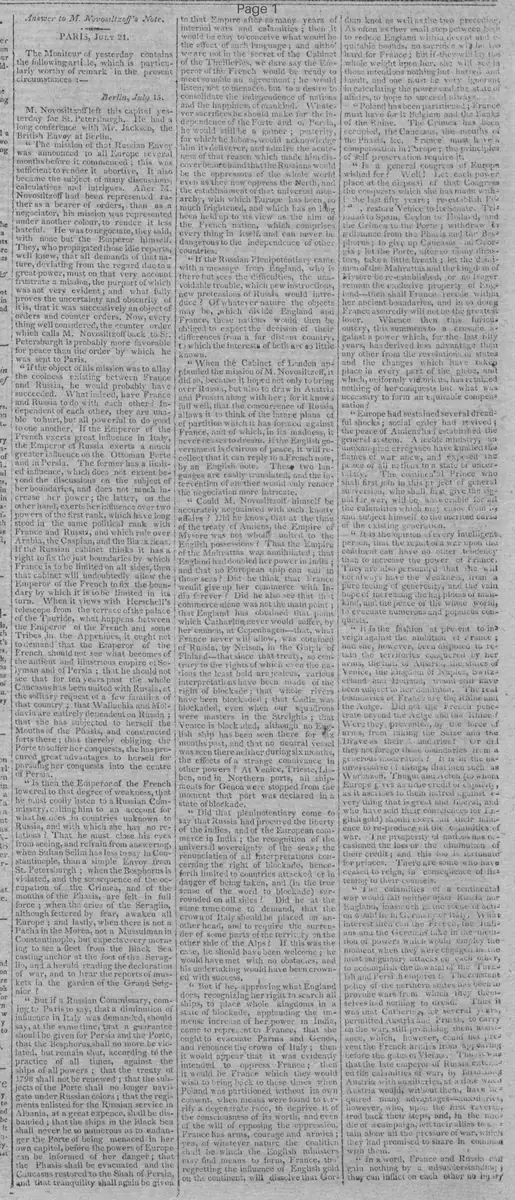
The Moniteur of yesterday contains the following article, which is particularly worthy of remark in the present circumstances:--
Berlin, July 15.
M. Novosiltzoff left this capital yesterday for St. Petersburgh. He had a long conference with Mr. Jackson, the British Envoy at Berlin.
The mission of that Russian Envoy was announced to all Europe several months before it commenced; this was sufficient to render it abortive. It also became the subject of many discussions, calculations and intrigues. After M. Novosiltzoff had been represented rather as a bearer of orders, than as a negotiator, his mission was represented under another colour, to render it less hateful. He was to negotiate, they said, with none but the Emperor himself. They, who propagated those idle reports, well knew, that all demands of that nature, deviating from the regard due to a great power, must on that very account frustrate a mission, the purport of which was not very evident; and what fully proves the uncertainty and obscurity of it is, that it was successively an object of orders and counter orders. Now, every thing well considered, the counter order which calls M. Novosiltzoff back to St. Petersburgh is probably more favorable for peace than the order by which he was sent to Paris.
If the object of his mission was to allay the coolness existing between France and Russia, he would probably have succeeded. What indeed, have France and Russia to do with each other? Independent of each other, they are unable to hurt, but all powerful to do good to one another. If the Emperor of the French exerts great influence in Italy, the Emperor of Russia exerts a much greater influence on the Ottoman Porte and in Persia. The former has a limited influence, which does not extend beyond the discussions on the subject of her boundaries, and does not much increase her power; the latter, on the other hand, exerts her influence over two powers of the first rank, which have long stood in the same political rank with France and Russia, and which rule over Arabia, the Caspian, and the Black Seas.
If the Russian cabinet thinks it has a right to fix the just boundaries by which France is to be limited on all sides, then that cabinet will undoubtedly allow the Emperor of the French to fix the boundary by which it is to be limited in its turn. When it views with Herschel's telescope from the terrace of the palace of the Tauride, what happens between the Emperor of the French and some Tribes in the Appenines, it ought not to demand that the Emperor of the French should not see what becomes of the ancient and illustrious empire of Solyman and of Persia; that he should not see that for ten years past the whole Caucasus has been united with Russia, at the solitary request of a few families of that country; that Wallachia and Moldavia are entirely dependent on Russia; that she has subjected to herself the Mouths of the Phasis, and constructed forts there; that thereby obliging the Porte to suffer her conquests, she has procured great advantages to herself for pursuing her conquests into the centre of Persia.
Is then the Emperor of the French lowered to that degree of weakness, that he must coolly listen to a Russian Commissary, calling him to an account for what he does in countries unknown to Russia, and with which she has no relations? That he must close his eyes from seeing, and refrain from answering, when Sultan Selim has less to say in Constantinople, than a simple Envoy from St. Petersburgh; when the Bosphorus is violated, and the consequence of the occupation of the Crimea, and of the mouths of the Phasis, are felt in full force; when the cries of the Seraglio, although fettered by fear, awaken all Europe; and lastly, when there is not a Pacha in the Morea, not a Mussulman in Constantinople, but expects every morning to see a fleet from the Black Sea casting anchor at the foot of the Seraglio, and a herald reading the declaration of war, and to hear the reports of muskets in the garden of the Grand Seignior?
But if a Russian Commissary, coming to Paris to say that a diminution of influence in Italy was demanded, should say, at the same time, that a guarantee should be given for Persia and the Porte, that the Bosphorus shall no more be violated, but remain shut, according to the practice of all times, against the ships of all powers; that the treaty of 1798 shall not be renewed; that the subjects of the Porte shall no longer navigate under Russian colors; that the regiments enlisted for the Russian service in Albania, at a great expense, shall be disbanded; that the ships in the Black Sea shall never be so numerous as to endanger the Porte of being menaced in her own capitol, before the powers of Europe can be informed of her danger; that the Phasis shall be evacuated and the Caucasus restored to the Shah of Persia, and that tranquility shall again be given to that Empire after so many years of internal wars and calamities: then it would be easy to conceive what would be the effect of such language: and altho' we are not in the secret of the Cabinet of the Thuilleries, we dare say the Emperor of the French would be ready to meet so noble an agreement: he would listen, not to menaces, but to a desire to consolidate the independence of nations and the happiness of mankind. Whatever sacrifices he should make for the independence of the Porte and of Persia, he would still be a gainer; posterity, for which he labors, would acknowledge him its deliverer, and admire the acuteness of that reason which made him discover beforehand that the Russians would be the oppressors of the whole world even as they now oppress the North, and the establishment of that universal monarchy, with which Europe has been so much frightened, and which has so long been held up to its view as the aim of the French nation, which comprises every thing in itself, and can never be dangerous to the independence of other countries.
If the Russian Plenipotentiary came with a message from England, who is there but sees the difficulties, the unavoidable trouble, which new instructions, new pretensions of Russia would introduce? Of whatever nature the objects may be, which divide England and France, those nations would then be obliged to expect the decision of their differences from a far distant country, to which the interests of both are so little known.
When the Cabinet of London applauded the mission of M. Novosiltzoff, it did so, because it hoped not only to bring over Russia, but also to draw in Austria and Prussia along with her; for it knows full well, that the concurrence of Russia allows it to think of the insane plans of partition which it has formed against France, and of which, in its madness, it never ceases to dream. If the English government is desirous of peace, it will recollect that it can reply to a French note, by an English note. These two languages are easily translated, and the intervention of another would only render the negociation more intricate.
Could M. Novosiltzoff himself be accurately acquainted with such knotty affairs? Did he know, that at the time of the treaty of Amiens, the Empire of Mysore was not wholly united to the English possessions? That the Empire of the Mahrattas was annihilated; that England had doubled her power in India; and that no European ship can sail in those seas? Did he think that France would give up her commerce with India forever? Did he also see that the commerce alone was not the main point; that England has obtained that point which Catharine never would suffer, by her cannon, at Copenhagen--that, what France never will allow, was obtained of Russia, by Nelson, in the Gulf of Finland--that since that treaty, so contrary to the rights of which even the nations the least bold are jealous, various interpretations have been made of the right of blockade: that whole rivers have been blockaded; that Cadiz was blockaded, even when our squadrons were masters in the Straits; that Venice is blockaded, although no English ship has been seen there for six months past. and that no neutral vessel was seen there neither during six months, the effects of a strange connivance in other powers? At Venice, Trieste, Lisbon, and in Northern ports, all shipments for Genoa were stopped from the moment that port was declared in a state of blockade.
Did that plenipotentiary come to say that Russia had procured the liberty of the Indies, and of the European commerce in India; the recognition of the universal sovereignty of the seas: the renunciation of all interpretations concerning the right of blockade, henceforth limited to countries attacked or in danger of being taken, and (in the true sense of the word to blockade) surrounded on all sides? Did he at the same time come to demand, that the crown of Italy should be placed on another head, and to require the surrender of some parts of the territory on the other side of the Alps? If this was the case, he should have been welcome; he would have met with no obstacles, and his undertaking would have been crowned with success.
But if he, approving what England does, recognizing her right to search all ships, to place whole kingdoms in a state of blockade, applauding the immense increase of her power in India, come to represent to France, that she ought to evacuate Parma and Genoa, and renounce the crown of Italy; then it would appear that it was evidently intended to oppress France; then it would be France which they would wish to bring back to those times when Poland was partitioned without its own consent, when means were found to terrify a degenerate race, to deprive it of the consciousness of its worth, and even of the will of opposing the oppression. France has arms, courage and armies; yea, of whatever nature the coalition shall be which the English ministers may find means to form, France, tho regretting the influence of English gold on the continent, will dissolve that Gordian knot as well as the two preceding. As often as they shall stand between her and her enemies to reduce England within decent and equitable bounds, no sacrifice will be too hard for France; but if they will lay the whole weight upon her, she will see in those intentions nothing but hatred and insult, and one must be very ignorant in calculating the power and the state of affairs, to hope to succeed always.
Poland has been partitioned: France must have for it Belgium and the Banks of the Rhine. The Crimea has been occupied, the Caucasus, the mouths of the Phasis, &c, France must have a compensation in Europe; the principles of self preservation require it.
Is a general congress of Europe wished for? Well! Let each power place at the disposal of that Congress the conquests which she has made within the last fifty years; reestablish Poland, restore Venice to its Senate, Trinidad to Spain, Ceylon to Holland, and the Crimea to the Porte: withdraw England from the Phasis and the Bosphorus; to give up Caucasus and Georgia; let the Porte, after so many disasters, take a little breath: let the dominion of the Mahrattas and the Kingdom of Mysore be re-established, or no longer remain the exclusive property of England--then shall France recede within her ancient boundaries, and in so doing France assuredly will not be the greatest loser. Whence then this furious outcry, this summons to a crusade against a power which, for the last fifty years, has derived less advantage than any other from the revolutions of states and the changes which have taken place in every part of the globe, and which, uniformly victorious, has retained nothing of her conquests but what was necessary to form an equitable compensation?
Europe had sustained several dreadful shocks: social order had revived: the peace of Amiens had established the general system. A feeble ministry, an unprecedented arrogance have kindled the flames of war anew, and exposed the peace of all nations to a state of uncertainty. The continental Prince who shall first join in this project of general subversion, who shall first give the signal for war, will be answerable for all the calamities which may ensue from it and subject himself to the merited curse of the existing generation.
It is the opinion of every intelligent person, that the result of a war upon the continent can have no other tendency than to increase the power of France. They are also persuaded that she will not always have the weakness, from a pure feeling of generosity, and the vain hope of increasing the happiness of mankind, and the peace of the whole world, to evacuate numerous and populous conquests.
It is the fashion at present to inveigh against the ambition of France; had she, however, been disposed to retain the territories conquered by her arms, the half of Austria, the states of Venice, the kingdom of Naples, Switzerland and Holland, would still have been subject to her dominion. The real boundaries of France are the Rhine and the Adige. Did not the French penetrate beyond the Adige and the Rhine? Were they prevented, by the force of arms, from taking the Saale and the Drave as their boundaries? Or did they not forego those boundaries from a generous moderation? It is in the nature of things, that men such as Woronzoff, Thugut and Acton (to whom Europe gives as little credit or capacity as it ascribes to them hatred against every thing that is great and liberal, and who have sold their consciences for English gold) should exert all their influence to re-produce all the Calamities of war. The prosperity of nations has occasioned the loss or the diminution of their credit; and this too is fortunate for princes. There are some who have ceased to reign, in consequence of listening to their counsels.
The calamities of a continental war would fall neither upon Russia nor England, inasmuch as the scene of action would be in Germany or Italy. What interest then can the French, the Italians and the Germans take in the mediation of powers which would employ the moment when they were engaged in the most sanguinary attacks on each other, to accomplish the downfall of the Turkish and Persian empires? The constant policy of the northern states has been to provoke wars from which they themselves had nothing to dread. Thus it was that Catharine, for several years, permitted Austria and Prussia to carry on the war, still promising them assistance, which, however, could not prevent the French armies from appearing before the gates of Vienna. Thus it was that the late emperor of Russia extended the calamities of war, by furnishing Austria with auxiliaries, at a time when Austria would, without them, have acquired many advantages; auxiliaries however, who, upon the first reverse, trod back their steps, and, in the midst of a campaign, left their allies to sustain alone all the pressure of war, which they had promised to share in common with them.
In a word, France and Russia gain nothing by a misunderstanding they can inflict on each other no injury.
by a war; and whatever may be the policy of either, there is nothing in which they can find so much advantage as in maintaining a good understanding with each other. We have already declared, and once more repeat it, that if Russia evacuate the Bosphorus, Caucasus, Phasis, Georgia, &c. France will accede to any arrangements which can be required with respect to Italy. But, unfortunately, it is too well known, that no one finds pleasure in sacrifices of this nature, and hence France must be allowed to indemnify herself so as to compensate for such advantages as are obtained by the other powers.
"As to England, the treaty of Amiens is still in force. It was concluded, after a deliberate and long investigation of the reciprocal interests of the two states; it was broken unexpectedly and upon idle pretensions. Re-establish that treaty, and both states are at peace. But if England requires new conditions; if she wishes to enter into a discussion respecting the frontiers of France on the side of Italy, let her give to France a share of the Mahratta territory; let her, in short, adopt maxims consistent with the independence of the other powers. But the English will perhaps say, it is better to sink than to consent that the flag shall protect the cargo—that a vessel, for whatever she contains, or whatever is done on board her, shall be accountable only to the sovereign of the state to which she belongs; that the Indies shall cease to be our property, or that any power whatever shall have a right to share with us in our superiority in the Indies! Do not you then expect that France shall enter into discussions with you upon points which do not concern you, or do you consent to enter into discussion with her upon points which involve the sacred interests of all nations? France duly appreciates the advantages: but she will carry on the war as long as it shall be necessary towards maintaining the honor of her flag, and the preponderance which it has acquired; and until she has obtained the assurance, that in whatever quarter of the world a Frenchman may show himself, he shall not have occasion to blush in consequence of the insults and arrogant assumptions of the English."
What sub-type of article is it?
What keywords are associated?
What entities or persons were involved?
Where did it happen?
Foreign News Details
Primary Location
Berlin
Event Date
July 15
Key Persons
Outcome
m. novosiltzoff's mission recalled to st. petersburgh, deemed more favorable for peace than its initiation; hypothetical diplomatic concessions discussed for france-russia reconciliation.
Event Details
Russian envoy M. Novosiltzoff departs Berlin for St. Petersburgh after conference with British envoy Mr. Jackson. Article critiques the mission's abortive nature, Russian expansions in Ottoman territories and Persia, and urges direct France-England negotiations without third-party intervention, proposing mutual territorial concessions for peace.