Thank you for visiting SNEWPapers!
Sign up free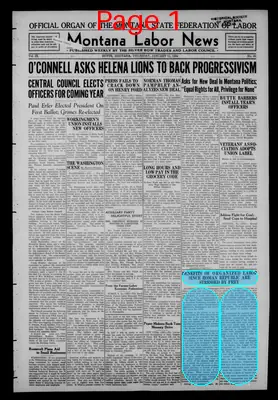
Story
January 11, 1934
Montana Labor News
Butte, Silver Bow County, Montana
What is this article about?
John P. Frey, AFL official, speaks in Washington on labor history, from Roman Republic unions to modern organizations, stressing collective bargaining, social involvement, and inter-union cooperation for industrial democracy.
Clipping
OCR Quality
100%
Excellent
Full Text
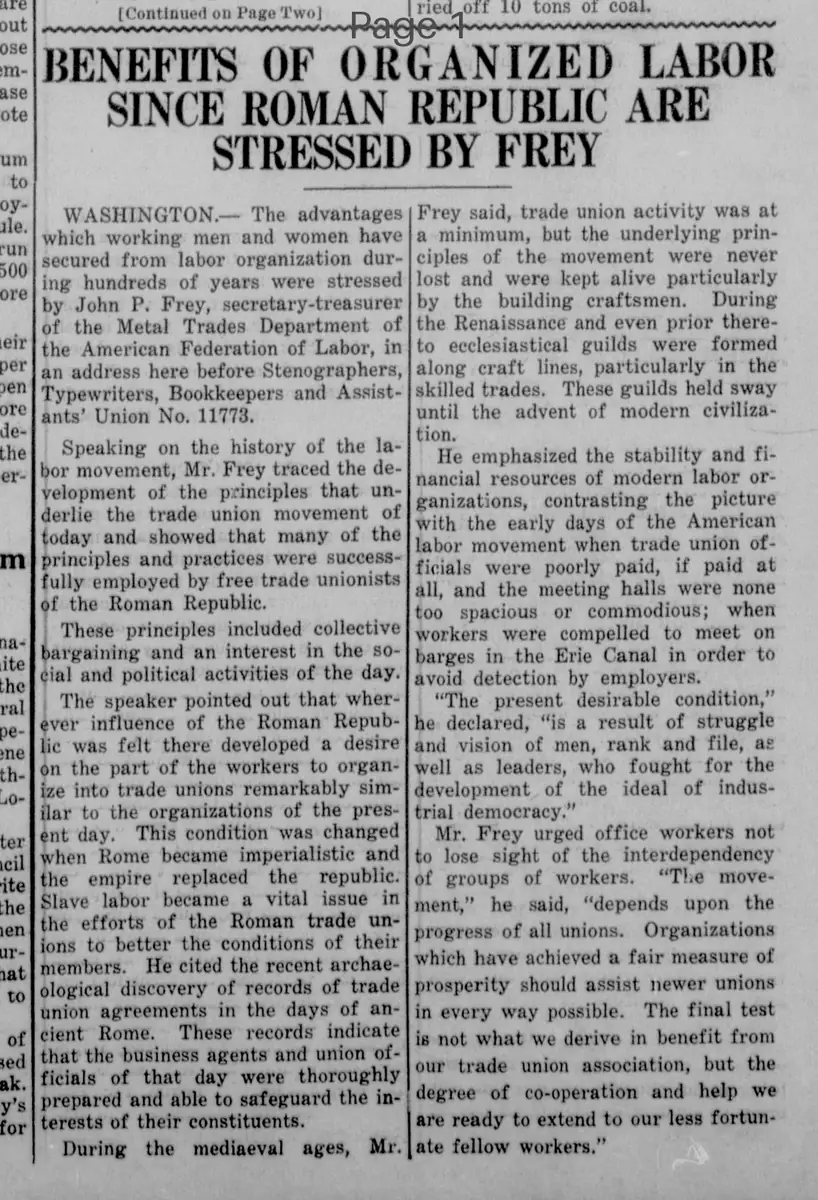
BENEFITS OF ORGANIZED LABOR
SINCE ROMAN REPUBLIC ARE
STRESSED BY FREY
WASHINGTON.- The advantages which working men and women have secured from labor organization during hundreds of years were stressed by John P. Frey, secretary-treasurer of the Metal Trades Department of the American Federation of Labor, in an address here before Stenographers, Typewriters, Bookkeepers and Assistants' Union No. 11773.
Speaking on the history of the labor movement, Mr. Frey traced the development of the principles that underlie the trade union movement of today and showed that many of the principles and practices were successfully employed by free trade unionists of the Roman Republic.
These principles included collective bargaining and an interest in the social and political activities of the day.
The speaker pointed out that wherever influence of the Roman Republic was felt there developed a desire on the part of the workers to organize into trade unions remarkably similar to the organizations of the present day. This condition was changed when Rome became imperialistic and the empire replaced the republic.
Slave labor became a vital issue in the efforts of the Roman trade unions to better the conditions of their members. He cited the recent archaeological discovery of records of trade union agreements in the days of ancient Rome. These records indicate that the business agents and union officials of that day were thoroughly prepared and able to safeguard the interests of their constituents.
During the mediaeval ages, Mr. Frey said, trade union activity was at a minimum, but the underlying principles of the movement were never lost and were kept alive particularly by the building craftsmen. During the Renaissance and even prior thereto ecclesiastical guilds were formed along craft lines, particularly in the skilled trades. These guilds held sway until the advent of modern civilization.
He emphasized the stability and financial resources of modern labor organizations, contrasting the picture with the early days of the American labor movement when trade union officials were poorly paid, if paid at all, and the meeting halls were none too spacious or commodious; when workers were compelled to meet on barges in the Erie Canal in order to avoid detection by employers.
"The present desirable condition," he declared, "is a result of struggle and vision of men, rank and file, as well as leaders, who fought for the development of the ideal of industrial democracy."
Mr. Frey urged office workers not to lose sight of the interdependency of groups of workers. "The movement," he said, "depends upon the progress of all unions. Organizations which have achieved a fair measure of prosperity should assist newer unions in every way possible. The final test is not what we derive in benefit from our trade union association, but the degree of co-operation and help we are ready to extend to our less fortunate fellow workers."
SINCE ROMAN REPUBLIC ARE
STRESSED BY FREY
WASHINGTON.- The advantages which working men and women have secured from labor organization during hundreds of years were stressed by John P. Frey, secretary-treasurer of the Metal Trades Department of the American Federation of Labor, in an address here before Stenographers, Typewriters, Bookkeepers and Assistants' Union No. 11773.
Speaking on the history of the labor movement, Mr. Frey traced the development of the principles that underlie the trade union movement of today and showed that many of the principles and practices were successfully employed by free trade unionists of the Roman Republic.
These principles included collective bargaining and an interest in the social and political activities of the day.
The speaker pointed out that wherever influence of the Roman Republic was felt there developed a desire on the part of the workers to organize into trade unions remarkably similar to the organizations of the present day. This condition was changed when Rome became imperialistic and the empire replaced the republic.
Slave labor became a vital issue in the efforts of the Roman trade unions to better the conditions of their members. He cited the recent archaeological discovery of records of trade union agreements in the days of ancient Rome. These records indicate that the business agents and union officials of that day were thoroughly prepared and able to safeguard the interests of their constituents.
During the mediaeval ages, Mr. Frey said, trade union activity was at a minimum, but the underlying principles of the movement were never lost and were kept alive particularly by the building craftsmen. During the Renaissance and even prior thereto ecclesiastical guilds were formed along craft lines, particularly in the skilled trades. These guilds held sway until the advent of modern civilization.
He emphasized the stability and financial resources of modern labor organizations, contrasting the picture with the early days of the American labor movement when trade union officials were poorly paid, if paid at all, and the meeting halls were none too spacious or commodious; when workers were compelled to meet on barges in the Erie Canal in order to avoid detection by employers.
"The present desirable condition," he declared, "is a result of struggle and vision of men, rank and file, as well as leaders, who fought for the development of the ideal of industrial democracy."
Mr. Frey urged office workers not to lose sight of the interdependency of groups of workers. "The movement," he said, "depends upon the progress of all unions. Organizations which have achieved a fair measure of prosperity should assist newer unions in every way possible. The final test is not what we derive in benefit from our trade union association, but the degree of co-operation and help we are ready to extend to our less fortunate fellow workers."
What sub-type of article is it?
Historical Event
What themes does it cover?
Moral Virtue
Triumph
Justice
What keywords are associated?
Labor Movement
Trade Unions
Roman Republic
Collective Bargaining
Industrial Democracy
What entities or persons were involved?
John P. Frey
Where did it happen?
Washington
Story Details
Key Persons
John P. Frey
Location
Washington
Story Details
John P. Frey addresses office workers on the history of labor organizations, tracing principles like collective bargaining from Roman Republic trade unions to modern times, highlighting struggles against slave labor, medieval guilds, and the development of industrial democracy through cooperation among unions.