Thank you for visiting SNEWPapers!
Sign up free
Story
February 12, 1800
Gazette Of The United States, & Philadelphia Daily Advertiser
Philadelphia, Philadelphia County, Pennsylvania
What is this article about?
In the US House, debate on Mr. Randolph's motion to discharge supernumerary officers from the additional army to consolidate regiments and save expenses. Speakers including Gallatin, Smith, Harper, Jones, and Smilie argued for and against, citing negotiation impacts and military readiness. Amendment negatived 38-57.
Clipping
OCR Quality
98%
Excellent
Full Text
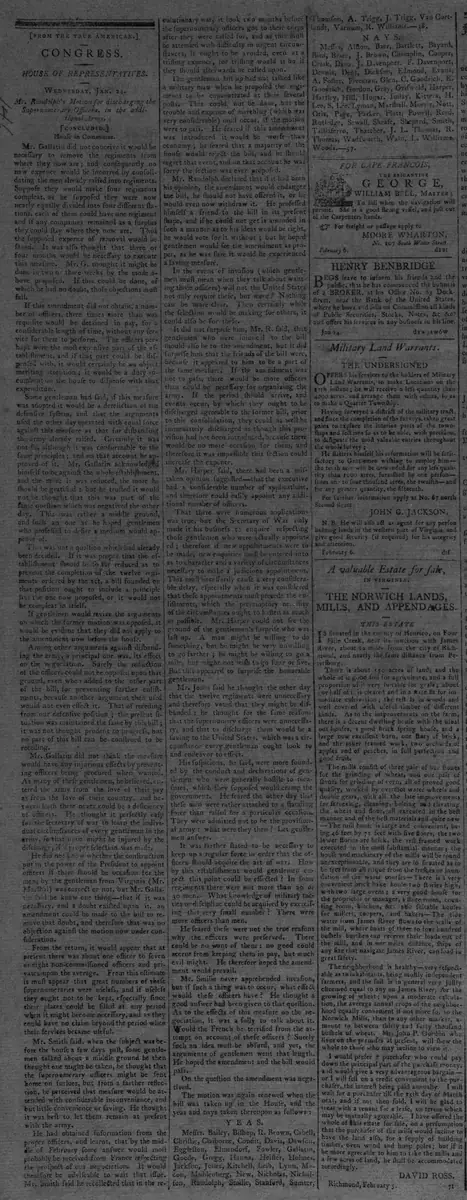
Mr. Randolph's Motion for discharging the Supernumerary Officers, in the additional Army.
CONCLUDED.
House in Committee.
Mr. Gallatin did not conceive it would be necessary to remove the regiments from where they now are; and consequently no new expense would be incurred by consolidating the men already raised into regiments. Suppose they would make four regiments complete, as he supposed they were now nearly equally divided into four different stations, each of them could have one regiment and if any companies remained as a surplus they could stay where they now are. Thus the supposed expense of removal would be saved. It was also thought that three or four months would be necessary to execute this measure. Mr. G. thought it might be done in two or three weeks by the mode above proposed. If this could be done, of which he had no doubt, those objections must fall.
If this amendment did not obtain, a number of officers, three times more than was requisite would be detained in pay, for a considerable length of time, without any service for them to perform. The officers perhaps were the most expensive part of the establishment, and if that part could be dispensed with, it would certainly be an object meriting attention : it would be a duty incumbent on the house to dispense with that expenditure.
Some gentleman had said, if this measure was adopted it would be a dereliction of the defensive system, and that the arguments used the other day operated with equal force against this measure as that for disbanding the army already raised. Certainly it was not so, although it was conformable to the same principles ; and on that account he approved of it. Mr. Gallatin acknowledged himself to be against the whole establishment, and the more it was reduced, the more he should be gratified : but he trusted it would not be thought that this was part of the same question which was negatived the other day. This was rather a middle ground, and such an one as he hoped gentlemen who professed to desire a medium would approve of.
This was not a question which had already been decided. If it was proper that the establishment should be so far reduced as to prevent the completion of the twelve regiments ordered by the act, a bill founded on that position ought to include a principle like the one now proposed, or it would not be complete in itself.
If gentlemen would revive the arguments on which the former motion was opposed, it would be evident that they did not apply to the amendment now before the house.
Among other arguments against disbanding the army, a principal one was, its effect on the negotiation. Surely the reduction of the officers could not be opposed upon that ground, even when added to the other part of the bill, for preventing further enlistments, because another argument then used would not even defeat it. That of receding from our defensive position ; the present situation was maintained the same by this bill; it was not thought prudent to progress, but no part of this bill can be construed to be receding.
Mr. Gallatin did not think the measure would have any injurious effects by preventing officers being procured when wanted. As many of these gentlemen, he believed, entered the army from the love of their pay as from the love of their country, and between both there never could be a deficiency of officers. He thought it perfectly easy for the Secretary of War to learn the individual circumstances of every gentleman in the army, so that none might be injured by the discharge, if a proper election was made.
He did not know whether the construction put in the power of the President to appoint officers if there should be occasion for the men, by the gentleman from Virginia (Mr. Marshall) was correct or not, but Mr. Gallatin said he knew one thing -that if it was necessary, and a doubt existed upon it, an amendment could be made to the bill to remove that doubt, and therefore that was no objection against the motion now under consideration.
From the return, it would appear that at present there was about one officer to seven or eight non-commissioned officers and privates upon the average. From this estimate it must appear that great numbers of these supernumeraries were useless, and if useless they ought not to be kept, especially since their places could be filled at any period when it might become necessary, and as they could have no claim beyond the period when their services became useful.
Mr. Smith said, when the subject was before the house a few days past, some gentlemen talked about a middle ground he then thought one might be taken, he thought that the supernumerary officers might be sent home on furloughs, but from a farther reflection, he perceived that measure would be attended with considerable inconvenience, and but little convenience or saving. He thought it was best to let them remain at present with the army.
He had obtained information from the proper officers, and learnt, that by the middle of February some answer would most probably be received from France respecting the prospect of our negotiation. It would therefore be advisable to wait that issue.
Mr. Smith said he recollected that in the revolutionary war, it took two months before the supernumerary officers got to their corps after they were called for, and as this must be attended with difficulty in urgent circumstances, it ought to be avoided, even at a trifling expense, for trifling would it be if they should afterwards be called upon.
The gentleman last up had not talked like a military man when he proposed the regiments to be concentrated at their several posts. This could not be done, but the trouble and expense of marching (which was very considerable) must occur, if the motion were to pass. He feared if this amendment was introduced it would be worse than economy; he feared that a majority of the house would reject the bill, and he should regret that event, and on that account he was sorry the section was ever proposed.
Mr. Randolph declared that if it had been his opinion, the amendment would endanger the bill, he should not have offered it, or he would even now withdraw it. He professed himself a friend to the bill in its present shape, and if he could not get it amended in such a manner as to his ideas would be right, he would vote for it without ; but he hoped gentlemen would see the amendment as proper, as he was sure it would be experienced a saving measure.
In the event of invasion (which gentlemen must mean when they talk about wanting those officers) will not the United States not only require these, but more ? Nothing can be more clear. Then certainly while the election would be making for others, it could also be for these.
It did not surprise him, Mr. R. said, that gentlemen who were inimical to the bill should also be to the amendment, but it did surprise him that the friends of the bill were, because it appeared to him to be a part of the same measure. If the amendment was not to pass, there would be more officers than could be necessary for organizing the army. If the period should arrive, and events occur, by which they ought to be discharged agreeable to the former bill, prior to this consolidation, they could as well be immediately discharged as though this provision had not been introduced, because there would be no more occasion for them, and therefore it was impossible this section could increase the expense.
Mr. Harper said, there had been a mistaken opinion suggested-that the executive had a considerable number of applications, and therefore could easily appoint any additional number of officers.
That there were numerous applications was true, but the Secretary of War only made it his business to enquire respecting those gentlemen who were actually appointed ; therefore if new appointments were to be made, new enquiries must be entered into as to character and a variety of circumstances necessary to make a judicious appointment.
This must necessarily cause a very considerable delay, especially when it was considered that these appointments must precede the enlistments, which the peremptory necessity of the circumstances ought to hasten as much as possible. Mr. Harper could not see the ground of the gentleman's surprise who was last up. A man might be willing to do something, but he might be very unwilling to go farther ; he might be willing to go a mile, but might not wish to go four or five. But this appeared to surprise the honorable gentleman.
Mr. Jones said he thought the other day that the twelve regiments were unnecessary and therefore voted that they might be disbanded : he thought for the same reasons that the supernumerary officers were unnecessary, and that to discharge them would be a saving to the United States, which was a circumstance every gentleman ought look to and endeavor to effect.
His suspicions, he said, were more founded by the conduct and declarations of gentlemen who were generally hostile to measures, which they supposed would cramp the government. He feared the other day that these men were rather attached to a standing force than raised for a particular occasion. They were admitted not to be the provisional army: what were they then ? Let gentlemen answer.
It was farther stated to be necessary to keep up a regular force in order that the officers should acquire the art of war. How by this establishment would gentlemen expect this point could be effected ? In some regiments there were not more than 20 or 30 men. What knowledge of military tactics or discipline could be acquired by exercising this very small number? There were more officers than men.
He feared these were not the true reasons why the officers were preserved. There could be no want of them: no good could accrue from keeping them in pay, but much evil might. He therefore hoped the amendment would prevail.
Mr. Smilie never apprehended invasion, but if such a thing was to occur, what effect would these officers have? He thought a good answer had been given to that question.
As to the effects of this measure on the negotiation, it was a folly to talk about it. Would the French be terrified from the attempt on account of these officers ? Surely such an idea must be absurd, and yet, the arguments of gentlemen went that length.
He hoped the amendment and the bill would pass.
On the question the amendment was negatived.
The motion was again renewed when the bill was taken up in the House, and the yeas and nays taken thereupon as follows:
YEAS.
Messrs. Bailey, Bishop, R. Brown, Cabell, Christie, Claiborne, Condit, Davis, Dawson, Eggleston, Elmendorf, Fowler, Gallatin, Goode, Gregg, Hanna, Heister, Holmes, Jackson, Jones, Kitchell, Leib, Lynn, Macon, Muhlenberg, New, Nicholas, Nicholson, Randolph, Smilie, Stanford, Sumter, Thomson, A. Trigg, L. Trigg, Van Cortlandt, Varnum, R. Williams.-38.
NAYS.
Messrs. Alston, Baer, Bartlett, Bayard, Bird, Brace, J. Brown, Champlin, Cooper, Craik, Dana, J. Davenport, F. Davenport, Dennis, Dent, Dickson, Edmond, Evans, A. Foster, Freeman, Glen, C. Goodrich, E. Goodrich, Gordon, Gray, Griswold, Harper, Hartley, Hill, Huger, Imlay, Kittera, H. Lee, S. Lee, Lyman, Marshall, Morris, Nott, Otis, Page, Parker, Platt, Powell, Reed, Rutledge, Sewall, Sheafe, Shepard, Smith, Taliaferro, Thatcher. J. L. Thomas, R. Thomas, Wadsworth, Waln, L. Williams, Woods.--57
CONCLUDED.
House in Committee.
Mr. Gallatin did not conceive it would be necessary to remove the regiments from where they now are; and consequently no new expense would be incurred by consolidating the men already raised into regiments. Suppose they would make four regiments complete, as he supposed they were now nearly equally divided into four different stations, each of them could have one regiment and if any companies remained as a surplus they could stay where they now are. Thus the supposed expense of removal would be saved. It was also thought that three or four months would be necessary to execute this measure. Mr. G. thought it might be done in two or three weeks by the mode above proposed. If this could be done, of which he had no doubt, those objections must fall.
If this amendment did not obtain, a number of officers, three times more than was requisite would be detained in pay, for a considerable length of time, without any service for them to perform. The officers perhaps were the most expensive part of the establishment, and if that part could be dispensed with, it would certainly be an object meriting attention : it would be a duty incumbent on the house to dispense with that expenditure.
Some gentleman had said, if this measure was adopted it would be a dereliction of the defensive system, and that the arguments used the other day operated with equal force against this measure as that for disbanding the army already raised. Certainly it was not so, although it was conformable to the same principles ; and on that account he approved of it. Mr. Gallatin acknowledged himself to be against the whole establishment, and the more it was reduced, the more he should be gratified : but he trusted it would not be thought that this was part of the same question which was negatived the other day. This was rather a middle ground, and such an one as he hoped gentlemen who professed to desire a medium would approve of.
This was not a question which had already been decided. If it was proper that the establishment should be so far reduced as to prevent the completion of the twelve regiments ordered by the act, a bill founded on that position ought to include a principle like the one now proposed, or it would not be complete in itself.
If gentlemen would revive the arguments on which the former motion was opposed, it would be evident that they did not apply to the amendment now before the house.
Among other arguments against disbanding the army, a principal one was, its effect on the negotiation. Surely the reduction of the officers could not be opposed upon that ground, even when added to the other part of the bill, for preventing further enlistments, because another argument then used would not even defeat it. That of receding from our defensive position ; the present situation was maintained the same by this bill; it was not thought prudent to progress, but no part of this bill can be construed to be receding.
Mr. Gallatin did not think the measure would have any injurious effects by preventing officers being procured when wanted. As many of these gentlemen, he believed, entered the army from the love of their pay as from the love of their country, and between both there never could be a deficiency of officers. He thought it perfectly easy for the Secretary of War to learn the individual circumstances of every gentleman in the army, so that none might be injured by the discharge, if a proper election was made.
He did not know whether the construction put in the power of the President to appoint officers if there should be occasion for the men, by the gentleman from Virginia (Mr. Marshall) was correct or not, but Mr. Gallatin said he knew one thing -that if it was necessary, and a doubt existed upon it, an amendment could be made to the bill to remove that doubt, and therefore that was no objection against the motion now under consideration.
From the return, it would appear that at present there was about one officer to seven or eight non-commissioned officers and privates upon the average. From this estimate it must appear that great numbers of these supernumeraries were useless, and if useless they ought not to be kept, especially since their places could be filled at any period when it might become necessary, and as they could have no claim beyond the period when their services became useful.
Mr. Smith said, when the subject was before the house a few days past, some gentlemen talked about a middle ground he then thought one might be taken, he thought that the supernumerary officers might be sent home on furloughs, but from a farther reflection, he perceived that measure would be attended with considerable inconvenience, and but little convenience or saving. He thought it was best to let them remain at present with the army.
He had obtained information from the proper officers, and learnt, that by the middle of February some answer would most probably be received from France respecting the prospect of our negotiation. It would therefore be advisable to wait that issue.
Mr. Smith said he recollected that in the revolutionary war, it took two months before the supernumerary officers got to their corps after they were called for, and as this must be attended with difficulty in urgent circumstances, it ought to be avoided, even at a trifling expense, for trifling would it be if they should afterwards be called upon.
The gentleman last up had not talked like a military man when he proposed the regiments to be concentrated at their several posts. This could not be done, but the trouble and expense of marching (which was very considerable) must occur, if the motion were to pass. He feared if this amendment was introduced it would be worse than economy; he feared that a majority of the house would reject the bill, and he should regret that event, and on that account he was sorry the section was ever proposed.
Mr. Randolph declared that if it had been his opinion, the amendment would endanger the bill, he should not have offered it, or he would even now withdraw it. He professed himself a friend to the bill in its present shape, and if he could not get it amended in such a manner as to his ideas would be right, he would vote for it without ; but he hoped gentlemen would see the amendment as proper, as he was sure it would be experienced a saving measure.
In the event of invasion (which gentlemen must mean when they talk about wanting those officers) will not the United States not only require these, but more ? Nothing can be more clear. Then certainly while the election would be making for others, it could also be for these.
It did not surprise him, Mr. R. said, that gentlemen who were inimical to the bill should also be to the amendment, but it did surprise him that the friends of the bill were, because it appeared to him to be a part of the same measure. If the amendment was not to pass, there would be more officers than could be necessary for organizing the army. If the period should arrive, and events occur, by which they ought to be discharged agreeable to the former bill, prior to this consolidation, they could as well be immediately discharged as though this provision had not been introduced, because there would be no more occasion for them, and therefore it was impossible this section could increase the expense.
Mr. Harper said, there had been a mistaken opinion suggested-that the executive had a considerable number of applications, and therefore could easily appoint any additional number of officers.
That there were numerous applications was true, but the Secretary of War only made it his business to enquire respecting those gentlemen who were actually appointed ; therefore if new appointments were to be made, new enquiries must be entered into as to character and a variety of circumstances necessary to make a judicious appointment.
This must necessarily cause a very considerable delay, especially when it was considered that these appointments must precede the enlistments, which the peremptory necessity of the circumstances ought to hasten as much as possible. Mr. Harper could not see the ground of the gentleman's surprise who was last up. A man might be willing to do something, but he might be very unwilling to go farther ; he might be willing to go a mile, but might not wish to go four or five. But this appeared to surprise the honorable gentleman.
Mr. Jones said he thought the other day that the twelve regiments were unnecessary and therefore voted that they might be disbanded : he thought for the same reasons that the supernumerary officers were unnecessary, and that to discharge them would be a saving to the United States, which was a circumstance every gentleman ought look to and endeavor to effect.
His suspicions, he said, were more founded by the conduct and declarations of gentlemen who were generally hostile to measures, which they supposed would cramp the government. He feared the other day that these men were rather attached to a standing force than raised for a particular occasion. They were admitted not to be the provisional army: what were they then ? Let gentlemen answer.
It was farther stated to be necessary to keep up a regular force in order that the officers should acquire the art of war. How by this establishment would gentlemen expect this point could be effected ? In some regiments there were not more than 20 or 30 men. What knowledge of military tactics or discipline could be acquired by exercising this very small number? There were more officers than men.
He feared these were not the true reasons why the officers were preserved. There could be no want of them: no good could accrue from keeping them in pay, but much evil might. He therefore hoped the amendment would prevail.
Mr. Smilie never apprehended invasion, but if such a thing was to occur, what effect would these officers have? He thought a good answer had been given to that question.
As to the effects of this measure on the negotiation, it was a folly to talk about it. Would the French be terrified from the attempt on account of these officers ? Surely such an idea must be absurd, and yet, the arguments of gentlemen went that length.
He hoped the amendment and the bill would pass.
On the question the amendment was negatived.
The motion was again renewed when the bill was taken up in the House, and the yeas and nays taken thereupon as follows:
YEAS.
Messrs. Bailey, Bishop, R. Brown, Cabell, Christie, Claiborne, Condit, Davis, Dawson, Eggleston, Elmendorf, Fowler, Gallatin, Goode, Gregg, Hanna, Heister, Holmes, Jackson, Jones, Kitchell, Leib, Lynn, Macon, Muhlenberg, New, Nicholas, Nicholson, Randolph, Smilie, Stanford, Sumter, Thomson, A. Trigg, L. Trigg, Van Cortlandt, Varnum, R. Williams.-38.
NAYS.
Messrs. Alston, Baer, Bartlett, Bayard, Bird, Brace, J. Brown, Champlin, Cooper, Craik, Dana, J. Davenport, F. Davenport, Dennis, Dent, Dickson, Edmond, Evans, A. Foster, Freeman, Glen, C. Goodrich, E. Goodrich, Gordon, Gray, Griswold, Harper, Hartley, Hill, Huger, Imlay, Kittera, H. Lee, S. Lee, Lyman, Marshall, Morris, Nott, Otis, Page, Parker, Platt, Powell, Reed, Rutledge, Sewall, Sheafe, Shepard, Smith, Taliaferro, Thatcher. J. L. Thomas, R. Thomas, Wadsworth, Waln, L. Williams, Woods.--57
What sub-type of article is it?
Historical Event
What themes does it cover?
Moral Virtue
Justice
What keywords are associated?
Supernumerary Officers
Army Consolidation
Congressional Debate
Military Reduction
Fiscal Savings
France Negotiation
What entities or persons were involved?
Gallatin
Smith
Randolph
Harper
Jones
Smilie
Marshall
Where did it happen?
House In Committee
Story Details
Key Persons
Gallatin
Smith
Randolph
Harper
Jones
Smilie
Marshall
Location
House In Committee
Story Details
Debate on motion to discharge supernumerary officers to consolidate regiments and reduce expenses; arguments on savings, military readiness, negotiation impacts; amendment rejected by vote of 38-57.