Thank you for visiting SNEWPapers!
Sign up free
Story
June 20, 1914
The Watchman And Southron
Sumter, Sumter County, South Carolina
What is this article about?
Autobiographical campaign speech by a South Carolina politician running for state office, detailing his humble farming background, legal career, mayoral role in Sumter, support for Democratic platform, voting reforms, and advocacy for honesty in politics under Wilson administration.
Clipping
OCR Quality
95%
Excellent
Full Text
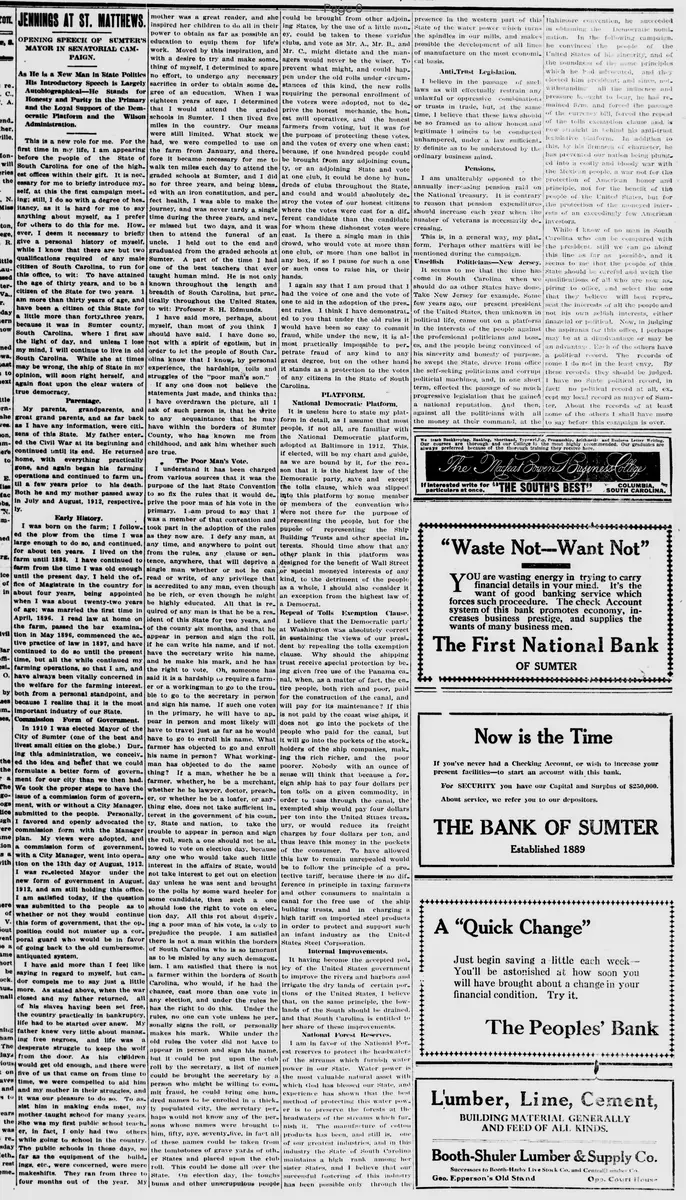
As He is a New Man in State Politics His Introductory Speech is Largely Autobiographical—He Stands for Honesty and Purity in the Primary and the Loyal Support of the Democratic Platform and the Wilson Administration.
This is a new role for me. For the first time in my life, I am appearing before the people of the State of South Carolina for one of the highest offices within their gift. It is necessary for me to briefly introduce myself, at this the first campaign meeting; still, I do with degree of hesitancy, as it is hard for me to say anything about myself, as I prefer for others to do this for me. However, I deem it necessary to briefly give personal history of myself, while I know that there are but two qualifications required of any male citizen of South Carolina, to run for this office, viz: To have attained the age of thirty years and to be a citizen of the State for two years.
I am more than thirty years of age, and have been a citizen of this State for a little more than forty-three years, because it was in Sumter county, South Carolina, where I first saw the light of day, and unless I lose my mind, I will continue to live in old South Carolina. While she at times may be wrong, the ship of State in my opinion, will soon right herself, and again float upon the clear waters of true democracy.
Parentage.
My parents, grandparents, and great grandparents, and as far back as I have any information, were citizens of this State. My father entered the Civil War at its beginning and continued until its end. He returned home, with everything practically gone, and again began his farming operations and continued to farm until a few years prior to his death. Both he and my mother passed away in July and August, 1912, respectively.
Early History
I was born on the farm; I followed the plow from the time I was large enough to do so, and continued, for about ten years. I lived on the farm until 1898, I have continued to farm from the time I was old enough until the present day. I held the office of Magistrate in the country for about four years, being appointed when I was about twenty-two years of age; was married the first time in April, 1896. I read law at home on the farm, passed the bar examination in May 1896, commenced the active practice of law in 1897, and have continued to do so until the present time, but all the while continued my farming operations, so that I am, and have always been vitally concerned in the welfare for the farming interest, both from a personal standpoint, and because I realize that it is the most important industry of our State.
Commission Form of Government.
In 1910 I was elected Mayor of the City of Sumter (one of the best and livest small cities on the globe.) During this administration, we conceived the idea and belief that we could formulate a better form of government for our city than we then had. We took the proper steps to have the issue of a commission form of government, with or without a City Manager, submitted to the people. Personally, I favored and openly advocated the commission form with the Manager plan. My views were adopted, and a commission form of government, with a City Manager, went into operation on the 13th day of August, 1912. I was re-elected Mayor under the new form of government in August, 1912, and am still holding this office. I am satisfied today, if the question was submitted to the people as to whether or not they would continue this form of government, that the opposition could not muster up a corporal guard who would be in favor of going back to the old cumbersome, antiquated system.
I have said more than I feel like saying in regard to myself, but candor compels me to say just a little more. As stated above, when the war closed and my father returned, all of his slaves having been set free, the country practically in bankruptcy, life had to be started over anew. My father knew very little about managing free negroes, and life was a desperate struggle to keep the wolf from the door. As his children would get old enough, and there were five of us that came on from time to time, we were compelled to aid him and my mother in their struggles, and it was our pleasure to do so. To assist him in making ends meet, my mother taught school for many years. She was my first public school teacher, in fact. I only had two others while going to school in the country. The public schools in those days, so far as the equipment of the buildings, etc., were concerned, were mere makeshifts. They ran from three to four months out of the year. My mother was a great reader, and she inspired her children to do all in their power to obtain as far as possible an education to equip them for life's work. Moved by this inspiration, and with a desire to try and make something of myself, I determined to spare no effort, to undergo any necessary sacrifice in order to obtain some degree of an education. When I was eighteen years of age, I determined that I would attend the graded schools in Sumter. I then lived five miles in the country. Our means were still limited. What stock we had, we were compelled to use on the farm from January, and therefore it became necessary for me to walk ten miles each day to attend the graded schools at Sumter, and I did so for three years, and being blessed with an iron constitution, and perfect health, I was able to make the journey, and was never tardy a single time during the three years, and never missed but two days, and it was then to attend the funeral of an uncle. I held out to the end and graduated from the graded schools at Sumter. A part of the time I had one of the best teachers that ever taught human mind. He is not only known throughout the length and breadth of South Carolina, but practically throughout the United States, to wit: Professor S. H. Edmunds.
I have said more, perhaps, about myself, than most of you think I should have said. I have done so, not with a spirit of egotism, but in order to let the people of South Carolina know that I know by personal experience, the hardships, toils and struggles of the "poor man's son." If any one does not believe the statements just made, and thinks that I have overdrawn the picture, all I ask of such person is, that he write to any acquaintance that he may have within the borders of Sumter County, who has known me from childhood, and ask him whether such are true.
The Poor Man's Vote.
I understand it has been charged from various sources that it was the purpose of the last State Convention to so fix the rules that it would deprive the poor man of his vote in the primary. I am proud to say that I was a member of that convention and took part in the adoption of the rules as they now are. I defy any man, at any time, and anywhere to point out from the rules, any clause or sentence, anywhere, that will deprive a single man whether or not he can read or write, of any privilege that is accredited to any man, even though he be rich, or even though he might be highly educated. All that is required of any man is that he be a resident of this State for two years, and of the county six months, and that he appear in person and sign the roll, if he can write his name, and if not, have the secretary write his name, and he make his mark, and he has the right to vote. Oh, someone has said it is a hardship to require a farmer or a workingman to go to the trouble to go to the secretary in person and sign his name. If such one votes in the primary, he will have to appear in person and most likely will have to travel just as far as he would have to go to enroll his name. What farmer has objected to go and enroll his name in person? What workingman has objected to do the same thing? If a man, whether he be a farmer, whether he be a merchant, whether he be lawyer, doctor, preacher, or whether he be a loafer, or anything else, does not take sufficient interest in the government of his county, State and nation, to take the trouble to appear in person and sign the roll, such a one should not be allowed to vote on election day, because any one who would take such little interest in the affairs of State, would not take interest to get out on election day unless he was sent and brought to the polls by some ward heeler for some candidate, then such a one should lose the right to vote on election day. All this rot about depriving a poor man of his vote, is only to prejudice the people. I am satisfied there is not a man within the borders of South Carolina who is so ignorant as to be misled by any such demagogism. I am satisfied that there is not a farmer within the borders of South Carolina, who would, if he had the chance, cast more than one vote in any election, and under the rules he has the right to do this. Under the rules, no one can vote unless he personally signs the roll, or personally makes his mark. While under the old rules the voter did not have to appear in person and sign his name, but it could be put upon the club roll by the secretary, a list of names could be brought the secretary by a person who might be willing to commit fraud, he could bring one hundred names to be enrolled in a thickly populated city, the secretary perhaps would not know any of the persons whose names were brought to him. Fifty, five, seventy-five, in fact all of these names could be taken from the tombstones of grave yards of other States and placed upon the club roll. This could be done all over the State. On election day, the toughs, bums and other unscrupulous people could be brought from other adjoining States, by the use of a little money, could be taken to these various clubs, and vote as Mr. A., Mr. B., and Mr. C., might dictate and the managers would never be the wiser. To prevent what might, and could happen under the old rolls under circumstances of this kind, the new rolls requiring the personal enrollment of the voters were adopted, not to deprive the honest mechanic, the honest mill operatives, and the honest farmers from voting, but it was for the purpose of protecting these votes, and the votes of every one when cast; because, if one hundred people could be brought from any adjoining county, or an adjoining State and vote at one club, it could be done by hundreds of clubs throughout the State, and could and would absolutely destroy the votes of our honest citizens where the votes were cast for a different candidate than the candidate for whom these dishonest votes were cast. Is there a single man in this crowd, who would vote at more than one club, or more than one ballot in any box, if so I pause for such a one or such ones to raise his, or their hands.
I again say that I am proud that I had the voice of one and the vote of one to aid in the adoption of the present rules. I think I have demonstrated to you that under the old rules it would have been so easy to commit fraud, while under the new, it is almost practically impossible to perpetrate fraud of any kind to any great degree, but on the other hand it stands as a protection to the votes of any citizens in the State of South Carolina.
PLATFORM.
National Democratic Platform,
It is useless here to state my platform in detail, as I assume that most people, if not all, are familiar with the National Democratic platform, adopted at Baltimore in 1912. This, if elected, will be my chart and guide, as we are bound by it, for the reason that it is the highest law of the Democratic party, save and except the tolls clause, which was slipped into this platform by some member or members of the convention who were not there for the purpose of representing the people, but for the purpose of representing the Ship Building Trusts and other special interests. Should time show that any other plank in this platform was designed for the benefit of Wall Street or special moneyed interests of any kind, to the detriment of the people as a whole, I should also consider it an exception from the highest law of a Democrat.
Repeal of Tolls Exemption Clause
I believe that the Democratic party at Washington was absolutely correct in sustaining the views of our president by repealing the tolls exemption clause. Why should the shipping trust receive special protection by being given free use of the Panama canal, when, as a matter of fact, the entire people, both rich and poor, paid for the construction of the canal, and will pay for its maintenance? If this is not paid by the coast wise ships, it does not go into the pockets of the people who paid for the canal, but it will go into the pockets of the stockholders of the ship companies, making the rich richer, and the poor poorer. Nobody with an ounce of sense will think that because a foreign ship has to pay four dollars per ton tolls on a given commodity, in order to pass through the canal, the exempted ship would pay four dollars per ton into the United States treasury, or would reduce its freight charges by four dollars per ton, and thus leave this money in the pockets of the consumer. To have allowed this law to remain unrepealed would be to follow the principle of a protective tariff, because there is no difference in principle in taxing farmers and other consumers to maintain a canal for the free use of the ship building trusts, and in charging a high tariff on imported steel products in order to protect and support such an infant industry as the United States Steel Corporation.
Internal Improvements.
It having become the accepted policy of the United States government to improve the rivers and harbors and irrigate the dry lands of certain portions of the United States, I believe that, on the same principle, the lowlands of the South should be drained, and that South Carolina is entitled to her share of these improvements.
National Forest Reserves
I am in favor of the National Forest reserves to protect the headwaters of the streams which furnish water power in our State. Water power is the most valuable natural asset with which God has blessed our State, and experience has shown that the best method of protecting this water power is to preserve the forests at the headwaters of the streams which furnish it. The manufacture of cotton products has been, and still is, one of our greatest industries, and in this industry the State of South Carolina maintains a high rank among her sister States, and I believe that our successful fostering of this industry has been possible only through the presence in the western part of this State of the water power which turns the spindles in our mills, and makes possible the development of all lines of manufacture on the most economical basis.
Anti-Trust Legislation.
I believe in the passage of such laws as will effectually restrain any unlawful or oppressive combinations or trusts in trade, but, at the same time, I believe that these laws should be so framed as to allow honest and legitimate business to be conducted unhampered, under a law sufficiently definite as to be understood by the ordinary business mind.
Pensions.
I am unalterably opposed to the annually increasing pension raid on the National treasury. It is contrary to reason that pension expenditures should increase each year when the number of veterans is necessarily decreasing.
This is, in a general way, my platform. Perhaps other matters will be mentioned during the campaign.
Unselfish Politicians New Jersey.
It seems to me that the time has come in South Carolina when we should do as other States have done. Take New Jersey for example. Some few years ago, our present president of the United States, then unknown in political life, came out on a platform in the interests of the people against the professional politicians and bosses, and the people being convinced of his sincerity and honesty of purpose, he swept the State, drove from office the self-seeking politicians and corrupt political machines, and, in one short term, effected the passage of so much progressive legislation that he gained a national reputation. And then, against all the politicians with all the money at their command, at the Baltimore convention, he succeeded in obtaining the Democratic nomination. In the following campaign, he convinced the people of the United States of his sincerity, and of the soundness of the same principles which he had advocated, and they elected him president; and since, notwithstanding all the influence and pressure brought to bear, he has remained firm, and forced the passage of the currency bill, forced the repeal of the tolls exemption clause and, is now straight in behind his anti-trust legislative platform. In addition to this, by his firmness of character, he has prevented our nation being plunged into a costly and bloody war with the Mexican people, a war not for the protection of American honor and principle, not for the benefit of the people of the United States, but for the protection of the moneyed interests of an exceedingly few American investors.
While I know of no man in South Carolina who can be compared with the president, still we can go along this line as far as possible, and it seems to me that the people of this State should be careful and weigh the qualifications of all who are now aspiring to office, and select the one that they believe will best represent the interests of all the people and not his own selfish interests, either financial or political. Now, in judging the aspirants for this office, I perhaps may be at a disadvantage or may be an advantage. Each of the others have a political record. The records of some I do not in the least envy. By these records they should be judged. I have no State political record, in fact no political record at all, except my local record as mayor of Sumter. About the records of at least some of the others I shall have more to say before this campaign is over.
This is a new role for me. For the first time in my life, I am appearing before the people of the State of South Carolina for one of the highest offices within their gift. It is necessary for me to briefly introduce myself, at this the first campaign meeting; still, I do with degree of hesitancy, as it is hard for me to say anything about myself, as I prefer for others to do this for me. However, I deem it necessary to briefly give personal history of myself, while I know that there are but two qualifications required of any male citizen of South Carolina, to run for this office, viz: To have attained the age of thirty years and to be a citizen of the State for two years.
I am more than thirty years of age, and have been a citizen of this State for a little more than forty-three years, because it was in Sumter county, South Carolina, where I first saw the light of day, and unless I lose my mind, I will continue to live in old South Carolina. While she at times may be wrong, the ship of State in my opinion, will soon right herself, and again float upon the clear waters of true democracy.
Parentage.
My parents, grandparents, and great grandparents, and as far back as I have any information, were citizens of this State. My father entered the Civil War at its beginning and continued until its end. He returned home, with everything practically gone, and again began his farming operations and continued to farm until a few years prior to his death. Both he and my mother passed away in July and August, 1912, respectively.
Early History
I was born on the farm; I followed the plow from the time I was large enough to do so, and continued, for about ten years. I lived on the farm until 1898, I have continued to farm from the time I was old enough until the present day. I held the office of Magistrate in the country for about four years, being appointed when I was about twenty-two years of age; was married the first time in April, 1896. I read law at home on the farm, passed the bar examination in May 1896, commenced the active practice of law in 1897, and have continued to do so until the present time, but all the while continued my farming operations, so that I am, and have always been vitally concerned in the welfare for the farming interest, both from a personal standpoint, and because I realize that it is the most important industry of our State.
Commission Form of Government.
In 1910 I was elected Mayor of the City of Sumter (one of the best and livest small cities on the globe.) During this administration, we conceived the idea and belief that we could formulate a better form of government for our city than we then had. We took the proper steps to have the issue of a commission form of government, with or without a City Manager, submitted to the people. Personally, I favored and openly advocated the commission form with the Manager plan. My views were adopted, and a commission form of government, with a City Manager, went into operation on the 13th day of August, 1912. I was re-elected Mayor under the new form of government in August, 1912, and am still holding this office. I am satisfied today, if the question was submitted to the people as to whether or not they would continue this form of government, that the opposition could not muster up a corporal guard who would be in favor of going back to the old cumbersome, antiquated system.
I have said more than I feel like saying in regard to myself, but candor compels me to say just a little more. As stated above, when the war closed and my father returned, all of his slaves having been set free, the country practically in bankruptcy, life had to be started over anew. My father knew very little about managing free negroes, and life was a desperate struggle to keep the wolf from the door. As his children would get old enough, and there were five of us that came on from time to time, we were compelled to aid him and my mother in their struggles, and it was our pleasure to do so. To assist him in making ends meet, my mother taught school for many years. She was my first public school teacher, in fact. I only had two others while going to school in the country. The public schools in those days, so far as the equipment of the buildings, etc., were concerned, were mere makeshifts. They ran from three to four months out of the year. My mother was a great reader, and she inspired her children to do all in their power to obtain as far as possible an education to equip them for life's work. Moved by this inspiration, and with a desire to try and make something of myself, I determined to spare no effort, to undergo any necessary sacrifice in order to obtain some degree of an education. When I was eighteen years of age, I determined that I would attend the graded schools in Sumter. I then lived five miles in the country. Our means were still limited. What stock we had, we were compelled to use on the farm from January, and therefore it became necessary for me to walk ten miles each day to attend the graded schools at Sumter, and I did so for three years, and being blessed with an iron constitution, and perfect health, I was able to make the journey, and was never tardy a single time during the three years, and never missed but two days, and it was then to attend the funeral of an uncle. I held out to the end and graduated from the graded schools at Sumter. A part of the time I had one of the best teachers that ever taught human mind. He is not only known throughout the length and breadth of South Carolina, but practically throughout the United States, to wit: Professor S. H. Edmunds.
I have said more, perhaps, about myself, than most of you think I should have said. I have done so, not with a spirit of egotism, but in order to let the people of South Carolina know that I know by personal experience, the hardships, toils and struggles of the "poor man's son." If any one does not believe the statements just made, and thinks that I have overdrawn the picture, all I ask of such person is, that he write to any acquaintance that he may have within the borders of Sumter County, who has known me from childhood, and ask him whether such are true.
The Poor Man's Vote.
I understand it has been charged from various sources that it was the purpose of the last State Convention to so fix the rules that it would deprive the poor man of his vote in the primary. I am proud to say that I was a member of that convention and took part in the adoption of the rules as they now are. I defy any man, at any time, and anywhere to point out from the rules, any clause or sentence, anywhere, that will deprive a single man whether or not he can read or write, of any privilege that is accredited to any man, even though he be rich, or even though he might be highly educated. All that is required of any man is that he be a resident of this State for two years, and of the county six months, and that he appear in person and sign the roll, if he can write his name, and if not, have the secretary write his name, and he make his mark, and he has the right to vote. Oh, someone has said it is a hardship to require a farmer or a workingman to go to the trouble to go to the secretary in person and sign his name. If such one votes in the primary, he will have to appear in person and most likely will have to travel just as far as he would have to go to enroll his name. What farmer has objected to go and enroll his name in person? What workingman has objected to do the same thing? If a man, whether he be a farmer, whether he be a merchant, whether he be lawyer, doctor, preacher, or whether he be a loafer, or anything else, does not take sufficient interest in the government of his county, State and nation, to take the trouble to appear in person and sign the roll, such a one should not be allowed to vote on election day, because any one who would take such little interest in the affairs of State, would not take interest to get out on election day unless he was sent and brought to the polls by some ward heeler for some candidate, then such a one should lose the right to vote on election day. All this rot about depriving a poor man of his vote, is only to prejudice the people. I am satisfied there is not a man within the borders of South Carolina who is so ignorant as to be misled by any such demagogism. I am satisfied that there is not a farmer within the borders of South Carolina, who would, if he had the chance, cast more than one vote in any election, and under the rules he has the right to do this. Under the rules, no one can vote unless he personally signs the roll, or personally makes his mark. While under the old rules the voter did not have to appear in person and sign his name, but it could be put upon the club roll by the secretary, a list of names could be brought the secretary by a person who might be willing to commit fraud, he could bring one hundred names to be enrolled in a thickly populated city, the secretary perhaps would not know any of the persons whose names were brought to him. Fifty, five, seventy-five, in fact all of these names could be taken from the tombstones of grave yards of other States and placed upon the club roll. This could be done all over the State. On election day, the toughs, bums and other unscrupulous people could be brought from other adjoining States, by the use of a little money, could be taken to these various clubs, and vote as Mr. A., Mr. B., and Mr. C., might dictate and the managers would never be the wiser. To prevent what might, and could happen under the old rolls under circumstances of this kind, the new rolls requiring the personal enrollment of the voters were adopted, not to deprive the honest mechanic, the honest mill operatives, and the honest farmers from voting, but it was for the purpose of protecting these votes, and the votes of every one when cast; because, if one hundred people could be brought from any adjoining county, or an adjoining State and vote at one club, it could be done by hundreds of clubs throughout the State, and could and would absolutely destroy the votes of our honest citizens where the votes were cast for a different candidate than the candidate for whom these dishonest votes were cast. Is there a single man in this crowd, who would vote at more than one club, or more than one ballot in any box, if so I pause for such a one or such ones to raise his, or their hands.
I again say that I am proud that I had the voice of one and the vote of one to aid in the adoption of the present rules. I think I have demonstrated to you that under the old rules it would have been so easy to commit fraud, while under the new, it is almost practically impossible to perpetrate fraud of any kind to any great degree, but on the other hand it stands as a protection to the votes of any citizens in the State of South Carolina.
PLATFORM.
National Democratic Platform,
It is useless here to state my platform in detail, as I assume that most people, if not all, are familiar with the National Democratic platform, adopted at Baltimore in 1912. This, if elected, will be my chart and guide, as we are bound by it, for the reason that it is the highest law of the Democratic party, save and except the tolls clause, which was slipped into this platform by some member or members of the convention who were not there for the purpose of representing the people, but for the purpose of representing the Ship Building Trusts and other special interests. Should time show that any other plank in this platform was designed for the benefit of Wall Street or special moneyed interests of any kind, to the detriment of the people as a whole, I should also consider it an exception from the highest law of a Democrat.
Repeal of Tolls Exemption Clause
I believe that the Democratic party at Washington was absolutely correct in sustaining the views of our president by repealing the tolls exemption clause. Why should the shipping trust receive special protection by being given free use of the Panama canal, when, as a matter of fact, the entire people, both rich and poor, paid for the construction of the canal, and will pay for its maintenance? If this is not paid by the coast wise ships, it does not go into the pockets of the people who paid for the canal, but it will go into the pockets of the stockholders of the ship companies, making the rich richer, and the poor poorer. Nobody with an ounce of sense will think that because a foreign ship has to pay four dollars per ton tolls on a given commodity, in order to pass through the canal, the exempted ship would pay four dollars per ton into the United States treasury, or would reduce its freight charges by four dollars per ton, and thus leave this money in the pockets of the consumer. To have allowed this law to remain unrepealed would be to follow the principle of a protective tariff, because there is no difference in principle in taxing farmers and other consumers to maintain a canal for the free use of the ship building trusts, and in charging a high tariff on imported steel products in order to protect and support such an infant industry as the United States Steel Corporation.
Internal Improvements.
It having become the accepted policy of the United States government to improve the rivers and harbors and irrigate the dry lands of certain portions of the United States, I believe that, on the same principle, the lowlands of the South should be drained, and that South Carolina is entitled to her share of these improvements.
National Forest Reserves
I am in favor of the National Forest reserves to protect the headwaters of the streams which furnish water power in our State. Water power is the most valuable natural asset with which God has blessed our State, and experience has shown that the best method of protecting this water power is to preserve the forests at the headwaters of the streams which furnish it. The manufacture of cotton products has been, and still is, one of our greatest industries, and in this industry the State of South Carolina maintains a high rank among her sister States, and I believe that our successful fostering of this industry has been possible only through the presence in the western part of this State of the water power which turns the spindles in our mills, and makes possible the development of all lines of manufacture on the most economical basis.
Anti-Trust Legislation.
I believe in the passage of such laws as will effectually restrain any unlawful or oppressive combinations or trusts in trade, but, at the same time, I believe that these laws should be so framed as to allow honest and legitimate business to be conducted unhampered, under a law sufficiently definite as to be understood by the ordinary business mind.
Pensions.
I am unalterably opposed to the annually increasing pension raid on the National treasury. It is contrary to reason that pension expenditures should increase each year when the number of veterans is necessarily decreasing.
This is, in a general way, my platform. Perhaps other matters will be mentioned during the campaign.
Unselfish Politicians New Jersey.
It seems to me that the time has come in South Carolina when we should do as other States have done. Take New Jersey for example. Some few years ago, our present president of the United States, then unknown in political life, came out on a platform in the interests of the people against the professional politicians and bosses, and the people being convinced of his sincerity and honesty of purpose, he swept the State, drove from office the self-seeking politicians and corrupt political machines, and, in one short term, effected the passage of so much progressive legislation that he gained a national reputation. And then, against all the politicians with all the money at their command, at the Baltimore convention, he succeeded in obtaining the Democratic nomination. In the following campaign, he convinced the people of the United States of his sincerity, and of the soundness of the same principles which he had advocated, and they elected him president; and since, notwithstanding all the influence and pressure brought to bear, he has remained firm, and forced the passage of the currency bill, forced the repeal of the tolls exemption clause and, is now straight in behind his anti-trust legislative platform. In addition to this, by his firmness of character, he has prevented our nation being plunged into a costly and bloody war with the Mexican people, a war not for the protection of American honor and principle, not for the benefit of the people of the United States, but for the protection of the moneyed interests of an exceedingly few American investors.
While I know of no man in South Carolina who can be compared with the president, still we can go along this line as far as possible, and it seems to me that the people of this State should be careful and weigh the qualifications of all who are now aspiring to office, and select the one that they believe will best represent the interests of all the people and not his own selfish interests, either financial or political. Now, in judging the aspirants for this office, I perhaps may be at a disadvantage or may be an advantage. Each of the others have a political record. The records of some I do not in the least envy. By these records they should be judged. I have no State political record, in fact no political record at all, except my local record as mayor of Sumter. About the records of at least some of the others I shall have more to say before this campaign is over.
What sub-type of article is it?
Biography
Historical Event
What themes does it cover?
Moral Virtue
Triumph
Justice
What keywords are associated?
Autobiographical Speech
South Carolina Politics
Democratic Platform
Voting Reform
Personal Triumph
Wilson Administration
Sumter Mayor
What entities or persons were involved?
Professor S. H. Edmunds
Woodrow Wilson
Where did it happen?
South Carolina, Sumter County, City Of Sumter
Story Details
Key Persons
Professor S. H. Edmunds
Woodrow Wilson
Location
South Carolina, Sumter County, City Of Sumter
Event Date
1912 1916
Story Details
The speaker introduces his life from farming roots post-Civil War, self-education, legal career, mayoral reforms in Sumter, defends voting rules against fraud, endorses Democratic platform except special interests, praises Wilson's progressive policies.