Thank you for visiting SNEWPapers!
Sign up free
Atlanta World
Atlanta, Fulton County, Georgia
What is this article about?
The Alabama State Interracial Commission held its annual meeting in Montgomery on January 15, presided by Dr. Henry Ed. Birmingham, discussing 'Law and Order' through speeches on race, industry, economics, women's status, and social changes. (187 characters)
Clipping
OCR Quality
Full Text
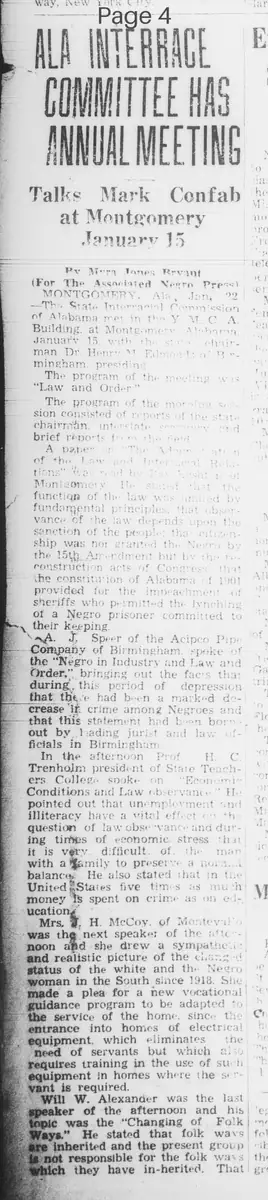
COMMITTEE HAS
ANNUAL MEETING
Talks Mark Confab
at Montgomery
January 15
By Mura Jones Revis
(For The Associated Negro Press)
MONTGOMERY, Ala., Jan. 12—
The State Interracial Commission of Alabama met in the Y.M.C.A. Building at Montgomery, January 15 with Dr. Henry Ed.
Birmingham presiding.
The program of the meeting was "Law and Order."
The program of the session consisted of parts of the state.
chairman introduced and brief report.
A paper of the tone "We Montgomery function of the law was fundamental principle.
vance of the law determined sanction of the people.
ship was not gained the 15th Amendment but the
construction act of Congress."
The constitution of Alabama of 1901 provided for the removal of sheriffs who permitted the lynching of a Negro prisoner committed to their keeping.
A. J. Speer of the Acipco Pipe Company of Birmingham spoke on the "Negro in Industry and Law and Order," bringing out the facts that during this period of depression that there had been a marked decrease in crime among Negroes and that this statement had been borne out by leading jurists and law officials in Birmingham.
In the afternoon Prof. H. C. Trenholm, president of State Teachers College, spoke on Economic Conditions and Law because he pointed out that unemployment and illiteracy have a vital effect on question of law observance and during times of economic stress it is very difficult for human with a family to preserve a normal balance. He also stated that in the United States five times as much money is spent on crime as on education.
Mrs. H. H. McCoy of Montgomery was the next speaker of the noon and she drew a sympathetic and realistic picture of the civil status of the white and the Negro woman in the South since 1918. She made a plea for a new vocational guidance program to be adapted the service of the home, since the entrance into homes of electrical equipment, which eliminates the need of servants but which also requires training in the use of such equipment in homes where the servant is required.
Will W. Alexander was the last speaker of the afternoon and his topic was the "Changing of Folk Ways." He stated that folk ways are inherited and the present group is not responsible for the folk ways which they have inherited. That legislation is useless and has meaning only when you do change folk ways: that education is responsible for the tremendous rapidity of the change of folk ways among Negroes in the last forty years.
What sub-type of article is it?
What themes does it cover?
What keywords are associated?
What entities or persons were involved?
Where did it happen?
Story Details
Key Persons
Location
Montgomery, Ala., Y.M.C.A. Building
Event Date
January 15
Story Details
The Alabama State Interracial Commission met in Montgomery with Dr. Henry Ed. Birmingham presiding. The program focused on 'Law and Order,' featuring reports, papers on law's function, the 15th Amendment, Alabama's 1901 constitution on lynching, speeches on Negroes in industry, economic conditions affecting law observance, civil status of women, and changing folk ways.