Thank you for visiting SNEWPapers!
Sign up free
Editorial
November 9, 1825
The Massachusetts Spy, And Worcester County Advertiser
Worcester, Worcester County, Massachusetts
What is this article about?
Editorial from Worcester, November 9, 1825, critiques General Andrew Jackson's resignation as U.S. Senator after nomination for President by Tennessee Legislature. It accuses him of hypocritical claims of disinterestedness, inconsistency in office principles, and early opposition to the Adams administration.
Merged-components note: Continuation of the editorial on Gen. Jackson across pages.
Clippings
1 of 2
OCR Quality
95%
Excellent
Full Text
Worcester:
Wednesday, November 9, 1825.
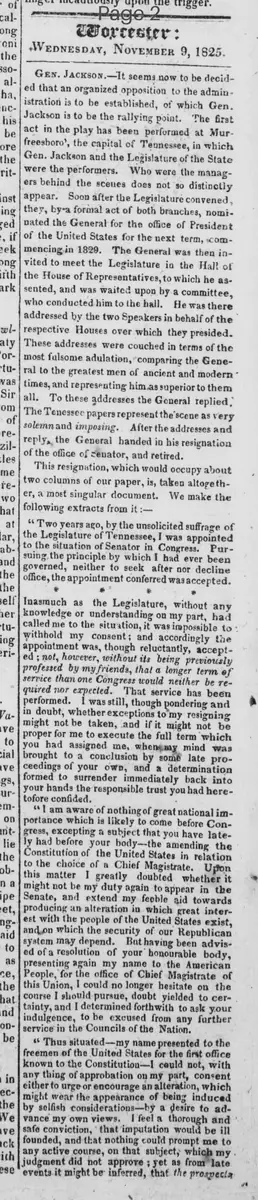
Gen. Jackson.--It seems now to be decided that an organized opposition to the administration is to be established, of which Gen. Jackson is to be the rallying point. The first act in the play has been performed at Murfreesboro', the capital of Tennessee, in which Gen. Jackson and the Legislature of the State were the performers. Who were the managers behind the scenes does not so distinctly appear. Soon after the Legislature convened, they, by a formal act of both branches, nominated the General for the office of President of the United States for the next term, commencing in 1829. The General was then invited to meet the Legislature in the Hall of the House of Representatives, to which he assented, and was waited upon by a committee, who conducted him to the hall. He was there addressed by the two Speakers in behalf of the respective Houses over which they presided. These addresses were couched in terms of the most fulsome adulation, comparing the General to the greatest men of ancient and modern times, and representing him as superior to them all. To these addresses the General replied. The Tennessee papers represent the scene as very solemn and imposing. After the addresses and reply, the General handed in his resignation of the office of senator, and retired.
This resignation, which would occupy about two columns of our paper, is, taken altogether, a most singular document. We make the following extracts from it :--
"Two years ago, by the unsolicited suffrage of the Legislature of Tennessee, I was appointed to the situation of Senator in Congress. Pursuing the principle by which I had ever been governed, neither to seek after nor decline office, the appointment conferred was accepted. Inasmuch as the Legislature, without any knowledge or understanding on my part, had called me to the situation, it was impossible to withhold my consent; and accordingly the appointment was, though reluctantly, accepted; not, however, without its being previously professed by my friends, that a longer term of service than one Congress would neither be required nor expected. That service has been performed. I was still, though pondering and in doubt, whether exceptions to my resigning might not be taken, and if it might not be proper for me to execute the full term which you had assigned me, when my mind was brought to a conclusion by some late proceedings of your own, and a determination formed to surrender immediately back into your hands the responsible trust you had heretofore confided.
"I am aware of nothing of great national importance which is likely to come before Congress, excepting a subject that you have lately had before your body--the amending the Constitution of the United States in relation to the choice of a Chief Magistrate. Upon this matter I greatly doubted whether it might not be my duty again to appear in the Senate, and extend my feeble aid towards producing an alteration in which great interest with the people of the United States exist, and on which the security of our Republican system may depend. But having been advised of a resolution of your honourable body, presenting again my name to the American People, for the office of Chief Magistrate of this Union, I could no longer hesitate on the course I should pursue, doubt yielded to certainty, and I determined forthwith to ask your indulgence, to be excused from any further service in the Councils of the Nation.
"Thus situated--my name presented to the freemen of the United States for the first office known to the Constitution--I could not, with any thing of approbation on my part, consent either to urge or encourage an alteration, which might wear the appearance of being induced by selfish considerations--by a desire to advance my own views. I feel a thorough and safe conviction, that imputation would be ill founded, and that nothing could prompt me to any active course, on that subject, which my judgment did not approve ; yet as from late events it might be inferred, that the prospects ... of your recommendation could be rendered probable only by the People having the choice given to them direct, abundant room would be afforded to ascribe any exertions of mine to causes appertaining exclusively to myself. Imputations thus made, would be extremely irksome to any person of virtuous and independent feeling : they would certainly prove so to me: and hence the determination to retire from a situation where strong suspicions might at least attach, and with great seeming propriety. I hasten, therefore, to tender this my resignation into the hands of those who conferred it, that, in the exercise of their constitutional rights, they may confide it to some one deserving their confidence and approbation.
The first thing that we notice in this letter is the oft repeated slang, (we know no better name to call it.) of Gen. Jackson, about his pre-eminent disinterestedness. When the Legislature of South Carolina, some three or four years since, nominated the now departed Lowndes for the office of President, he said, in his reply to the Committee which announced the nomination, that the office of President was one which was neither to be sought nor declined. This idea was seized upon by Gen. Jackson, and afterward impressed into his service, when the Legislature of Tennessee nominated him for the same station, and he has not failed to harp upon it, whenever opportunity presented, ever since.
This principle may, perhaps, be defended, if applied to the office of President only, but when made of general application, as it is by Gen. Jackson. it is manifestly incorrect. It is the duty of a good citizen, to seek an office for which he is conscious he is well qualified, if thereby one who is unsuitable will be excluded: and he is equally bound to decline, when his acceptance will exclude one who is more worthy of it.
But Gen. Jackson's practice does not correspond with his professions. Almost in the same breath, in which he lays it down as a principle to decline no office, he does decline serving for four years in the office of Senator, to which he has been appointed, and avows, as a motive for so doing, the desire that some person may be appointed in his stead, who may carry into effect the only measures that can secure his appointment to another office. (which, however, he would have us believe he does not seek,) without the imputation of personal or sinister motives. He has, also, on another occasion, declared that the new Administration should be judged only by its acts, and yet he is found, almost in its outset, concerting measures with the Legislature of Tennessee for raising the standard of opposition to it.
But why all this affectation of delicacy, and fear of improper imputations, if Gen. Jackson is a man of the firmness and independence which his friends represent him to be? During the last four years, John Quincy Adams and William H. Crawford were placed in a far more delicate situation than the General, and went straight forward, in the discharge of their respective duties, as far as they were capable, without any of this palaver on the subject, either in communications to Legislative bodies, or in any published correspondence with their political friends.
One who is unacquainted with our political history would be led from a perusal of Gen. Jackson's communications, to believe that he afforded a peculiar and striking instance of disinterestedness and patriotism. Such an imputation on the character of our public men it is our duty to repel. We have seen no instances of such peculiar self devotion, and disregard to public favor. On the contrary in whatever situation he has been placed, he has, generally, either failed to shew any extraordinary fitness for the place, or has abused the trust reposed in him
On the whole, if Gen. Jackson is to be tried by the rules which he has laid down, he will find Tekel inscribed on the wall, in a hand writing, neither to be misinterpreted or misunderstood.
Wednesday, November 9, 1825.
Gen. Jackson.--It seems now to be decided that an organized opposition to the administration is to be established, of which Gen. Jackson is to be the rallying point. The first act in the play has been performed at Murfreesboro', the capital of Tennessee, in which Gen. Jackson and the Legislature of the State were the performers. Who were the managers behind the scenes does not so distinctly appear. Soon after the Legislature convened, they, by a formal act of both branches, nominated the General for the office of President of the United States for the next term, commencing in 1829. The General was then invited to meet the Legislature in the Hall of the House of Representatives, to which he assented, and was waited upon by a committee, who conducted him to the hall. He was there addressed by the two Speakers in behalf of the respective Houses over which they presided. These addresses were couched in terms of the most fulsome adulation, comparing the General to the greatest men of ancient and modern times, and representing him as superior to them all. To these addresses the General replied. The Tennessee papers represent the scene as very solemn and imposing. After the addresses and reply, the General handed in his resignation of the office of senator, and retired.
This resignation, which would occupy about two columns of our paper, is, taken altogether, a most singular document. We make the following extracts from it :--
"Two years ago, by the unsolicited suffrage of the Legislature of Tennessee, I was appointed to the situation of Senator in Congress. Pursuing the principle by which I had ever been governed, neither to seek after nor decline office, the appointment conferred was accepted. Inasmuch as the Legislature, without any knowledge or understanding on my part, had called me to the situation, it was impossible to withhold my consent; and accordingly the appointment was, though reluctantly, accepted; not, however, without its being previously professed by my friends, that a longer term of service than one Congress would neither be required nor expected. That service has been performed. I was still, though pondering and in doubt, whether exceptions to my resigning might not be taken, and if it might not be proper for me to execute the full term which you had assigned me, when my mind was brought to a conclusion by some late proceedings of your own, and a determination formed to surrender immediately back into your hands the responsible trust you had heretofore confided.
"I am aware of nothing of great national importance which is likely to come before Congress, excepting a subject that you have lately had before your body--the amending the Constitution of the United States in relation to the choice of a Chief Magistrate. Upon this matter I greatly doubted whether it might not be my duty again to appear in the Senate, and extend my feeble aid towards producing an alteration in which great interest with the people of the United States exist, and on which the security of our Republican system may depend. But having been advised of a resolution of your honourable body, presenting again my name to the American People, for the office of Chief Magistrate of this Union, I could no longer hesitate on the course I should pursue, doubt yielded to certainty, and I determined forthwith to ask your indulgence, to be excused from any further service in the Councils of the Nation.
"Thus situated--my name presented to the freemen of the United States for the first office known to the Constitution--I could not, with any thing of approbation on my part, consent either to urge or encourage an alteration, which might wear the appearance of being induced by selfish considerations--by a desire to advance my own views. I feel a thorough and safe conviction, that imputation would be ill founded, and that nothing could prompt me to any active course, on that subject, which my judgment did not approve ; yet as from late events it might be inferred, that the prospects ... of your recommendation could be rendered probable only by the People having the choice given to them direct, abundant room would be afforded to ascribe any exertions of mine to causes appertaining exclusively to myself. Imputations thus made, would be extremely irksome to any person of virtuous and independent feeling : they would certainly prove so to me: and hence the determination to retire from a situation where strong suspicions might at least attach, and with great seeming propriety. I hasten, therefore, to tender this my resignation into the hands of those who conferred it, that, in the exercise of their constitutional rights, they may confide it to some one deserving their confidence and approbation.
The first thing that we notice in this letter is the oft repeated slang, (we know no better name to call it.) of Gen. Jackson, about his pre-eminent disinterestedness. When the Legislature of South Carolina, some three or four years since, nominated the now departed Lowndes for the office of President, he said, in his reply to the Committee which announced the nomination, that the office of President was one which was neither to be sought nor declined. This idea was seized upon by Gen. Jackson, and afterward impressed into his service, when the Legislature of Tennessee nominated him for the same station, and he has not failed to harp upon it, whenever opportunity presented, ever since.
This principle may, perhaps, be defended, if applied to the office of President only, but when made of general application, as it is by Gen. Jackson. it is manifestly incorrect. It is the duty of a good citizen, to seek an office for which he is conscious he is well qualified, if thereby one who is unsuitable will be excluded: and he is equally bound to decline, when his acceptance will exclude one who is more worthy of it.
But Gen. Jackson's practice does not correspond with his professions. Almost in the same breath, in which he lays it down as a principle to decline no office, he does decline serving for four years in the office of Senator, to which he has been appointed, and avows, as a motive for so doing, the desire that some person may be appointed in his stead, who may carry into effect the only measures that can secure his appointment to another office. (which, however, he would have us believe he does not seek,) without the imputation of personal or sinister motives. He has, also, on another occasion, declared that the new Administration should be judged only by its acts, and yet he is found, almost in its outset, concerting measures with the Legislature of Tennessee for raising the standard of opposition to it.
But why all this affectation of delicacy, and fear of improper imputations, if Gen. Jackson is a man of the firmness and independence which his friends represent him to be? During the last four years, John Quincy Adams and William H. Crawford were placed in a far more delicate situation than the General, and went straight forward, in the discharge of their respective duties, as far as they were capable, without any of this palaver on the subject, either in communications to Legislative bodies, or in any published correspondence with their political friends.
One who is unacquainted with our political history would be led from a perusal of Gen. Jackson's communications, to believe that he afforded a peculiar and striking instance of disinterestedness and patriotism. Such an imputation on the character of our public men it is our duty to repel. We have seen no instances of such peculiar self devotion, and disregard to public favor. On the contrary in whatever situation he has been placed, he has, generally, either failed to shew any extraordinary fitness for the place, or has abused the trust reposed in him
On the whole, if Gen. Jackson is to be tried by the rules which he has laid down, he will find Tekel inscribed on the wall, in a hand writing, neither to be misinterpreted or misunderstood.
What sub-type of article is it?
Partisan Politics
Constitutional
What keywords are associated?
Jackson Nomination
Tennessee Legislature
Senate Resignation
Political Opposition
Disinterestedness
Constitutional Amendment
Adams Administration
What entities or persons were involved?
Gen. Jackson
Legislature Of Tennessee
John Quincy Adams
William H. Crawford
Lowndes
Editorial Details
Primary Topic
Critique Of Gen. Jackson's Senate Resignation And Presidential Nomination
Stance / Tone
Critical Of Jackson's Feigned Disinterestedness And Political Inconsistency
Key Figures
Gen. Jackson
Legislature Of Tennessee
John Quincy Adams
William H. Crawford
Lowndes
Key Arguments
Jackson's Repeated Claim Of Neither Seeking Nor Declining Office Is Hypocritical Slang.
His Resignation Avoids Apparent Self Interest In Constitutional Amendments For Presidential Election.
Practice Contradicts Professions By Declining Senate Term To Pursue Presidency Without Imputation.
Early Opposition To Adams Administration Contradicts Prior Statements To Judge By Acts.
Lacks True Firmness; Contrasts With Adams And Crawford's Straightforward Duty.
No Evidence Of Peculiar Patriotism; Often Unfit Or Abusive Of Trust.
By His Own Rules, Jackson Is Found Wanting (Tekel).