Thank you for visiting SNEWPapers!
Sign up free
Editorial
August 19, 1933
The Omaha Guide
Omaha, Douglas County, Nebraska
What is this article about?
Editorial argues against demands to reduce utility rates in line with falling living costs, explaining utilities' unique position under regulation, slow capital turnover, and need for stable service. Rates will decrease naturally through efficiency improvements.
Clipping
OCR Quality
98%
Excellent
Full Text
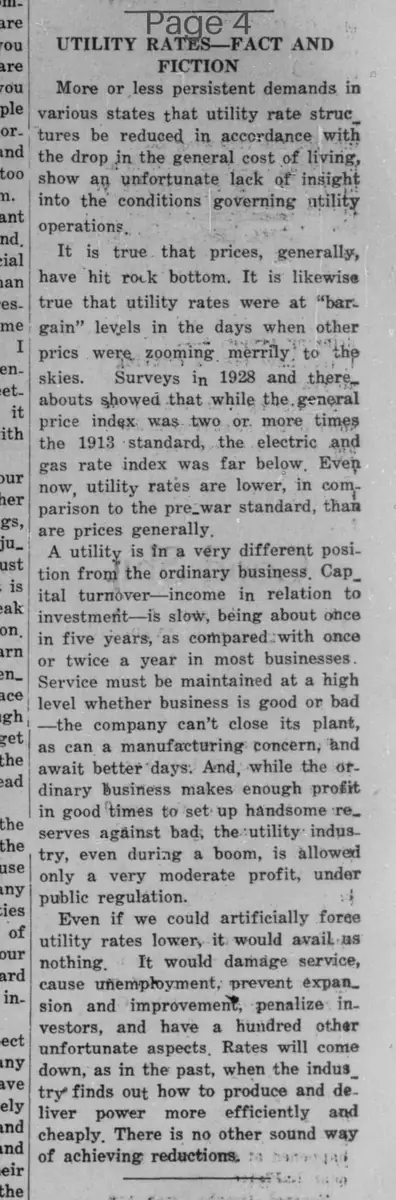
UTILITY RATES-FACT AND FICTION
More or less persistent demands in various states that utility rate structures be reduced in accordance with the drop in the general cost of living, show an unfortunate lack of insight into the conditions governing utility operations.
It is true that prices, generally, have hit rock bottom. It is likewise true that utility rates were at bargain levels in the days when other prices were zooming, merrily, to the skies. Surveys in 1928 and thereabouts showed that while the general price index was two or more times the 1913 standard, the electric and gas rate index was far below. Even now, utility rates are lower, in comparison to the pre-war standard, than are prices generally.
A utility is in a very different position from the ordinary business. Capital turnover--income in relation to investment--is slow, being about once in five years, as compared with once or twice a year in most businesses. Service must be maintained at a high level whether business is good or bad--the company can't close its plant, as can a manufacturing concern, and await better days: And, while the ordinary business makes enough profit in good times to set up handsome reserves against bad, the utility industry, even during a boom, is allowed only a very moderate profit, under public regulation.
Even if we could artificially force utility rates lower, it would avail us nothing. It would damage service, cause unemployment, prevent expansion and improvement, penalize investors, and have a hundred other unfortunate aspects. Rates will come down, as in the past, when the industry finds out how to produce and deliver power more efficiently and cheaply. There is no other sound way of achieving reductions.
More or less persistent demands in various states that utility rate structures be reduced in accordance with the drop in the general cost of living, show an unfortunate lack of insight into the conditions governing utility operations.
It is true that prices, generally, have hit rock bottom. It is likewise true that utility rates were at bargain levels in the days when other prices were zooming, merrily, to the skies. Surveys in 1928 and thereabouts showed that while the general price index was two or more times the 1913 standard, the electric and gas rate index was far below. Even now, utility rates are lower, in comparison to the pre-war standard, than are prices generally.
A utility is in a very different position from the ordinary business. Capital turnover--income in relation to investment--is slow, being about once in five years, as compared with once or twice a year in most businesses. Service must be maintained at a high level whether business is good or bad--the company can't close its plant, as can a manufacturing concern, and await better days: And, while the ordinary business makes enough profit in good times to set up handsome reserves against bad, the utility industry, even during a boom, is allowed only a very moderate profit, under public regulation.
Even if we could artificially force utility rates lower, it would avail us nothing. It would damage service, cause unemployment, prevent expansion and improvement, penalize investors, and have a hundred other unfortunate aspects. Rates will come down, as in the past, when the industry finds out how to produce and deliver power more efficiently and cheaply. There is no other sound way of achieving reductions.
What sub-type of article is it?
Economic Policy
Infrastructure
What keywords are associated?
Utility Rates
Economic Regulation
Price Indices
Capital Turnover
Public Utilities
Rate Reduction Demands
What entities or persons were involved?
Utility Companies
Public Regulators
Editorial Details
Primary Topic
Opposition To Reducing Utility Rates Amid Falling Prices
Stance / Tone
Defensive Of Utility Industry Stability And Regulation
Key Figures
Utility Companies
Public Regulators
Key Arguments
Utility Rates Are Already Low Compared To General Prices And Pre War Standards.
Utilities Have Slow Capital Turnover And Must Maintain Service Regardless Of Economic Conditions.
Regulated Profits Are Moderate, Unlike Other Businesses That Build Reserves In Good Times.
Forcing Lower Rates Would Harm Service, Cause Unemployment, And Penalize Investors.
Rates Will Decrease Naturally Through Efficiency Improvements.