Thank you for visiting SNEWPapers!
Sign up free
Staunton Spectator
Staunton, Virginia
What is this article about?
The Peace Conference in Washington proposes a settlement to national differences on slavery: prohibiting involuntary servitude north of 36°30' N latitude, protecting it south, restricting territorial acquisitions, and adding constitutional safeguards against federal interference in states' slavery laws. The Richmond Whig endorses it for Virginia and the nation.
Clipping
OCR Quality
Full Text
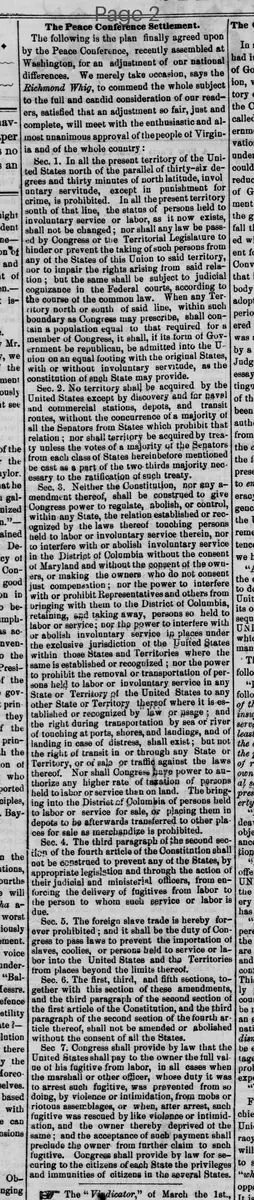
The following is the plan finally agreed upon by the Peace Conference, recently assembled at Washington, for an adjustment of our national differences. We merely take occasion, says the Richmond Whig, to commend the whole subject to the full and candid consideration of our readers, satisfied that an adjustment so fair, just and complete, will meet with the enthusiastic and almost unanimous approval of the people of Virginia and of the whole country:
Sec. 1. In all the present territory of the United States north of the parallel of thirty-six degrees and thirty minutes of north latitude, involuntary servitude, except in punishment for crime, is prohibited. In all the present territory south of that line, the status of persons held to involuntary service or labor, as it now exists, shall not be changed; nor shall any law be passed by Congress or the Territorial Legislature to hinder or prevent the taking of such persons from any of the States of this Union to said territory, nor to impair the rights arising from said relation; but the same shall be subject to judicial cognizance in the Federal courts, according to the course of the common law. When any Territory north or south of said line, within such boundary as Congress may prescribe, shall contain a population equal to that required for a member of Congress, it shall, if its form of Government be republican, be admitted into the Union on an equal footing with the original States, with or without involuntary servitude, as the constitution of such State may provide.
Sec. 2. No territory shall be acquired by the United States except by discovery and for naval and commercial stations, depots, and transit routes, without the concurrence of a majority of all the Senators from States which prohibit that relation; nor shall territory be acquired by treaty unless the votes of a majority of the Senators from each class of States hereinbefore mentioned be cast as a part of the two-thirds majority necessary to the ratification of such treaty.
Sec. 3. Neither the Constitution, nor any amendment thereof, shall be construed to give Congress power to regulate, abolish, or control, within any State, the relation established or recognized by the laws thereof touching persons held to labor or involuntary service therein, nor to interfere with or abolish involuntary service in the District of Columbia without the consent of Maryland and without the consent of the owners, or making the owners who do not consent just compensation; nor the power to interfere with or prohibit Representatives and others from bringing with them to the District of Columbia, retaining, and taking away, persons so held to labor or service; nor the power to interfere with or abolish involuntary service in places under the exclusive jurisdiction of the United States within those States and Territories where the same is established or recognized; nor the power to prohibit the removal or transportation of persons held to labor or involuntary service in any State or Territory of the United States to any other State or Territory thereof where it is established or recognized by law or usage; and the right during transportation by sea or river of touching at ports, shores, and landings, and of landing in case of distress, shall exist; but not the right of transit in or through any State or Territory, or of sale or traffic against the laws thereof. Nor shall Congress have power to authorize any higher rate of taxation of persons held to labor or service than on land. The bringing into the District of Columbia of persons held to labor or service for sale, or placing them in depots to be afterwards transferred to other places for sale as merchandise is prohibited.
Sec. 4. The third paragraph of the second section of the fourth article of the Constitution shall not be construed to prevent any of the States, by appropriate legislation and through the action of their judicial and ministerial officers, from enforcing the delivery of fugitives from labor to the person to whom such service or labor is due.
Sec. 5. The foreign slave trade is hereby forever prohibited; and it shall be the duty of Congress to pass laws to prevent the importation of slaves, coolies, or persons held to service or labor into the United States and the Territories from places beyond the limits thereof.
Sec. 6. The first, third, and fifth sections, together with this section of these amendments, and the third paragraph of the second section of the first article of the Constitution, and the third paragraph of the second section of the fourth article thereof, shall not be amended or abolished without the consent of all the States.
Sec. 7. Congress shall provide by law that the United States shall pay to the owner the full value of his fugitive from labor, in all cases when the marshall or other officer, whose duty it was to arrest such fugitive, was prevented from so doing, by violence or intimidation, from mobs or riotous assemblages, or when, after arrest, such fugitive was rescued by like violence or intimidation, and the owner thereby deprived of the same; and the acceptance of such payment shall preclude the owner from further claim to such fugitive. Congress shall provide by law for securing to the citizens of each State the privileges and immunities of citizens in the several States.
What sub-type of article is it?
What keywords are associated?
What entities or persons were involved?
Where did it happen?
Domestic News Details
Primary Location
Washington
Event Date
Recently
Key Persons
Outcome
plan agreed upon for adjustment of national differences on slavery and territories, commended for approval by virginia and the country.
Event Details
The Peace Conference assembled at Washington agrees on a plan with seven sections addressing slavery in territories, territorial acquisitions, congressional powers over slavery in states and federal areas, fugitive slave enforcement, prohibition of foreign slave trade, amendment protections, and compensation for lost fugitives.