Thank you for visiting SNEWPapers!
Sign up free
Literary
September 17, 1884
The Vermont Watchman
Montpelier, Washington County, Vermont
What is this article about?
In Chapter V of 'A Romance of the Granite State,' William Forest excels at college despite financial constraints. Facing a shortage, he receives mysterious anonymous financial aid delivered by a negro messenger. He teaches school in Randolph, VT, receives ongoing aid, and graduates honorably, crediting God's providence.
Clipping
OCR Quality
95%
Excellent
Full Text
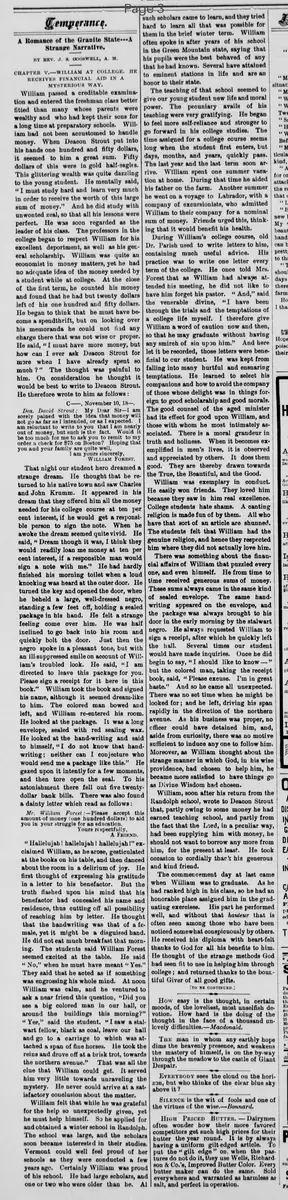
A Romance of the Granite State—A
Strange Narrative.
BY REV. J. S. COGSWELL, A. M.
CHAPTER V.—WILLIAM AT COLLEGE. HE
RECEIVES FINANCIAL AID IN A
MYSTERIOUS WAY.
William passed a creditable examination
and entered the freshman class better
fitted than many whose parents were
wealthy and who had kept their sons for
a long time at preparatory schools. William
had not been accustomed to handle
money. When Deacon Strout put into
his hands one hundred and fifty dollars,
it seemed to him a great sum. Fifty
dollars of this were in gold half-eagles.
This glittering wealth was quite dazzling
to the young student. He mentally said,
"I must study hard and learn very much
in order to receive the worth of this large
sum of money." And he did study with
unwonted zeal, so that all his lessons were
perfect. He was soon regarded as the
leader of his class. The professors in the
college began to respect William for his
excellent deportment, as well as his general
scholarship. William was quite an
economist in money matters, yet he had
no adequate idea of the money needed by
a student while at college. At the close
of the first term, he counted his money
and found that he had but twenty dollars
left of his one hundred and fifty dollars.
He began to think that he must have be-
come a spendthrift, but on looking over
his memoranda he could not find any
charge there that was not wise or proper.
He said, "I must have more money, but
how can I ever ask Deacon Strout for
more when I have already spent so
much?" The thought was painful to
him. On consideration he thought it
would be best to write to Deacon Strout.
He therefore wrote to him as follows:
C——, November 10, 18—.
Dea. David Strout: My Dear Sir—I am
sorely pained with the idea that money will
not go as far as I intended, or as I expected. I
am reluctant to write to you that I am nearly
out of money, but such is the fact. Would it
be too much for me to ask you to remit to my
order a check for $75 on Boston? Hoping that
you and your family are quite well,
I am yours sincerely,
WILLIAM FOREST.
That night our student hero dreamed a
strange dream. He thought that he re-
turned to his native town and saw Charles
and John Krumm. It appeared in his
dream that they offered him all the money
needed for his college course at ten per
cent interest, if he would get a responsi-
ble person to sign the note. When he
awoke the dream seemed quite vivid. He
said, "Dream though it was, I think they
would readily loan me money at ten per
cent interest, if a responsible man would
sign a note with me." He had hardly
finished his morning toilet when a loud
knocking was heard at the outer door. He
turned the key and opened the door, where
he beheld a large, well-dressed negro,
standing a few feet off, holding a sealed
package in his hand. He felt a strange
feeling come over him. He was half
inclined to go back into his room and
quickly bolt the door. Just then the
negro spoke in a pleasant tone, but with
an ill-suppressed smile on account of Will-
iam's troubled look. He said, "I am
directed to leave this package for you.
Please sign a receipt for it here in this
book." William took the book and signed
his name, although it seemed dream-like
to him. The colored man bowed and
left, and William re-entered his room.
He looked at the package. It was a long
envelope, sealed with red sealing wax.
He looked at the hand-writing and said
to himself, "I do not know that hand
writing; neither can I conjecture who
would send me a package like this." He
gazed upon it intently for a few moments,
and then tore open the seal. To his
astonishment there fell out five twenty.
dollar bank bills. There was also found
a dainty letter which read as follows:
Mr. William Forest:—Please accept this
amount of money (one hundred dollars) to aid
you in your struggle for an education.
Yours respectfully,
A FRIEND.
"Hallelujah! hallelujah! hallelujah!" ex-
claimed William, as he arose, gesticulated
at the books on his table, and then danced
about the room in a delirium of joy. He
first thought of expressing his gratitude
in a letter to his benefactor. But the
truth flashed upon his mind that his
benefactor had concealed his name and
residence, thus cutting off all possibility
of reaching him by letter. He thought
that the handwriting was that of a fe-
male, yet it might be a disguised hand.
He did not eat much breakfast that morn-
ing. The students said William Forest
seemed excited at the table. He said
"No," when he must have meant "Yes."
They said that he acted as if something
was engrossing his whole mind. At noon
William was calm, and he ventured to
ask a near friend this question, "Did you
see a big colored man in our hall, or
around the buildings this morning?"
"Yes," said the student, "I saw a stal-
wart fellow, black as coal, leave our hall
and go to a carriage to which was at-
tached a span of fine horses. He took the
reins and drove off at a brisk trot, towards
the northern avenue." That was all the
clue that William could get. It served
him very little towards unraveling the
mystery. He never could arrive at a sat-
isfactory conclusion about the matter.
William felt that while he was grateful
for the help so unexpectedly given, yet
he must help himself. So he applied for
and obtained a winter school in Randolph.
The school was large, and the scholars
soon became interested in their studies.
Vermont could well feel proud of her
schools as they were conducted a few
years ago. Certainly William was proud
of his school. He had large scholars, and
one or two who were older than he. All
such scholars came to learn, and they tried
hard to learn all that was possible for
them in the brief winter term. William
often spoke in after years of his school
in the Green Mountain state, saying that
his pupils were the best behaved of any
that he had known. Several have attained
to eminent stations in life and are an
honor to their state.
The teaching of that school seemed to
give our young student new life and moral
power. The pecuniary avails of his
teaching were very gratifying. He began
to feel more self-reliance and stronger to
go forward in his college studies. The
time assigned for a college course seems
long when the student first enters, but
days, months, and years, quickly pass.
The last year and the last term soon ar-
rive. William spent one summer vaca-
tion at home. During that time he aided
his father on the farm. Another summer
he went on a voyage to Labrador, with a
company of excursionists, who admitted
William to their company for a nominal
sum of money. Friends urged this, think-
ing that it would benefit his health.
During William's college course, old
Dr. Parish used to write letters to him,
containing much useful advice. His
practice was to write one letter every
term of the college. He once told Mrs.
Forest that as William had always at-
tended his meeting, he did not like to
have him forget his pastor. "And," said
the venerable divine, "I have been
through the trials and the temptations of
a college life myself. I therefore give
William a word of caution now and then,
so that he may graduate without having
any smirch of sin upon him." And here
let it be recorded, those letters were bene-
ficial to our student. He was kept from
falling into many hurtful and ensnaring
temptations. He learned to select his
companions and how to avoid the company
of those whose delight was in things for-
eign to good scholarship and good morals.
The good counsel of the aged minister
had its effect for good upon William, and
those with whom he most intimately as-
sociated. There is a moral grandeur in
truth and holiness. When it becomes ex-
emplified in men's lives, it is observed
and appreciated by others. It does them
good. They are thereby drawn towards
the True, the Beautiful, and the Good.
William was exemplary in conduct.
He easily won friends. They loved him
because they saw in him real excellence.
College students hate shams. A canting
religion is made fun of by them. All who
have that sort of an article are shunned.
The students felt that William had the
genuine religion, and hence they respected
him where they did not actually love him.
There was something about the finan-
cial affairs of William that puzzled every
one, and even himself. He from time to
time received generous sums of money.
These sums always came in the same kind
of sealed envelope. The same hand.
writing appeared on the envelope, and
the package was always brought to his
door in the early morning by the stalwart
negro. He always requested William to
sign a receipt, after which he quickly left
the hall. Several times our student
would have made inquiries. Once he did
begin to say, "I should like to know—"
but the colored man, taking the receipt
book, said, "Please excuse. I'm in great
haste." And so he came all unexpected.
There was no set time when he might be
looked for; and he left, driving his span
rapidly in the direction of the northern
avenue.
As his business was proper, no
officer could have detained him, and,
aside from curiosity, there was no motive
sufficient to induce any one to follow him.
Moreover, as William thought about the
strange manner in which God, in his wise
providence, had chosen to help him, he
became more satisfied to have things go
as Divine Wisdom had chosen.
William, soon after his return from the
Randolph school, wrote to Deacon Strout
that, partly owing to some money he had
earned teaching school, and partly from
the fact that the Lord, in a peculiar way,
had been supplying him with money, he
should not want to borrow any more from
him, for the present at least. He took
occasion to cordially thank his generous
and kind friend.
The commencement day at last came
when William was to graduate. As he
had ranked high in his class, so he had an
honorable place assigned him in the grad.
uating exercises.
His part he performed
well, and without that hauteur that is
often seen among those who have been
noticed somewhat conspicuously by others.
He received his diploma with heart-felt
thanks to God for all his benefits to him.
He thought of the strange methods God
had seen fit to use in helping him through
college; and returned thanks to the boun-
tiful Giver of all good gifts.
[TO BE CONTINUED.]
Strange Narrative.
BY REV. J. S. COGSWELL, A. M.
CHAPTER V.—WILLIAM AT COLLEGE. HE
RECEIVES FINANCIAL AID IN A
MYSTERIOUS WAY.
William passed a creditable examination
and entered the freshman class better
fitted than many whose parents were
wealthy and who had kept their sons for
a long time at preparatory schools. William
had not been accustomed to handle
money. When Deacon Strout put into
his hands one hundred and fifty dollars,
it seemed to him a great sum. Fifty
dollars of this were in gold half-eagles.
This glittering wealth was quite dazzling
to the young student. He mentally said,
"I must study hard and learn very much
in order to receive the worth of this large
sum of money." And he did study with
unwonted zeal, so that all his lessons were
perfect. He was soon regarded as the
leader of his class. The professors in the
college began to respect William for his
excellent deportment, as well as his general
scholarship. William was quite an
economist in money matters, yet he had
no adequate idea of the money needed by
a student while at college. At the close
of the first term, he counted his money
and found that he had but twenty dollars
left of his one hundred and fifty dollars.
He began to think that he must have be-
come a spendthrift, but on looking over
his memoranda he could not find any
charge there that was not wise or proper.
He said, "I must have more money, but
how can I ever ask Deacon Strout for
more when I have already spent so
much?" The thought was painful to
him. On consideration he thought it
would be best to write to Deacon Strout.
He therefore wrote to him as follows:
C——, November 10, 18—.
Dea. David Strout: My Dear Sir—I am
sorely pained with the idea that money will
not go as far as I intended, or as I expected. I
am reluctant to write to you that I am nearly
out of money, but such is the fact. Would it
be too much for me to ask you to remit to my
order a check for $75 on Boston? Hoping that
you and your family are quite well,
I am yours sincerely,
WILLIAM FOREST.
That night our student hero dreamed a
strange dream. He thought that he re-
turned to his native town and saw Charles
and John Krumm. It appeared in his
dream that they offered him all the money
needed for his college course at ten per
cent interest, if he would get a responsi-
ble person to sign the note. When he
awoke the dream seemed quite vivid. He
said, "Dream though it was, I think they
would readily loan me money at ten per
cent interest, if a responsible man would
sign a note with me." He had hardly
finished his morning toilet when a loud
knocking was heard at the outer door. He
turned the key and opened the door, where
he beheld a large, well-dressed negro,
standing a few feet off, holding a sealed
package in his hand. He felt a strange
feeling come over him. He was half
inclined to go back into his room and
quickly bolt the door. Just then the
negro spoke in a pleasant tone, but with
an ill-suppressed smile on account of Will-
iam's troubled look. He said, "I am
directed to leave this package for you.
Please sign a receipt for it here in this
book." William took the book and signed
his name, although it seemed dream-like
to him. The colored man bowed and
left, and William re-entered his room.
He looked at the package. It was a long
envelope, sealed with red sealing wax.
He looked at the hand-writing and said
to himself, "I do not know that hand
writing; neither can I conjecture who
would send me a package like this." He
gazed upon it intently for a few moments,
and then tore open the seal. To his
astonishment there fell out five twenty.
dollar bank bills. There was also found
a dainty letter which read as follows:
Mr. William Forest:—Please accept this
amount of money (one hundred dollars) to aid
you in your struggle for an education.
Yours respectfully,
A FRIEND.
"Hallelujah! hallelujah! hallelujah!" ex-
claimed William, as he arose, gesticulated
at the books on his table, and then danced
about the room in a delirium of joy. He
first thought of expressing his gratitude
in a letter to his benefactor. But the
truth flashed upon his mind that his
benefactor had concealed his name and
residence, thus cutting off all possibility
of reaching him by letter. He thought
that the handwriting was that of a fe-
male, yet it might be a disguised hand.
He did not eat much breakfast that morn-
ing. The students said William Forest
seemed excited at the table. He said
"No," when he must have meant "Yes."
They said that he acted as if something
was engrossing his whole mind. At noon
William was calm, and he ventured to
ask a near friend this question, "Did you
see a big colored man in our hall, or
around the buildings this morning?"
"Yes," said the student, "I saw a stal-
wart fellow, black as coal, leave our hall
and go to a carriage to which was at-
tached a span of fine horses. He took the
reins and drove off at a brisk trot, towards
the northern avenue." That was all the
clue that William could get. It served
him very little towards unraveling the
mystery. He never could arrive at a sat-
isfactory conclusion about the matter.
William felt that while he was grateful
for the help so unexpectedly given, yet
he must help himself. So he applied for
and obtained a winter school in Randolph.
The school was large, and the scholars
soon became interested in their studies.
Vermont could well feel proud of her
schools as they were conducted a few
years ago. Certainly William was proud
of his school. He had large scholars, and
one or two who were older than he. All
such scholars came to learn, and they tried
hard to learn all that was possible for
them in the brief winter term. William
often spoke in after years of his school
in the Green Mountain state, saying that
his pupils were the best behaved of any
that he had known. Several have attained
to eminent stations in life and are an
honor to their state.
The teaching of that school seemed to
give our young student new life and moral
power. The pecuniary avails of his
teaching were very gratifying. He began
to feel more self-reliance and stronger to
go forward in his college studies. The
time assigned for a college course seems
long when the student first enters, but
days, months, and years, quickly pass.
The last year and the last term soon ar-
rive. William spent one summer vaca-
tion at home. During that time he aided
his father on the farm. Another summer
he went on a voyage to Labrador, with a
company of excursionists, who admitted
William to their company for a nominal
sum of money. Friends urged this, think-
ing that it would benefit his health.
During William's college course, old
Dr. Parish used to write letters to him,
containing much useful advice. His
practice was to write one letter every
term of the college. He once told Mrs.
Forest that as William had always at-
tended his meeting, he did not like to
have him forget his pastor. "And," said
the venerable divine, "I have been
through the trials and the temptations of
a college life myself. I therefore give
William a word of caution now and then,
so that he may graduate without having
any smirch of sin upon him." And here
let it be recorded, those letters were bene-
ficial to our student. He was kept from
falling into many hurtful and ensnaring
temptations. He learned to select his
companions and how to avoid the company
of those whose delight was in things for-
eign to good scholarship and good morals.
The good counsel of the aged minister
had its effect for good upon William, and
those with whom he most intimately as-
sociated. There is a moral grandeur in
truth and holiness. When it becomes ex-
emplified in men's lives, it is observed
and appreciated by others. It does them
good. They are thereby drawn towards
the True, the Beautiful, and the Good.
William was exemplary in conduct.
He easily won friends. They loved him
because they saw in him real excellence.
College students hate shams. A canting
religion is made fun of by them. All who
have that sort of an article are shunned.
The students felt that William had the
genuine religion, and hence they respected
him where they did not actually love him.
There was something about the finan-
cial affairs of William that puzzled every
one, and even himself. He from time to
time received generous sums of money.
These sums always came in the same kind
of sealed envelope. The same hand.
writing appeared on the envelope, and
the package was always brought to his
door in the early morning by the stalwart
negro. He always requested William to
sign a receipt, after which he quickly left
the hall. Several times our student
would have made inquiries. Once he did
begin to say, "I should like to know—"
but the colored man, taking the receipt
book, said, "Please excuse. I'm in great
haste." And so he came all unexpected.
There was no set time when he might be
looked for; and he left, driving his span
rapidly in the direction of the northern
avenue.
As his business was proper, no
officer could have detained him, and,
aside from curiosity, there was no motive
sufficient to induce any one to follow him.
Moreover, as William thought about the
strange manner in which God, in his wise
providence, had chosen to help him, he
became more satisfied to have things go
as Divine Wisdom had chosen.
William, soon after his return from the
Randolph school, wrote to Deacon Strout
that, partly owing to some money he had
earned teaching school, and partly from
the fact that the Lord, in a peculiar way,
had been supplying him with money, he
should not want to borrow any more from
him, for the present at least. He took
occasion to cordially thank his generous
and kind friend.
The commencement day at last came
when William was to graduate. As he
had ranked high in his class, so he had an
honorable place assigned him in the grad.
uating exercises.
His part he performed
well, and without that hauteur that is
often seen among those who have been
noticed somewhat conspicuously by others.
He received his diploma with heart-felt
thanks to God for all his benefits to him.
He thought of the strange methods God
had seen fit to use in helping him through
college; and returned thanks to the boun-
tiful Giver of all good gifts.
[TO BE CONTINUED.]
What sub-type of article is it?
Prose Fiction
What themes does it cover?
Moral Virtue
Religious
What keywords are associated?
College Life
Mysterious Aid
Financial Struggle
Divine Providence
Moral Education
Student Success
What entities or persons were involved?
By Rev. J. S. Cogswell, A. M.
Literary Details
Title
Chapter V.—William At College. He Receives Financial Aid In A Mysterious Way.
Author
By Rev. J. S. Cogswell, A. M.
Key Lines
"Hallelujah! Hallelujah! Hallelujah!" Exclaimed William, As He Arose, Gesticulated At The Books On His Table, And Then Danced About The Room In A Delirium Of Joy.
Mr. William Forest:—Please Accept This Amount Of Money (One Hundred Dollars) To Aid You In Your Struggle For An Education.
Yours Respectfully,
A Friend.
"I Must Study Hard And Learn Very Much In Order To Receive The Worth Of This Large Sum Of Money."
He Thought Of The Strange Methods God Had Seen Fit To Use In Helping Him Through College; And Returned Thanks To The Bountiful Giver Of All Good Gifts.