Thank you for visiting SNEWPapers!
Sign up free
Letter to Editor
August 7, 1772
The New Hampshire Gazette And Historical Chronicle
Portsmouth, Greenland, Rockingham County, New Hampshire
What is this article about?
A correspondent commenting on the Somerset slavery case argues that slaves cannot be property, as all humans are born free, and condemns the slave trade as a violation of natural rights.
Clipping
OCR Quality
100%
Excellent
Full Text
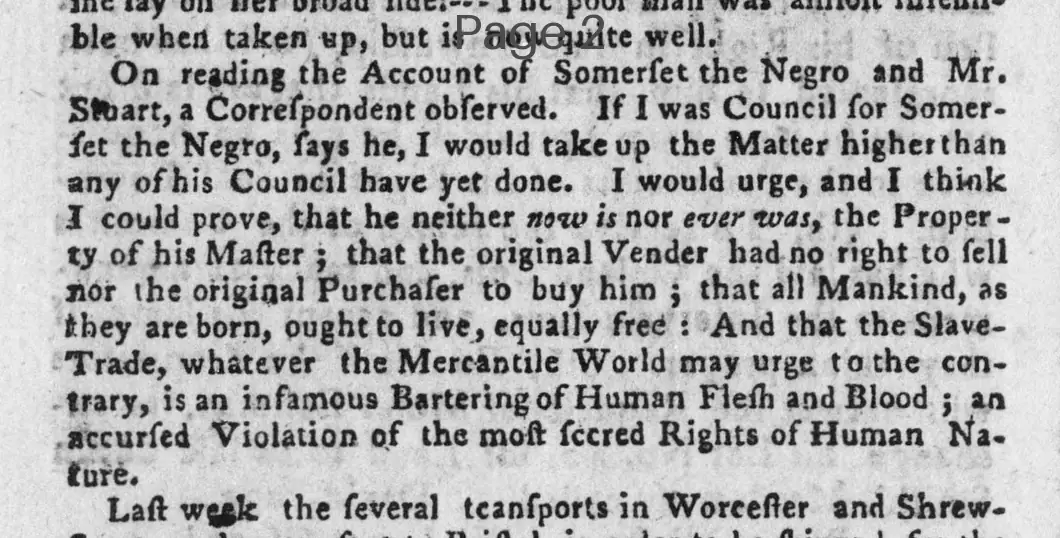
On reading the Account of Somerset the Negro and Mr. Stuart, a Correspondent observed. If I was Council or Somerset the Negro, says he, I would take up the Matter higher than any of his Council have yet done. I would urge, and I think I could prove, that he neither is nor ever was, the Property of his Master; that the original Vender had no right to sell nor the original Purchaser to buy him; that all Mankind, as they are born, ought to live, equally free: And that the Slave-Trade, whatever the Mercantile World may urge to the contrary, is an infamous Bartering of Human Flesh and Blood; an accursed Violation of the most sacred Rights of Human Nature.
What sub-type of article is it?
Persuasive
Ethical Moral
Philosophical
What themes does it cover?
Slavery Abolition
Morality
What keywords are associated?
Somerset Case
Slave Trade
Human Rights
Property Of Slaves
Equally Free
What entities or persons were involved?
A Correspondent
Letter to Editor Details
Author
A Correspondent
Main Argument
in the somerset case, the slave is not and never was the property of his master; the original vendor had no right to sell him, nor the purchaser to buy; all mankind are born equally free, and the slave-trade is an infamous violation of human rights.
Notable Details
References Somerset The Negro And Mr. Stuart
Urges Taking The Legal Argument Higher Than Current Counsel