Thank you for visiting SNEWPapers!
Sign up free
The New Hampshire Gazette
Portsmouth, Rockingham County, New Hampshire
What is this article about?
Detailed account of the court martial of Admiral John Byng at Portsmouth from December 28, 1756, to January 27, 1757, for failing to relieve St. Philip's Castle in Minorca and not engaging the French fleet fully on May 20, 1756. He was unanimously sentenced to death under the 12th Article of War, but the court recommended mercy, citing no cowardice.
Clipping
OCR Quality
Full Text
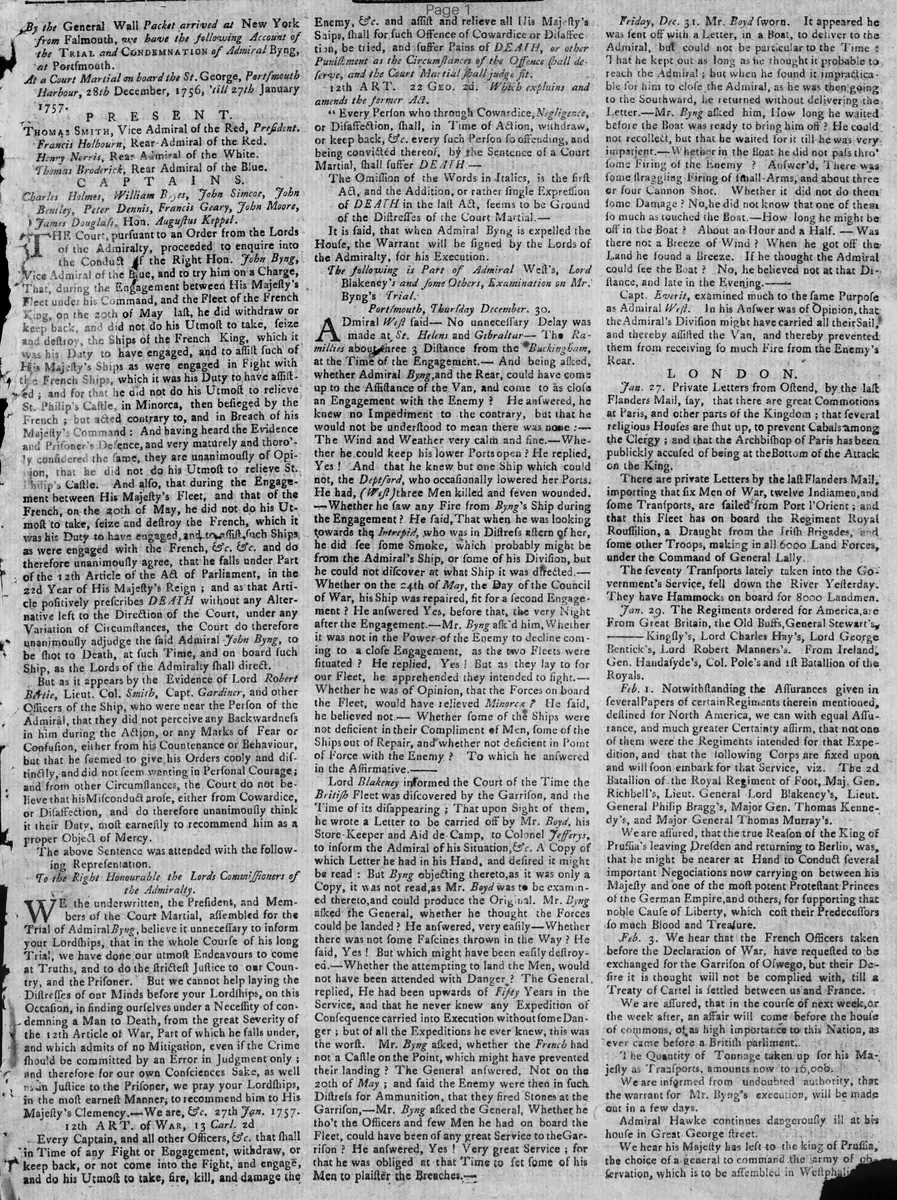
At a Court Martial on board the St. George, Portsmouth Harbour, 28th December, 1756, till 27th January 1757:
PRESENT
Thomas Smith, Vice Admiral of the Red, President.
Francis Holburne, Rear-Admiral of the Red.
Henry Norris, Rear Admiral of the White.
Thomas Broderick, Rear Admiral of the Blue.
CAPTAINS.
Charles Holmes, William Bates, John Simcoe, John Bentley, Peter Dennis, Francis Geary, John Moore, James Douglas, Hon. Augustus Keppel.
The Court, pursuant to an Order from the Lords of the Admiralty, proceeded to enquire into the Conduct of the Right Hon. John Byng, Vice Admiral of the Blue, and to try him on a Charge, That, during the Engagement between His Majesty's Fleet under his Command, and the Fleet of the French King, on the 20th of May last, he did withdraw or keep back, and did not do his utmost to take, seize and destroy, the Ships of the French King, which it was his Duty to have engaged, and to assist such of His Majesty's Ships as were engaged in Fight with the French Ships, which it was his Duty to have assisted; and for that he did not do his utmost to relieve St. Philip's Castle, in Minorca, then besieged by the French: but acted contrary to, and in Breach of his Majesty's Command: And having heard the Evidence and Prisoner's Defence, and very maturely and thoroughly considered the same, they are unanimously of Opinion, that he did not do his utmost to relieve St. Philip's Castle. And also, that during the Engagement between His Majesty's Fleet, and that of the French, on the 20th of May, he did not do his utmost to take, seize and destroy the French, which it was his Duty to have engaged, and to assist such Ships as were engaged with the French, etc. etc. and do therefore unanimously agree, that he falls under Part of the 12th Article of the Act of Parliament, in the 22d Year of His Majesty's Reign; and as that Article positively prescribes DEATH without any Alternative left to the Direction of the Court, under any Variation of Circumstances, the Court do therefore unanimously adjudge the said Admiral John Byng, to be shot to Death, at such Time, and on board such Ship, as the Lords of the Admiralty shall direct.
But as it appears by the Evidence of Lord Robert Bertie, Lieut. Col. Smith, Capt. Gardiner, and other Officers of the Ship, who were near the Person of the Admiral, that they did not perceive any Backwardness in him during the Action, or any Marks of Fear or Confusion, either from his Countenance or Behaviour, but that he seemed to give his Orders cooly and distinctly, and did not seem wanting in Personal Courage; and from other Circumstances, the Court do not believe that his Misconduct arose, either from Cowardice or Disaffection, and do therefore unanimously think it their Duty, most earnestly to recommend him as a proper Object of Mercy.
The above Sentence was attended with the following Representation.
To the Right Honourable the Lords Commissioners of the Admiralty.
WE the underwritten, the President, and Members of the Court Martial, assembled for the Trial of Admiral Byng, believe it unnecessary to inform your Lordships, that in the whole Course of his long Trial, we have done our utmost Endeavours to come at the Truth, and to do the strictest Justice to our Country, and the Prisoner. But we cannot help laying the Distresses of our Minds before your Lordships, on this Occasion, in finding ourselves under a Necessity of condemning a Man to Death, from the great Severity of the 12th Article of War, Part of which he falls under, and which admits of no Mitigation, even if the Crime should be committed by an Error in Judgment only: and therefore for our own Consciences Sake, as well as in Justice to the Prisoner, we pray your Lordships, in the most earnest Manner, to recommend him to His Majesty's Clemency.--We are, etc. 27th Jan. 1757.
12th ART. of WAR, 13 Car. 2d
Every Captain, and all other Officers, etc. that shall in Time of any Fight or Engagement, withdraw, or keep back, or not come into the Fight and engage, and do his utmost to take, seize, kill, and damage the Enemy, etc. and assist and relieve all His Majesty's Ships, Shall for such Offence of Cowardice or Disaffection, be tried, and suffer Pains of DEATH, or other Punishment as the Circumstances of the Offence shall deserve, and the Court Martial shall judge fit.
12th ART. 22 Geo. 2d. Which explains and amends the former Act.
Every Person who through Cowardice, Negligence, or Disaffection, shall, in Time of Action, withdraw, or keep back, etc. every such Person so offending, and being convicted thereof, by the Sentence of a Court Martial, shall suffer DEATH.
The Omission of the Words in Italics is the first Act, and the Addition, or rather single Expression of DEATH in the last Act, seems to be Ground of the Distresses of the Court Martial.
It is said, that when Admiral Byng is executed, the Warrant will be signed by the Lords of the Admiralty, for his Execution.
The following is Part of Admiral West's, Lord Blakeney's and some Others Examination on Mr. Byng's Trial.
Portsmouth, Thursday December 30.
Admiral West said-- No unnecessary Delay was made at St. Helens and Gibraltar-- The Ramillies about three Leagues Distance from the Buckingham, at the Time of the Engagement. And being asked, whether Admiral Byng, and the Rear, could have come up to the Assistance of the Van, and come to as close an Engagement with the Enemy? He answered, he knew no Impediment to the contrary, but that he would not be understood to mean there was none:
The Wind and Weather very calm and fine. Whether he could keep his lower Ports open? He replied, Yes! And that he knew but one Ship which could not, the Deptford, who occasionally lowered her Ports.
He had (West) three Men killed and seven wounded.
Whether he saw any Fire from Byng's Ship during the Engagement? He said, That when he was looking towards the Intrepid, who was in Distress astern of her, he did see some Smoke, which probably might be from the Admiral's Ship or some of his Division, but he could not discover at what Ship it was directed.
Whether on the 24th of May, the Day of the Council of War, his Ship was repaired, fit for a second Engagement? He answered Yes, before that, the very Night after the Engagement. Mr. Byng asked him, Whether it was not in the Power of the Enemy to decline coming to a close Engagement, as the two Fleets were situated? He replied, Yes; But as they lay to for our Fleet, he apprehended they intended to fight.
Whether he was of Opinion, that the Forces on board the Fleet would have relieved Minorca? He said, he believed not. Whether some of the Ships were not deficient in their Complement of Men, some of the Ships out of Repair, and whether not deficient in Point of Force with the Enemy? To which he answered in the Affirmative.
Lord Blakeney informed the Court of the Time the British Fleet was discovered by the Garrison, and the Time of its disappearing; That upon Sight of them, he wrote a Letter to be carried off by Mr. Boyd, his Store-Keeper and Aide de-Camp, to Colonel Jefferys, to inform the Admiral of his Situation, etc. A Copy of which Letter he had in his Hand, and desired it might be read: But Byng objecting thereto, as it was only a Copy, it was not read, as Mr. Boyd was to be examined thereto, and could produce the Original. Mr. Byng asked the General whether he thought the Forces could be landed? He answered, very easily. Whether there was not some Fascines thrown in the Way? He said, Yes! But which might have been easily destroyed. Whether the attempting to land the Men, would not have been attended with Danger? The General replied, He had been upwards of Fifty Years in the Service, and that he never knew any Expedition of Consequence carried into Execution without some Danger; but of all the Expeditions he ever knew, this was the least. Mr. Byng asked, whether the French had not a Castle on the Point, which might have prevented their landing? The General answered, Not on the 20th of May; and said the Enemy were then in such Distress for Ammunition, that they fired Stones at the Garrison. Mr. Byng asked the General, Whether he thought the Officers and few Men he had on board the Fleet could have been of any great Service to the Garrison? He answered, Yes! Very great Service; for that he was obliged at that Time to set some of his Men to plaster the Breaches.
Friday, Dec. 31. Mr. Boyd sworn. It appeared he was sent off with a Letter, in a Boat, to deliver to the Admiral, but could not be particular to the Time: That he kept out as long as he thought it probable to reach the Admiral; but when he found it impracticable for him to close the Admiral, as he was then going to the Southward, he returned without delivering the Letter. Mr. Byng asked him, How long he waited before the Boat was ready to bring him off? He could not recollect, but that he waited for it till he was very impatient. Whether in the Boat he did not pass thro' some Firing of the Enemy? Answered, There was some straggling Firing of small-Arms, and about three or four Cannon Shot. Whether it did not do them some Damage? No, he did not know that one of them so much as touched the Boat. How long he might be off in the Boat? About an Hour and a Half. Was there not a Breeze of Wind? When he got off the Land he found a Breeze. If he thought the Admiral could see the Boat? No, he believed not at that Distance, and late in the Evening.
Capt. Everett, examined much to the same Purpose as Admiral West. In his Answer was of Opinion, that the Admiral's Division might have carried all their Sail, and thereby assisted the Van, and thereby prevented them from receiving so much Fire from the Enemy's Rear.
What sub-type of article is it?
What themes does it cover?
What keywords are associated?
What entities or persons were involved?
Where did it happen?
Story Details
Key Persons
Location
Portsmouth Harbour, On Board The St. George
Event Date
28th December 1756 Till 27th January 1757
Story Details
Court martial tried Admiral Byng for not doing his utmost to engage French fleet on May 20, 1756, and relieve Minorca's St. Philip's Castle. Unanimously found guilty under 12th Article of War, sentenced to death by shooting, but recommended mercy as misconduct not from cowardice. Included representations to Admiralty and excerpts from examinations of witnesses like Admiral West, Lord Blakeney, Mr. Boyd, and Capt. Everett.