Thank you for visiting SNEWPapers!
Sign up free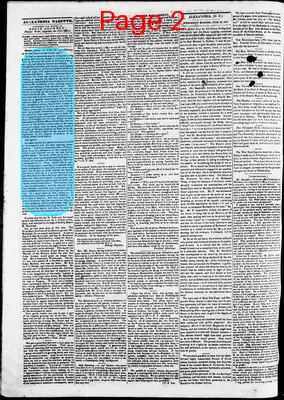
Story
June 19, 1833
Phenix Gazette
Alexandria, Virginia
What is this article about?
A writer in the American Quarterly argues that Negro slavery is a necessary evil in the southern states, predicting catastrophic consequences like insurrection or military despotism if emancipation occurs abruptly, as slaves lack self-control akin to children.
Clipping
OCR Quality
95%
Excellent
Full Text
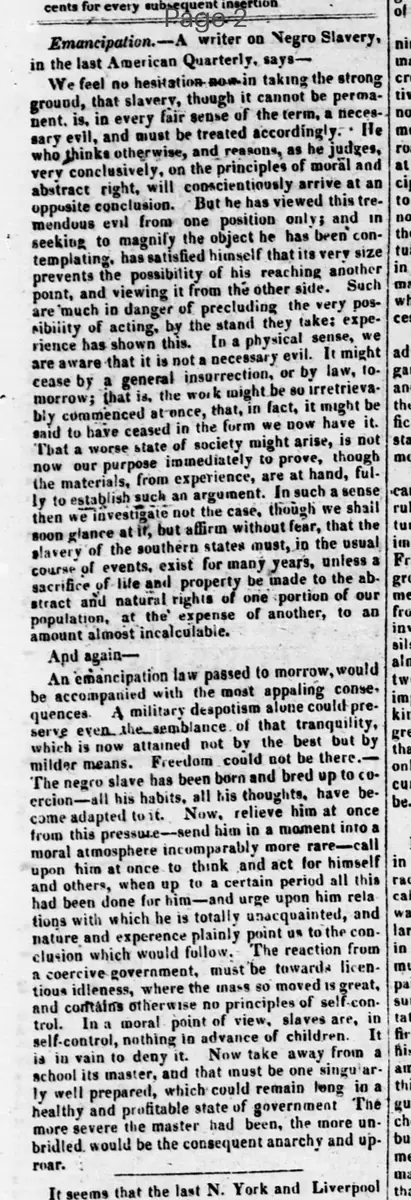
Emancipation.—A writer on Negro Slavery, in the last American Quarterly, says—We feel no hesitation in taking the strong ground, that slavery, though it cannot be permanent, is, in every fair sense of the term, a necessary evil, and must be treated accordingly. He very conclusively, on the principles of moral and abstract right, will conscientiously arrive at an opposite conclusion. But he has viewed this tremendous evil from one position only; and in seeking to magnify the object he has been contemplating, has satisfied himself that its very size prevents the possibility of his reaching another point, and viewing it from the other side. Such are much in danger of precluding the very possibility of acting, by the stand they take: experience has shown this. In a physical sense, we are aware that it is not a necessary evil. It might cease by a general insurrection, or by law, to-morrow; that is, the work might be so irretrievably commenced at once, that, in fact, it might be said to have ceased in the form we now have it. That a worse state of society might arise, is not now our purpose immediately to prove, though we shall then we investigate not the case, from experience, the materials are at hand, full soon glance at it, but affirm without fear, that the slavery of the southern states must, in the usual course of events, exist for many years, unless a sacrifice of life and property be made to the abstract and natural rights of one portion of our population, at the expense of another, to an amount almost incalculable.
And again—An emancipation law passed to-morrow, would be accompanied with the most appalling consequences. A military despotism alone could preserve even the semblance of that tranquility, which is now attained not by the best but by milder means. Freedom could not be there. The negro slave has been born and bred up to coercion—all his habits, all his thoughts, have become adapted to it. Now, relieve him at once from this pressure—send him in a moment into a moral atmosphere incomparably more rare—call upon him at once to think and act for himself and others, when up to a certain period all this had been done for him—and urge upon him relations with which he is totally unacquainted, and nature and experience plainly point us to the conclusion which would follow. The reaction from a coercive government, must be towards licentious idleness, where the mass so moved is great, and contains otherwise no principles of self-control. In a moral point of view, slaves are, in self-control, nothing in advance of children. It is in vain to deny it. Now take away from a school its master, and that must be one singularly well prepared, which could remain long in a healthy and profitable state of government. The more severe the master had been, the more unbridled would be the consequent anarchy and uproar.
And again—An emancipation law passed to-morrow, would be accompanied with the most appalling consequences. A military despotism alone could preserve even the semblance of that tranquility, which is now attained not by the best but by milder means. Freedom could not be there. The negro slave has been born and bred up to coercion—all his habits, all his thoughts, have become adapted to it. Now, relieve him at once from this pressure—send him in a moment into a moral atmosphere incomparably more rare—call upon him at once to think and act for himself and others, when up to a certain period all this had been done for him—and urge upon him relations with which he is totally unacquainted, and nature and experience plainly point us to the conclusion which would follow. The reaction from a coercive government, must be towards licentious idleness, where the mass so moved is great, and contains otherwise no principles of self-control. In a moral point of view, slaves are, in self-control, nothing in advance of children. It is in vain to deny it. Now take away from a school its master, and that must be one singularly well prepared, which could remain long in a healthy and profitable state of government. The more severe the master had been, the more unbridled would be the consequent anarchy and uproar.
What sub-type of article is it?
Opinion Essay
Social Argument
What themes does it cover?
Moral Virtue
Justice
What keywords are associated?
Slavery
Emancipation
Necessary Evil
Southern States
Insurrection
Self Control
Moral Rights
What entities or persons were involved?
Writer On Negro Slavery
Where did it happen?
Southern States
Story Details
Key Persons
Writer On Negro Slavery
Location
Southern States
Story Details
The writer argues slavery is a necessary evil that must endure for years to prevent chaos from sudden emancipation, comparing slaves to children lacking self-control and predicting idleness, anarchy, or military despotism.