Thank you for visiting SNEWPapers!
Sign up free
Editorial
June 10, 1788
The Daily Advertiser
New York, New York County, New York
What is this article about?
An address attributed to Tench Coxe urges Virginia's Convention to ratify the US Constitution, warning that rejection after nine states approve would isolate Virginia, hinder foreign relations, and lead to partial confederacies. It refutes concerns over slave importation and highlights natural geographic union via infrastructure.
Clipping
OCR Quality
95%
Excellent
Full Text
ADDRESS to the Honorable the Members of the CONVENTION of VIRGINIA.
(Said to be written by Tench Coxe, Esq.
(Continued from yesterday's paper.)
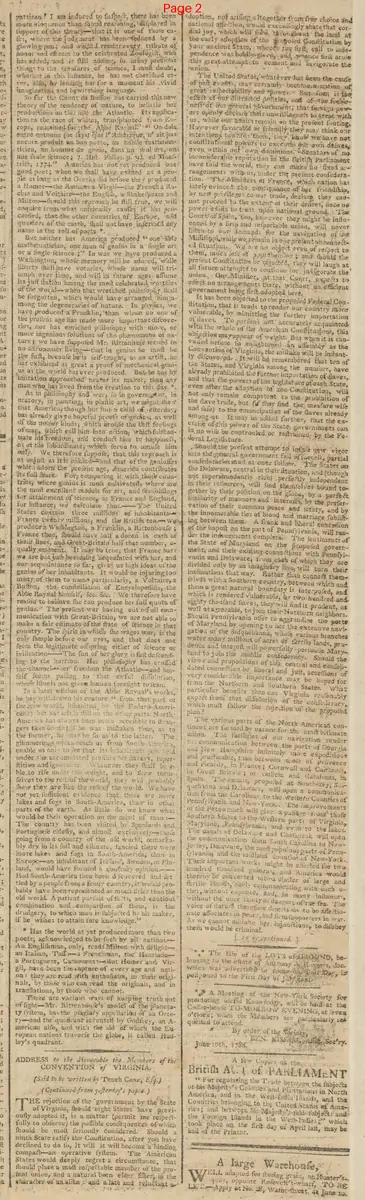
The rejection of the government by the State of Virginia, should eight States have previously adopted it, is a matter (permit me respectfully to observe) the possible consequences of which should be most seriously considered. Should a ninth State ratify the Constitution, after you have declined to do so, it will become a binding compact—an operative system. The American States would deeply regret a circumstance, that should place a most respectable member of the present union, and a natural born elder sister, in the character of an alien: and a late and reluctant adoption, not arising altogether from free choice and national affection, would exceedingly abate that cordial joy, which will flow throughout the land, at the early adoption of the proposed Constitution by your ancient State, whence the first call to independence was boldly given, and whence first arose this great attempt to cement and invigorate the union.
The United States, whatever has been the cause of past events, may certainly become a nation of great respectability and power.—But such is the effect of our distracted politics, and of the feebleness of our general government; that foreign powers openly declare their unwillingness to treat with us, while our affairs remain on the present footing. However favorable or friendly they may think our intentions towards them, they know we have not constitutional powers to execute our own decrees even within our own dominions. Senators of no inconsiderable reputation in the British Parliament have told the world, they can make no fixed arrangements with us, under the present confederation. The Ministers of France, which nation has lately evinced the continuance of her friendship, by new privileges to our trade, declare they cannot proceed to the extent of their desires, since no power exists to treat upon national ground. The Court of Spain, too, however they might be influenced by a firm and respectable union, will never listen to our demands for the navigation of the Mississippi, while we remain in our present unconnected situation. We are no object even of respect to them, much less of apprehension; and should the present Constitution be rejected, they will laugh at all future attempts to cement or invigorate the union. Our Minister, at that Court, expects to effect no arrangements there, without an efficient government being first adopted here.
It has been objected to the proposed Federal Constitution, that it tends to render our country more vulnerable, by admitting the further importation of slaves. To persons not accurately acquainted with the whole of the American Constitutions, this objection may appear of weight. But when it is canvassed before so enlightened an assembly as the Convention of Virginia, the mistake will be instantly discovered. It will be remembered that ten of the States, and Virginia among the number, have already prohibited the further importation of slaves, and that the powers of the legislature of each State, even after the adoption of the Constitution, will not only remain competent to the prohibition of the slave trade, but (if they find the measure wise and safe) to the emancipation of the slaves already among us. It may be added further, that the exercise of this power of the State governments can in no wise be controuled or restrained, by the Federal Legislature.
Should the present attempt to infuse new vigor into the general government fail of success, partial confederacies must at once follow. The States on the Delaware, central in their situation, and (though not superabundantly rich) perfectly independent in their resources, will find themselves bound together by their position on the globe, by a perfect similarity of manners and interests, by the preservation of their common peace and safety, and by the innumerable ties of blood and marriage uniting between them. A frank and liberal concession of the port on the part of Pennsylvania, will render the inducements complete. The sentiments of the State of Maryland on the proposed government, and their existing connections with Pennsylvania and Delaware, from each of which they are divided only by an imaginary line, will turn their inclinations that way. Rather than connect themselves with a Southern country, between which and them a great natural boundary is interposed, and which is rendered vulnerable, by two hundred and eighty thousand slaves, they will find it prudent, as well as agreeable, to join their Northern neighbors. Should Pennsylvania offer to aggrandize the ports of Maryland by opening to her the extensive navigation of the Susquehanna, whose various branches water many millions of acres of fertile lands, prudence and interest will powerfully persuade Maryland to join the middle confederacy. Should the views and propositions of this central and consolidated connection be liberal and just, accessions of very considerable importance may be hoped for from the Northern and Southern States. What particular benefits then can Virginia reasonably expect from that dissolution of the confederacy, which must follow the rejection of the proposed plan?
The various parts of the North American continent are formed by nature for the most intimate union. The facilities of our navigation render the communication between the ports of Georgia and New Hampshire infinitely more expeditious and practicable, than between those of Provence and Picardy, in France; Cornwall and Caithness, in Great Britain; or Galicia and Catalonia, in Spain. The canals, proposed at South-river, Susquehanna and Delaware, will open a communication from the Carolinas to the Western Counties of Pennsylvania and New-York. The improvements of the Potomac will give a passage from those Southern States to the Western parts of Virginia, Maryland, Pennsylvania, and even to the lakes. The canals of Delaware and Chesapeake will open the communication from South Carolina to New-Jersey, Delaware, the most populous parts of Pennsylvania, and the midland counties of New-York. These important works might be effected for two hundred thousand guineas, and America would thereby be converted into a cluster of large and fertile islands, easily communicating with each other, without expence, and, in many instances, without the uncertainty or dangers of the sea. The voice of nature therefore directs us to be affectionate associates in peace, and firm supporters in war. As we cannot mistake her injunctions, to disobey them would be criminal.
[To be continued.]
(Said to be written by Tench Coxe, Esq.
(Continued from yesterday's paper.)
The rejection of the government by the State of Virginia, should eight States have previously adopted it, is a matter (permit me respectfully to observe) the possible consequences of which should be most seriously considered. Should a ninth State ratify the Constitution, after you have declined to do so, it will become a binding compact—an operative system. The American States would deeply regret a circumstance, that should place a most respectable member of the present union, and a natural born elder sister, in the character of an alien: and a late and reluctant adoption, not arising altogether from free choice and national affection, would exceedingly abate that cordial joy, which will flow throughout the land, at the early adoption of the proposed Constitution by your ancient State, whence the first call to independence was boldly given, and whence first arose this great attempt to cement and invigorate the union.
The United States, whatever has been the cause of past events, may certainly become a nation of great respectability and power.—But such is the effect of our distracted politics, and of the feebleness of our general government; that foreign powers openly declare their unwillingness to treat with us, while our affairs remain on the present footing. However favorable or friendly they may think our intentions towards them, they know we have not constitutional powers to execute our own decrees even within our own dominions. Senators of no inconsiderable reputation in the British Parliament have told the world, they can make no fixed arrangements with us, under the present confederation. The Ministers of France, which nation has lately evinced the continuance of her friendship, by new privileges to our trade, declare they cannot proceed to the extent of their desires, since no power exists to treat upon national ground. The Court of Spain, too, however they might be influenced by a firm and respectable union, will never listen to our demands for the navigation of the Mississippi, while we remain in our present unconnected situation. We are no object even of respect to them, much less of apprehension; and should the present Constitution be rejected, they will laugh at all future attempts to cement or invigorate the union. Our Minister, at that Court, expects to effect no arrangements there, without an efficient government being first adopted here.
It has been objected to the proposed Federal Constitution, that it tends to render our country more vulnerable, by admitting the further importation of slaves. To persons not accurately acquainted with the whole of the American Constitutions, this objection may appear of weight. But when it is canvassed before so enlightened an assembly as the Convention of Virginia, the mistake will be instantly discovered. It will be remembered that ten of the States, and Virginia among the number, have already prohibited the further importation of slaves, and that the powers of the legislature of each State, even after the adoption of the Constitution, will not only remain competent to the prohibition of the slave trade, but (if they find the measure wise and safe) to the emancipation of the slaves already among us. It may be added further, that the exercise of this power of the State governments can in no wise be controuled or restrained, by the Federal Legislature.
Should the present attempt to infuse new vigor into the general government fail of success, partial confederacies must at once follow. The States on the Delaware, central in their situation, and (though not superabundantly rich) perfectly independent in their resources, will find themselves bound together by their position on the globe, by a perfect similarity of manners and interests, by the preservation of their common peace and safety, and by the innumerable ties of blood and marriage uniting between them. A frank and liberal concession of the port on the part of Pennsylvania, will render the inducements complete. The sentiments of the State of Maryland on the proposed government, and their existing connections with Pennsylvania and Delaware, from each of which they are divided only by an imaginary line, will turn their inclinations that way. Rather than connect themselves with a Southern country, between which and them a great natural boundary is interposed, and which is rendered vulnerable, by two hundred and eighty thousand slaves, they will find it prudent, as well as agreeable, to join their Northern neighbors. Should Pennsylvania offer to aggrandize the ports of Maryland by opening to her the extensive navigation of the Susquehanna, whose various branches water many millions of acres of fertile lands, prudence and interest will powerfully persuade Maryland to join the middle confederacy. Should the views and propositions of this central and consolidated connection be liberal and just, accessions of very considerable importance may be hoped for from the Northern and Southern States. What particular benefits then can Virginia reasonably expect from that dissolution of the confederacy, which must follow the rejection of the proposed plan?
The various parts of the North American continent are formed by nature for the most intimate union. The facilities of our navigation render the communication between the ports of Georgia and New Hampshire infinitely more expeditious and practicable, than between those of Provence and Picardy, in France; Cornwall and Caithness, in Great Britain; or Galicia and Catalonia, in Spain. The canals, proposed at South-river, Susquehanna and Delaware, will open a communication from the Carolinas to the Western Counties of Pennsylvania and New-York. The improvements of the Potomac will give a passage from those Southern States to the Western parts of Virginia, Maryland, Pennsylvania, and even to the lakes. The canals of Delaware and Chesapeake will open the communication from South Carolina to New-Jersey, Delaware, the most populous parts of Pennsylvania, and the midland counties of New-York. These important works might be effected for two hundred thousand guineas, and America would thereby be converted into a cluster of large and fertile islands, easily communicating with each other, without expence, and, in many instances, without the uncertainty or dangers of the sea. The voice of nature therefore directs us to be affectionate associates in peace, and firm supporters in war. As we cannot mistake her injunctions, to disobey them would be criminal.
[To be continued.]
What sub-type of article is it?
Constitutional
Foreign Affairs
Trade Or Commerce
What keywords are associated?
Constitution Ratification
Virginia Convention
Federal Union
Foreign Relations
Slave Trade Objection
Partial Confederacies
American Infrastructure
What entities or persons were involved?
Virginia Convention
Tench Coxe
United States
British Parliament
France
Spain
Pennsylvania
Maryland
Delaware
Editorial Details
Primary Topic
Urging Ratification Of The Us Constitution By Virginia
Stance / Tone
Strongly Pro Ratification And Pro Union
Key Figures
Virginia Convention
Tench Coxe
United States
British Parliament
France
Spain
Pennsylvania
Maryland
Delaware
Key Arguments
Rejection By Virginia After Nine States Ratify Would Isolate It As An Alien State
Weak Current Government Prevents Effective Foreign Treaties With Britain, France, And Spain
Objection To Constitution Allowing Slave Importation Is Mistaken; States Retain Prohibition Powers
Failure Of Ratification Leads To Partial Confederacies Excluding Virginia
Geographic And Infrastructural Features Demand Continental Union