Thank you for visiting SNEWPapers!
Sign up free
Literary
October 26, 1803
The National Intelligencer And Washington Advertiser
Washington, District Of Columbia
What is this article about?
This eleventh letter defends republican governments by arguing they inherently prevent luxury and promote economic equality among citizens through equal rights, economical administration, and light taxes, contrasting sharply with monarchies that foster inequality, opulence, and oppression. Quotes Montesquieu extensively.
Clipping
OCR Quality
95%
Excellent
Full Text
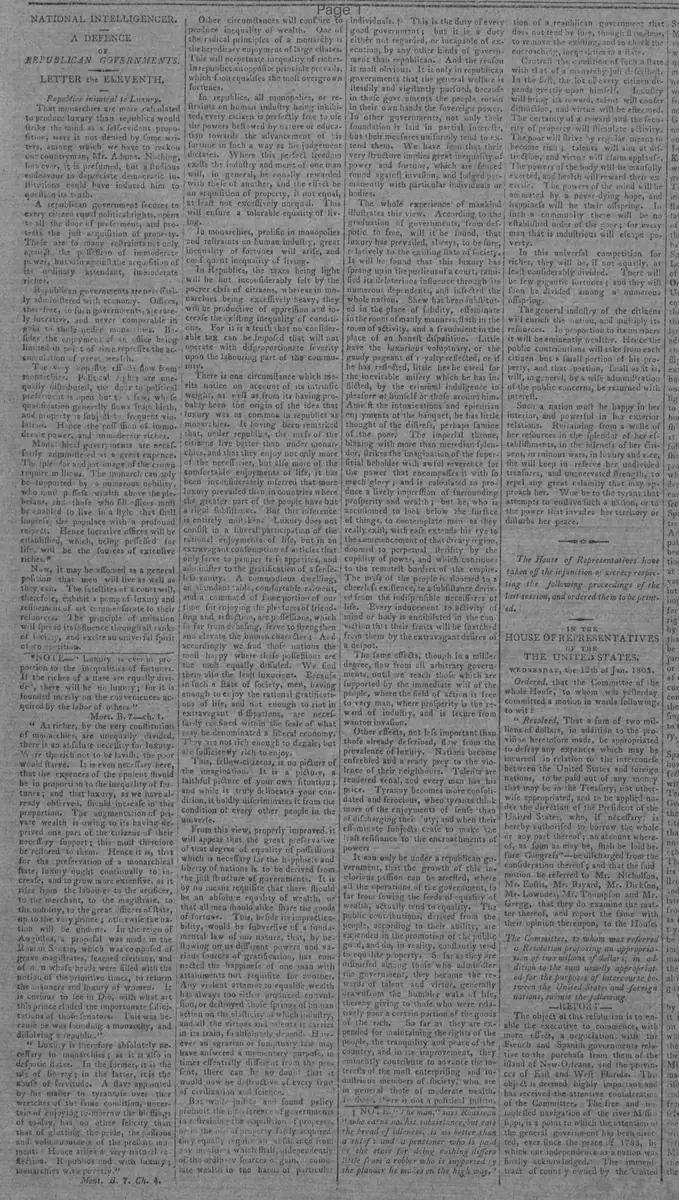
NATIONAL INTELLIGENCER.
DEFENCE
REPUBLICAN GOVERNMENTS.
LETTER the ELEVENTH.
Republics inimical to Luxury.
That monarchies are more calculated to produce luxury than republics would strike the mind as a self-evident proposition, were it not denied by some writers, among which we have to reckon our countryman, Mr. Adams. Nothing, however, it is presumed, but a studious endeavour to depreciate democratic institutions could have induced him to question its truth.
A republican government secures to every citizen equal political rights, opens to all the door of preferment, and protects the just acquisition of property. There are so many restraints not only against the possession of immoderate power, but also against the acquisition of its ordinary attendant, immoderate riches.
Republican governments are necessarily administered with economy. Offices, therefore, in such governments, are rarely lucrative, and never comparable in gain to those under monarchies. Besides the enjoyment of an office being limited in point of time prevents the accumulation of great wealth.
The very opposite effects flow from monarchies. Political rights are unequally distributed, the door to political preferment is open but to a few, where qualification generally flows from birth, and property is subject to frequent violation. Hence the possession of immoderate power, and immoderate riches.
Monarchical governments are necessarily administered at a great expense. The splendor and patronage of the crown require millions. The monarch can only be supported by a numerous nobility, who must possess wealth above the plebeians, and those who fill offices must be enabled to live in a style that shall impress the populace with a profound respect. Hence lucrative offices will be established, which, being held for life, will be the sources of extensive riches.*
Now, it may be assumed as a general position that men will live as well as they can. The satellites of a court will, therefore, exhibit a pomp of luxury and refinement of art commensurate to their resources. The principle of imitation will spread its influence through all ranks of society, and excite a universal spirit of competition.
*NOTE: Luxury is ever in proportion to the inequalities of fortunes. If the riches of a state are equally divided, there will be no luxury; for it is founded merely on the conveniences acquired by the labor of others."
Mont. B. 7ch. 1.
"As riches, by the very constitution of monarchies, are unequally divided, there is an absolute necessity for luxury. Were the rich not to be lavish, the poor would starve. It is even necessary here, that the expenses of the opulent should be in proportion to the inequality of fortunes; and that luxury, as we have already observed, should increase in this proportion. The augmentation of private wealth is owing to its having deprived one part of the citizens of their necessary support: this must therefore be restored to them. Hence it is, that for the preservation of a monarchical state, luxury ought continually to increase, and to grow more extensive, as it rises from the laborer to the artificer, to the merchant, to the magistrate, to the nobility, to the great officers of state, up to the very prince: otherwise the nation will be undone. In the reign of Augustus, a proposal was made in the Roman Senate, which was composed of grave magistrates, learned civilians, and of men whose heads were filled with the notion of the primitive times, to reform the manners and luxury of women. It is curious to see in Dio, with what art this prince eluded the importunate solicitations of those senators. This was because he was founding a monarchy, and dissolving a republic."
"Luxury is therefore absolutely necessary in monarchies; as it is also in despotic states. In the former, it is the use of liberty; in the latter, it is the abuse of servitude. A slave appointed by his master to tyrannize over other wretches of the same condition, uncertain of enjoying to-morrow the blessings of to-day, has no other felicity than that of glutting the pride, the passions and voluptuousness of the present moment. Hence arises a very natural reflection. Republics end with luxury; monarchies with poverty."
Mont. B. 7. Ch. 4.
Other circumstances will conspire to produce inequality of wealth. One of the radical principles of a monarchy is the hereditary enjoyment of large estates. This will perpetuate inequality of riches.
In republics an opposite principle prevails, which one equalizes the most overgrown fortunes.
In republics, all monopolies, or restraints on human industry being inhibited, every citizen is perfectly free to use the powers bestowed by nature or education towards the advancement of his fortune in such a way as his judgement dictates. Where this perfect freedom exists the industry and merit of one man will, in general, be equally rewarded with that of another, and the effect be an acquisition of property, if not equal, at least not excessively unequal. This will ensure a tolerable equality of living.
In monarchies, prolific in monopolies and restraints on human industry, great inequality of fortunes will arise, and consequent inequality of living.
In Republics, the taxes being light will be but inconsiderably felt by the poorer class of citizens, whereas in monarchies being excessively heavy, they will be productive of oppression and increase the existing inequality of conditions. For it is a truth that no considerable tax can be imposed that will not operate with disproportionate severity upon the labouring part of the community.
There is one circumstance which merits notice on account of its intrinsic weight, as well as from its having probably been the origin of the idea that luxury was as common in republics as monarchies. It having been remarked that, under republics, the mass of the citizens live better than under monarchies, and that they enjoy not only more of the necessaries, but also more of the comfortable enjoyments of life, it has been inconsiderately inferred that more luxury prevailed than in countries where the greater part of the people have but a rigid subsistence. But this inference is entirely mistaken. Luxury does not consist in a liberal participation of the rational enjoyments of life, but in an extravagant consumption of articles that only serve to pamper fastidious appetites, and administer to the gratification of sensual vanity. A commodious dwelling, an abundant table, comfortable raiment, and a command of some portion of our time for enjoying the pleasures of friendship and free reflection, are possessions, which so far from debasing, serve to strengthen and elevate the human character: And accordingly we find those nations the most happy where these possessions are the most equally diffused. We find them also the least luxurious. Because in such a state of society, men, having enough to enjoy the rational gratifications of life, and not enough to riot in extravagant dissipations, are necessarily confined within the scale of what may be denominated a liberal economy. They are not rich enough to dazzle, but sufficiently rich to enjoy.
This, fellow-citizens, is no picture of the imagination. It is a picture, a faithful picture of your own situation; and while it truly delineates your condition, it boldly discriminates it from the condition of every other people in the universe.
From this view, properly improved, it will appear that the great preservative of that degree of equality of possessions which is necessary for the happiness and liberty of nations is to be derived from the just structure of governments. It is by no means requisite that there should be an absolute equality of wealth, or that all men should alike share the goods of fortune. This, beside its impracticability, would be subversive of a fundamental law of our nature, that, by bestowing on us different powers and various sources of gratification, has connected the happiness of one man with attainments not requisite for another.
Any violent attempt to equalize wealth has always too either produced convulsion, or destroyed those springs of human action on the elasticity of which industry, and all the virtues and talents it carries in its train, absolutely depend. However an agrarian or sumptuary law may have answered a momentary purpose, in times essentially different from the present, there can be no doubt that it would now be destructive of every fruit of civilization and science.
But while justice and sound policy prohibit the interference of governments in restraining the acquisition of property, or in the use of property fairly acquired they equally require an abstinence from any measures which shall, independently of the ordinary sources of gain, accumulate wealth in the hands of particular individuals. This is the duty of every good government; but it is a duty either not regarded, or incapable of execution, by any other kinds of government than republican. And the reason is most obvious. It is only in republican governments that the general welfare is steadily and vigilantly pursued, because in those governments the people retain in their own hands the sovereign power.
In other governments, not only their foundation is laid in partial interests, but their measures uniformly tend to extend them. We have seen that their very structure implies great inequality of power and fortune, which are fenced round against invasion, and lodged permanently with particular individuals or bodies.
The whole experience of mankind illustrates this view. According to the graduation of governments, from despotic to free, will it be found, that luxury has prevailed, always, to be sure, relatively to the existing state of society. It will be found that this luxury has sprung up in the purlieus of a court, ramified its deleterious influence through its numerous dependents, and infected the whole nation. Show has been substituted in the place of solidity, effeminacy in the room of manly manners, sloth in the room of activity, and a fraudulent in the place of an honest disposition. Little have the luxurious voluptuary, or the gaudy pageant of royalty reflected, or if he has reflected, little has he cared for the inevitable misery which he has inflicted, by the criminal indulgence in pleasure of himself or those around him.
Amidst the intoxications and epicurian enjoyments of the banquet, he has little thought of the distress, perhaps famine of the poor: The imperial throne, blazing with more than meridian splendor, strikes the imagination of the superficial beholder with awful reverence for the power that encompasses it with so much glory; and is calculated to produce a lively impression of surrounding prosperity and wealth; but he, who is accustomed to look below the surface of things, to contemplate men as they really exist, with ease extends his eyes to the commencement of that dreary region, doomed to perpetual sterility by the cupidity of power, and which continues to the remotest borders of the empire.
The mass of the people is doomed to a cheerless existence, to a subsistence derived from the indispensable necessaries of life. Every inducement to activity of mind or body is annihilated in the conviction that their fruits will be snatched from them by the extravagant desires of a despot.
The same effects, though in a milder degree, flow from all arbitrary governments, until we reach those which are supported by the immediate will of the people, where the field of action is free to every man, where prosperity is the reward of industry, and is secure from wanton invasion.
Other effects, not less important than those already described, flow from the prevalence of luxury. Nations become enfeebled and a ready prey to the violence of their neighbours. Talents are rendered venal, and every man has his price. Tyranny becomes more consolidated and ferocious, when tyrants think more of the enjoyments of sense than of discharging their duty, and when their effeminate subjects cease to make the least resistance to the encroachments of power:
It can only be under a republican government, that the growth of this inglorious passion can be arrested, where all the operations of the government, so far from sowing the seeds of inequality of wealth, actually tend to equality. The public contributions, derived from the people, according to their ability, are expended in the promotion of the public good, and do, in reality, constantly tend to equalize property. So far as they are divided among those who administer the government, they become the rewards of talent and virtue, generally drawn from the humbler walks of life, thereby giving to those who were relatively poor a certain portion of the goods of the rich. So far as they are expended for maintaining the rights of the people, the tranquility and peace of the country, and in its improvement, they eminently contribute to advance the interests of the most enterprising and industrious members of society, who are in general those of moderate wealth.
In short, there is not a political institution of a republican government: that does not tend by sure, though slow steps, to remove the existing, and to check the encroaching, inequalities in a state.
Contrast the condition of such a state with that of a monarchy just described. In the first, the lot of every citizen depends greatly upon himself. Industry will bring its reward, talent will confer distinction, and virtue will be esteemed. The certainty of a reward and the security of property will stimulate activity. The poor will strive by regular means to become rich; talents will aim at distinction, and virtue will claim applause. The powers of the body will be manfully exerted, and health will reward their exercise. The powers of the mind will be animated by a never-dying hope, and happiness will be their offspring. In such a community there will be no established order of the poor; or every man that is industrious will escape poverty.
In this universal competition for riches, they will be, if not equally, at least considerably divided. There will be few gigantic fortunes; and they will soon be divided among a numerous offspring.
The general industry of the citizens will enrich the nation, and multiply its resources. In proportion to its numbers it will be eminently wealthy. Hence the public contributions will take from each citizen but a small portion of his property, and that portion, small as it is, will, in general, by a wise administration of the public concerns, be returned with interest.
Such a nation must be happy in her interior, and powerful in her exterior relations. Refraining from a waste of her resources in the splendor of her establishments, in the idleness of her citizens, in ruinous wars, in luxury and vice, she will keep in reserve her undivided treasures, and unenervated strength, to repel any great calamity that may approach her. Woe be to the tyrant that attempts to enslave such a nation, or to the power that invades her territory or disturbs her peace.
DEFENCE
REPUBLICAN GOVERNMENTS.
LETTER the ELEVENTH.
Republics inimical to Luxury.
That monarchies are more calculated to produce luxury than republics would strike the mind as a self-evident proposition, were it not denied by some writers, among which we have to reckon our countryman, Mr. Adams. Nothing, however, it is presumed, but a studious endeavour to depreciate democratic institutions could have induced him to question its truth.
A republican government secures to every citizen equal political rights, opens to all the door of preferment, and protects the just acquisition of property. There are so many restraints not only against the possession of immoderate power, but also against the acquisition of its ordinary attendant, immoderate riches.
Republican governments are necessarily administered with economy. Offices, therefore, in such governments, are rarely lucrative, and never comparable in gain to those under monarchies. Besides the enjoyment of an office being limited in point of time prevents the accumulation of great wealth.
The very opposite effects flow from monarchies. Political rights are unequally distributed, the door to political preferment is open but to a few, where qualification generally flows from birth, and property is subject to frequent violation. Hence the possession of immoderate power, and immoderate riches.
Monarchical governments are necessarily administered at a great expense. The splendor and patronage of the crown require millions. The monarch can only be supported by a numerous nobility, who must possess wealth above the plebeians, and those who fill offices must be enabled to live in a style that shall impress the populace with a profound respect. Hence lucrative offices will be established, which, being held for life, will be the sources of extensive riches.*
Now, it may be assumed as a general position that men will live as well as they can. The satellites of a court will, therefore, exhibit a pomp of luxury and refinement of art commensurate to their resources. The principle of imitation will spread its influence through all ranks of society, and excite a universal spirit of competition.
*NOTE: Luxury is ever in proportion to the inequalities of fortunes. If the riches of a state are equally divided, there will be no luxury; for it is founded merely on the conveniences acquired by the labor of others."
Mont. B. 7ch. 1.
"As riches, by the very constitution of monarchies, are unequally divided, there is an absolute necessity for luxury. Were the rich not to be lavish, the poor would starve. It is even necessary here, that the expenses of the opulent should be in proportion to the inequality of fortunes; and that luxury, as we have already observed, should increase in this proportion. The augmentation of private wealth is owing to its having deprived one part of the citizens of their necessary support: this must therefore be restored to them. Hence it is, that for the preservation of a monarchical state, luxury ought continually to increase, and to grow more extensive, as it rises from the laborer to the artificer, to the merchant, to the magistrate, to the nobility, to the great officers of state, up to the very prince: otherwise the nation will be undone. In the reign of Augustus, a proposal was made in the Roman Senate, which was composed of grave magistrates, learned civilians, and of men whose heads were filled with the notion of the primitive times, to reform the manners and luxury of women. It is curious to see in Dio, with what art this prince eluded the importunate solicitations of those senators. This was because he was founding a monarchy, and dissolving a republic."
"Luxury is therefore absolutely necessary in monarchies; as it is also in despotic states. In the former, it is the use of liberty; in the latter, it is the abuse of servitude. A slave appointed by his master to tyrannize over other wretches of the same condition, uncertain of enjoying to-morrow the blessings of to-day, has no other felicity than that of glutting the pride, the passions and voluptuousness of the present moment. Hence arises a very natural reflection. Republics end with luxury; monarchies with poverty."
Mont. B. 7. Ch. 4.
Other circumstances will conspire to produce inequality of wealth. One of the radical principles of a monarchy is the hereditary enjoyment of large estates. This will perpetuate inequality of riches.
In republics an opposite principle prevails, which one equalizes the most overgrown fortunes.
In republics, all monopolies, or restraints on human industry being inhibited, every citizen is perfectly free to use the powers bestowed by nature or education towards the advancement of his fortune in such a way as his judgement dictates. Where this perfect freedom exists the industry and merit of one man will, in general, be equally rewarded with that of another, and the effect be an acquisition of property, if not equal, at least not excessively unequal. This will ensure a tolerable equality of living.
In monarchies, prolific in monopolies and restraints on human industry, great inequality of fortunes will arise, and consequent inequality of living.
In Republics, the taxes being light will be but inconsiderably felt by the poorer class of citizens, whereas in monarchies being excessively heavy, they will be productive of oppression and increase the existing inequality of conditions. For it is a truth that no considerable tax can be imposed that will not operate with disproportionate severity upon the labouring part of the community.
There is one circumstance which merits notice on account of its intrinsic weight, as well as from its having probably been the origin of the idea that luxury was as common in republics as monarchies. It having been remarked that, under republics, the mass of the citizens live better than under monarchies, and that they enjoy not only more of the necessaries, but also more of the comfortable enjoyments of life, it has been inconsiderately inferred that more luxury prevailed than in countries where the greater part of the people have but a rigid subsistence. But this inference is entirely mistaken. Luxury does not consist in a liberal participation of the rational enjoyments of life, but in an extravagant consumption of articles that only serve to pamper fastidious appetites, and administer to the gratification of sensual vanity. A commodious dwelling, an abundant table, comfortable raiment, and a command of some portion of our time for enjoying the pleasures of friendship and free reflection, are possessions, which so far from debasing, serve to strengthen and elevate the human character: And accordingly we find those nations the most happy where these possessions are the most equally diffused. We find them also the least luxurious. Because in such a state of society, men, having enough to enjoy the rational gratifications of life, and not enough to riot in extravagant dissipations, are necessarily confined within the scale of what may be denominated a liberal economy. They are not rich enough to dazzle, but sufficiently rich to enjoy.
This, fellow-citizens, is no picture of the imagination. It is a picture, a faithful picture of your own situation; and while it truly delineates your condition, it boldly discriminates it from the condition of every other people in the universe.
From this view, properly improved, it will appear that the great preservative of that degree of equality of possessions which is necessary for the happiness and liberty of nations is to be derived from the just structure of governments. It is by no means requisite that there should be an absolute equality of wealth, or that all men should alike share the goods of fortune. This, beside its impracticability, would be subversive of a fundamental law of our nature, that, by bestowing on us different powers and various sources of gratification, has connected the happiness of one man with attainments not requisite for another.
Any violent attempt to equalize wealth has always too either produced convulsion, or destroyed those springs of human action on the elasticity of which industry, and all the virtues and talents it carries in its train, absolutely depend. However an agrarian or sumptuary law may have answered a momentary purpose, in times essentially different from the present, there can be no doubt that it would now be destructive of every fruit of civilization and science.
But while justice and sound policy prohibit the interference of governments in restraining the acquisition of property, or in the use of property fairly acquired they equally require an abstinence from any measures which shall, independently of the ordinary sources of gain, accumulate wealth in the hands of particular individuals. This is the duty of every good government; but it is a duty either not regarded, or incapable of execution, by any other kinds of government than republican. And the reason is most obvious. It is only in republican governments that the general welfare is steadily and vigilantly pursued, because in those governments the people retain in their own hands the sovereign power.
In other governments, not only their foundation is laid in partial interests, but their measures uniformly tend to extend them. We have seen that their very structure implies great inequality of power and fortune, which are fenced round against invasion, and lodged permanently with particular individuals or bodies.
The whole experience of mankind illustrates this view. According to the graduation of governments, from despotic to free, will it be found, that luxury has prevailed, always, to be sure, relatively to the existing state of society. It will be found that this luxury has sprung up in the purlieus of a court, ramified its deleterious influence through its numerous dependents, and infected the whole nation. Show has been substituted in the place of solidity, effeminacy in the room of manly manners, sloth in the room of activity, and a fraudulent in the place of an honest disposition. Little have the luxurious voluptuary, or the gaudy pageant of royalty reflected, or if he has reflected, little has he cared for the inevitable misery which he has inflicted, by the criminal indulgence in pleasure of himself or those around him.
Amidst the intoxications and epicurian enjoyments of the banquet, he has little thought of the distress, perhaps famine of the poor: The imperial throne, blazing with more than meridian splendor, strikes the imagination of the superficial beholder with awful reverence for the power that encompasses it with so much glory; and is calculated to produce a lively impression of surrounding prosperity and wealth; but he, who is accustomed to look below the surface of things, to contemplate men as they really exist, with ease extends his eyes to the commencement of that dreary region, doomed to perpetual sterility by the cupidity of power, and which continues to the remotest borders of the empire.
The mass of the people is doomed to a cheerless existence, to a subsistence derived from the indispensable necessaries of life. Every inducement to activity of mind or body is annihilated in the conviction that their fruits will be snatched from them by the extravagant desires of a despot.
The same effects, though in a milder degree, flow from all arbitrary governments, until we reach those which are supported by the immediate will of the people, where the field of action is free to every man, where prosperity is the reward of industry, and is secure from wanton invasion.
Other effects, not less important than those already described, flow from the prevalence of luxury. Nations become enfeebled and a ready prey to the violence of their neighbours. Talents are rendered venal, and every man has his price. Tyranny becomes more consolidated and ferocious, when tyrants think more of the enjoyments of sense than of discharging their duty, and when their effeminate subjects cease to make the least resistance to the encroachments of power:
It can only be under a republican government, that the growth of this inglorious passion can be arrested, where all the operations of the government, so far from sowing the seeds of inequality of wealth, actually tend to equality. The public contributions, derived from the people, according to their ability, are expended in the promotion of the public good, and do, in reality, constantly tend to equalize property. So far as they are divided among those who administer the government, they become the rewards of talent and virtue, generally drawn from the humbler walks of life, thereby giving to those who were relatively poor a certain portion of the goods of the rich. So far as they are expended for maintaining the rights of the people, the tranquility and peace of the country, and in its improvement, they eminently contribute to advance the interests of the most enterprising and industrious members of society, who are in general those of moderate wealth.
In short, there is not a political institution of a republican government: that does not tend by sure, though slow steps, to remove the existing, and to check the encroaching, inequalities in a state.
Contrast the condition of such a state with that of a monarchy just described. In the first, the lot of every citizen depends greatly upon himself. Industry will bring its reward, talent will confer distinction, and virtue will be esteemed. The certainty of a reward and the security of property will stimulate activity. The poor will strive by regular means to become rich; talents will aim at distinction, and virtue will claim applause. The powers of the body will be manfully exerted, and health will reward their exercise. The powers of the mind will be animated by a never-dying hope, and happiness will be their offspring. In such a community there will be no established order of the poor; or every man that is industrious will escape poverty.
In this universal competition for riches, they will be, if not equally, at least considerably divided. There will be few gigantic fortunes; and they will soon be divided among a numerous offspring.
The general industry of the citizens will enrich the nation, and multiply its resources. In proportion to its numbers it will be eminently wealthy. Hence the public contributions will take from each citizen but a small portion of his property, and that portion, small as it is, will, in general, by a wise administration of the public concerns, be returned with interest.
Such a nation must be happy in her interior, and powerful in her exterior relations. Refraining from a waste of her resources in the splendor of her establishments, in the idleness of her citizens, in ruinous wars, in luxury and vice, she will keep in reserve her undivided treasures, and unenervated strength, to repel any great calamity that may approach her. Woe be to the tyrant that attempts to enslave such a nation, or to the power that invades her territory or disturbs her peace.
What sub-type of article is it?
Essay
What themes does it cover?
Political
Liberty Freedom
What keywords are associated?
Republican Government
Luxury
Monarchy
Equality
Political Rights
Taxation
Industry
Montesquieu
Literary Details
Title
Defence Of Republican Governments. Letter The Eleventh.
Subject
Republics Inimical To Luxury
Key Lines
Republics End With Luxury; Monarchies With Poverty.
Luxury Is Therefore Absolutely Necessary In Monarchies; As It Is Also In Despotic States. In The Former, It Is The Use Of Liberty; In The Latter, It Is The Abuse Of Servitude.