Thank you for visiting SNEWPapers!
Sign up free
The Liberator
Boston, Suffolk County, Massachusetts
What is this article about?
In the French Chamber of Peers on February 23, a petition for emancipating Negroes in French colonies was discussed. The Duc de Broglie urged government action, citing British success, while M. de Montlosier opposed. The petition was referred to government.
Clipping
OCR Quality
Full Text
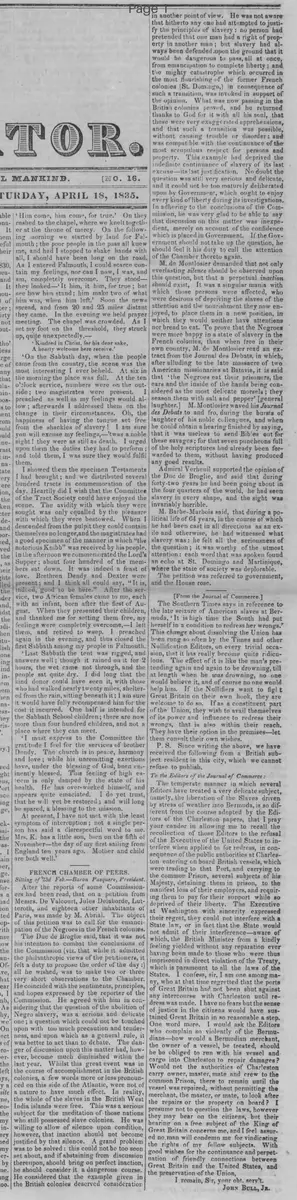
Sitting of 23d Feb.—Baron Pusquere, President.
After the reports of some Commissioners had been read, that on a petition from Messrs. De Valcourt, Jules Delaborde, Lutteroth, and eighteen other inhabitants of Paris, was made by M. Abrial. The object of this petition was to call for the emancipation of the Negroes in the French colonies. The Duc de Broglie said, that it was not his intention to combat the conclusions of the Commission (viz. that while it admitted the philanthropic views of the petitioners, it felt a duty to propose the order of the day :) all he wished, was to make two or three very short observations to the Chamber. He coincided with the sentiments, principles, and hopes expressed by the reporter of the Commission. He agreed with him in considering that the question of the abolition of Negro slavery, was a serious and delicate one; a question which could not be touched upon with too much precaution and tenderness, and upon which as a general rule, it was better to act than to debate. The danger of discussion upon this matter had, however, become much diminished within the last year. Whilst this great event was in the course of accomplishment in the British colonies, a few words more or less pronounced on this side of the Atlantic, were not of a nature to have much effect. In reality, the whole of the slaves in the British West India islands were free. This was a serious subject for the meditation of those nations who still possessed slave colonies. He was willing to allow of silence upon condition, however, that inaction should not become justified by that silence. A grand problem was to be solved: this could not be too soon set about, and if abstaining from discussion thereupon, should bring on perfect inaction, he should consider it a dangerous course. He considered that the example given in the British colonies deserved consideration in another point of view. He was not aware that hitherto any one had attempted to justify the principles of slavery: no person had pretended that one man had a right of property in another man; but slavery had always been defended upon the ground that it would be dangerous to pass, all at once, from emancipation to complete liberty; and the mighty catastrophe which occurred in the most flourishing of the former French colonies (St. Domingo,) in consequence of such a transition, was invoked in support of the opinion. What was now passing in the British colonies proved, and he returned thanks to God for it with all his soul, that these were very exaggerated apprehensions, and that such a transition was possible, without causing trouble or disorder: and was compatible with the continuance of the most scrupulous respect for persons and property. This example had deprived the indefinite continuance of slavery of its last excuse—its last justification. No doubt the question was still very serious and delicate, and it could not be too maturely deliberated upon by Government, which ought to enjoy every kind of liberty during its investigations. In adhering to the conclusions of the Commission, he was very glad to be able to say that discussion on this matter was inexpedient, merely on account of the confidence which is placed in Government. If the Government should not take up the question, he should feel it his duty to call the attention of the Chamber thereto again.
M. de Montlosier demanded that not only everlasting silence should be observed upon this question, but that a perpetual inaction should exist. It was a singular mania with which those persons were affected, who were desirous of depriving the slaves of the attention and the nourishment they now enjoyed, to place them in a new position, in which they would neither have attentions nor bread to eat. To prove that the Negroes were more happy in a state of slavery in the French colonies, than when free in their own country, M. de Montlosier read an extract from the Journal des Debats, in which, after alluding to the late massacre of two American missionaries at Batavia, it is said that the Negroes eat their prisoners, the ears and the inside of the hands being considered as the most delicate morsels; they season them with salt and pepper' [general laughter.] M. Montlosier waved his Journal des Debats to and fro, during the bursts of laughter of his noble colleagues, and when he could obtain a hearing finished by saying, that it was useless to send Bibles out for these savages: for that seven puncheons full of the holy scriptures had already been forwarded to them, without having produced any good results.
Admiral Verheuil supported the opinion of the Duc de Broglie, and said that during forty-two years he had been going about in the four quarters of the world, he had seen slavery in every shape, and the sight was invariably horrible.
M. Barbe-Marbois said, that during a political life of 64 years, in the course of which he had been cast in all directions as an exile and otherwise, he had witnessed what slavery was: he felt all the seriousness of the question; it was worthy of the utmost attention: each word that was spoken found an echo at St. Domingo and Martinique, where the state of society was deplorable.
The petition was referred to government, and the House rose.
What sub-type of article is it?
What keywords are associated?
What entities or persons were involved?
Where did it happen?
Foreign News Details
Primary Location
French Colonies
Event Date
23d Feb.
Key Persons
Outcome
the petition was referred to government.
Event Details
The Chamber discussed a petition from Paris inhabitants for Negro emancipation in French colonies. M. Abrial reported on the Commission's recommendation for order of the day. Duc de Broglie supported action, citing British colonies' success without disorder and criticizing inaction. M. de Montlosier opposed, arguing slaves were better off and citing cannibalism reports. Admiral Verheuil and M. Barbe-Marbois emphasized slavery's horrors and the question's seriousness.