Thank you for visiting SNEWPapers!
Sign up free
Richmond Enquirer
Richmond, Richmond County, Virginia
What is this article about?
Negotiations at Prairie du Chien in August resulted in a treaty of peace, friendship, and boundaries among nine Upper Mississippi Indian nations, mediated by U.S. Commissioners Gov. Clark and Gov. Cass. The council involved Sioux, Fox, Sacs, Iowas, Chippewas, Winnebagoes, Menomonees, Ottawas, and Pottawatamies. Clark and Cass arrived in St. Louis on Sept. 3.
Merged-components note: Continuation of news article on Indian negotiations and treaty at Prairie du Chien.
Clipping
OCR Quality
Full Text
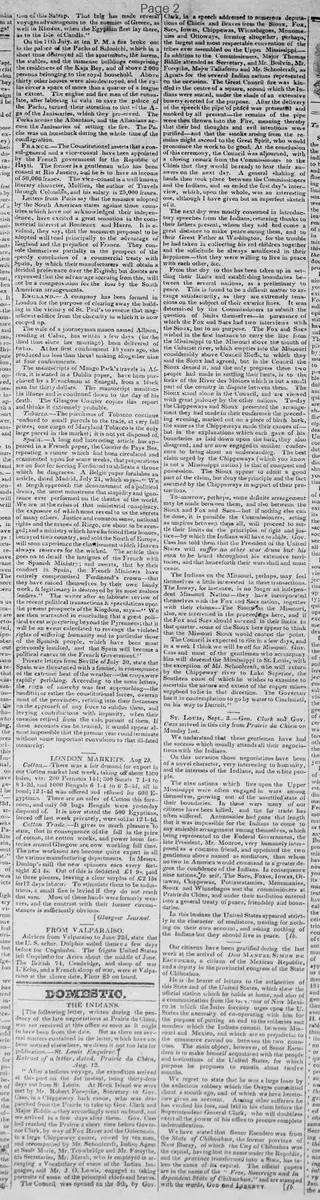
THE INDIANS
[The following letter, written during the pendency of the late negociations at Prairie du Chien, was not received at this office as soon as it ought to have been from the date. But as there are several matters contained in the letter, which have not been noticed elsewhere, we deem it not too late for publication.--St. Louis Enquirer.]
Extract of a letter, dated, Prairie du Chien, Aug. 12
"After a tedious voyage, the expedition arrived at this post on the 1st instant, being thirty-four days out from St Louis. At Rock Island we were met by Mr. Robert Forsythe, Secretary to Gov. Cass, in a Chippeway bark canoe, who was despatched from the Prairie to take up Gov. Clark and Major Biddle—they accordingly went on board, and we arrived in a few days after them. Gov. Cass had reached the Prairie a short time before Governor Clark, by way of Fox River and the Wisconsin, in a large Chippeway canoe, rowed by ten men, and accompanied by Mr. Schoolcraft, Indian Agent at Sault Marie, Mr. Trowbridge and Mr. Forsythe, his Secretaries, Mr. Marsh, who is employed in arranging a Vocabulary of some of the Indian languages, and Mr. J. O. Lewis, engaged in taking portraits of some of the principal chiefs and braves.
The Council was opened on the 5th, by Gov. Clark, in a speech addressed to numerous deputations of Chiefs and Braves from the Sioux, Fox, Sacs, Iowas, Chippewas, Winnebagoes, Menomonees and Ottawas, forming altogether, perhaps, the largest and most respectable convention of the tribes ever assembled on the Upper Mississippi.-- In addition to the Commissioners, Major Thomas Biddle attended as Secretary, and Mr. Boilvin, Mr. Forsythe, Major Taliaferro and Mr. Schoolcraft, as Agents for the several Indian nations represented on the occasion. The Great Council fire was kindled in the centre of a square, around which the Indians were seated, under the shade of an extensive bowery erected for the purpose. After the delivery of the speech the pipe of peace was presented and smoked by all present--the remains of the pipe were then thrown into the Fire, meaning thereby that their bad thoughts and evil intentions were purified-and that the smoke arising from the remains might ascend to the Great Spirit, who would pronounce the work to be good. At the conclusion of this ceremony, the Council was adjourned, with a closing remark from the Commissioners to the Chiefs that they would be ready to hear their answers on the next day. A general shaking of hands then took place between the Commissioners and the Indians, and so ended the first day's interview, which, upon the whole, was an interesting one, although I have given but an imperfect sketch of it.
The next day was mostly consumed in introductory speeches from the Indians, returning thanks to their fathers present, whom they said had come a great distance to make peace among them, and to their Great Father at Washington, for the trouble he had taken in collecting his red children together and the solicitude he always manifested in their happiness--that they were willing to live in peace with each other, &c.
From that day to this has been taken up in settling their limits and establishing boundaries between the several nations, as a preliminary to peace. This is found to be a difficult matter to arrange satisfactorily, as they are extremely tenacious on the subject of their exterior lines. It was determined by the Commissioners to submit the question of limits themselves--in pursuance of which the Fox and Sacs had two interviews with the Sioux, but to no purpose. The Fox and Sacs wished in the first instance to carry the line from the Mississippi to the Missouri above the mouth of the Calumet river, which empties into the Missouri considerably above Council Bluffs, to which they said the Sioux had agreed, but in the Council the Sioux denied it, and the only progress these two people had made in settling their limits, is to the forks of the River des Moines which is but a small part of the country in dispute between them. The Sioux stand alone in the Council, and are viewed with great jealousy by the other nations. To-day the Chippeways and Sioux presented the arrangement they had made in their conference the preceding evening, marked out on a piece of birch bark. the same as the Chippeways make their canoes of- but in the explanations which each gave of his boundaries as laid down upon the bark, they also disagreed, and are now engaged in another conference to bring about an understanding. The best claim urged by the Chippeways (which you know is not a Mississippi nation) is that of conquest and possession. The Sioux appear to admit a good part of the claim, but deny the principle and the fact assumed by the Chippeways in support of their pretensions.
To-morrow, perhaps, some definite arrangement may be made between them, and also between the Sioux and Fox and Sacs-but if nothing else can be done, it is possible the Commissioners, acting as umpires between them all, will proceed to settle their limits on the principles of right and justice-by which the Indians will have to abide. Gov. Cass has told them that the President of the United States will suffer no other war drum but his own to be heard throughout his extensive territories, and that henceforth their wars shall and must cease.
The Indians on the Missouri, perhaps, may feel themselves a little interested in these transactions. The Iowa, for instance, is no longer an independent Missouri Nation-they have incorporated themselves with the Fox and Sacs nation, together with their claims--The Sioux on the Missouri, also, are interested in the proceedings here, and if the Fox and Sacs should succeed in their limits in that quarter, some of the Sioux here appear to think that the Missouri Sioux would contest the point.
The Council is expected to rise in a few days, and in a week I think we will be off for Missouri. Gov. Cass and most of the gentlemen who accompany him will descend the Mississippi to St. Louis, with the exception of Mr. Schoolcraft, who will return by the Chippeway river to Lake Superior, the Southern coast of which he wishes to examine to ascertain the nature and extent of the copper mines supposed to lie in that direction. The Governor has it in contemplation to go by water to Cincinnati, on his way to Detroit."
St. Louis, Sept. 3.--Gen. Clark and Gov. Cass arrived in this city from Prairie du Chien on Monday last.
We understand that these gentlemen have had the success which usually attends all their negociations with the Indians.
On this occasion those negociations have been of a novel character, very interesting to humanity, and the interests of the Indians, and the white people.
The nine nations which live upon the Upper Mississippi were often engaged in wars among themselves, growing out of the unsettled state of their boundaries. In these wars many of our citizens have been killed, and the fur trade has often suffered. Animosities had gone that length that it was impossible for the Indians to come to any amicable arrangement among themselves, which being represented to the Federal Government, the late President, Mr. Monroe, very humanely interposed as a common friend, and appointed the two gentlemen above named as mediators, than whom no two in America would command in a greater degree the confidence of the Indians. In consequence nine nations, to wit, The Sacs, Foxes, Iowas, Ottawas, Chippewas, Pottawatamies, Menomonees, Sioux and Winnebagos met the commissioners at Prairie du Chien, and under their mediation entered into a general treaty of peace, friendship and boundaries.
In this business the United States appeared strictly in the character of mediators, treating for nothing on their own account, and asking nothing of the Indians but they should live in peace. [Ib.
What sub-type of article is it?
What keywords are associated?
What entities or persons were involved?
Where did it happen?
Domestic News Details
Primary Location
Prairie Du Chien
Event Date
Aug. 5 To Mid Aug., Reported Sept. 3
Key Persons
Outcome
general treaty of peace, friendship and boundaries among nine nations: sacs, foxes, iowas, ottawas, chippewas, pottawatamies, menomonees, sioux and winnebagos. u.s. acted as mediators to end intertribal wars affecting citizens and fur trade.
Event Details
U.S. Commissioners Gov. Clark and Gov. Cass mediated negotiations at Prairie du Chien to settle boundaries and establish peace among Upper Mississippi Indian nations. Council opened Aug. 5 with speech by Gov. Clark to chiefs and braves of Sioux, Fox, Sacs, Iowas, Chippewas, Winnebagoes, Menomonees and Ottawas. Discussions focused on territorial limits, with difficulties between Sioux and others; pipe of peace ceremony performed. Iowas incorporated with Fox and Sacs. Council expected to conclude soon; Clark and Cass arrived St. Louis Sept. 3.