Thank you for visiting SNEWPapers!
Sign up free
The New Hampshire Gazette And General Advertiser
Portsmouth, Rockingham County, New Hampshire
What is this article about?
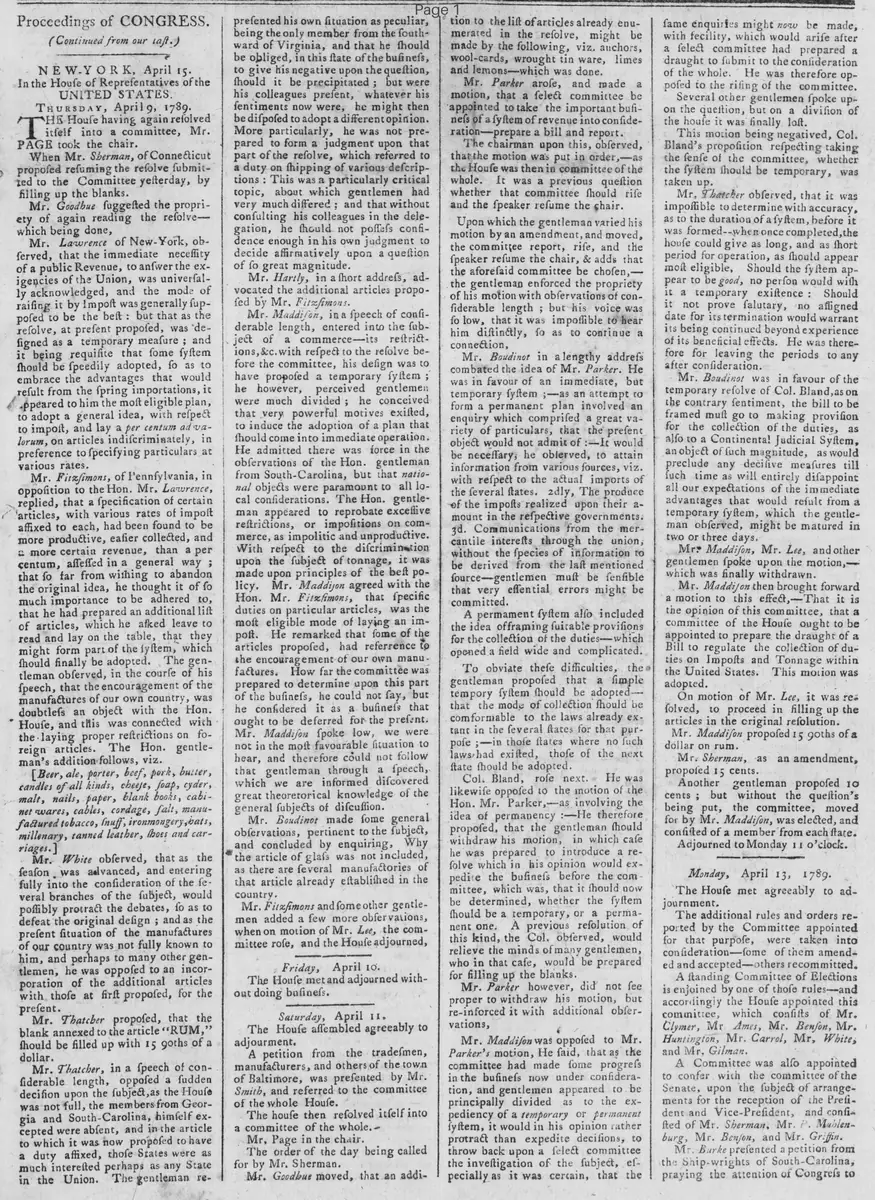
Detailed account of U.S. House debates from April 9-16, 1789, in New York, on establishing a temporary impost system for federal revenue, including votes on duties for rum, molasses, wines, sugars, hemp, salt, and other goods, balancing commerce, manufactures, and regional interests.
Merged-components note: This is a continuation of the detailed narrative report on congressional proceedings, merging across pages based on sequential reading order and explicit text connection ('their situation' continues the petition mentioned at the end of the first component). Label adjusted to 'story' as it is a full narrative article on national government proceedings.
Clippings
1 of 2
OCR Quality
Full Text
(Continued from our last.)
NEW-YORK, April 15.
In the House of Representatives of the UNITED STATES.
Thursday, April 9, 1789.
The House having again resolved itself into a committee, Mr. PAGE took the chair.
When Mr. Sherman, of Connecticut proposed resuming the resolve submitted to the Committee yesterday, by filling up the blanks.
Mr. Goodhue suggested the propriety of again reading the resolve-- which being done,
Mr. Lawrence of New-York, observed, that the immediate necessity of a public Revenue, to answer the exigencies of the Union, was universally acknowledged, and the mode of raising it by Impost was generally proposed to be the best : but that as the resolve, at present proposed, was designed as a temporary measure ; and it being requisite that some system should be speedily adopted, so as to embrace the advantages that would result from the spring importations, it appeared to him the most eligible plan, to adopt a general idea, with respect to impost, and lay a per centum ad valorem, on articles indiscriminately, in preference to specifying particulars at various rates.
Mr. Fitzsimons, of Pennsylvania, in opposition to the Hon. Mr. Lawrence, replied, that a specification of certain articles, with various rates of impost affixed to each, had been found to be more productive, easier collected, and a more certain revenue, than a per centum, assessed in a general way ; that so far from wishing to abandon the original idea, he thought it of so much importance to be adhered to. that he had prepared an additional list of articles, which he asked leave to read and lay on the table, that they might form part of the system, which should finally be adopted. The gentleman observed, in the course of his speech, that the encouragement of the manufactures of our own country, was doubtless an object with the Hon. House, and this was connected with the-laying proper restrictions on foreign articles. The Hon. gentleman’s addition follows, viz.
Beer, ale, porter, beef, pork, butter, candles of all kinds, cheese, soap, cyder, malt, nails, paper, blank books, cabinet wares, cables, cordage, salt, manufactured tobacco, snuff, ironmongery, hats, millenary, tanned leather, shoes and carriages.
Mr. White observed, that as the season was advanced, and entering fully into the consideration of the several branches of the subject, would possibly protract the debates, so as to defeat the original design ; and as the present situation of the manufactures of our country was not fully known to him, and perhaps to many other gentlemen, he was opposed to an incorporation of the additional articles with those at first proposed, for the present.
Mr. Thatcher proposed, that the blank annexed to the article "RUM." should be filled up with 15/90ths of a dollar.
Mr. Thatcher, in a speech of considerable length, opposed a sudden decision upon the subject, as the House was not full, the members from Georgia and South-Carolina, himself excepted were absent, and in the article to which it was now proposed to have a duty affixed, those States were as much interested perhaps as any State in the Union. The gentleman represented his own situation as peculiar. being the only member from the southward of Virginia, and that he should be obliged, in this state of the business, to give his negative upon the question, should it be precipitated; but were his colleagues present, whatever his sentiments now were, he might then be disposed to adopt a different opinion. More particularly, he was not prepared to form a judgment upon that part of the resolve, which referred to a duty on shipping of various-descriptions : This was a particularly critical topic, about which gentlemen had very much differed : and that without consulting his colleagues in the delegation, he should not possess confidence enough in his own judgment to decide affirmatively upon a question of so great magnitude.
Mr. Hartley, in a short address, advocated the additional articles proposed by Mr. Fitzsimons.
Mr. Madison, in a speech of considerable length, entered into the subject of commerce--its restrictions,&c.with respect to the resolve before the committee, his design was to have proposed a temporary system ; he however, perceived gentlemen were much divided: he conceived that very powerful motives existed, to induce the adoption of a plan that should come into immediate operation. He admitted there was force in the observations of the Hon. gentleman from South-Carolina, but that national objects were paramount to all local considerations. The Hon. gentleman appeared to reprobate excessive restrictions, or impositions on commerce, as impolitic and unproductive. With respect to the discrimination upon the subject of tonnage, it was made upon principles of the best policy. Mr. Madison agreed with the Hon. Mr. Fitzsimons, that specific duties on particular articles. was the most eligible mode of laying an impost. He remarked that some of the articles proposed, had reference to the encouragement-of our own manufactures. How far the committee was prepared to determine upon this part of the business. he could not say, but he considered it as a business that ought to be deferred for the present. Mr. Madison spoke low, we were not in the most favourable situation to hear, and therefore could not follow that gentleman through a speech, which we are informed discovered great theoretical knowledge of the general subjects of discussion.
Mr. Boudinot made some general observations, pertinent to the subject, and concluded by enquiring, Why the article of glass was not included, as there are several manufactories of that article already established in the country.
Mr. Fitzsimons and some other gentlemen added a few more observations, when on motion of Mr. Lee, the committee rose, and the House adjourned,
Friday, April 10.
The House met and adjourned without doing business.
Saturday, April 11.
The House assembled agreeably to adjournment.
A petition from the tradesmen, manufacturers, and others of the town of Baltimore, was presented by Mr. Smith, and referred to the committee of the whole House.
The house then resolved itself into a committee of the whole.-
Mr. Page in the chair.
The order of the day being called for by Mr. Sherman.
Mr. Goodhue moved, that an addition to the list of articles already enumerated in the resolve, might be made by the following, viz. anchors, wool-cards, wrought tin ware, limes and lemons--which was done.
Mr. Parker arose, and made a motion, that a select committee be appointed to take the important business of a system of revenue into consideration--prepare a bill and report.
The chairman upon this, observed, that the motion was out of order,-as the House was then in committee of the whole. It was a previous question whether that committee should rise and the speaker resume the chair.
Upon which the gentleman varied his motion by an amendment, and moved, the committee report, rise, and the speaker resume the chair, & adds that the aforesaid committee be chosen,-- the gentleman enforced the propriety of his motion with observations of considerable length ; but his voice was so low, that it was impossible to hear him distinctly, so as to continue a connection,
Mr. Boudinot in a lengthy address combated the idea of Mr. Parker. He was in favour of an immediate, but temporary system ;-as an attempt to form a permanent plan involved an enquiry which comprised a great variety of particulars, that the present object would not admit of :-It would be necessary, he observed, to attain information from various sources, viz. with respect to the actual imports of the several states. 2dly, The produce of the imposts realized upon their amount in the respective governments. 3d. Communications from the mercantile interests through the union, without the species of information to be derived from the last mentioned source--gentlemen must be sensible that very essential errors might be committed.
A permanent system also included the idea of framing suitable provisions for the collection of the duties--which opened a field wide and complicated.
To obviate these difficulties, the gentleman proposed that a simple temporary system should be adopted-- that the mode of collection should be conformable to the laws already extant in the several states for that purpose ;-in those states where no such laws had existed, those of the next state should be adopted.
Col. Bland, rose next. He was likewise opposed to the motion of the Hon. Mr. Parker,--as involving the idea of permanency :--He therefore proposed. that the gentleman should withdraw his motion, in which case he was prepared to introduce a resolve which in his opinion would expedite the business before the committee, which was, that it should now be determined, whether the system should be a temporary, or a permanent one. A previous resolution of this kind, the Col. observed, would relieve the minds of many gentlemen, who in that case, would be prepared for filling up the blanks.
Mr. Parker however, did not see proper to withdraw his motion, but re-inforced it with additional observations,
Mr. Madison was opposed to Mr. Parker's motion. He said, that as the committee had made some progress in the business now under consideration, and gentlemen appeared to be principally divided as to the expediency of a temporary or permanent system, it would in his opinion rather protract than expedite decisions, to throw back upon a select committee the investigation of the subject, especially as it was certain, that the same enquiries might now be made, with facility, which would arise after a select committee had prepared a draught to submit to the consideration of the whole. He was therefore opposed to the rising of the committee.
Several other gentlemen spoke upon the question, but on a division of the house it was finally lost.
This motion being negatived, Col. Bland's proposition respecting taking the sense of the committee, whether the system should be temporary, was taken up.
Mr. Thatcher observed, that it was impossible to determine with accuracy, as to the duration of a system, before it was formed--when once completed,the house could give as long, and as short period for operation, as should appear most eligible, Should the system appear to be good, no person would wish it a temporary existence : Should it not prove salutary, no assigned date for its termination would warrant its being continued beyond experience of its beneficial effects. He was therefore for leaving the periods to any after consideration.
Mr. Boudinot was in favour of the temporary resolve of Col. Bland,as on the contrary sentiment, the bill to be framed must go to making provision as also to a Continental judicial System, an object of such magnitude. as would preclude any decisive measures till such time as will entirely disappoint all our expectations of the immediate advantages that would result from a temporary system, which the gentleman observed, might be matured in two or three days.
Mr: Madison, Mr. Lee, and other gentlemen spoke upon the motion,- which was finally withdrawn.
Mr. Madison then brought forward a motion to this effect,--That it is the opinion of this committee, that a committee of the House ought to be appointed to prepare the draught of a Bill to regulate the collection of duties on Imports and Tonnage within the United States. This motion was adopted.
On motion of Mr. Lee, it was resolved, to proceed in filling up the articles in the original resolution.
Mr. Madison proposed 15/90ths of a dollar on rum.
Mr. Sherman, as an amendment, proposed 15 cents.
Another gentleman proposed 10 cents ; but without the question's being put, the committee, moved for by Mr. Madison, was elected, and consisted of a member from each state.
Adjourned to Monday 11 o'clock.
Monday, April 13, 1789.
The House met agreeably to adjournment.
The additional rules and orders reported by the Committee appointed for that purpose, were taken into consideration-some of them amended and accepted-others recommitted.
A standing Committee of Elections is enjoined by one of those rules--and accordingly the House appointed this committee, which consists of Mr. Clymer, Mr Ames, Mr. Benson, Mr. Huntington, Mr. Carrol, Mr, White; and Mr. Gilman.
A Committee was also appointed to confer with the committee of the Senate, upon the subject of arrangements for the reception of the President and Vice-President, and consisted of Mr. Sherman. Mr. P. Muhlenberg, Mr. Benson, and Mr. Griffin.
Mr. Burke presented a petition from the Ship-wrights of South-Carolina, praying the attention of Congress to
their situation, and that a navigation Act might be passed in favour of American vessels--this was referred to a Committee of the whole.
Adjourned.
Tuesday, April 14.
Met agreeably to adjournment.
A Bill for regulating the manner of taking the oath prescribed by the Constitution, was read the first time.
The articles of the additional rules, which were re-committed yesterday, were read as amended by the committee and accepted.
Order of the day being called for, the House went into a committee of the whole.
Mr. Page in the chair.
Mr. Lawrence proposed that for the article of rum in the resolve before the Committee ardent Spirits, Jamaica proof, should be substituted; this was afterwards changed to distilled Spirits, Jamaica proof, as it now stands.
Mr. Bland, after adverting to a temporary system, as the most eligible, enforced the idea upon the impropriety of taxing several articles in the resolve, which were essential to the formation of many species of tools made use of by our manufacturers; and in order that Congress might have time properly to discriminate between the articles, and form a complete and permanent system, he introduced a motion to this effect, That Congress pass a law, authorising and establishing the collection of impost through the states, agreeably to the revenue laws extant in the several governments, and the officers be subject to the same regulations and penalties.
Mr. Floyd observed, that the subject naturally divided itself into two parts, general and specified articles: The latter were too numerous, he conceived, to be taken up collectively: The question was, how shall we discriminate? he would propose therefore, to expedite the business, that the articles should be taken individually, and determined upon--and if gentlemen would bring the question to this issue, whether, considering the particular situation of the country, it would be advisable thus to tax the respective articles? A proper distinction would be made, and the business brought to a speedy determination.
Mr. Boudinot seconded the motion of Mr. Bland.
Mr. Madison objected to its introduction, as not being in order. Col. Bland observed that the present object of the Committee, a permanent system, would in all probability subject the states to a loss of two or three hundred thousand pounds.
The chairman observing that he considered the motion as not in order: It was withdrawn by Mr. Bland.
Mr. Lawrence, upon the subject of filling up the blanks, proposed twelve cents to fill that annexed to distilled spirits, Jamaica proof: He observed, that lower duties would be more certainly collected, as experience had verified, that high duties held out powerful temptations to smuggling--rendered a more vigorous mode of collection necessary, which again was proportionably expensive, and eventually diminished the produce of the revenue, below the amount of moderate duties.
Mr. Fitzsimons was in favour of 15 cents.
Mr. Madison proposed 10 cents.
Mr. Boudinot 15, which was finally voted, and 12 cents pr. gallon on all other spirits.
Upon the article of molasses, Mr. Lawrence proposed 2 cents pr. gallon.
Mr. Madison 8 cents pr. gallon.
Mr. Parker made some observations which we could not distinctly hear.
Mr. Lawrence observed, that 2 cents in his opinion were quite high enough, in proportion to the prime cost, the pre-conceived ideas of the duty on that article, and its being a raw material, the basis of an extensive manufacture.
Mr. Madison continued, however, in favour of 8 cents, and made some allusions to the pernicious effects resulting from the use of spirituous liquors: He reprobated the idea of a draw-back, as opening a door to various species of fraud.
Mr. Fitzsimons was also in favour of 8 cents--upon similar principles.
Mr. Goodhue was totally opposed to so high a duty, which amounted to near 50 per cent.--He observed, that the importation of molasses was an important branch of commerce, and principally to the eastern States; that independent of its being a great article of manufacture, it was used by many as a necessary of life, being a substitute for sugar, and mixed with water, for beer; that so high a duty would operate injuriously toward a very numerous class of people; besides being attended with the most pernicious consequence to the navigation and the fishery of the eastern States.
Mr. Madison observed, that if the duty on molasses was to be complained of, where that was used in lieu of sugar, the duty on sugar would be a counter-balance to it.
Mr. Clymer, in support of a high duty, introduced the policy of discouraging the use of spirituous liquors, and encouraging that of malt liquors.
Mr. Ames combated the laying so high a duty, as it was beyond the ratio that gentlemen could possibly think eligible as a general idea--as it operated as a tax upon a raw material, which proved to some of the States a very important branch of manufactures; as it will strike a mortal blow to this manufacture--prove highly injurious to the eastern fisheries and to their navigation, which was very extensively employed by this business: Molasses was a more refuse article in the islands, though valuable to us: The refuse of our fish and lumber were the great remittances for it: When imported and manufactured, from the cheapness at which it could be afforded, it served a sale even in the British islands. It was the ostensible design of gentlemen, to raise a revenue--this excessive duty would annihilate an extensive source of revenue: It would prove suddenly destructive to great property appropriated to that business, and effectually destroy a very important manufacture. For these reasons (and for many others which Mr. Ames offered but which time will not permit us to transcribe) he was decidedly opposed to so high a duty.
Mr. Madison proposed to amend his motion by making the duty 7 cents.
Mr. Partridge, Mr. Boudinot, and Mr. Fitzsimons, severally spoke on the subject--when the vote being called for, the duty on Molasses, was laid at 6 cents per gallon.
On Madeira wine, 3 cents pr. gallon.
On all other wines, 20 cents per gallon.
On brown sugar, 1 cent per lb.
On loaf sugar, 3 cents per lb.
On all other sugars, 1 cents per lb.
On coffee, 2 cents per lb.
The committee then rose: The Speaker resumed the chair, and the House adjourned.
Thursday, April 16.
The bill for providing the mode of taking the oath or affirmation, required by the constitution, was read a second time, and on motion of Mr. White, was committed to a committee of the whole house, and made the order of the day for Monday next.
The house proceeded to ballot for a committee of five, who with a committee of the Senate, are to receive the President on the Jersey Shore, and attend him to this city, and Mr. Boudinot, Mr. Bland, Mr. Benson, Mr. Lawrence, and Mr. Tucker, were appointed. Mr. Gilman, Mr. Ames, and Mr. Gerry, were then chosen a committee to wait on the Vice-President, on his arrival, and in the name of the two houses to congratulate him.
The House went into a committee.
ON THE STATE OF THE UNION.
The committee resumed the consideration of the resolve, for laying an impost.
Mr. Gilman moved to have the article of Hemp struck out of the enumeration.
Mr. Hartley observed that there appeared to him an inconsistency in the proceedings in this business--The committee had just resolved, that a duty should be laid on cables and cordage, and it was now proposed to tax the principal material of that manufacture.--If the object was to protect the manufactures of this country, it was absurd to discourage the importation of raw materials essential to those manufactures. To be sure it was of importance to encourage American productions, but was it of higher importance than ship building? --It was the opinion of many, that there would be a great demand for shipping in the states--It was the policy of all manufacturing countries to encourage the importation of raw materials. To lay a duty on hemp would be giving a fatal blow to the manufacture of cordage. He was of opinion for these reasons, that it ought only to suffer a duty of five per cent. with the mass of articles not enumerated.
Mr. Moore, of Virginia, thought it incumbent on the committee to encourage manufactures to a certain degree, but he had no idea of sacrificing the agricultural interest.--It would be difficult to persuade a farmer, that the manufacture of every particular article, should be promoted, while he could procure them cheaper from a foreign country. He thought that forcing manufactures was injuring the agricultural interest. He conceived it not only the interest of the state he represented, but of every part of America, to encourage the raising of Hemp. At this time, when the great staple of the Southern States had fallen in value, and the planter was at a loss what course to pursue, if he were advised that the general government would encourage the raising of Hemp, he would engage in it with vigour, and render essential service to the country. But if he was not encouraged, he would apply himself to some other branch, by no means so profitable. It appeared to him, that the system before the committee had it too much in view to promote certain manufactures, to the neglect of agriculture. He concluded with hoping that the article would not be struck out.
Mr. Heister, of Pennsylvania, observed, that the hemp of this season, was already sown, so that the farmer would not profit by any encouragement this year. He did not therefore wish to render the duty heavy at present, it might be proper in a year or two to increase it.
Mr. White opposed the motion for striking out the article, and was rather for filling it up with a large sum. Agriculture ought, he said, to be the principal object in this country.--To this point the attention of government should be directed; and as hemp was a plant congenial with the nature of our soil, and might be raised abundantly in the interior country, it deserves encouragement. He moved that the blank be filled up with Seventy-five cents.
Mr. Partridge, (Massachusetts) on the other hand contended, that a tax on hemp would operate against ship-building, and consequently be detrimental to the fisheries.
Mr. Lawrence imagined, that the article of hemp was not raised at present in sufficient quantities to warrant any extraordinary duties, which might in the end operate as a prohibition. If he was justly informed, cordage could now be imported nearly as cheap as hemp. If the duty on hemp was higher than that on cordage, it would be the interest of merchants to import the latter, to the discouragement of its manufacture here.
Mr. Scott observed, that commerce and agriculture were inseparably connected, and that nothing commercial ought to be adopted which would injure agriculture, on which it so essentially depended. He disapproved of the immoderate zeal in favour of manufactures.
Mr. Boudinot moved for fifty cents.
The question on fifty cents being put, was carried. The committee then resolved to impose ten cents per bushel on Malt, six cents per bushel on Barley, one dollar per hhd. on Lime, and one cent per lb. on Nails and Spikes.
The article of Salt, was next considered.
Mr. Burke, South-Carolina, moved to strike it out.--It was a necessary of life, and a tax on it in any state, was ever considered as oppressive, but particularly in the southern states, it would be insupportable,--In these states the raising of stock was a capital object, and great importation of salt was necessary. The people in the interior parts, were obliged to transport their Salt by land, three or four hundred miles, and it was there sold for seven or eight shillings per bushel.
Mr. Lawrence was of a different opinion. He thought it no argument that a duty should not be laid on salt, because it bore a high price in some particular parts of the Union. He moved to fill up the blank with six cents.
Mr. Tucker said, a duty on salt was the most oppressive tax that could be imposed.--Salt being a necessary of life, its consumption was indispensable both by the rich and the poor.--It operated more odiously than a poll-tax, for it fell heavier on the poor than on the rich.
Mr. Scott was for striking out the article.--He was sensible it would be productive, but he considered the tax to be unjust--He feared, that if it were once imposed, it would be generally odious, and would have a tendency to shake the foundation of the people's confidence in the new government, which he believed to be the anchor of our political salvation.
Mr. Moore and Mr. Smith, South-Carolina, opposed the duty, and also thought it would make a dangerous impression upon the people.
The further consideration of this article was postponed until to-morrow.
(To be continued.)
What sub-type of article is it?
What keywords are associated?
What entities or persons were involved?
Where did it happen?
Story Details
Key Persons
Location
New York, House Of Representatives Of The United States
Event Date
April 9 To 16, 1789
Story Details
Proceedings of the House of Representatives debating and voting on a temporary impost system for revenue, including duties on rum, spirits, molasses, wines, sugars, coffee, hemp, salt, and other articles, with motions for specific rates, additions to lists, and discussions on protecting manufactures, agriculture, and commerce.