Thank you for visiting SNEWPapers!
Sign up free
Domestic News
February 18, 1806
Virginia Argus
Richmond, Virginia
What is this article about?
In the Virginia House of Delegates on January 20, Mr. Aylett delivered a speech opposing the call for a constitutional convention, arguing that the people are satisfied with the current constitution, which has served well through peace and war, and that changes are unnecessary without public demand.
Clipping
OCR Quality
95%
Excellent
Full Text
House of Delegates, Monday, January 20.
CALL OF A CONVENTION.
(Concluded.)
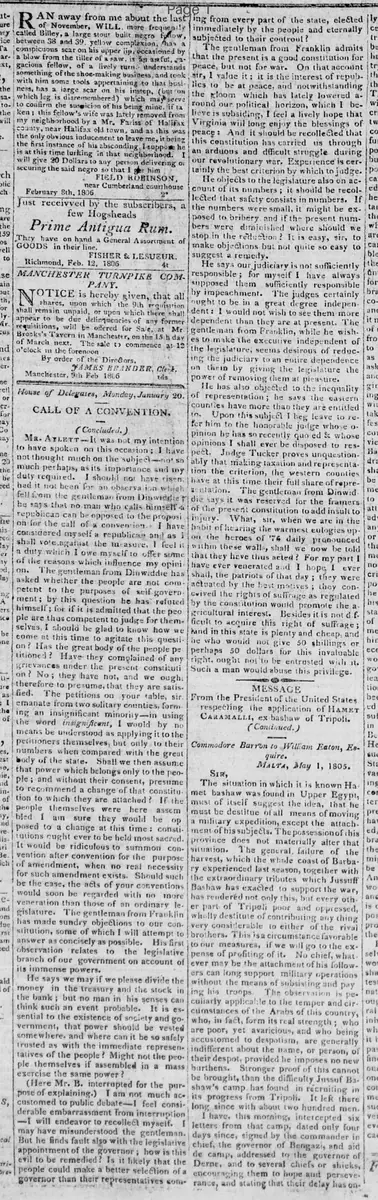
MR. Aylett--It was not my intention to have spoken on this occasion: I have not thought much on the subject, no so much perhaps, as its importance and my duty required. I should not have risen, had it not been for an observation which fell from the gentleman from Dinwiddie; he says that no man who calls himself a republican can be opposed to the proposition for the call of a convention. I have considered myself a republican and as I shall vote against the measure, I feel it a duty which I owe myself to offer some of the reasons which influence my opinion. The gentleman from Dinwiddie has asked whether the people are not competent to the purposes of self government; by this question he has refuted himself; for if it is admitted that the people are thus competent to judge for themselves, I should be glad to know how we come at this time to agitate this question? Has the great body of the people petitioned? Have they complained of any grievances under the present constitution? No; they have not, and we ought therefore to presume, that they are satisfied. The petitions on your table, sir, emanate from two solitary counties, forming an insignificant minority--in using the word insignificant, I would by no means be understood as applying it to the petitioners themselves, but only to their numbers when compared with the great body of the state. Shall we then assume that power which belongs only to the people: and without their consent, presume to recommend a change of that constitution to which they are attached? If the people themselves were here assembled I am sure they would be opposed to a change at this time: constitutions ought ever to be held most sacred. It would be ridiculous to summon convention after convention for the purpose of amendment, when no real necessity for such amendment exists. Should such be the case, the acts of your conventions would soon be regarded with no more veneration than those of an ordinary legislature. The gentleman from Franklin has made sundry objections to our constitution, some of which I will attempt to answer as concisely as possible. His first observation relates to the legislative branch of our government on account of its immense powers. He says we may if we please divide the money in the treasury and the stock in the bank; but no man in his senses can think such an event probable. It is essential to the existence of society and government, that power should be vested somewhere, and where can it be so safely trusted as with the immediate representatives of the people? Might not the people themselves if assembled in a mass exercise the same power? (Here Mr. B. interrupted for the purpose of explaining.) I am not much accustomed to public debate--I feel considerable embarrassment from interruption--I will endeavor to recollect myself. I may have misunderstood the gentleman. But he finds fault also with the legislative appointment of the governor; how is this evil to be remedied? Is it likely that the people could make a better selection of a governor than their representatives coming from every part of the state, elected immediately by the people and eternally subjected to their controul? The gentleman from Franklin admits that the present is a good constitution for peace, but not for war. On that account sir, I value it; it is the interest of republics to be at peace, and notwithstanding the gloom which has lately lowered around our political horizon, which I believe is subsiding, I feel a lively hope that Virginia will long enjoy the blessings of peace: And it should be recollected that this constitution has carried us through an arduous and difficult struggle during our revolutionary war. Experience is certainly the best criterion by which to judge. He objects to the legislature also on account of its numbers: it should be recollected that safety consists in numbers. If the numbers were small, it might be exposed to bribery and if the present numbers were diminished where should we stop in the reduction? It is easy, sir, to make objections but not quite so easy to suggest a remedy. He says our judiciary is not sufficiently responsible; for myself I have always supposed them sufficiently responsible by impeachment. The judges certainly ought to be in a great degree independent: I would not wish to see them more dependent than they are at present. The gentleman from Franklin, while he wishes to make the executive independent of the legislature, seems desirous of reducing the judiciary to an entire dependence on them by giving the legislature the power of removing them at pleasure. He has also objected to the inequality of representation; he says the eastern counties have more than they are entitled to. Upon this subject I beg leave to refer him to the honorable judge whose opinion he has so recently quoted & whose opinions I shall ever be disposed to respect. Judge Tucker proves unquestionably that making taxation and representation the criterion, the western counties have at this time their full share of representation. The gentleman from Dinwiddie says it was reserved for the framers of the present constitution to add insult to injury. What, sir, when we are in the habit of hearing the warmest eulogies upon the heroes of '76 daily pronounced within these walls, shall we now be told that they have thus acted? For my part I have ever venerated and I hope I ever shall, the patriots of that day; they were actuated by the best motives; they considered the rights of suffrage as regulated by the constitution would promote the agricultural interest. Besides it is not difficult to acquire this right of suffrage; land in this state is plenty and cheap, and he who would not give 50 shillings or perhaps 50 dollars for this invaluable right, ought not to be entrusted with it. Such a man would abuse this privilege.
CALL OF A CONVENTION.
(Concluded.)
MR. Aylett--It was not my intention to have spoken on this occasion: I have not thought much on the subject, no so much perhaps, as its importance and my duty required. I should not have risen, had it not been for an observation which fell from the gentleman from Dinwiddie; he says that no man who calls himself a republican can be opposed to the proposition for the call of a convention. I have considered myself a republican and as I shall vote against the measure, I feel it a duty which I owe myself to offer some of the reasons which influence my opinion. The gentleman from Dinwiddie has asked whether the people are not competent to the purposes of self government; by this question he has refuted himself; for if it is admitted that the people are thus competent to judge for themselves, I should be glad to know how we come at this time to agitate this question? Has the great body of the people petitioned? Have they complained of any grievances under the present constitution? No; they have not, and we ought therefore to presume, that they are satisfied. The petitions on your table, sir, emanate from two solitary counties, forming an insignificant minority--in using the word insignificant, I would by no means be understood as applying it to the petitioners themselves, but only to their numbers when compared with the great body of the state. Shall we then assume that power which belongs only to the people: and without their consent, presume to recommend a change of that constitution to which they are attached? If the people themselves were here assembled I am sure they would be opposed to a change at this time: constitutions ought ever to be held most sacred. It would be ridiculous to summon convention after convention for the purpose of amendment, when no real necessity for such amendment exists. Should such be the case, the acts of your conventions would soon be regarded with no more veneration than those of an ordinary legislature. The gentleman from Franklin has made sundry objections to our constitution, some of which I will attempt to answer as concisely as possible. His first observation relates to the legislative branch of our government on account of its immense powers. He says we may if we please divide the money in the treasury and the stock in the bank; but no man in his senses can think such an event probable. It is essential to the existence of society and government, that power should be vested somewhere, and where can it be so safely trusted as with the immediate representatives of the people? Might not the people themselves if assembled in a mass exercise the same power? (Here Mr. B. interrupted for the purpose of explaining.) I am not much accustomed to public debate--I feel considerable embarrassment from interruption--I will endeavor to recollect myself. I may have misunderstood the gentleman. But he finds fault also with the legislative appointment of the governor; how is this evil to be remedied? Is it likely that the people could make a better selection of a governor than their representatives coming from every part of the state, elected immediately by the people and eternally subjected to their controul? The gentleman from Franklin admits that the present is a good constitution for peace, but not for war. On that account sir, I value it; it is the interest of republics to be at peace, and notwithstanding the gloom which has lately lowered around our political horizon, which I believe is subsiding, I feel a lively hope that Virginia will long enjoy the blessings of peace: And it should be recollected that this constitution has carried us through an arduous and difficult struggle during our revolutionary war. Experience is certainly the best criterion by which to judge. He objects to the legislature also on account of its numbers: it should be recollected that safety consists in numbers. If the numbers were small, it might be exposed to bribery and if the present numbers were diminished where should we stop in the reduction? It is easy, sir, to make objections but not quite so easy to suggest a remedy. He says our judiciary is not sufficiently responsible; for myself I have always supposed them sufficiently responsible by impeachment. The judges certainly ought to be in a great degree independent: I would not wish to see them more dependent than they are at present. The gentleman from Franklin, while he wishes to make the executive independent of the legislature, seems desirous of reducing the judiciary to an entire dependence on them by giving the legislature the power of removing them at pleasure. He has also objected to the inequality of representation; he says the eastern counties have more than they are entitled to. Upon this subject I beg leave to refer him to the honorable judge whose opinion he has so recently quoted & whose opinions I shall ever be disposed to respect. Judge Tucker proves unquestionably that making taxation and representation the criterion, the western counties have at this time their full share of representation. The gentleman from Dinwiddie says it was reserved for the framers of the present constitution to add insult to injury. What, sir, when we are in the habit of hearing the warmest eulogies upon the heroes of '76 daily pronounced within these walls, shall we now be told that they have thus acted? For my part I have ever venerated and I hope I ever shall, the patriots of that day; they were actuated by the best motives; they considered the rights of suffrage as regulated by the constitution would promote the agricultural interest. Besides it is not difficult to acquire this right of suffrage; land in this state is plenty and cheap, and he who would not give 50 shillings or perhaps 50 dollars for this invaluable right, ought not to be entrusted with it. Such a man would abuse this privilege.
What sub-type of article is it?
Politics
What keywords are associated?
Virginia Constitution
Convention Call
House Of Delegates
Mr Aylett Speech
Representation Debate
What entities or persons were involved?
Mr. Aylett
Gentleman From Dinwiddie
Gentleman From Franklin
Mr. B.
Judge Tucker
Where did it happen?
Virginia
Domestic News Details
Primary Location
Virginia
Event Date
Monday, January 20
Key Persons
Mr. Aylett
Gentleman From Dinwiddie
Gentleman From Franklin
Mr. B.
Judge Tucker
Event Details
MR. Aylett spoke against calling a convention to amend the Virginia constitution, defending its provisions on legislative powers, governor appointment, judiciary independence, representation, and suffrage, arguing no public demand exists and it has proven effective.