Thank you for visiting SNEWPapers!
Sign up free
Foreign News
October 31, 1869
Nashville Union And American
Nashville, Davidson County, Tennessee
What is this article about?
The London Times editorial on the Irish land tenure question argues for justice between Irish classes without appeasing Fenians, avoiding short-term concessions that could lead to future anarchy, while recognizing past prescriptive rights.
Clipping
OCR Quality
98%
Excellent
Full Text
A Candid Review of the Land-Tenure Question.
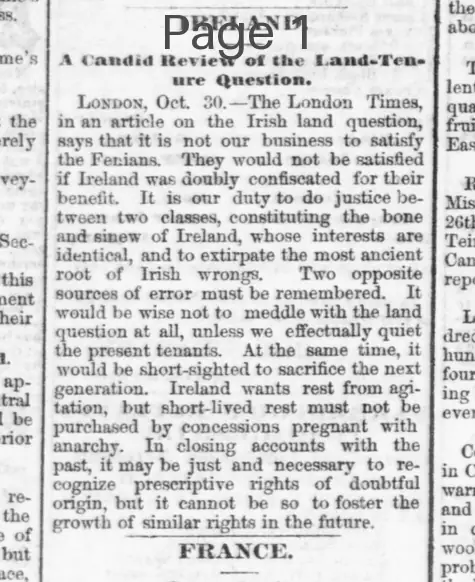
London, Oct. 30.-The London Times, in an article on the Irish land question, says that it is not our business to satisfy the Fenians. They would not be satisfied if Ireland was doubly confiscated for their benefit. It is our duty to do justice between two classes, constituting the bone and sinew of Ireland, whose interests are identical, and to extirpate the most ancient root of Irish wrongs. Two opposite sources of error must be remembered. It would be wise not to meddle with the land question at all, unless we effectually quiet the present tenants. At the same time, it would be short-sighted to sacrifice the next generation. Ireland wants rest from agitation, but short-lived rest must not be purchased by concessions pregnant with anarchy. In closing accounts with the past, it may be just and necessary to recognize prescriptive rights of doubtful origin, but it cannot be so to foster the growth of similar rights in the future.
London, Oct. 30.-The London Times, in an article on the Irish land question, says that it is not our business to satisfy the Fenians. They would not be satisfied if Ireland was doubly confiscated for their benefit. It is our duty to do justice between two classes, constituting the bone and sinew of Ireland, whose interests are identical, and to extirpate the most ancient root of Irish wrongs. Two opposite sources of error must be remembered. It would be wise not to meddle with the land question at all, unless we effectually quiet the present tenants. At the same time, it would be short-sighted to sacrifice the next generation. Ireland wants rest from agitation, but short-lived rest must not be purchased by concessions pregnant with anarchy. In closing accounts with the past, it may be just and necessary to recognize prescriptive rights of doubtful origin, but it cannot be so to foster the growth of similar rights in the future.
What sub-type of article is it?
Political
Colonial Affairs
What keywords are associated?
Irish Land Question
Fenians
Land Tenure
Prescriptive Rights
Irish Agitation
Where did it happen?
Ireland
Foreign News Details
Primary Location
Ireland
Event Date
Oct. 30
Event Details
The London Times article argues it is not the duty to satisfy Fenians on the Irish land question, but to do justice between Irish classes, quiet present tenants without sacrificing future generations or fostering anarchy through concessions, while recognizing past prescriptive rights.