Thank you for visiting SNEWPapers!
Sign up free
Editorial
August 10, 1883
Sacramento Daily Record Union
Sacramento, Sacramento County, California
What is this article about?
Editorial discusses General J.N. Phelps' resolution at the National Educational Convention in Saratoga, NY, condemning the growth of military spirit in education and society, its tabling, Phelps' background as a West Point graduate and abolitionist, and offers a balanced view: while citizen soldiery bolsters liberty, excess military displays may waste energy without investigation.
Clipping
OCR Quality
98%
Excellent
Full Text
THE MILITARY SPIRIT.
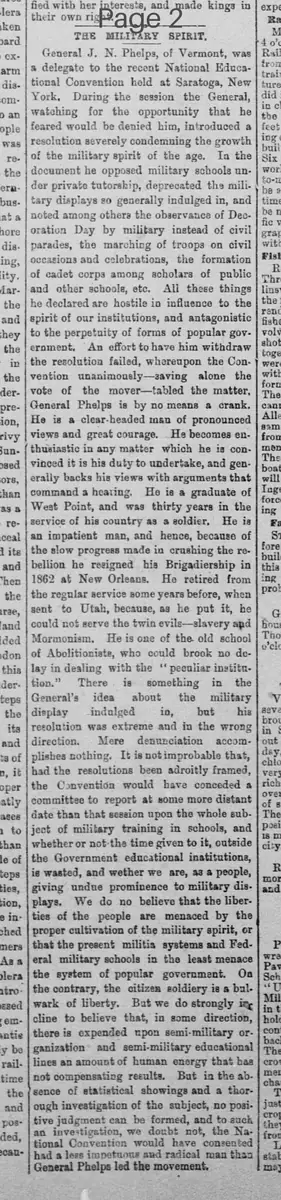
General J. N. Phelps, of Vermont, was a delegate to the recent National Educational Convention held at Saratoga, New York. During the session the General, watching for the opportunity that he feared would be denied him, introduced a resolution severely condemning the growth of the military spirit of the age. In the document he opposed military schools under private tutorship, deprecated the military displays so generally indulged in, and noted among others the observance of Decoration Day by military instead of civil parades, the marching of troops on civil occasions and celebrations, the formation of cadet corps among scholars of public and other schools, etc. All these things he declared are hostile in influence to the spirit of our institutions, and antagonistic to the perpetuity of forms of popular government. An effort to have him withdraw the resolution failed, whereupon the Convention unanimously—saving alone the vote of the mover—tabled the matter. General Phelps is by no means a crank. He is a clear-headed man of pronounced views and great courage. He becomes enthusiastic in any matter which he is convinced it is his duty to undertake, and generally backs his views with arguments that command a hearing. He is a graduate of West Point, and was thirty years in the service of his country as a soldier. He is an impatient man, and hence, because of the slow progress made in crushing the rebellion he resigned his Brigadiership in 1862 at New Orleans. He retired from the regular service some years before, when sent to Utah, because, as he put it, he could not serve the twin evils—slavery and Mormonism. He is one of the old school of Abolitionists, who could brook no delay in dealing with the "peculiar institution." There is something in the General's idea about the military display indulged in, but his resolution was extreme and in the wrong direction. Mere denunciation accomplishes nothing. It is not improbable that, had the resolutions been adroitly framed, the Convention would have conceded a committee to report at some more distant date than that session upon the whole subject of military training in schools, and whether or not the time given to it, outside the Government educational institutions, is wasted, and whether we are, as a people, giving undue prominence to military displays. We do not believe that the liberties of the people are menaced by the proper cultivation of the military spirit, or that the present militia systems and Federal military schools in the least menace the system of popular government. On the contrary, the citizen soldiery is a bulwark of liberty. But we do strongly incline to believe that, in some direction, there is expended upon semi-military organization and semi-military educational lines an amount of human energy that has not compensating results. But in the absence of statistical showings and a thorough investigation of the subject, no positive judgment can be formed, and to such an investigation, we doubt not, the National Convention would have consented had a less impetuous and radical man than General Phelps led the movement.
General J. N. Phelps, of Vermont, was a delegate to the recent National Educational Convention held at Saratoga, New York. During the session the General, watching for the opportunity that he feared would be denied him, introduced a resolution severely condemning the growth of the military spirit of the age. In the document he opposed military schools under private tutorship, deprecated the military displays so generally indulged in, and noted among others the observance of Decoration Day by military instead of civil parades, the marching of troops on civil occasions and celebrations, the formation of cadet corps among scholars of public and other schools, etc. All these things he declared are hostile in influence to the spirit of our institutions, and antagonistic to the perpetuity of forms of popular government. An effort to have him withdraw the resolution failed, whereupon the Convention unanimously—saving alone the vote of the mover—tabled the matter. General Phelps is by no means a crank. He is a clear-headed man of pronounced views and great courage. He becomes enthusiastic in any matter which he is convinced it is his duty to undertake, and generally backs his views with arguments that command a hearing. He is a graduate of West Point, and was thirty years in the service of his country as a soldier. He is an impatient man, and hence, because of the slow progress made in crushing the rebellion he resigned his Brigadiership in 1862 at New Orleans. He retired from the regular service some years before, when sent to Utah, because, as he put it, he could not serve the twin evils—slavery and Mormonism. He is one of the old school of Abolitionists, who could brook no delay in dealing with the "peculiar institution." There is something in the General's idea about the military display indulged in, but his resolution was extreme and in the wrong direction. Mere denunciation accomplishes nothing. It is not improbable that, had the resolutions been adroitly framed, the Convention would have conceded a committee to report at some more distant date than that session upon the whole subject of military training in schools, and whether or not the time given to it, outside the Government educational institutions, is wasted, and whether we are, as a people, giving undue prominence to military displays. We do not believe that the liberties of the people are menaced by the proper cultivation of the military spirit, or that the present militia systems and Federal military schools in the least menace the system of popular government. On the contrary, the citizen soldiery is a bulwark of liberty. But we do strongly incline to believe that, in some direction, there is expended upon semi-military organization and semi-military educational lines an amount of human energy that has not compensating results. But in the absence of statistical showings and a thorough investigation of the subject, no positive judgment can be formed, and to such an investigation, we doubt not, the National Convention would have consented had a less impetuous and radical man than General Phelps led the movement.
What sub-type of article is it?
Education
Military Affairs
Constitutional
What keywords are associated?
Military Spirit
Educational Convention
General Phelps
West Point
Abolitionist
Decoration Day
Citizen Soldiery
Popular Government
What entities or persons were involved?
General J. N. Phelps
National Educational Convention
West Point
Editorial Details
Primary Topic
Condemnation Of Military Spirit In Education And Society
Stance / Tone
Balanced Critique Supporting Proper Military Cultivation But Questioning Excess
Key Figures
General J. N. Phelps
National Educational Convention
West Point
Key Arguments
Military Displays And Training In Schools Are Hostile To Popular Government Institutions.
Phelps' Resolution Was Extreme And Poorly Received.
Citizen Soldiery Bolsters Liberty, Not Menaces It.
Excess Energy May Be Wasted On Semi Military Activities Without Investigation.
A Committee Inquiry Could Have Been Productive If Framed Adroitly.