Thank you for visiting SNEWPapers!
Sign up free
The New Hampshire Gazette And General Advertiser
Portsmouth, Exeter, Rockingham County, New Hampshire
What is this article about?
In Paris on Oct. 18, a rumored English proposition to partition American colonies: Britain would cede New England to France if France breaks alliance with Congress and helps subdue southern colonies. Comte de Vergennes appears surprised but dismisses it lightly, noting benefits to Britain. English negotiator hints other powers might accept. French politicians divided on merits.
Clipping
OCR Quality
Full Text
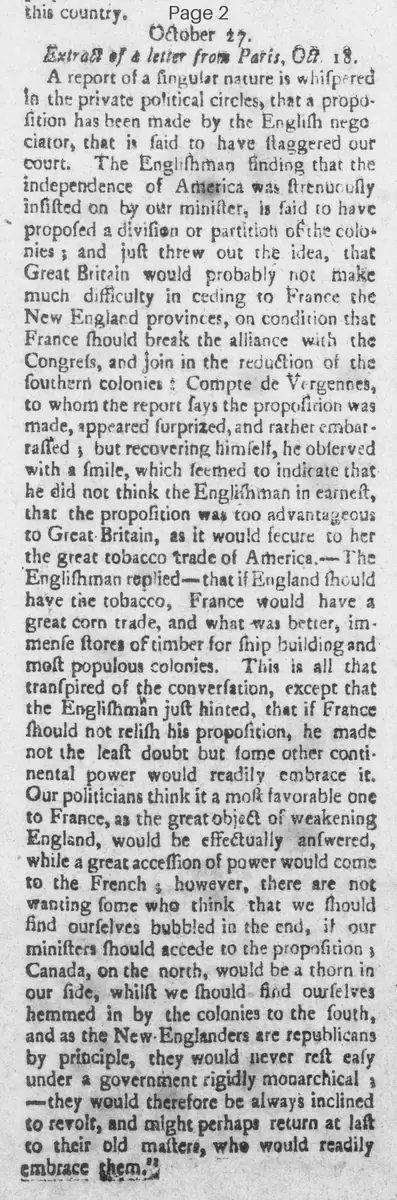
Extract of a letter from Paris, Oct. 18.
A report of a singular nature is whispered in the private political circles, that a proposition has been made by the English negotiator, that is said to have staggered our court. The Englishman finding that the independence of America was strenuously insisted on by our minister, is said to have proposed a division or partition of the colonies: and it threw out the idea, that Great Britain would probably not make much difficulty in ceding to France the New England provinces, on condition that France should break the alliance with the Congress, and join in the reduction of the southern colonies: Comte de Vergennes, to whom the report says the proposition was made, appeared surprised, and rather embarrassed: but recovering himself, he observed with a smile, which seemed to indicate that he did not think the Englishman in earnest, that the proposition was too advantageous to Great Britain, as it would secure to her the great tobacco trade of America. The Englishman replied that if England should have the tobacco, France would have a great corn trade, and what was better, immense stores of timber for ship building and most populous colonies. This is all that transpired of the conversation, except that the Englishman just hinted, that if France should not relish his proposition, he made not the least doubt but some other continental power would readily embrace it. Our politicians think it a most favorable one to France, as the great object of weakening England, would be effectually answered, while a great accession of power would come to the French: however, there are not wanting some who think that we should find ourselves bubbled in the end, if our ministers should accede to the proposition: Canada, on the north, would be a thorn in our side, whilst we should find ourselves hemmed in by the colonies to the south, and as the New Englanders are republicans by principle, they would never rest easy under a government rigidly monarchical as they would therefore be always inclined to revolt, and might perhaps return at last to their old masters, who would readily embrace them.
What sub-type of article is it?
What keywords are associated?
What entities or persons were involved?
Where did it happen?
Foreign News Details
Primary Location
Paris
Event Date
Oct. 18
Key Persons
Outcome
proposition dismissed lightly by vergennes; french politicians divided, some see it as favorable to weaken england, others fear long-term issues with canada and southern colonies, potential revolts by new englanders.
Event Details
English negotiator proposes partitioning American colonies, offering New England to France in exchange for breaking alliance with Congress and aiding reduction of southern colonies. Vergennes surprised but smiles, notes it advantages Britain with tobacco trade. Englishman counters with benefits to France in corn, timber, populous colonies, hints other powers might accept. Report whispered in private political circles.