Thank you for visiting SNEWPapers!
Sign up free
New Hampshire Statesman And State Journal
Concord, Merrimack County, New Hampshire
What is this article about?
The Whig State Convention in Concord, New Hampshire, on November 21, 1837, organized, nominated James Wilson Jr. of Keene as their candidate for Governor, adopted resolutions condemning the Jackson and Van Buren administrations for executive overreach and economic policies, and planned party organization.
Clipping
OCR Quality
Full Text
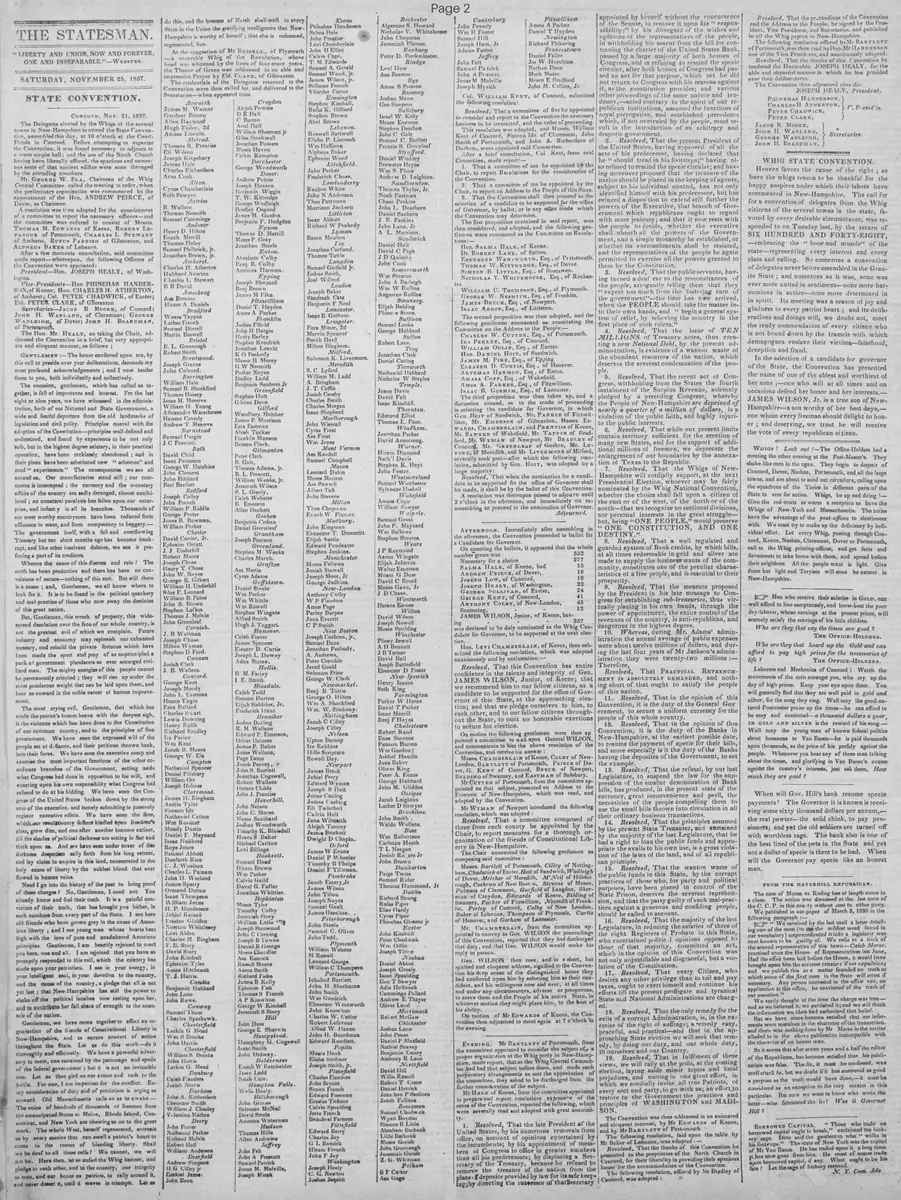
STATE CONVENTION.
Concord, Nov. 21, 1837.
The Delegates elected by the Whigs of the several towns in New-Hampshire to attend the State Convention, assembled this day, at 10 o'clock at the Court-House in Concord. Before attempting to organize the Convention, it was found necessary to adjourn to a more ample hall; and the use of the North Church having been liberally offered, the spacious and numerous seats of that ancient edifice were soon thronged by the attending members.
Mr. GEORGE W. ELA, Chairman of the Whig Central Committee, called the meeting to order, when the preliminary organization was commenced by the appointment of the Hon. ANDREW PEIRCE, of Dover, as Chairman.
A resolution was then adopted for the appointment of a committee to report the necessary officers—and the committee was ordered to consist of Messrs. Thomas M. Edwards of Keene, Robert Lefavour of Portsmouth, Charles L. Stewart of Amherst, Rufus Parrish of Gilmanton, and Alpheus Baker of Lebanon.
After a few moments consultation, said committee made report—whereupon, the following Officers of the Convention were appointed:
President—Hon. JOSEPH HEALY, of Washington.
Vice-Presidents—Hon. PHINEHAS HANDERSON, of Keene; Hon. CHARLES H. ATHERTON, of Amherst; Col. PETER CHADWICK, of Exeter; Eld. PETER CLARK, of Gilmanton.
Secretaries—JACOB B. MOORE, of Concord; JOHN H. WARLAND, of Claremont; GEORGE WADLEIGH, of Dover; JOHN H. BOARDMAN, of Portsmouth.
The Hon. Mr. Healy, on taking the Chair, addressed the Convention in a brief, but very appropriate and eloquent manner, as follows:
GENTLEMEN:—The honor conferred upon me, by this call to preside over your deliberations, demands my most profound acknowledgements; and I now tender them to you, both individually and collectively.
The occasion, gentlemen, which has called us together, is full of importance and interest. For the last eight or nine years, we have witnessed in the administration, both of our National and State Government, a wide and fearful departure from the old landmarks of legislation and civil polity. Principles coequal with the adoption of the Constitution—principles well defined and understood, and found by experience to be not only safe, but in the highest degree salutary, in their practical operation, have been recklessly abandoned; and in their place have been substituted new "schemes" and mad "experiments."
The consequences we see all around us. Our manufactories stand still; our commerce is interrupted; the currency and the monetary affairs of the country are sadly deranged, almost annihilated; an unnatural paralysis has fallen upon our enterprise, and industry in all its branches. Thousands of our most worthy countrymen have been reduced from affluence to want, and from competency to beggary.—The government itself, with a full and overflowing Treasury but ten short months ago has become bankrupt, and like other insolvent debtors, we see it preserving a part of its creditors.
Whence the cause of this distress and ruin? The earth has been productive and there has been no convulsions of nature—nothing of this sort. But still there is a cause; and, Gentlemen, we all know where to look for it. It is to be found in the political quackery and mal-practice of those who now sway the destinies of this great nation.
But, Gentlemen, this wreck of property, this widespread desolation over the face of our whole country, is not the greatest evil of which we complain. Future industry and economy may replenish our exhausted treasury, and rebuild the private fortunes which have been made the sport and prey of as unprincipled a pack of government plunderers as ever scourged civilized man. The mighty energies of this people cannot be permanently crippled; they will rise up under the most ponderous weight that can be laid upon them, and bear us onward in the noble career of human improvement.
The most crying evil, Gentlemen, that which has made the patriot's bosom heave with the deepest sigh, is the violence which has been done to the Constitution of our common country, and to the principles of free government. We have seen the expressed will of the people set at defiance, and their petitions thrown back, into their faces. We have seen the executive usurp and exercise the most important functions of the other co-ordinate branches of the Government, setting aside what Congress had done in opposition to his will, and enacting upon his own responsibility what Congress had refused to do at his bidding. We have seen the Congress of the United States broken down by the strong arm of the executive, and tamely submitting to passively register executive edicts. We have seen the fires, which our revolutionary fathers kindled upon freedom's altar, grow dim, and one after another become extinct, till the shades of political darkness are setting in fast and thick upon us. And we have seen under cover of this darkness despotism sally forth from his long retreat, and lay claim to empire in this land, consecrated to the holy cause of liberty by the noblest blood that ever flowed in human veins.
Need I go into the history of the past to bring proof of these charges? No, Gentleman, I need not. You already know and feel their truth. It is a painful conviction of their truth, that has brought you hither, in such numbers from every part of the State. I see here old friends who have grown grey in the cause of American liberty; and I see young men whose hearts beat high with the love of pure and unadulterated American principles. Gentlemen, I am heartily rejoiced to meet you here, one and all. I am rejoiced that you have so promptly responded to this call, which the country has made upon your patriotism. I see in your energy, in your intelligent zeal, in your devotion to the country, and the cause of the country, a pledge that all is not yet lost; that New-Hampshire has still the power to shake off the political incubus now resting upon her, and to contribute her full share of strength to the counsels of the nation.
Gentlemen, we have come together to effect an organization of the friends of Constitutional Liberty in New-Hampshire, and to secure concert of action throughout the State. Let us do this work—do it thoroughly and efficiently. We have a powerful adversary to meet, one sustained by the patronage and spoils of the federal government; but it is not an invincible one. Let us then gird on our armor and rush to the battle. For one, I am impatient for the conflict. Every consideration of duty and of patriotism is urging us onward. Old Massachusetts calls on us to awake—The voice of hundreds of thousands of freemen from the emancipated States of Maine, Rhode Island, Connecticut, and New York are cheering us on to the great work. The whole West, herself regenerated, entreats us by every motive that can swell a patriot's heart to come to the rescue of bleeding liberty. Shall we be deaf to all these calls? We cannot, we will not be. Here then, let us unfurl the Whig banner, and pledge to each other, and to the country, our integrity as men, and our honor as patriots, to rally around it, and never desert it, until it waves in triumph. Let us do this, and the breezes of March will waft to every State in the Union the gratifying intelligence that New-Hampshire is worthy of herself; that she is redeemed, regenerated, free.
At the suggestion of Mr. Russell, of Plymouth—a venerable Whig of the Revolution, whose head was whitened by the frosts of four score years, the Throne of Grace was addressed in an able and impressive Prayer by Eld. CLARK, of Gilmanton.
The credentials of the Delegates returned to the Convention were then called for, and delivered to the Secretaries—when appeared from the returns the following Delegates, viz:
[Full list of delegates from indices 154-689, corrected for OCR errors, e.g., 'Phinehas Hlandoron' to 'Phinehas Handerson', 'Alzernon S. lownrd' to 'Algernon S. Howard', etc. The list is alphabetical by town, with names like Saltns Hale to 'Salmon Hale', John Prentiss, Nicholas V. Whitehouse, etc., continuing through all towns up to Washington, Z. G. Whitman, Joseph Healy, C. G. Newton, Joshua Jaquith. Preserve as a bulleted or listed paragraph in the text.]
Col. WILLIAM KENT, of Concord, submitted the following resolution:
Resolved, That a committee of five be appointed to consider and report to the Convention the necessary business to be transacted, and the order of proceeding.
This resolution was adopted, and Messrs. William Kent of Concord, Simeon Ide of Claremont, John Smith of Portsmouth, and John A. Richardson of Durham, were appointed said Committee.
After a brief consultation, Col. Kent, from said Committee, made report:-
1. That a committee of ten be appointed by the Chair, to report Resolutions for the consideration of the Convention.
2. That a committee of ten be appointed by the Chair, to report an Address to the People of this State.
3. That the Convention shall then proceed to the selection of a candidate to be supported for the office of Governor, by ballot, or in any other mode which the Convention may determine.
The first proposition contained in said report, was then considered, and adopted, and the following gentlemen were announced as the Committee on Resolutions:-
Hon. SALMA HALE, of Keene.
Dr. ROBERT LANE, of Sutton,
Ebenezer Wentworth, Esq., of Portsmouth.
Thomas W. Kittredge, Esq., of Dover.
Simeon B. Little, Esq., of Boscawen.
Nicholas V. Whitehouse, Esq., of Rochester.
William C. Thompson, Esq., of Plymouth.
George W. Nesmith, Esq., of Franklin,
James Breck, Esq., of Newport.
Isaac Abbott, Esq., of Littleton.
The second proposition was then adopted, and the following gentlemen announced as constituting the Committee on the Address to the People:-
Charles W. Cutter, Esq., of Portsmouth.
Ira Perley, Esq., of Concord,
William Odlin, Esq., of Exeter.
Hon. Daniel Hoit, of Sandwich,
James M. Pike, Esq., of Epping,
Eleazer D. Currier, Esq., of Hanover,
Artemas Harmon, Esq., of Eaton,
Amasa Copp, Esq., of Wakefield.
Amos A. Parker, Esq., of Fitzwilliam,
Isaac B. Gorham, Esq., of Lancaster.
The third proposition was then taken up, and a discussion ensued, as to the mode of proceeding in selecting the candidate for Governor, in which Gen. Hoit of Sandwich, Mr. Parker of Fitzwilliam, Mr. Emerson of Gilmanton, Messrs. Edwards, Chamberlain, and Prentiss of Keene, Mr. Sawyer of Wakefield, Mr. Tappan of Bradford, Mr. Wyman of Newport, Mr. Bradley of Concord, Mr. Greenleaf of Goshen, Mr. Lyford of Meredith, and Mr. Livermore of Milford, severally took part—after which the following resolution, submitted by Gen. Hoit, was adopted by a large majority:
Resolved, That when the nomination for a candidate to be supported for the office of Governor shall be made, it shall be by the ballot of this Convention.
A resolution was thereupon passed to adjourn until 2 o'clock in the afternoon, and immediately on re-assembling to proceed to the nomination of Governor.
Adjourned.
AFTERNOON. Immediately after assembling in the afternoon, the Convention proceeded to ballot for a Candidate for Governor.
On counting the ballots, it appeared that the whole number given was 552—Necessary for a choice 277.
SALMA HALE, of Keene, had 15
Andrew Peirce, of Dover, 18
Joseph Low, of Concord, 18
Joseph Healy, of Washington, 22
George Sullivan, of Exeter, 24
GEORGE KENT, of Concord, 41
ANTHONY COLBY, of New-London, 45
Scattering, 12
JAMES WILSON, Junior, of Keene, having 357 was declared to be duly nominated as the Whig Candidate for Governor, to be supported at the next election.
Hon. LEVI CHAMBERLAIN, of Keene, then submitted the following resolution, which was adopted unanimously and by acclamation:-
Resolved, That this Convention has entire confidence in the talents and integrity of Gen. JAMES WILSON, Junior, of Keene; that we recommend him to our fellow citizens, as a candidate to be supported for the office of Governor of this State, at the approaching election; and that we pledge ourselves to him, to each other, and to our fellow citizens throughout the State, to omit no honorable exertions to secure his election.
On motion the following gentlemen were then appointed a committee to wait upon General Wilson, and communicate to him the above resolution of the Convention, and receive his answer:
Messrs. Chamberlain of Keene, Colby of New-London, Bartlett of Portsmouth, Peirce of Dover, G. Kent of Concord, Breck of Newport, Belding of Swanzey, and Eastman of Salisbury.
Mr. Cutter of Portsmouth, from the committee appointed on that subject, presented an Address to the Freemen of New-Hampshire, which was read, and adopted by the Convention.
Mr. Wyman of Newport introduced the following resolution, which was adopted:
Resolved, That a committee composed of three from each county be appointed by the Chair, to report measures or a thorough organization of the friends of Constitutional Liberty in New-Hampshire.
The Chair announced the following gentlemen as composing said committee:
Messrs. Bartlett of Portsmouth, Cilley of Nottingham, Chadwick of Exeter, Hoit of Sandwich, Wadleigh of Dover, Melcher of Meredith, M'Neil of Hillsborough, Cochran of New Boston, Stevens of Mason, Putnam of Claremont, Garfield of Langdon, Sherman of Croydon, Edwards of Keene, Belding of Swanzey, Parker of Fitzwilliam, Nesmith of Franklin, Perley of Concord, Colby of New London, Baker of Lebanon, Thompson of Plymouth, Curtis of Hanover, and Gorham of Lancaster.
Mr. Chamberlain, from the committee appointed to convey to Gen. Wilson the proceedings of this Convention, reported that they had discharged that duty, and that Gen. Wilson would make his reply in person.
Gen. Wilson then rose, and in a short, but spirited and eloquent address, signified to the Convention his deep sense of the distinguished honor they had conferred upon him by selecting him as their candidate, and his willingness now and ever, at all times and under any circumstances, adverse or prosperous, to serve them and the People of his native State, in whatever station they might place him, to the best of his ability.
On motion of Mr. Edwards of Keene, the Convention then adjourned to meet again at 7 o'clock in the evening.
Evening. Mr. Bartlett of Portsmouth, from the committee appointed to consider the subject of a proper organization of the Whig party in New-Hampshire, made report, that as the Whig Central Committee had had that subject before them, and made such preparatory arrangements as met the approbation of the committee, they asked to be discharged from the further consideration of the subject.
Mr. Hale of Keene, from the committee appointed to prepare and report resolutions expressive of the sense of the Convention, reported the following, which were severally read and adopted with great unanimity.
1. Resolved, That the late President of the United States, by his numerous removals from office, on account of opinions entertained by the incumbents; by his appointment of members of Congress to office in greater numbers than all his predecessors; by displacing a Secretary of the Treasury, because he refused to remove the treasure of the nation from the place of deposit provided by law for its safe keeping; by appointing agents by himself without the concurrence of the Senate, to remove it upon his "responsibility;" by his disregard of the wishes and opinions of the representatives of the people, in withholding his assent from the bill for continuing the charter of the United States Bank, passed by a large majority of both houses of Congress, and in refusing to rescind the specie circular, after both houses of Congress had passed an act for that purpose, which act he did not return to Congress with his reasons against it, as the constitution provides; and various other proceedings of the same nature and tendency,—acted contrary to the spirit of our republican institutions, assumed the functions of royal prerogative, and established precedents which, if not overruled by the people, must result in the introduction of an arbitrary and despotic government.
2. Resolved, That the present President of the United States, having approved of all the acts of his predecessor, having declared that he "should tread in his footsteps;" having also refused to rescind the specie circular; and having moreover proposed that the treasure of the nation should be placed in the keeping of agents, subject to his individual control, has not only identified himself with his predecessor, but has evinced a disposition to extend still further the powers of the Executive, that branch of Government which republicans ought to regard with most jealousy; and that it now rests with the people to decide, whether the executive shall absorb all the powers of the Government, and a simple monarchy be established, or whether its encroachments shall be resisted, and the representatives of the people be again permitted to exercise all the powers granted to them by the Constitution.
3. Resolved, That the public servants, having turned a deaf ear to the remonstrances of the people, arrogantly telling them that they "expect too much from the fostering care of the government"—the time has now arrived, when the PEOPLE should take the matter into their own hands, and "begin a general system of relief, by relieving the country in the first place of such rulers."
4. Resolved, That the issue of TEN MILLIONS of Treasury notes, thus creating a new National Debt, by the present administration, is evidence of a wanton waste of the abundant resources of the nation, which deserves the severest condemnation of the people.
5. Resolved, That the recent act of Congress, withholding from the States the fourth instalment of the Surplus Revenue, solemnly pledged by a preceding Congress, whereby the People of New-Hampshire are deprived of nearly a quarter of a million of dollars, is a violation of the public faith, and highly injurious to the public interests.
6. Resolved, That while our present limits contain territory sufficient for the erection of many new States, and for the support of additional millions of freemen, we deprecate the enlargement of our boundaries by the annexation of Texas to the Republic.
7. Resolved, That the Whigs of New-Hampshire will cordially support, at the next Presidential Election, whoever may be fairly nominated by the Whig National Convention, whether the choice shall fall upon a citizen of the east or of the west, of the north or of the south—that we recognize no sectional divisions, nor personal interests in the great struggle—but, being "ONE PEOPLE," would preserve "ONE CONSTITUTION, AND ONE DESTINY."
8. Resolved, That a well regulated and guarded system of Bank credits, by which bills, at all times redeemable in gold and silver are made to supply the business wants of the community, constitutes one of the peculiar characteristics of a free people, and is essential to their prosperity.
9. Resolved, That the measure proposed by the President in his late message to Congress for establishing sub-treasuries, thus virtually placing in his own hands, through the power of appointment, the entire control of the revenues of the country, is anti-republican, and dangerous in the highest degree.
10. Whereas, during Mr. Adams' administration the annual average of public expenses were about twelve millions of dollars, and during the last four years of Mr. Jackson's administration they were twenty-two millions:—Therefore,
Resolved, That PRACTICAL RETRENCHMENT IS ABSOLUTELY DEMANDED, and nothing short of that ought to satisfy the people of this nation.
11. Resolved, That in the opinion of this Convention, it is the duty of the General Government, to secure a uniform currency for the people of this whole country.
12. Resolved, That in the opinion of this Convention, it is the duty of the Banks in New-Hampshire, at the earliest possible date, to resume the payment of specie for their bills; and more especially is it the duty of the Banks having the deposits of the Government, to set the example.
13. Resolved, That the refusal, by our last Legislature, to suspend the law for the suppression of the smaller denomination of Bank bills, has produced, in the present state of the currency, great inconvenience and peril, the necessities of the people compelling them to use the small bills thrown into circulation in all their ordinary business transactions.
14. Resolved, That the principles assumed by the present State Treasurer, and sustained by the majority of the last Legislature, that he had a right to loan the public funds and appropriate the avails to his own use, is a gross violation of the laws of the land, and of all republican principle.
15. Resolved, That the wanton waste of the public funds in this State, by the corrupt practices of those who, for party and political purposes, have been placed in control of the State Prison, deserves the severest reprehension, and that the party guilty of such malpractices against a generous and confiding people, should be called to account.
16. Resolved, That the majority of the last Legislature, in reducing the salaries of three of the eight Registers of Probate in this State, who entertained political opinions opposed to those of that majority, committed an act, which in the opinion of this Convention was not only unjustifiable and disgraceful, but a violation of the Constitution.
17. Resolved, That every Citizen, who desires any other privilege than to toil and pay taxes, ought to exert himself and continue his efforts till the present profligate and tyrannical State and National Administrations are changed.
18. Resolved, That the only remedy for the evils of a corrupt Administration, is, in the exercise of the right of suffrage; a remedy easy, peaceful, and practical—and that in the approaching State election we will seek that remedy, by doing our duty, and our whole duty, to ourselves and our Country.
19. Resolved, That in fulfilment of these views, we will rally at the polls, at the coming election, laying aside minor topics and local prejudices, and uniting in one great effort, in which we cordially invite all true Patriots, of every sect and party, to go with us; an effort to restore to the Government the practices and principles of WASHINGTON and MADISON.
The Convention was then addressed in an animated and eloquent manner, by Mr. Edwards of Keene, and by Mr. Bartlett of Portsmouth.
The following resolution, laid upon the table by Mr. Baker of Lebanon, was adopted:-
Resolved, That the thanks of this Convention be presented to the proprietors of the North Church in Concord, for their liberality in providing their spacious house for the accommodation of the Convention.
The following resolution, offered by Mr. Bradley of Concord, was adopted:
Resolved, That the proceedings of the Convention and the Address to the People, be signed by the President, Vice Presidents, and Secretaries, and published in all the Whig papers in New-Hampshire.
The following resolution offered by Mr. Bartlett of Portsmouth, was then read by Hon. Mr. Handerson, one of the Vice Presidents, and unanimously adopted:
Resolved, That the thanks of this Convention be tendered the Honorable JOSEPH HEALY, for the able and impartial manner in which he has presided over their deliberations.
The Convention then adjourned sine die.
JOSEPH HEALY, President.
PHINEHAS HANDERSON,
Charles H. Atherton,
Vice Presidents.
Peter Chadwick,
Peter Clark,
JACOB B. MOORE,
JOHN H. WARLAND,
Secretaries
George WADLEIGH,
JOHN H. BOARDMAN,
What sub-type of article is it?
What themes does it cover?
What keywords are associated?
What entities or persons were involved?
Where did it happen?
Story Details
Key Persons
Location
Concord, New Hampshire
Event Date
November 21, 1837
Story Details
Whig delegates assembled in Concord to organize the party, nominate James Wilson Jr. as Governor candidate by ballot, adopt an address and 19 resolutions criticizing Jackson and Van Buren administrations for executive usurpation, economic mismanagement, and constitutional violations, and appoint committees for further organization.