Thank you for visiting SNEWPapers!
Sign up free
Virginia Argus
Richmond, Virginia
What is this article about?
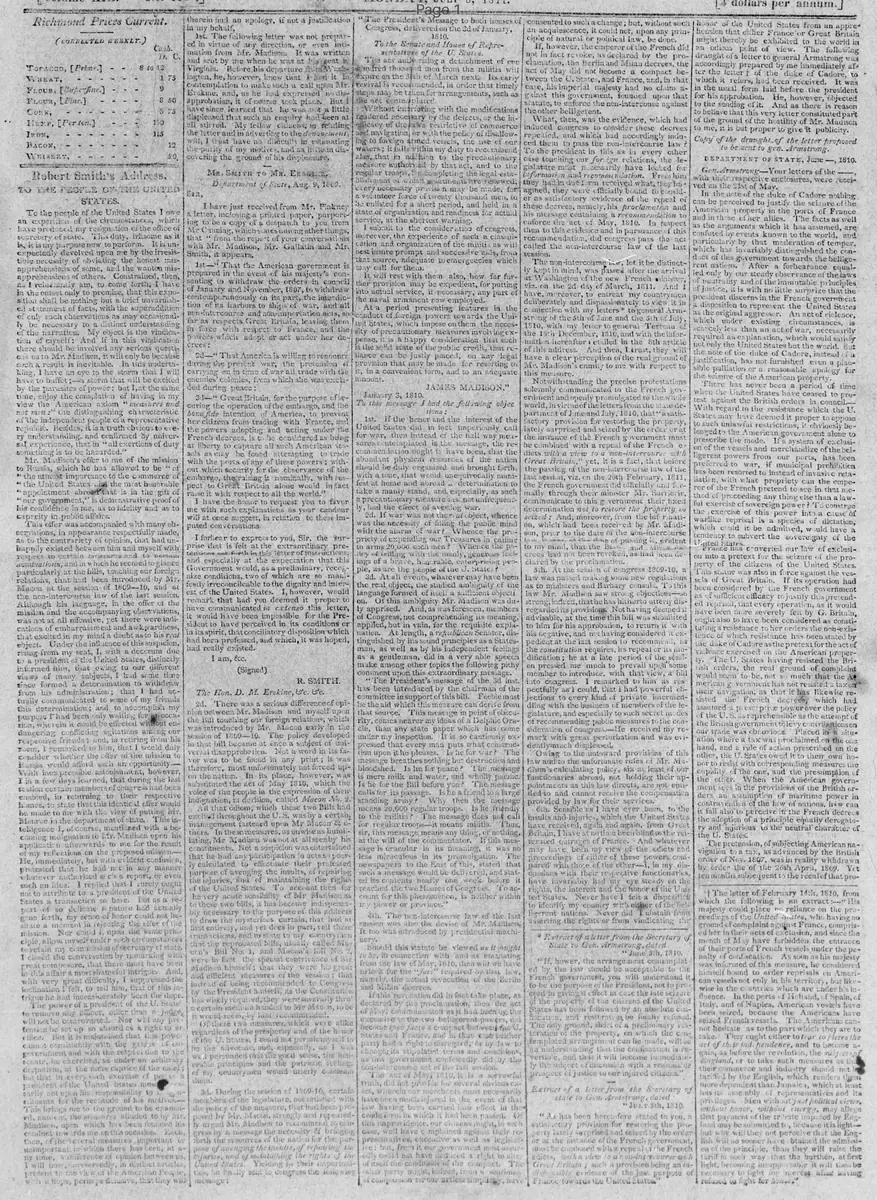
Robert Smith, former Secretary of State, publishes a defense of his resignation from President James Madison's administration in 1811, citing political differences over foreign policy, suspected intrigue to replace him with James Monroe, and Madison's covert role in controversial bills like Macon's Bills and the non-intercourse law.
Merged-components note: Direct textual continuation of Robert Smith's political address on his resignation and U.S. foreign policy disputes; original label on second component was incorrectly 'foreign_news' as it is narrative personal exposition, not news report
Clippings
1 of 2
OCR Quality
Full Text
Mr. Madison's offer to me of the mission to Russia, which he has allowed to be "of the utmost importance to the commerce of the United States and the most honorable appointment abroad that is in the gift of our government," is demonstrative proof of his confidence in me, as to fidelity and as to capacity in public affairs.
This offer was accompanied with many observations, in appearance respectfully made, as to the contrariety of opinion, that had unhappily existed between him and myself with respect to certain measures and to certain administrations, and in which he seemed to glance particularly at the bills, touching our foreign relations, that had been introduced by Mr. Macon at the session of 1809-10, and at the non-intercourse law of the last session.
Although his language, in the offer of the mission and the accompanying observations, was not at all offensive, yet there were indications of embarrassment and awkwardness, that excited in my mind a doubt as to his real object. Under the influence of this suspicion, rising from my seat, I, with a decorum due to a president of the United States, distinctly informed him, that owing to our different views of many subjects, I had some time since formed a determination to withdraw from his administration; that I had actually communicated to some of my friends this determination; and to accomplish my purpose I had been only waiting for an occasion, wherein it could be effected without endangering conflicting agitations among our respective friends; and, in retiring from his room, I remarked to him, that I would duly consider whether the offer of the mission to Russia would afford such an opportunity.
With inexpressible astonishment, however, I in a few days learned, that during the last session certain members of congress had been enabled, in returning to their respective homes, to state that this identical offer would be made to me with the view of putting Mr. Monroe in the department of state. This intelligence I, of course, mentioned with a becoming indignation to Mr. Madison upon his application afterwards to me for the result of my reflections on the proposed mission.
He, immediately, but with evident confusion, protested that he had not in any manner whatever authorized so such a report, or even such an idea. I replied that I surely ought not to attribute to a president of the United States a transaction so base. But as a report of so delicate a nature had actually gone forth, my sense of honor could not hesitate a moment in rejecting the offer of the mission. Nor could I, upon the same principle, allow myself under such circumstances to retain my commission of secretary of state.
I closed the conversation by remarking with great composure, that there must have been in this affair a most shameful intrigue. And, with very great difficulty, I suppressed the inclination I felt, to tell him, that of this intrigue he had inconsiderately been the dupe.
The power of a president of the U. States to remove any officer, other than a judge, will not be controverted. Nor will any pretension be set up so absurd as a right to an office. But it is maintained that this power cannot consistently with the genius of our government and with the respect due to the senate, be exercised, as under an arbitrary despotism, at the mere caprice of the chief; but that in every such exercise of presidential authority, the president of the United States must necessarily act upon his responsibility to the elements of the rectitude of his motives.
This brings me to the ground to be examined, namely, the measures alluded to by Mr. Madison, upon which has been founded his conduct towards me on this occasion. Each, then, of the several measures important or unimportant, on which there has been, at any time, a different opinion between us, I will now, unreservedly, in distinct articles, present to the view of the American People, with a hope, perhaps dormant, that they will therein find an apology, if not a justification in my behalf,
1st. The following letter was not prepared in virtue of any direction, or even intimation from Mr. Madison. It was written and sent by me when he was at his seat in Virginia. Before his departure from Washington, he, however, knew that I had it in contemplation to make such a call upon Mr. Erskine, and, as he had expressed no disapprobation, it of course took place. But I have since learned that he was not a little displeased that such an enquiry had been at all stirred. My fellow citizens, in reading the letter and in adverting to the denouement, will, I trust have no difficulty in estimating the purity of my motives, and as little in discovering the ground of his displeasure.
MR. SMITH TO MR. ERSKINE.
Department of State, Aug. 9, 1809.
SIR,
I have just received from Mr. Pinkney a letter, inclosing a printed paper, purporting to be a copy of a despatch to you from Mr. Canning, which states among other things, that "from the report of your Conversations with Mr. Madison, Mr. Gallatin and Mr. Smith, it appears,
1st--" That the American government is prepared in the event of his majesty's consenting to withdraw the orders in council of January and November, 1807, to withdraw contemporaneously on its part, the interdiction of its harbors to ships of war, and all non-intercourse and non-importation acts, so far as respects Great Britain, leaving them in force with respect to France, and the powers which adopt or act under her decrees:
2d--" That America is willing to renounce during the present war, the pretension of carrying on in time of war all trade with the enemies' colonies, from which she was excluded during peace:
3d--" Great Britain, for the purpose of securing the operation of the embargo, and the bona fide intention of America, to prevent her citizens from trading with France, and the powers adopting and acting under the French decrees, is to be considered as being at liberty to capture all such American vessels as may be found attempting to trade with the ports of any of these powers; without which security for the observance of the embargo, the raising it nominally, with respect to Great Britain alone would in fact raise it with respect to all the world."
I have the honor to request you to favor me with such explanations as your candour will at once suggest, in relation to these imputed conversations.
I forbear to express to you, Sir, the surprise that is felt at the extraordinary pretensions set forth in this letter of instructions, and especially at the expectation that this Government would, as a preliminary, recognize conditions, two of which are so manifestly irreconcilable to the dignity and interest of the United States. I, however, would remark that had you deemed it proper to have communicated in extenso this letter, it would have been impossible for the President to have perceived in its conditions or in its spirit, that conciliatory disposition which had been professed, and which, it was hoped, had really existed.
I am, &c.
(Signed) R. SMITH.
The Hon. D. M. Erskine, &c. &c.
2d. There was a serious difference of opinion between Mr. Madison and myself upon the Bill touching our foreign relations, which was introduced by Mr. Macon early in the session of 1809-10. The policy developed in that bill became at once a subject of universal disapprobation. Not a word in its favor was to be found in any print; it was therefore, most unfortunately not passed upon the nation. in its place, however, was substituted the act of May 1810, which the voice of the people in the expression of their indignation, in derision, called Macon's Bill No. 2.
All that odium, which these two Bills had excited throughout the U.S. was by a certain management fastened upon Mr. Macon & others. In these measures, as unwise as humiliating, Mr. Madison was not at all seen by his constituents. Not a suspicion was entertained that he had any participation in acts so poorly calculated to effectuate their professed purpose of avenging the insults, of repairing the injuries, and of maintaining the rights of the United States. To account then for the very acute sensibility of Mr. Madison as to these two bills, it has become indispensably necessary to the purpose of this address to draw the mysterious curtain, that had at first entirely, and yet does in part, veil these transactions, and to state to my Countrymen that the reprobated bills, usually called Macon's Bill No. 1, and Macon's Bill No. 2, were in fact the special contrivance of Mr. Madison himself; that they were his ready and efficient measures of the session: that instead of being recommended to Congress by the President himself, as the Constitution has wisely required, they were covertly thro' a certain medium handed to Mr. Macon, to be it would seem, by him recommended.
Of these two measures, which were alike regardless of the prosperity and of the honor of the U. States. I could not permit myself to be the advocate, and, especially, as I was well persuaded that the good sense, the honorable principles and the patriotic feeling of my countrymen would utterly condemn them.
3d. During the session of 1809-10, certain members of the legislature, not satisfied with the policy of the measure, that had been pursued by Mr. Macon, strongly and repeatedly urged Mr. Madison to recommend to Congress by a message the necessity of bringing forth the resources of the nation for the purpose of avenging the insults, of repairing the injuries, and of maintaining the rights of the United States. Yielding to their importunities, he finally sent to congress the following message:
Citizens of the U. States.
The act authorising a detachment of one hundred thousand men from the militia will expire on the 4th of March next. Its early revival is recommended, in order that timely steps may be taken for arrangements, such as the act contemplated.
Without interfering with the modifications rendered necessary by the defects, or the inefficacy of those usually restrictive of commerce and navigation or with the policy of disallowing to foreign armed vessels, the use of our waters; it falls within my duty to recommend also, that in addition to the precautionary measure authorised by that act, and to the regular troops, for completing the legal establishment of which estimates are renewed, every necessary provision may be made, for a volunteer force of twenty thousand men, to be enlisted for a short period, and held in a state of organization and readiness for actual service, at the shortest warning.
I submit to the consideration of congress, moreover, the expediency of such a classification and organization of the militia as will best insure prompt and successive aids, from that source, adequate to emergencies which may call for them.
It will rest with them also, how far further provision may be expedient, for putting into actual service, if necessary, any part of the naval armament now employed.
At a period presenting features in the conduct of foreign powers towards the United States, which impose on them the necessity of precautionary measures involving expense, it is a happy consideration that such is the solid state of the public credit, that reliance can be justly placed, on any legal provision that may be made for resorting to it, in a convenient form, and to an adequate amount.
JAMES MADISON.
January 3, 1810.
To this message I had the following objections:
1st. If the honor and the interest of the United States did in fact imperiously call for war, then instead of the half way measures contemplated in the message, the recommendation ought to have been, that the abundant physical resources of the nation should be duly organized and brought forth, with a tone, that would unequivocally manifest at home and abroad a determination to take a manly stand, and, especially, as such a precautionary measure is, not unfrequently, had the effect of averting war.
2d. If war was not the real object, whence was the necessity of filling the public mind with the alarm of war? Whence the propriety of expending our Treasures in calling to arms 200,000 such men? Whence the policy of trifling with the manly, generous feelings of a brave, honorable, enterprising people, as are the people of the U. States?
3d. At all events, whatever may have been the real object, the studied ambiguity of the language formed of itself a sufficient objection. Of this ambiguity Mr. Madison was duly apprised. And, as was foreseen, members of Congress, not comprehending its meaning, applied, but in vain, for the requisite explanation. At length, a republican Senator, distinguished by his sound principles as a Statesman, as well as by his independent feelings as a gentleman, did in a very able speech make among other topics the following pithy comment upon this extraordinary message.
"The President's message of the 3d inst. has been introduced by the chairman of the committee in support of this bill. Feeble must be the aid which this measure can derive from that source. This message in point of obscurity, comes nearer my ideas of a Delphic Oracle, than any state paper which has come under my inspection. It is so cautiously expressed that every man puts what construction upon it he pleases. Is he for war? The message breathes nothing but destruction and bloodshed. Is he for peace? The message is mere milk and water, and wholly pacific. Is he for the Bill before you? The message calls for its passage. Is he a friend to a large standing army? Why then the message means 20,000 regular troops. Is he friendly to the militia? The message does not call for regular troops-it means militia. Thus, sir, this message means any thing, or nothing, at the will of the commentator, If this message is oracular in its meaning, it was no less miraculous in its promulgation. The newspapers to the East of this, stated that such a message would be delivered, and stated its contents nearly one week before it reached the two Houses of Congress. To account for this phenomenon, is neither within my power or province."
4th. The non-intercourse law of the last session was also the device of Mr. Madison. It too was introduced by presidential machinery.
Should this statute be viewed as it ought to be, in connection with and as continuing from the law of May, 1810, then with we have to look for the "cue" required by that law, namely, the actual revocation of the Berlin and Milan decrees.
If this revocation did in act take place, as declared by the proclamation, then the act of May; communicated as it had been by the executive to the two belligerent powers, did become the facto a compact between the U. States and France, and in that case neither party had a right to disregard, by law to change; its stipulated terms and conditions, as the government confessedly did by the non-intercourse act of the last session.
The act of May 1810. it is a sorrowful truth, did not provide for several obvious cases, wherein our merchants must necessarily have been much injured in the event of that law having been carried into effect in the mode dormant in which it had been passed. () of this improvidence, our citizens might, in such case, well have complained against their representatives, executive as well as legislative: but, from it our government most assuredly could not have deduced a right to alter of itself the conditions of the compact. The other party might, indeed, from a sentiment of compassion to our artless umpire, have consented to such a change; but, without such an acquiescence, it could not, upon any principle of natural or political law, be done.
If, however, the emperor of the French did not in fact revoke, as declared by the proclamation, the Berlin and Milan decrees, the act of May did not become a compact between the U. States, and France, and, in that case, his imperial majesty had no claim against this government, founded upon that statute, to enforce the non-intercourse against the other belligerent.
What, then, was the evidence, which had induced congress to consider these decrees repealed, and which had accordingly induced them to pass the non-intercourse law?
To the president in this as in every other case touching our foreign relations, the legislature must necessarily have looked for information and recommendation. From him they had in due form received what, they imagined, they were officially bound to border as satisfactory evidence of the repeal of these decrees, namely, his proclamation and his message containing a recommendation to enforce the act of May, 1810. In respect then to this evidence and in pursuance of this recommendation, did congress pass the act called the non-intercourse law of the last session.
The non-intercourse law, let it be distinctly kept in mind, was passed after the arrival at Washington of the new French minister, viz. on the 2d day of March, 1811. And I have, moreover, to entreat my countrymen deliberately and dispassionately to view it in connection with my letters * to general Armstrong of the 5th of June and the 5th of July, 1810, with my letter to general Turreau of the 18th December, 1810, and with the information hereafter detailed in the 8th article of this address. And then, I trust, they will have a clear perception of the real ground of Mr. Madison's enmity to me with respect to this measure.
Notwithstanding the precise protestations solemnly communicated to the French government and openly promulgated to the whole world, in virtue of the letters from the state department of June and July, 1810, that "a satisfactory provision for restoring the property, lately surprised and seized by the order or at the instance of the French government must be combined with a repeal of the French edicts with a view to a non-intercourse with Great Britain," yet, it is a fact, that before the passing of the non-intercourse law of the last session, viz. on the 20th February, 1811, the French government did officially and formally through their minister Mr. Serrurier, communicate to this government their fixed determination not to restore the property so seized: And, moreover, from the information, which had been received by Mr. Madison, prior to the date of the non-intercourse law it was, at the time of passing it, evident to my mind, that the Berlin and Milan decrees had not been revoked, as had been declared by the proclamation.
5th. At the session of congress 1809-10, a law was passed making some new regulations as to ministers and Barbary consuls. To this law Mr. Madison saw strong objections--so strong, indeed, that he has hitherto utterly disregarded its provisions. Not having deemed it advisable, at the time this bill was submitted to him for his approbation, to return it with his negative, and not having considered it expedient at the last session to recommend, as the constitution requires, its repeal or its modification; he at a late period of the session pressed me much to prevail upon some member to introduce, with that view, a bill into congress. I remarked to him as respectfully as I could, that I had powerful objections to every kind of private intermeddling with the business of members of the legislature, and especially to such secret modes of recommending public measures to the consideration of congress. He received my remark with great perturbation and was evidently much displeased.
Owing to the untoward provisions of this law and to the unfortunate rules of Mr. Madison's calculating policy, six at least of our functionaries abroad, not holding their appointments as this law directs, are not entitled to and cannot receive the compensation provided by law for their services.
6th. Sensible as I have ever been, to the insults and injuries, which the United States have received, again and again, from Great Britain, I have at no time been blind to the reiterated outrages of France. And whatever may have been my view of the edicts and proceedings of either of these powers compared with those of the other--I, in my discussions with their respective functionaries, have invariably had my eye steady on the rights, the interest and the honor of the United States. Never have I felt a disposition to identify my country with either of the belligerent nations. Never did I abstain from asserting the rights or from vindicating the honor of the United States from an apprehension that either France or Great Britain might thereby be exhibited to the world in an odious point of view. The following draught of a letter to general Armstrong was accordingly prepared by me immediately after the letter + of the duke of Cadore, to which it refers, had been received. It was in the usual form laid before the president for his approbation. He, however, objected to the sending of it. And as there is reason to believe that this very letter constituted part of the ground of the hostility of Mr. Madison to me, it is but proper to give it publicity.
Copy of the draught of the letter proposed to be sent to gen. Armstrong.
DEPARTMENT OF STATE, JUNE, 1810.
Gen. Armstrong--Your letters of the ---
with their respective enclosures, were received on the 21st of May.
In the note of the duke of Cadore nothing can be perceived to justify the seizure of the American property in the ports of France and in those of her allies. The facts as well as the arguments which it has assumed, are confuted by events known to the world, and particularly by that moderation of temper, which has invariably distinguished the conduct of this government towards the belligerent nations. After a forbearance equalled only by our steady observance of the laws of neutrality and of the immutable principles of justice, it is with no little surprize that the president discerns in the French government a disposition to represent the United States as the original aggressor. An act of violence, which under existing circumstances, is scarcely less than an act of war, necessarily required an explanation, which would satisfy not only the United States but the world. But the note of the duke of Cadore, instead of a justification, has not furnished even a plausible palliation or a reasonable apology for the seizure of the American property.
There has never been a period of time when the United States have ceased to protest against the British orders in council. With regard to the resistance which the U. States may have deemed it proper to oppose to such unlawful restrictions, it obviously belonged to the American government alone to prescribe the mode. If a system of exclusion of the vessels and merchandize of the belligerent powers from our ports, has been preferred to war, if municipal prohibition has been resorted to instead of invasive retaliation, with what propriety can the emperor of the French pretend to see in that method of proceeding any thing else than a lawful exercise of sovereign power? To construe the exercise of this power into a cause of warlike reprisal is a species of dictation, which could it be admitted, would have a tendency to subvert the sovereignty of the United States.
France has converted our law of exclusion into a pretext for the seizure of the property of the citizens of the United States. This statute was also in force against the vessels of Great Britain. If its operation had been considered by the French government as of sufficient efficacy to justify this pretended reprisal, that every operation, as it would have been more severely felt by G. Britain, ought also to have been considered as constituting a resistance to her orders the non-existence of which resistance has been stated by the duke of Cadore as the pretext for the act of violence exercised on the American property. "The U. States having resisted the British orders, the real ground of complaint would seem to be, not so much that the American government has not resisted a tax on their navigation, as that it has likewise resisted the French decrees, which had assumed a prescriptive power over the policy of the U. S. as reprehensible as the attempt of the British government to levy contributions on our trade was obnoxious. Placed in a situation where a tax was proclaimed on the one hand, and a rule of action prescribed on the other, the U. States owed it to their own honor to resist with corresponding measures the cupidity of the one, and the presumption of the other. When the American government sees in the provisions of the British orders, an assumption of maritime power in contravention of the law of nations, how can it fail also to perceive in the French decrees the adoption of a principle equally derogatory and injurious to the neutral character of the U. States.
The pretension, of subjecting American navigation to a tax, as advanced by the British order of Nov. 1807, was in reality withdrawn by order of the 26th April, 1809. Yet ten months subsequent to the repeal of that pro-
The letter of February 14th, 1810, from which the following is an extract:-" His majesty could place no reliance on the proceedings of the United States, who having no ground of complaint against France, comprised her in their acts of exclusion, and since the month of May have forbidden the entrance of their ports of French vessels under the penalty of confiscation. As soon as his majesty was informed of this measure, he considered himself bound to order reprisals on American vessels not only in his territory, but likewise in the countries which are under his influence. In the ports of Holland, of Spain, of Italy, and of Naples, American vessels have been seized, because the Americans have seized French vessels. The Americans cannot hesitate as to the part which they are to take. They ought either to tear to pieces the act of their independence, and to become again, as before the revolution, the subjects of England, or to take such measures as that their commerce and industry should not be trifled with by the English, which renders them more dependent than Jamaica, which at least has its assembly of representatives and its privileges. Men without just political virtue, without honor, without energy, may allege that payment of the tribute imposed by England may be submitted to, because it is light: but why will they not perceive that the English will no sooner have obtained the admission of the principle, than they will raise the tariff in such way that the burden, at first light, becoming insupportable it will then be necessary to fight for interest alone having refused to fight for honor."
tension, its alleged existence is made the basis of reproach against the American government by the emperor of the French. It would be fruitless to comment on the disposition to insist upon the prevailing influence of a fact which no longer exists; which, when it did exist, was uniformly combated; and the final extinction of which was the manifest consequence of the measures of this government.
If the American government had seized French vessels, as erroneously asserted in the note of the duke of Cadore, the occurrence could only have been attributed to the temerity of their owners or commanders, who, after a previous notification, from the 1st of March to the 20th of May, of the act of exclusion, would have strangely presumed upon impunity in the violation of a prohibitory municipal law of the U. S. Had France interdicted to our vessels all the ports within the sphere of her influence, and had she given a warning of equal duration with that given by our law, there would have been no cause of complaint on the part of the United States. The French government would not then have had the opportunity of exercising its power, in a manner as contrary to the forms as to the spirit of justice, over the property of the citizens of the U. States.
It was, at all times, in the power of France to suspend with regard to herself, our acts of exclusion, of which she complains, by simply annulling or modifying her decrees. Propositions to this effect have been made to her government through you. They were not accepted. On the contrary, a policy was preferred, which was calculated to produce any other result than that of a good understanding between the two countries. By the act of congress of the last session an opportunity is again afforded to his imperial majesty to establish the most amicable relations between the U. States and France. Let him withdraw or modify his decrees; let him restore the property of our citizens so unjustly seized, and a law of the U. States exists, which authorises the President to promote the best possible understanding with France, and to impose a system of exclusion against the ships and merchandize of Great Britain in the event of her failing to conform to the same just terms of conciliation. In fine, as the emperor will now be acquainted with the fact that no French vessels have been unlawfully seized in the ports of the U. States, as the law of exclusion against the commerce of France is no more in operation, there can be no longer a solitary reasonable pretext for procrastinating the delivery of the American property, detained by the French government, into the possession of the respective owners.
These observations you will not fail to present to the view of the French government, in order that the emperor may learn that the United States insist upon nothing but their acknowledged rights, and that they still entertain a desire to adjust all differences with the government of France upon a basis equally beneficial and honorable to both nations.
I have the honor to be, &c. &c. &c.
R. SMITH.
Gen. Armstrong, &c.&c. &c.
(To be Continued.)
What sub-type of article is it?
What themes does it cover?
What keywords are associated?
What entities or persons were involved?
Where did it happen?
Story Details
Key Persons
Location
Washington, D.C.
Event Date
1811
Story Details
Robert Smith details his resignation as Secretary of State due to policy disagreements with President Madison over foreign relations bills, an offer of a diplomatic mission seen as a ploy to replace him with Monroe, and accusations of Madison's covert intrigue in legislation like Macon's Bills and the non-intercourse law, while defending his own diplomatic correspondence.