Thank you for visiting SNEWPapers!
Sign up free
Letter to Editor
February 9, 1831
The Arkansas Advocate
Little Rock, Pulaski County, Arkansas
What is this article about?
A traveler describes a journey from Izard to Washington County, Arkansas, praising the fertile, scenic lands along White River and Crooked Creek suitable for settlement. He notes Shawnee Indian villages, admires an Indian woman's beauty, and sympathizes with their displacement due to the 1828 treaty, supporting federal removal policy.
Clipping
OCR Quality
98%
Excellent
Full Text
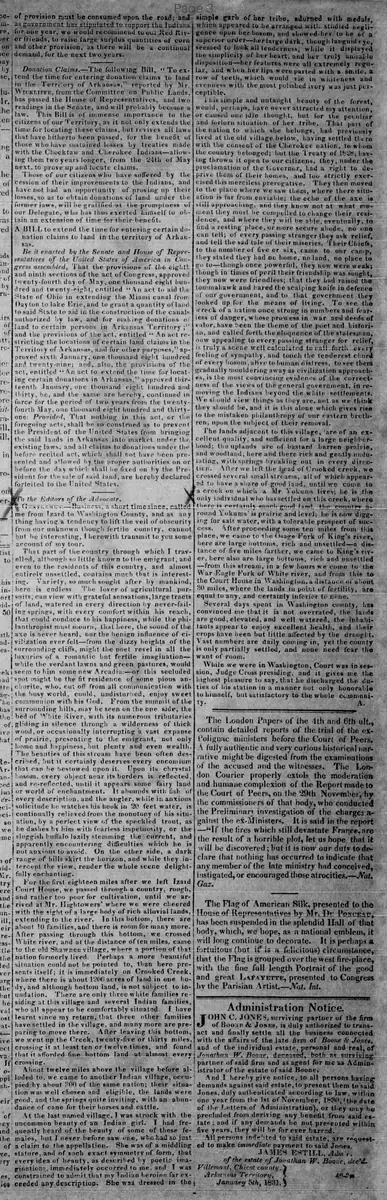
To the Editors of the Advocate.
Gentlemen--Business, a short time since, called me from Izard to Washington County, and as any thing having a tendency to lift the veil of obscurity from our unknown though fertile country, cannot but be interesting, I herewith transmit to you some account of my tour.
That part of the country through which I travelled, although so little known to the emigrant, and even to the residents of this country, and almost entirely unsettled, contains much that is interesting. Variety, so much sought after by mankind, here is endless. The lover of agricultural pursuits, can view with grateful sensations, large tracts of land, watered in every direction by never-failing springs, with every comfort within his reach, that could conduce to his happiness, while the philanthropist must mourn, that here, the sound of the axe is never heard, nor the benign influence of civilization ever felt--from the dizzy heights of the surrounding cliffs, might the poet revel in all the luxuries of a romantic but fertile imagination--while the verdant lawns and green pastures, would seem to him some new Arcadia:--or this secluded spot might be the fit residence of some pious anchorite, who, cut off from all communication with the busy world, could, undisturbed, enjoy sweet communion with his God. From the summit of the surrounding hills, may be seen on the one side, the bed of White River, with its numerous tributaries gliding in silence through a wilderness of thick wood, or occasionally interrupting a vast expanse of prairie, presenting to the emigrant, not only home and happiness, but plenty and even wealth.
The beauties of this stream have been often described, but it certainly deserves every encomium that can be bestowed upon it. Upon its crystal bosom, every object near its borders is reflected, and re-reflected, until it appears some fairy land or world of enchantment. It abounds with fish of every description, and the angler, while in anxious solicitude he watches his hook in 20 feet water, is continually relieved from the monotony of his situation, by a perfect view of the speckled trout, as he dashes by him with fearless impetuosity, or the sluggish buffalo lazily stemming the current, and apparently encountering difficulties which he is not anxious to avoid. On the other side, a dark range of hills skirt the horizon, and while they intercept the view, render the whole scene delightfully enchanting.
For the first eighteen miles after we left Izard Court House, we passed through a country, rough, and rather too poor for cultivation, until we arrived at Mr. Hightower's where we were cheered with the sight of a large body of rich alluvial lands, extending to the river. In this bottom, there are about 10 families, and there is room for many more.
After passing through this bottom, we crossed White river, and at the distance of ten miles, came to the old Shawnee village, where a portion of that nation formerly lived. Perhaps a more beautiful situation could not be pointed to, than here presents itself; it is immediately on Crooked Creek, where there is about 1200 acres of land in one body, and although bottom land, is not subject to inundation. There are only three white families residing at this village and several Indian families, who all appear to be comfortably situated. I have learnt since my return, that three other families have settled in the village, and many more are preparing to move there. After leaving this bottom, we went up the Creek, twenty-five or thirty miles, crossing it at least ten or twelve times, and found that it afforded fine bottom land at almost every crossing.
About twelve miles above the village before alluded to, we came to another Indian village, occupied by about 200 of the same nation; their situation was well chosen and eligible, the lands were good, and the springs quite inviting, with an abundance of cane for their horses and cattle.
At the last named village, I was struck with the uncommon beauty of an Indian girl. I had frequently heard of the beauty of some of these females, but I never before saw one, who had so just a claim to the appellation. She was of a middling stature, and of such exact symmetry of form, that every idea of beauty, as described by poetic imaginations, immediately occurred to me, and I was constrained to admit that my Indian heroine far exceeded any description. She was dressed in the simple garb of her tribe, adorned with medals which appeared to be arranged with studied negligence upon her bosom, and showed her to be of a superior order--her large dark, though languid eye, seemed to look all tenderness, while it displayed the simplicity of her heart, and her truly amiable disposition--her features were all extremely regular, and when her lips were parted with a smile, a row of teeth, which would vie in whiteness and evenness with the most polished ivory was just perceptible.
This simple and untaught beauty of the forest, would, perhaps, have never attracted my attention, or caused one idle thought, but for the peculiar and forlorn situation of her tribe. That part of the nation to which she belongs, had previously lived at the old village below, having settled there with the consent of the Cherokee nation, to whom the country belonged; but the Treaty of 1828, having thrown it open to our citizens, they, under the proclamation of the Governor, had a right to deprive them of their homes, and too strictly exercised this merciless prerogative. They then moved to the place where we saw them, where their situation is far from enviable; the echo of the axe is still approaching, and they know not at what moment they must be compelled to change their residence, and where they will be able, eventually, to find a resting place, or more secure abode, no one can tell; of every passing stranger they ask relief, and tell the sad tale of their miseries. Their Chiefs, to the number of five or six, came to our camp, they stated they had no home, no land, no place to go to--though once powerful, they now were weak; though in times of peril their friendship was sought, they now were friendless; that they had raised the tomahawk and bared the scalping knife in defence of our government, and to that government they looked up for the means of living. To see the wreck of a nation once strong in numbers and fearless of danger, whose prowess in war and deeds of valor, have been the theme of the poet and historian, and called forth the eloquence of the statesman, now appealing to every passing stranger for relief is truly a scene well calculated to call forth every feeling of sympathy, and touch the tenderest chord of every bosom, alive to human distress, to see them gradually mouldering away as civilization approaches, is the most convincing evidence of the correctness of the views of the general government, in removing the Indians beyond the white settlements.
We should view things as they are, not as we think they should be, and it is this alone which gives rise to the mistaken philanthropy of our eastern brethren, upon the subject of their removal.
The lands adjacent to this village, are of an excellent quality, and sufficient for a large neighborhood; the uplands are of bastard barren prairie, and woodland, here and there rich and gently undulating, with springs breaking out in every direction. After we left the head of Crooked creek, we crossed several small streams, all of which appeared to have a share of good land, until we come to a creek on which a Mr. Yokums lives; he is the only individual who has settled on this creek, where there is certainly much good land. The country around Yokums' is prairie and level; he is now digging for salt water, with a tolerable prospect of success. After proceeding some ten miles from this place, we came to the Osage Fork of King's river, here are large bottoms, rich and unsettled--a distance of five miles farther, we came to King's river, here also are large bottoms, rich and unsettled--from this stream, in a few hours we come to the War Eagle Fork of White river, and from this to the Court House in Washington, a distance of about 30 miles, where the lands in point of fertility, are equal to any, and certainly inferior to none.
Several days spent in Washington county, has convinced me that it is not overrated, the lands are good, elevated, and well watered, the inhabitants appear to enjoy excellent health, and their crops have been but little affected by the drought. Vast numbers are daily coming in, yet the county is only partially settled, and none need fear the want of room.
While we were in Washington, Court was in session, Judge Cross presiding, and it gives me the highest pleasure to say, that he discharged the duties of his station in a manner not only honorable to himself, but satisfactory to the whole community.
A.
Gentlemen--Business, a short time since, called me from Izard to Washington County, and as any thing having a tendency to lift the veil of obscurity from our unknown though fertile country, cannot but be interesting, I herewith transmit to you some account of my tour.
That part of the country through which I travelled, although so little known to the emigrant, and even to the residents of this country, and almost entirely unsettled, contains much that is interesting. Variety, so much sought after by mankind, here is endless. The lover of agricultural pursuits, can view with grateful sensations, large tracts of land, watered in every direction by never-failing springs, with every comfort within his reach, that could conduce to his happiness, while the philanthropist must mourn, that here, the sound of the axe is never heard, nor the benign influence of civilization ever felt--from the dizzy heights of the surrounding cliffs, might the poet revel in all the luxuries of a romantic but fertile imagination--while the verdant lawns and green pastures, would seem to him some new Arcadia:--or this secluded spot might be the fit residence of some pious anchorite, who, cut off from all communication with the busy world, could, undisturbed, enjoy sweet communion with his God. From the summit of the surrounding hills, may be seen on the one side, the bed of White River, with its numerous tributaries gliding in silence through a wilderness of thick wood, or occasionally interrupting a vast expanse of prairie, presenting to the emigrant, not only home and happiness, but plenty and even wealth.
The beauties of this stream have been often described, but it certainly deserves every encomium that can be bestowed upon it. Upon its crystal bosom, every object near its borders is reflected, and re-reflected, until it appears some fairy land or world of enchantment. It abounds with fish of every description, and the angler, while in anxious solicitude he watches his hook in 20 feet water, is continually relieved from the monotony of his situation, by a perfect view of the speckled trout, as he dashes by him with fearless impetuosity, or the sluggish buffalo lazily stemming the current, and apparently encountering difficulties which he is not anxious to avoid. On the other side, a dark range of hills skirt the horizon, and while they intercept the view, render the whole scene delightfully enchanting.
For the first eighteen miles after we left Izard Court House, we passed through a country, rough, and rather too poor for cultivation, until we arrived at Mr. Hightower's where we were cheered with the sight of a large body of rich alluvial lands, extending to the river. In this bottom, there are about 10 families, and there is room for many more.
After passing through this bottom, we crossed White river, and at the distance of ten miles, came to the old Shawnee village, where a portion of that nation formerly lived. Perhaps a more beautiful situation could not be pointed to, than here presents itself; it is immediately on Crooked Creek, where there is about 1200 acres of land in one body, and although bottom land, is not subject to inundation. There are only three white families residing at this village and several Indian families, who all appear to be comfortably situated. I have learnt since my return, that three other families have settled in the village, and many more are preparing to move there. After leaving this bottom, we went up the Creek, twenty-five or thirty miles, crossing it at least ten or twelve times, and found that it afforded fine bottom land at almost every crossing.
About twelve miles above the village before alluded to, we came to another Indian village, occupied by about 200 of the same nation; their situation was well chosen and eligible, the lands were good, and the springs quite inviting, with an abundance of cane for their horses and cattle.
At the last named village, I was struck with the uncommon beauty of an Indian girl. I had frequently heard of the beauty of some of these females, but I never before saw one, who had so just a claim to the appellation. She was of a middling stature, and of such exact symmetry of form, that every idea of beauty, as described by poetic imaginations, immediately occurred to me, and I was constrained to admit that my Indian heroine far exceeded any description. She was dressed in the simple garb of her tribe, adorned with medals which appeared to be arranged with studied negligence upon her bosom, and showed her to be of a superior order--her large dark, though languid eye, seemed to look all tenderness, while it displayed the simplicity of her heart, and her truly amiable disposition--her features were all extremely regular, and when her lips were parted with a smile, a row of teeth, which would vie in whiteness and evenness with the most polished ivory was just perceptible.
This simple and untaught beauty of the forest, would, perhaps, have never attracted my attention, or caused one idle thought, but for the peculiar and forlorn situation of her tribe. That part of the nation to which she belongs, had previously lived at the old village below, having settled there with the consent of the Cherokee nation, to whom the country belonged; but the Treaty of 1828, having thrown it open to our citizens, they, under the proclamation of the Governor, had a right to deprive them of their homes, and too strictly exercised this merciless prerogative. They then moved to the place where we saw them, where their situation is far from enviable; the echo of the axe is still approaching, and they know not at what moment they must be compelled to change their residence, and where they will be able, eventually, to find a resting place, or more secure abode, no one can tell; of every passing stranger they ask relief, and tell the sad tale of their miseries. Their Chiefs, to the number of five or six, came to our camp, they stated they had no home, no land, no place to go to--though once powerful, they now were weak; though in times of peril their friendship was sought, they now were friendless; that they had raised the tomahawk and bared the scalping knife in defence of our government, and to that government they looked up for the means of living. To see the wreck of a nation once strong in numbers and fearless of danger, whose prowess in war and deeds of valor, have been the theme of the poet and historian, and called forth the eloquence of the statesman, now appealing to every passing stranger for relief is truly a scene well calculated to call forth every feeling of sympathy, and touch the tenderest chord of every bosom, alive to human distress, to see them gradually mouldering away as civilization approaches, is the most convincing evidence of the correctness of the views of the general government, in removing the Indians beyond the white settlements.
We should view things as they are, not as we think they should be, and it is this alone which gives rise to the mistaken philanthropy of our eastern brethren, upon the subject of their removal.
The lands adjacent to this village, are of an excellent quality, and sufficient for a large neighborhood; the uplands are of bastard barren prairie, and woodland, here and there rich and gently undulating, with springs breaking out in every direction. After we left the head of Crooked creek, we crossed several small streams, all of which appeared to have a share of good land, until we come to a creek on which a Mr. Yokums lives; he is the only individual who has settled on this creek, where there is certainly much good land. The country around Yokums' is prairie and level; he is now digging for salt water, with a tolerable prospect of success. After proceeding some ten miles from this place, we came to the Osage Fork of King's river, here are large bottoms, rich and unsettled--a distance of five miles farther, we came to King's river, here also are large bottoms, rich and unsettled--from this stream, in a few hours we come to the War Eagle Fork of White river, and from this to the Court House in Washington, a distance of about 30 miles, where the lands in point of fertility, are equal to any, and certainly inferior to none.
Several days spent in Washington county, has convinced me that it is not overrated, the lands are good, elevated, and well watered, the inhabitants appear to enjoy excellent health, and their crops have been but little affected by the drought. Vast numbers are daily coming in, yet the county is only partially settled, and none need fear the want of room.
While we were in Washington, Court was in session, Judge Cross presiding, and it gives me the highest pleasure to say, that he discharged the duties of his station in a manner not only honorable to himself, but satisfactory to the whole community.
A.
What sub-type of article is it?
Informative
Reflective
Historical
What themes does it cover?
Agriculture
Social Issues
Politics
What keywords are associated?
Arkansas Tour
White River
Crooked Creek
Shawnee Indians
Indian Removal
Fertile Lands
Treaty 1828
What entities or persons were involved?
A.
To The Editors Of The Advocate.
Letter to Editor Details
Author
A.
Recipient
To The Editors Of The Advocate.
Main Argument
the tour reveals fertile, scenic lands in arkansas ideal for settlement, while the displaced shawnee indians' plight underscores the necessity of federal removal policies to protect them from encroaching civilization.
Notable Details
Description Of Indian Girl's Beauty
Shawnee Chiefs' Plea For Relief
Reference To Treaty Of 1828
Support For Indian Removal Policy
Praise For Judge Cross