Thank you for visiting SNEWPapers!
Sign up free
Iowa County Democrat
Mineral Point, Iowa County, Wisconsin
What is this article about?
A lawyer questions the legal validity of a marriage conducted via telegraph between parties in Milwaukee, Wisconsin, and Owatonna, Minnesota, citing state statutes on ministerial authority, presence requirements, witnesses, certificates, inheritance, and marital status.
Clipping
OCR Quality
Full Text
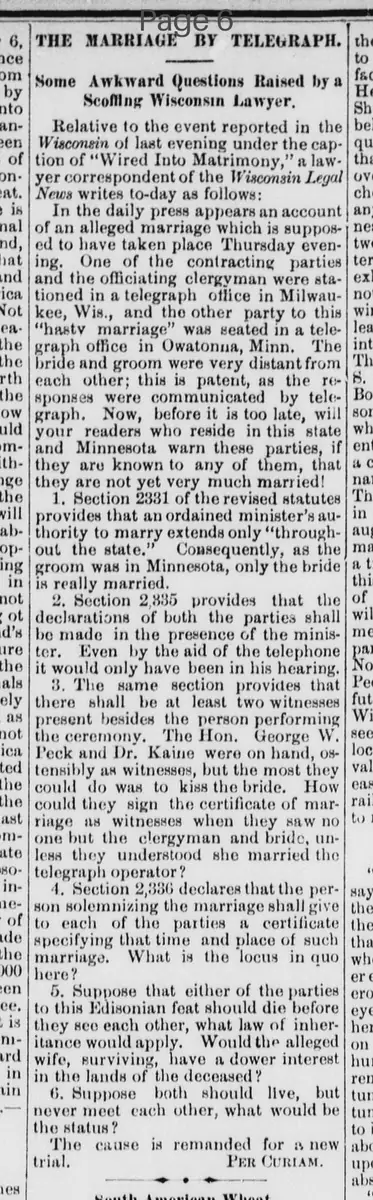
Some Awkward Questions Raised by a Scoffing Wisconsin Lawyer.
Relative to the event reported in the Wisconsin of last evening under the caption of "Wired Into Matrimony," a lawyer correspondent of the Wisconsin Legal News writes to-day as follows:
In the daily press appears an account of an alleged marriage which is supposed to have taken place Thursday evening. One of the contracting parties and the officiating clergyman were stationed in a telegraph office in Milwaukee, Wis., and the other party to this "hasty marriage" was seated in a telegraph office in Owatonna, Minn. The bride and groom were very distant from each other: this is patent, as the responses were communicated by telegraph. Now, before it is too late, will your readers who reside in this state and Minnesota warn these parties, if they are known to any of them, that they are not yet very much married!
1. Section 2331 of the revised statutes provides that an ordained minister's authority to marry extends only "throughout the state." Consequently, as the groom was in Minnesota, only the bride is really married.
2. Section 2835 provides that the declarations of both the parties shall be made in the presence of the minister. Even by the aid of the telephone it would only have been in his hearing.
3. The same section provides that there shall be at least two witnesses present besides the person performing the ceremony. The Hon. George W. Peck and Dr. Kaine were on hand, ostensibly as witnesses, but the most they could do was to kiss the bride. How could they sign the certificate of marriage as witnesses when they saw no one but the clergyman and bride, unless they understood she married the telegraph operator?
4. Section 2386 declares that the person solemnizing the marriage shall give to each of the parties a certificate specifying the time and place of such marriage.
What is the locus in quo here?
5. Suppose that either of the parties to this Edisonian feat should die before they see each other, what law of inheritance would apply. Would the alleged wife, surviving, have a dower interest in the lands of the deceased?
6. Suppose both should live, but never meet each other, what would be the status?
The cause is remanded for a new trial.
Per Curiam.
What sub-type of article is it?
What themes does it cover?
What keywords are associated?
What entities or persons were involved?
Where did it happen?
Story Details
Key Persons
Location
Milwaukee, Wis.; Owatonna, Minn.
Event Date
Thursday Evening
Story Details
A marriage ceremony is performed via telegraph with the groom in Owatonna, Minnesota, and the bride and clergyman in Milwaukee, Wisconsin. A lawyer raises doubts about its legality under Wisconsin and Minnesota statutes, including ministerial jurisdiction, presence of parties and witnesses, marriage certificate, inheritance rights, and overall marital status.