Thank you for visiting SNEWPapers!
Sign up free
Fisherman & Farmer
Elizabeth City, Edenton, Pasquotank County, Chowan County, North Carolina
What is this article about?
In Atchison, Kansas, a monument marks the grave of Richard Harris, who died of delirium tremens in 1877. The story recounts his secret marriage to seamstress Loretta Hullett, social fallout, descent into alcoholism, and his widow's defiant memorial with a snake carving.
Clipping
OCR Quality
Full Text
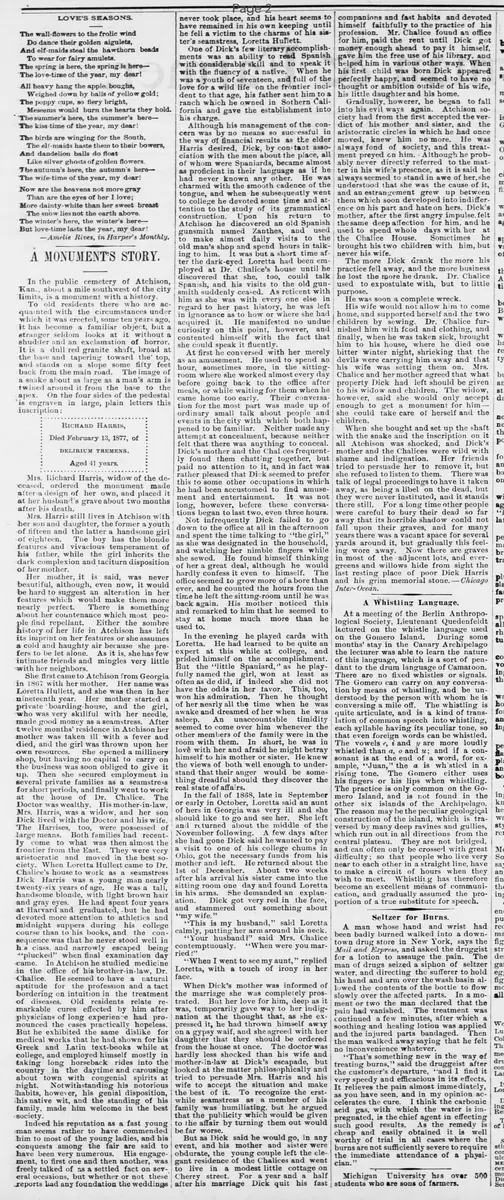
In the public cemetery of Atchison, Kan., about a mile southwest of the city limits, is a monument with a history. To old residents there who are acquainted with the circumstances under which it was erected, some ten years ago, it has become a familiar object, but a stranger seldom looks at it without a shudder and an exclamation of horror.
It is a dull red granite shaft, broad at the base and tapering toward the top, and stands on a slope some fifty feet back from the main road. The image of a snake about as large as a man's arm is twined around it from the base to the apex. On the four sides of the pedestal is engraven in large, plain letters this inscription:
Richard Harris,
Died February 13, 1877, of
DELIRIUM TREMENS.
Aged 41 years.
Mrs. Richard Harris, widow of the deceased, ordered the monument made after a design of her own, and placed it at her husband's grave about two months after his death.
Mrs. Harris still lives in Atchison with her son and daughter, the former a youth of fifteen and the latter a handsome girl of eighteen. The boy has the blonde features and vivacious temperament of his father, while the girl inherits the dark complexion and taciturn disposition of her mother.
Her mother, it is said, was never beautiful, although, even now, it would be hard to suggest an alteration in her features which would make them more nearly perfect. There is something about her countenance which most people find repellant. Either the sombre history of her life in Atchison has left its imprint on her features or she assumes a cold and haughty air because she prefers to be let alone. As it is, she has few intimate friends and mingles very little with her neighbors.
She first came to Atchison from Georgia in 1867 with her mother. Her name was Loretta Hullett, and she was then in her nineteenth year. Her mother started a private boarding-house, and the girl, who was very skillful with her needle, made good money as a seamstress. After twelve months' residence in Atchison her mother was taken ill with a fever and died, and the girl was thrown upon her own resources.
She opened a millinery shop, but having no capital to carry on the business was soon obliged to give it up. Then she secured employment in several private families as a seamstress for short periods, and finally went to work at the house of Dr. Chalice. The Doctor was wealthy. His mother-in-law, Mrs. Harris, was a widow, and her son Dick lived with the Doctor and his wife. The Harrises, too, were possessed of large means. Both families had recently come to what was then almost the frontier from the East. They were very aristocratic and moved in the best society.
When Loretta Hullett came to Dr. Chalice's house to work as a seamstress Dick Harris was a young man nearly twenty-six years of age. He was a tall, handsome blonde, with light brown hair and gray eyes. He had spent four years at Harvard and graduated, but he had devoted more attention to athletics and midnight suppers during his college course than to his books, and the consequence was that he never stood well in his class, and narrowly escaped being "plucked" when final examination day came.
In Atchison he studied medicine in the office of his brother-in-law, Dr. Chalice. He seemed to have a natural aptitude for the profession and a tact bordering on intuition in the treatment of diseases. Old residents relate remarkable cures effected by him after physicians of long experience had pronounced the cases practically hopeless.
But he exhibited the same dislike for medical works that he had shown for his Greek and Latin text-books while at college, and employed himself mostly in taking long horseback rides into the country in the daytime and carousing about town with congenial spirits at night. Notwithstanding his notorious habits, however, his genial disposition, his native wit, and the standing of his family made him welcome in the best society.
Indeed his reputation as a fast young man seems rather to have commended him to most of the young ladies, and his conquests among the fair are said to have been very numerous. His engagement to first one and then another was freely talked of as a settled fact on several occasions, but whether or not these reports had any foundation the weddings never took place, and his heart seems to have remained in his own keeping until he fell a victim to the charms of his sister's seamstress, Loretta Hullett.
One of Dick's few literary accomplishments was an ability to read Spanish with considerable skill and to speak it with the fluency of a native. When he was a youth of seventeen, and full of the love for a wild life on the frontier incident to that age, his father sent him to a ranch which he owned in Southern California and gave the establishment into his charge.
Although his management of the concern was by no means so successful in the way of financial results as the elder Harris desired, Dick, by constant association with the men about the place, all of whom were Spaniards, became almost as proficient in their language as if he had never known any other. He was charmed with the smooth cadence of the tongue, and when he subsequently went to college he devoted some time and attention to the study of its grammatical construction.
Upon his return to Atchison he discovered an old Spanish gunsmith named Zanthes, and used to make almost daily visits to the old man's shop and spend hours in talking to him. It was but a short time after the dark-eyed Loretta had been employed at Dr. Chalice's house until he discovered that she, too, could talk Spanish, and his visits to the old gunsmith suddenly ceased.
As reticent with him as she was with every one else in regard to her past history, he was left in ignorance as to how or where she had acquired it. He manifested no undue curiosity on this point, however, and contented himself with the fact that she could speak it fluently.
At first he conversed with her merely as an amusement. He used to spend an hour, sometimes more, in the sitting-room where she worked almost every day before going back to the office after meals, or while waiting for them when he came home too early. Their conversation for the most part was made up of ordinary small talk about people and events in the city with which both happened to be familiar. Neither made any attempt at concealment, because neither felt that there was anything to conceal.
Dick's mother and the Chalices frequently found them chatting together, but paid no attention to it, and in fact was rather pleased that Dick seemed to prefer this to some other occupations in which he had been accustomed to find amusement and entertainment.
It was not long, however, before these conversations began to last two, even three hours. Not infrequently Dick failed to go down to the office at all in the afternoon and spent the time talking to "the girl," as she was designated in the household, and watching her nimble fingers while she sewed.
He found himself thinking of her a great deal, although he would hardly confess it even to himself. The office seemed to grow more of a bore than ever, and he counted the hours from the time he left the sitting-room until he was back again. His mother noticed this and remarked to him that he seemed to stay at home much more than he used to.
In the evening he played cards with Loretta. He had learned to be quite an expert at this while at college, and prided himself on the accomplishment. But the "little Spaniard," as he playfully named the girl, won at least as often as he did, if indeed she did not have the odds in her favor. This, too, won his admiration.
Then he thought of her nearly all the time when he was awake and dreamed of her when he was asleep.
An unaccountable timidity seemed to come over him whenever the other members of the family were in the room with them. In short, he was in love with her and afraid he might betray himself to his mother or sister. He knew the views of both well enough to understand that their anger would be something dreadful should they discover the real state of affairs.
In the fall of 1868, late in September or early in October, Loretta said an aunt of hers in Georgia was very ill and she should like to go and see her. She left and returned about the middle of the November following. A few days after she had gone Dick said he wanted to pay a visit to one of his college chums in Ohio, got the necessary funds from his mother and left. He returned about the 1st of December.
About two weeks after his arrival his sister came into the sitting room one day and found Loretta in his arms. She demanded an explanation. Dick got very red in the face, and stammered out something about "my wife."
"This is my husband," said Loretta calmly, putting her arm around his neck.
"Your husband?" said Mrs. Chalice contemptuously.
"When were you married?"
"When I went to see my aunt," replied Loretta, with a touch of irony in her face.
When Dick's mother was informed of the marriage she was completely prostrated. But her love for him, deep as it was, temporarily gave way to her indignation at the thought that, as she expressed it, he had thrown himself away on a gypsy waif, and she agreed with her daughter that they should be ordered from the house at once.
The doctor was hardly less shocked than his wife and mother-in-law at Dick's escapade, but looked at the matter philosophically and tried to persuade Mrs. Harris and his wife to accept the situation and make the best of it. To recognize the erstwhile seamstress as a member of his family was humiliating, but he argued that the publicity which would be given to the affair by turning them out would be far worse.
But as Dick said he would go, in any event, and his mother and sister were obdurate, the young couple left the elegant residence of the Chalices and went to live in a modest little cottage on Cherry street.
For a year and a half after his marriage Dick quit his fast companions and fast habits and devoted himself faithfully to the practice of his profession. Dr. Chalice found an office for him, paid the rent until Dick got money enough ahead to pay it himself, gave him the free use of his library, and helped him in various other ways.
When his first child was born Dick appeared perfectly happy, and seemed to have no thought or ambition outside of his wife, his little daughter and his home.
Gradually, however, he began to fall into his evil ways again. Atchison society had from the first accepted the verdict of his mother and sister, and the aristocratic circles in which he had once moved, knew him no more. He was always fond of society, and this treatment preyed on him.
Although he probably never directly referred to the matter in his wife's presence, as it is said he always seemed to stand in awe of her, she understood that she was the cause of it, and an estrangement grew up between them which soon developed into indifference on his part and hate on hers.
Dick's mother, after the first angry impulse, felt the same deep affection for him, and he used to spend whole days with her at the Chalice House. Sometimes he brought his two children with him, but never his wife.
The more Dick drank the more his practice fell away, and the more business he lost the more he drank. Dr. Chalice used to expostulate with, but to little purpose.
He was soon a complete wreck. His wife would not allow him to come home, and supported herself and the two children by sewing. Dr. Chalice furnished him with food and clothing, and finally, when he was taken sick, brought him to his house, where he died one bitter winter night, shrieking that the devils were carrying him away and that his wife was setting them on.
Mrs. Chalice and her mother agreed that what property Dick had left should be given to his widow and children. The widow, however, said she would only accept enough to get a monument for him—she could take care of herself and the children.
When she bought and set up the shaft with the snake and the inscription on it all Atchison was shocked, and Dick's mother and the Chalices were wild with shame and indignation. Her friends tried to persuade her to remove it, but she refused to listen to them. There was talk of legal proceedings to have it taken away, as being a libel on the dead, but they were never instituted, and it stands there still.
For a long time other people were careful to bury their dead so far away that its horrible shadow could not fall upon their graves, and for many years there was a vacant space for several yards around it, but gradually this feeling wore away. Now there are graves in most of the adjacent lots, and evergreens and willows hide from sight the last resting place of poor Dick Harris and his grim memorial stone.—Chicago Inter-Ocean.
What sub-type of article is it?
What themes does it cover?
What keywords are associated?
What entities or persons were involved?
Where did it happen?
Story Details
Key Persons
Location
Atchison, Kan.
Event Date
February 13, 1877
Story Details
Richard Harris, a promising but wayward young man from a wealthy family, marries seamstress Loretta Hullett secretly, leading to social ostracism. He abandons his medical practice for drinking, estranges from his wife, and dies of delirium tremens. His widow erects a monument inscribed with his cause of death and a snake symbolizing his vice.