Thank you for visiting SNEWPapers!
Sign up free
Editorial
July 28, 1814
Daily National Intelligencer
Washington, District Of Columbia
What is this article about?
A continuation of satirical criticism of Gouverneur Morris's oration on the fall of Napoleon and Europe's emancipation, mocking its bombastic style, the author's declining intellect, and failure to match the grandeur of the subject, contrasting it with Burke and Johnson.
Clipping
OCR Quality
98%
Excellent
Full Text
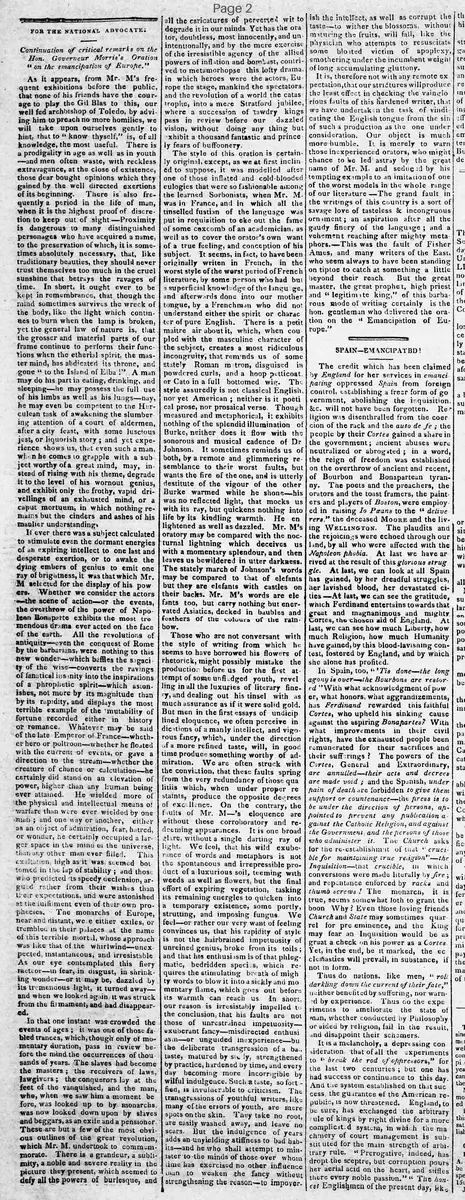
Continuation of critical remarks on the Hon. Gouverneur Morris's Oration on the emancipation of Europe.
As it appears, from Mr. M's frequent exhibitions before the public, that none of his friends have the courage to play the Gil Blas to this, our well fed archbishop of Toledo, by advising him to preach no more homilies, we will take upon ourselves gently to hint, that to "know thyself," is, of all knowledge, the most useful. There is a prodigality in age as well as in youth and men often waste, with reckless extravagance, at the close of existence, those dear bought opinions which they gained by the well directed exertions of its beginning. There is also frequently a period in the life of man, when it is the highest proof of discretion to keep out of sight --Proximity is dangerous to many distinguished personages who have acquired a name, to the preservation of which, it is sometimes absolutely necessary, that, like traditionary beauties, they should never trust themselves too much in the cruel sunshine that betrays the ravages of time. In short, it ought ever to be kept in remembrance, that though the mind sometimes survives the wreck of the body, like the light which continues to burn when the lamp is broken, yet the general law of nature is, that the grosser and material parts of our frame continue to perform their functions when the ethereal spirit, the master mind, has abdicated its throne, and gone "to the Island of Elba!". A man may do his part in eating, drinking, and sleeping--he may possess the full use of his limbs as well as his lungs--nay, he may even be competent to the Herculean task of awakening the slumbering attention of a court of aldermen, after a city feast, with some luscious jest, or liquorish story; and yet experience shows us, that even such a man, when he comes to grapple with a subject worthy of a great mind, may, instead of rising with his theme, degrade it to the level of his wornout genius, and exhibit only the frothy, vapid drivellings of an exhausted mind, or a caput mortuum, in which nothing remains but the cinders and ashes of his manlier understanding
If ever there was a subject calculated to stimulate even the dormant energies of an expiring intellect to one last and desperate exertion, or to awake the dying embers of genius to emit one ray of brightness, it was that which Mr. M selected for the display of his powers. Whether we consider the actors the scene of action or the events, the overthrow of the power of Napoleon Bonaparte exhibits the most tremendous drama ever acted on the face of the earth. All the revolutions of antiquity--even the conquest of Rome by the barbarians, were nothing to this new wonder --which baffles the sagacity of the wise --converts the ravings of fanatical insanity into the inspirations of a prophetic spirit which astonishes, not more by its magnitude than by its rapidity, and displays the most terrible example of the mutability of fortune recorded either in history or romance. Whatever may be said of the late Emperor of France--whether hero or poltroon--whether he floated with the current of events, or gave a direction to the stream --whether the creature of chance or calculation--he certainly did stand on an elevation of power, higher than any human being ever attained. He wielded more of the physical and intellectual means of warfare than were ever wielded by one man; and one way or another, either as an object of admiration, fear, hatred, or wonder, he certainly occupied a larger space in the mind of the universe than any other man ever filled. This exaltation, high as it was, seemed bottomed in the lap of stability ; and those who predicted its speedy declension, argued rather from their wishes than their expectations, and were astonished at the fulfilment even of their own prophecies. The monarchs of Europe, near and distant, were either exiles, or trembled in their palaces at the name of this terrible mortal, whose approach was like that of the whirlwind --unexpected, instantaneous, and irresistible
As our eye contemplated this fiery meteor--in fear, in disgust, in shrinking wonder--or it may be, dazzled by its tremendous light, it turned away-- and when we looked again, it was struck from the firmament, and had disappeared.
In that one instant was crowded the events of ages ; it was one of those fabled trances, which, though only of momentary duration, pass in review before the mind the occurrences of thousands of years. The slaves had become the masters; the receivers of laws, lawgivers; the conquerors lay at the feet of the vanquished, and the man, who, when we saw him a moment before, was looked up to by monarchs, was now looked down upon by slaves and beggars, as an exile and a pensioner.
These are but a few of the most obvious outlines of the great revolution, which Mr. M. undertook to commemorate. There is a grandeur, a sublimity, a noble and severe reality in the picture they present, which seemed to defy all the powers of burlesque, and all the caricatures of perverted wit to degrade it in our minds. Yet has the orator, doubtless, most innocently, and unintentionally, and by the mere exercise of the irresistible agency of the allied powers of inflation and bombast, contrived to metamorphose this lofty drama, in which heroes were the actors, Europe the stage, mankind the spectators, and the revolution of a world the catastrophe, into a mere Stratford jubilee, where a succession of tawdry kings pass in review before our dazzled vision, without doing any thing but exhibit a thousand fantastic and princely feats of buffoonery.
The style of this oration is certainly original, except, as we at first inclined to suppose, it was modelled after one of those inflated and cold-blooded eulogies that were so fashionable among the learned Sorbonists, when Mr. M. was in France, and in which all the tinselled fustian of the language was put in requisition to eke out the fame of some coxcomb of an academician, as well as to cover the orator's own want of a true feeling, and conception of his subject. It seems, in fact, to have been originally written in French, in the worst style of the worst period of French literature, by some person who had but a superficial knowledge of the language, and afterwards done into our mother tongue, by a Frenchman who did not understand either the spirit or character of pure English. There is a petit maitre air about it, which, when coupled with the masculine character of the subject, creates a most ridiculous incongruity, that reminds us of some stately Roman matron, disguised in powdered curls, and a hoop petticoat, or Cato in a full bottomed wig. The style assuredly is not classical English, nor yet American ; neither is it poetical prose, nor prosaical verse. Though measured and metaphorical, it exhibits nothing of the splendid illumination of Burke, neither does it flow with the sonorous and musical cadence of Dr. Johnson. It sometimes reminds us of both, by a remote and glimmering resemblance to their worst faults, but wants the fire of the one, and is utterly destitute of the vigour of the other
Burke warmed while he shone --his was no reflected light, that mocks us with its ray, but quickens nothing into life by its kindling warmth. He enlightened as well as dazzled. Mr. M's oratory may be compared with the nocturlnal lightning which deceives us with a momentary splendour, and then leaves us bewildered in utter darkness.
The stately march of Johnson's words may be compared to that of elephants but they are elephants with castles on their backs. Mr. M's words are elephants too, but carry nothing but enervated Asiatics, decked in baubles and feathers of the colours of the rainbow.
Those who are not conversant with the style of writing from which he seems to have borrowed his flowers of rhetorick, might possibly mistake the production before us for the first attempt of some unfledged youth, revelling in all the luxuries of literary finery, and dealing out his tinsel with as much assurance as if it were solid gold. But men in their first essays of undisciplined eloquence, we often perceive indications of a manly intellect, and vigorous fancy, which, under the direction of a more refined taste, will, in good time produce something worthy of admiration. We are often struck with the conviction, that these faults spring from the very redundancy of those qualities which, when under proper restraints, produce the opposite degrees of excellence. On the contrary, the faults of Mr. M-'s eloquence are without these corroboratory and redeeming appearances. It is one broad glare, without a single darting ray of light. We feel, that his wild exuberance of words and metaphors is not the spontaneous and irrepressible product of a luxurious soil, teeming with weeds as well as flowers, but the final effort of expiring vegetation, tasking its remaining energies to quicken into a temporary existence, some portly, strutting, and imposing fungus. We feel or rather our very want of feeling convinces us, that his rapidity of style is not the hairbrained impetuosity of unreined genius, broke from its toils; and that his enthusiasm is of that phlegmatic, bedridden species, which requires the stimulating breath of mighty words to blow it into a sickly and momentary flame, which goes out before its warmth can reach us. In short our reason is irresistibly impelled to the conclusion, that his faults are not those of unrestrained impetuosity-- exuberant fancy--misdirected enthusiasm--or unguided inexperience--but the deliberate transgression of a bad taste, matured by study, strengthened by practice, hardened by time, and every day becoming more incorrigible by wilful indulgence. Such a taste, so fortified, is invulnerable to criticism. The transgressions of youthful writers, like many of the errors of youth, are mere spots on the skin. They take no root, are easily washed away, and leave no scars. But the indulgence of years adds an unyielding stiffness to bad habits--and he who shall attempt to minister to the minds of those over whom time has exercised no other influence than to weaken the fancy without strengthening the reason--to impoverish the intellect, as well as corrupt the taste--to wither the blossoms, without maturing the fruits, will fall, like the physician who attempts to resuscitate some bloated victim of apoplexy, smothering under the incumbent weight of long accumulating gluttony.
As it appears, from Mr. M's frequent exhibitions before the public, that none of his friends have the courage to play the Gil Blas to this, our well fed archbishop of Toledo, by advising him to preach no more homilies, we will take upon ourselves gently to hint, that to "know thyself," is, of all knowledge, the most useful. There is a prodigality in age as well as in youth and men often waste, with reckless extravagance, at the close of existence, those dear bought opinions which they gained by the well directed exertions of its beginning. There is also frequently a period in the life of man, when it is the highest proof of discretion to keep out of sight --Proximity is dangerous to many distinguished personages who have acquired a name, to the preservation of which, it is sometimes absolutely necessary, that, like traditionary beauties, they should never trust themselves too much in the cruel sunshine that betrays the ravages of time. In short, it ought ever to be kept in remembrance, that though the mind sometimes survives the wreck of the body, like the light which continues to burn when the lamp is broken, yet the general law of nature is, that the grosser and material parts of our frame continue to perform their functions when the ethereal spirit, the master mind, has abdicated its throne, and gone "to the Island of Elba!". A man may do his part in eating, drinking, and sleeping--he may possess the full use of his limbs as well as his lungs--nay, he may even be competent to the Herculean task of awakening the slumbering attention of a court of aldermen, after a city feast, with some luscious jest, or liquorish story; and yet experience shows us, that even such a man, when he comes to grapple with a subject worthy of a great mind, may, instead of rising with his theme, degrade it to the level of his wornout genius, and exhibit only the frothy, vapid drivellings of an exhausted mind, or a caput mortuum, in which nothing remains but the cinders and ashes of his manlier understanding
If ever there was a subject calculated to stimulate even the dormant energies of an expiring intellect to one last and desperate exertion, or to awake the dying embers of genius to emit one ray of brightness, it was that which Mr. M selected for the display of his powers. Whether we consider the actors the scene of action or the events, the overthrow of the power of Napoleon Bonaparte exhibits the most tremendous drama ever acted on the face of the earth. All the revolutions of antiquity--even the conquest of Rome by the barbarians, were nothing to this new wonder --which baffles the sagacity of the wise --converts the ravings of fanatical insanity into the inspirations of a prophetic spirit which astonishes, not more by its magnitude than by its rapidity, and displays the most terrible example of the mutability of fortune recorded either in history or romance. Whatever may be said of the late Emperor of France--whether hero or poltroon--whether he floated with the current of events, or gave a direction to the stream --whether the creature of chance or calculation--he certainly did stand on an elevation of power, higher than any human being ever attained. He wielded more of the physical and intellectual means of warfare than were ever wielded by one man; and one way or another, either as an object of admiration, fear, hatred, or wonder, he certainly occupied a larger space in the mind of the universe than any other man ever filled. This exaltation, high as it was, seemed bottomed in the lap of stability ; and those who predicted its speedy declension, argued rather from their wishes than their expectations, and were astonished at the fulfilment even of their own prophecies. The monarchs of Europe, near and distant, were either exiles, or trembled in their palaces at the name of this terrible mortal, whose approach was like that of the whirlwind --unexpected, instantaneous, and irresistible
As our eye contemplated this fiery meteor--in fear, in disgust, in shrinking wonder--or it may be, dazzled by its tremendous light, it turned away-- and when we looked again, it was struck from the firmament, and had disappeared.
In that one instant was crowded the events of ages ; it was one of those fabled trances, which, though only of momentary duration, pass in review before the mind the occurrences of thousands of years. The slaves had become the masters; the receivers of laws, lawgivers; the conquerors lay at the feet of the vanquished, and the man, who, when we saw him a moment before, was looked up to by monarchs, was now looked down upon by slaves and beggars, as an exile and a pensioner.
These are but a few of the most obvious outlines of the great revolution, which Mr. M. undertook to commemorate. There is a grandeur, a sublimity, a noble and severe reality in the picture they present, which seemed to defy all the powers of burlesque, and all the caricatures of perverted wit to degrade it in our minds. Yet has the orator, doubtless, most innocently, and unintentionally, and by the mere exercise of the irresistible agency of the allied powers of inflation and bombast, contrived to metamorphose this lofty drama, in which heroes were the actors, Europe the stage, mankind the spectators, and the revolution of a world the catastrophe, into a mere Stratford jubilee, where a succession of tawdry kings pass in review before our dazzled vision, without doing any thing but exhibit a thousand fantastic and princely feats of buffoonery.
The style of this oration is certainly original, except, as we at first inclined to suppose, it was modelled after one of those inflated and cold-blooded eulogies that were so fashionable among the learned Sorbonists, when Mr. M. was in France, and in which all the tinselled fustian of the language was put in requisition to eke out the fame of some coxcomb of an academician, as well as to cover the orator's own want of a true feeling, and conception of his subject. It seems, in fact, to have been originally written in French, in the worst style of the worst period of French literature, by some person who had but a superficial knowledge of the language, and afterwards done into our mother tongue, by a Frenchman who did not understand either the spirit or character of pure English. There is a petit maitre air about it, which, when coupled with the masculine character of the subject, creates a most ridiculous incongruity, that reminds us of some stately Roman matron, disguised in powdered curls, and a hoop petticoat, or Cato in a full bottomed wig. The style assuredly is not classical English, nor yet American ; neither is it poetical prose, nor prosaical verse. Though measured and metaphorical, it exhibits nothing of the splendid illumination of Burke, neither does it flow with the sonorous and musical cadence of Dr. Johnson. It sometimes reminds us of both, by a remote and glimmering resemblance to their worst faults, but wants the fire of the one, and is utterly destitute of the vigour of the other
Burke warmed while he shone --his was no reflected light, that mocks us with its ray, but quickens nothing into life by its kindling warmth. He enlightened as well as dazzled. Mr. M's oratory may be compared with the nocturlnal lightning which deceives us with a momentary splendour, and then leaves us bewildered in utter darkness.
The stately march of Johnson's words may be compared to that of elephants but they are elephants with castles on their backs. Mr. M's words are elephants too, but carry nothing but enervated Asiatics, decked in baubles and feathers of the colours of the rainbow.
Those who are not conversant with the style of writing from which he seems to have borrowed his flowers of rhetorick, might possibly mistake the production before us for the first attempt of some unfledged youth, revelling in all the luxuries of literary finery, and dealing out his tinsel with as much assurance as if it were solid gold. But men in their first essays of undisciplined eloquence, we often perceive indications of a manly intellect, and vigorous fancy, which, under the direction of a more refined taste, will, in good time produce something worthy of admiration. We are often struck with the conviction, that these faults spring from the very redundancy of those qualities which, when under proper restraints, produce the opposite degrees of excellence. On the contrary, the faults of Mr. M-'s eloquence are without these corroboratory and redeeming appearances. It is one broad glare, without a single darting ray of light. We feel, that his wild exuberance of words and metaphors is not the spontaneous and irrepressible product of a luxurious soil, teeming with weeds as well as flowers, but the final effort of expiring vegetation, tasking its remaining energies to quicken into a temporary existence, some portly, strutting, and imposing fungus. We feel or rather our very want of feeling convinces us, that his rapidity of style is not the hairbrained impetuosity of unreined genius, broke from its toils; and that his enthusiasm is of that phlegmatic, bedridden species, which requires the stimulating breath of mighty words to blow it into a sickly and momentary flame, which goes out before its warmth can reach us. In short our reason is irresistibly impelled to the conclusion, that his faults are not those of unrestrained impetuosity-- exuberant fancy--misdirected enthusiasm--or unguided inexperience--but the deliberate transgression of a bad taste, matured by study, strengthened by practice, hardened by time, and every day becoming more incorrigible by wilful indulgence. Such a taste, so fortified, is invulnerable to criticism. The transgressions of youthful writers, like many of the errors of youth, are mere spots on the skin. They take no root, are easily washed away, and leave no scars. But the indulgence of years adds an unyielding stiffness to bad habits--and he who shall attempt to minister to the minds of those over whom time has exercised no other influence than to weaken the fancy without strengthening the reason--to impoverish the intellect, as well as corrupt the taste--to wither the blossoms, without maturing the fruits, will fall, like the physician who attempts to resuscitate some bloated victim of apoplexy, smothering under the incumbent weight of long accumulating gluttony.
What sub-type of article is it?
Satire
Foreign Affairs
What keywords are associated?
Gouverneur Morris
Napoleon Fall
Oration Critique
Bombastic Style
Declining Genius
European Emancipation
Satirical Review
What entities or persons were involved?
Gouverneur Morris
Napoleon Bonaparte
Edmund Burke
Dr. Johnson
Editorial Details
Primary Topic
Critique Of Gouverneur Morris's Oration On Napoleon's Fall
Stance / Tone
Satirical Mockery Of Inflated Style And Declining Genius
Key Figures
Gouverneur Morris
Napoleon Bonaparte
Edmund Burke
Dr. Johnson
Key Arguments
Morris's Frequent Public Appearances Show Declining Intellect Better Kept Private
The Fall Of Napoleon Is History's Greatest Drama, Yet Morris Degrades It With Bombast
Oration's Style Is Original But Poor, Mimicking Bad French Eulogies
Lacks The Fire Of Burke And Vigor Of Johnson, Like Nocturnal Lightning Or Empty Elephants
Faults Stem From Matured Bad Taste, Not Youthful Exuberance