Thank you for visiting SNEWPapers!
Sign up free
Editorial
September 22, 1787
The New Hampshire Gazette And General Advertiser
Portsmouth, Rockingham County, New Hampshire
What is this article about?
Reflective essay on the biblical fall of Adam and Eve, viewing labor as a providential blessing, quoting Milton's lament, and extolling religion's power to console exiles from Paradise, restore divine image, and foster humility amid sin and calamity.
Clipping
OCR Quality
98%
Excellent
Full Text
THE MONITOR.
RELIGION.
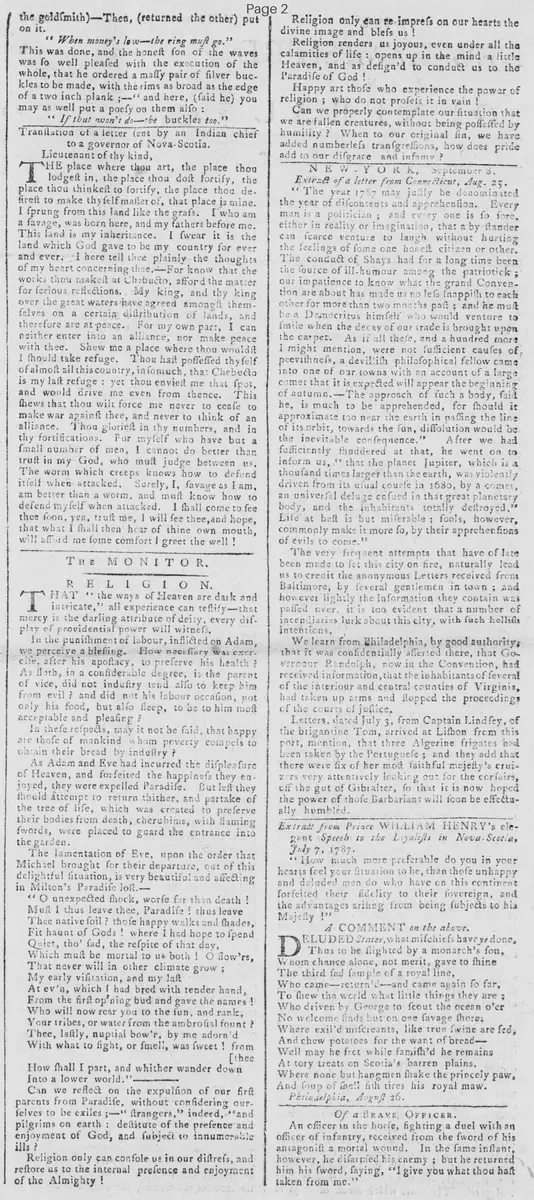
That "the ways of Heaven are dark and intricate," all experience can testify--that mercy is the darling attribute of deity, every display of providential power will witness.
In the punishment of labour, inflicted on Adam, we perceive a blessing. How necessary was exercise, after his apostacy, to preserve his health! As sloth, in a considerable degree, is the parent of vice, did not industry tend also to keep him from evil? and did not his labour occasion, not only his food, but also sleep, to be to him most acceptable and pleasing?
In these respects, may it not be said, that happy are those of mankind whom poverty compels to obtain their bread by industry?
As Adam and Eve had incurred the displeasure of Heaven, and forfeited the happiness they enjoyed, they were expelled Paradise. But lest they should attempt to return thither, and partake of the tree of life, which was created to preserve their bodies from death, cherubims, with flaming swords, were placed to guard the entrance into the garden.
The lamentation of Eve, upon the order that Michael brought for their departure, out of this delightful situation, is very beautiful and affecting in Milton's Paradise Lost.-
"O unexpected stroke, worse far than death!
Must I thus leave thee, Paradise! thus leave
Thee, native soil? these happy walks and shades,
Fit haunt of Gods! where I had hope to spend
Quiet, tho' sad, the respite of that day
Which must be mortal to us both! O flowers,
That never will in other climate grow,
My early visitation, and my last
At ev'n, which I had bred with tender hand,
From the first op'ning bud, and gave ye names!
Who now will rear you to the sun, and rank
Your tribes, or water from the ambrosial fount?
Thee, lastly, nuptial bower, by me adorn'd
With what to sight, or smell, was sweet! from thee
How shall I part, and whither wander down
Into a lower world."
Can we reflect on the expulsion of our first parents from Paradise, without considering ourselves to be exiles ;--"strangers," indeed, "and pilgrims on earth: destitute of the presence and enjoyment of God, and subject to innumerable ills?"
Religion only can console us in our distress, and restore us to the internal presence and enjoyment of the Almighty!
Religion only can re-impress on our hearts the divine image and bless us!
Religion renders us joyous, even under all the calamities of life: opens up in the mind a little Heaven, and as design'd to conduct us to the Paradise of God!
Happy are those who experience the power of religion; who do not profess it in vain!
Can we properly contemplate our situation that we are fallen creatures, without being possessed by humility? When to our original sin, we have added numberless transgressions, how does pride add to our disgrace and infamy?
RELIGION.
That "the ways of Heaven are dark and intricate," all experience can testify--that mercy is the darling attribute of deity, every display of providential power will witness.
In the punishment of labour, inflicted on Adam, we perceive a blessing. How necessary was exercise, after his apostacy, to preserve his health! As sloth, in a considerable degree, is the parent of vice, did not industry tend also to keep him from evil? and did not his labour occasion, not only his food, but also sleep, to be to him most acceptable and pleasing?
In these respects, may it not be said, that happy are those of mankind whom poverty compels to obtain their bread by industry?
As Adam and Eve had incurred the displeasure of Heaven, and forfeited the happiness they enjoyed, they were expelled Paradise. But lest they should attempt to return thither, and partake of the tree of life, which was created to preserve their bodies from death, cherubims, with flaming swords, were placed to guard the entrance into the garden.
The lamentation of Eve, upon the order that Michael brought for their departure, out of this delightful situation, is very beautiful and affecting in Milton's Paradise Lost.-
"O unexpected stroke, worse far than death!
Must I thus leave thee, Paradise! thus leave
Thee, native soil? these happy walks and shades,
Fit haunt of Gods! where I had hope to spend
Quiet, tho' sad, the respite of that day
Which must be mortal to us both! O flowers,
That never will in other climate grow,
My early visitation, and my last
At ev'n, which I had bred with tender hand,
From the first op'ning bud, and gave ye names!
Who now will rear you to the sun, and rank
Your tribes, or water from the ambrosial fount?
Thee, lastly, nuptial bower, by me adorn'd
With what to sight, or smell, was sweet! from thee
How shall I part, and whither wander down
Into a lower world."
Can we reflect on the expulsion of our first parents from Paradise, without considering ourselves to be exiles ;--"strangers," indeed, "and pilgrims on earth: destitute of the presence and enjoyment of God, and subject to innumerable ills?"
Religion only can console us in our distress, and restore us to the internal presence and enjoyment of the Almighty!
Religion only can re-impress on our hearts the divine image and bless us!
Religion renders us joyous, even under all the calamities of life: opens up in the mind a little Heaven, and as design'd to conduct us to the Paradise of God!
Happy are those who experience the power of religion; who do not profess it in vain!
Can we properly contemplate our situation that we are fallen creatures, without being possessed by humility? When to our original sin, we have added numberless transgressions, how does pride add to our disgrace and infamy?
What sub-type of article is it?
Moral Or Religious
What keywords are associated?
Religion
Paradise Expulsion
Adam And Eve
Divine Mercy
Moral Humility
Milton Quote
What entities or persons were involved?
Adam
Eve
God
Milton
Editorial Details
Primary Topic
Consoling Power Of Religion After The Fall Of Man
Stance / Tone
Devout Reflection And Exhortation
Key Figures
Adam
Eve
God
Milton
Key Arguments
Ways Of Heaven Are Dark But Merciful
Labor As Punishment Is A Blessing Preserving Health And Preventing Vice
Expulsion From Paradise Guarded By Cherubim
Religion Consoles Exiles And Restores Divine Presence
Religion Fosters Joy Amid Calamities And Leads To Paradise
Humility Essential In Recognizing Fallen State And Sins