Thank you for visiting SNEWPapers!
Sign up free
Story
September 16, 1837
New Hampshire Statesman And State Journal
Concord, Merrimack County, New Hampshire
What is this article about?
Joseph R. Chandler recalls a boyhood encounter on Plymouth Bay with a drunken laborer who warns him against alcohol, sharing his own tragic fall from respectability to poverty and explaining how drunkenness destroys self-esteem, preventing reform that might lead to starvation.
Clipping
OCR Quality
95%
Excellent
Full Text
FROM THE PHILADELPHIA U. S. GAZETTE.
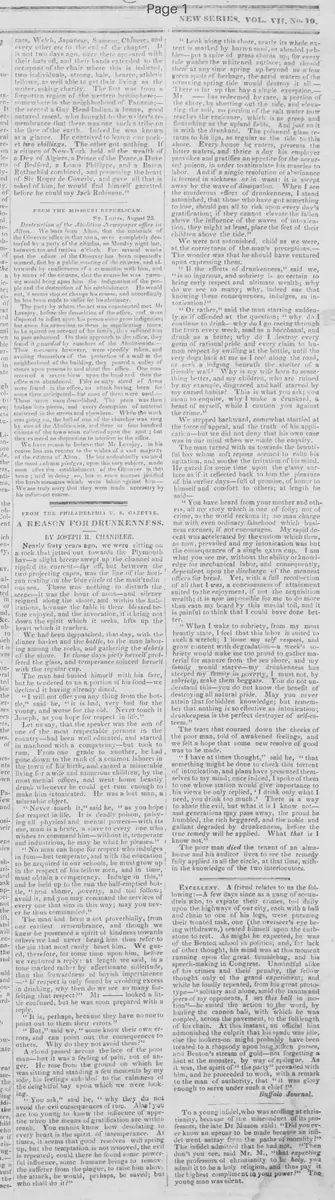
A REASON FOR DRUNKENNESS.
BY JOSEPH R. CHANDLER.
Nearly forty years ago, we were sitting on a rock that jutted out towards the Plymouth bay—a slight breeze swept up the channel and rippled its current—far off, but between the two projecting capes, was the line of the horizon resting on the blue circle of the multitudinous sea. There was nothing to disturb the scene—it was the hour of noon—and silence reigned along the shore, and within the habitations, because the table is there blessed before enjoyed, and the invocation, if it bring not down the spirit which it seeks, lifts up the heart which it reaches.
We had been dispatched, that day, with the dinner basket and the bottle, to the man laboring among the rocks, and gathering the debris of the shore. In those days piety herself proffered the glass, and temperance solaced herself with the regular cup.
The man had busied himself with his fare, but he tendered to us a portion of his food—we declined it having already dined.
"I will not offer you any thing from the bottle," said he, "it is bad, very bad for the young, and worse for the old. Never touch it Joseph, as you hope for respect in life."
Let us say, that the speaker was the son of one of the most respectable persons in the country—had been well educated, and started in manhood with a competency—but took to rum. From one grade to another, he had gone down to the rank of a common laborer in the town of his birth, and earned a miserable living for a wife and numerous children, by the most menial offices, and went home beastly drunk whenever he could get rum enough to make him intoxicated. He was a lost man, a miserable object.
"Never touch it," said he, "as you hope for respect in life. It is deadly poison, palsy-ing all physical and mental powers—with its use, man is a brute, a slave to every one who wishes to command him—without it, temperate and industrious, he may be what he pleases."
"No man can hope for respect who indulges in Rum—but temperate, and with the education to be acquired in our schools, he must grow up in the respect of his fellow men, and in time, must obtain a competency. Indulge in this," and he held up to the sun the half-emptied bottle, "and shame, poverty, and toil follow; avoid it, and you may command the services of every one that sins in this way; may you never be thus commanded."
The man had been a sot proverbially, from our earliest remembrance, and though we knew he possessed a spirit of kindness towards others we had never heard him thus refer to the sin that most easily beset him. We gazed, therefore, for some time upon him, before we ventured a reply: at length we said, in a tone marked rather by affectionate solicitude, than the forwardness of boyish impertinence—"If respect is only found by avoiding excess in drinking, why then do we see so many forfeiting that respect?" Mr. — looked a little confused, but he was soon prepared with a reply.
"It is, perhaps, because they have no one to point out to them their errors."
"But," said we, "some know their own errors, and can point out the consequences to others. Why do they not avoid them?"
A cloud passed across the face of the poor man—but it was a feeling of pain, not of anger. He rose from the ground on which he was sitting and standing a few moments by my side, his feelings subsided to the calmness of the delightful bay upon which we were looking.
"You ask," said he, "why they do not avoid the evil consequences of rum. Alas! you are too young to know the influence of appetite when the means of gratification are within reach. You cannot know how desolating to every heart is the spirit of intemperance. At times, it seems that good resolves will spring up, but the temptation is not removed, the evil is repeated; could there be found some powerful influence, some humane beings to remove the sufferer from the plague, to raise him above the attack, he would, perhaps, be saved; but who shall do it?"
"Look along this shore, nearly its whole extent is marked by barren sand, or abraded pebbles—not a spire of grass shoots up; for every tide washes the whitened surface; and should there at any time spring up beyond us a few green spots of herbage, the acrid waters of the returning spring tide would destroy it all.—There is far up the bay a single exception.—Mr. — has redeemed by care, a portion of the shore, by shutting out the tide, and elevating the soil, no portion of the salt water now reaches the enclosure, which is as green and flourishing as the upland fields. And just so it is with the drunkard. The poisoned glass returns to his lips, as regular as the tide to this shore. Every house he enters, presents the bitter waters, and thrice a day his employer provokes and gratifies an appetite for the accursed poison, in order to stimulate his muscles to labor. And if a single resolution of abstinence is formed in sickness or in want: it is swept away by the wave of dissipation. When I see the murderous effect of drunkenness, I stand astonished, that those who have got something to lose, should put all to risk upon every day's gratification; if they cannot elevate the fallen above the influence of the waves of intoxication, they might at least, place the feet of their children above the tide."
We were not astonished, child as we were, at the correctness of the man's perceptions.—The wonder was that he should have ventured upon expressing them.
"If the effects of drunkenness," said we, "is so injurious, and sobriety is so certain to bring early respect and ultimate wealth; why do we see so many; why, indeed one that knowing these consequences, indulges, in intoxication?"
"Or rather," said the man starting suddenly as if offended at the question; "why do I continue to drink—why do I go racing through the town every week, mad as a bacchanal, and drunk as a brute; why do I destroy every germ of rational pride and every claim to human respect by swilling at the bottle, until the very dogs bark at me as I reel along the road, or seek a lodging beneath the shelter of a friendly wall? Why is my wife born to something better, and my children, who are ruined by my example, disgraced and half starved by my cursed habits? This is what you ask; you mean to enquire, why I make a drunkard, a beast of myself, while I caution you against the crime."
We stepped backward, somewhat startled at the force of appeal, and the truth of his application—but we did not deny that his own case was in our mind when we made the enquiry.
The man turned with us towards the beautiful bay whose soft repose seemed to calm his agitation, and soothe the irritation of his mind. He gazed for some time upon the glassy surface as if it reflected back to him the pleasure of his earlier days—full of promise, of honor to himself and comfort to others; at length he said
"You have heard from your mother and others, all my story which is one of folly; not of crime, as the world reckons it; no man charge me with even ordinary falsehood which business excuses, if not encourages. My rapid descent was accelerated by the custom which then, as now, prevailed and my intoxication was but the consequences of a single extra cup. I am what you see me, without the ability or knowledge for mechanical labor, and consequently, dependent upon the discharge of the meanest offices for bread. Yet, with a full recollection of all that I was, a consciousness of attainment suited to the enjoyment, if not the acquisition wealth; it is now impossible for me to do more than earn my board by this menial toil, and it is painful to think that I could have done better.
When I wake to sobriety, from my most beastly state, I feel that this labor is suited to such a wretch; I lose my self respect, and grow content with degradation—a week's sobriety would make me too proud to gather material for manure from the sea shore, and my family would starve—my drunkenness has steeped my family in poverty, I must not, by sobriety, make them beggars. You do not understand this—you do not know the benefit of destroying all natural pride. May you never attain that forbidden knowledge; but remember that nothing is so effective as intoxication; drunkenness is the perfect destroyer of self-esteem."
The tears that coursed down the cheeks of the poor man, told of awakened feelings, and we felt a hope that some new resolve of good was to be made.
"I have at times thought," said he, "that something might be done to check this torrent of intoxication, and plans have presented themselves to my mind; once indeed, I spoke of them to one whose station would give importance to his views he only replied, 'I drink only what I need, you drink too much.' There is a way to abate the evil, but what it is I know not—and generations may pass away, the proud be humbled, the rich beggared, and the noble and gallant degraded by drunkenness, before the true remedy will be applied. What that is I know not."
The poor man died the tenant of an alms-house and his auditor lives to see the remedy fully applied in all the circle, at that time, within the knowledge of the two interlocutors.
A REASON FOR DRUNKENNESS.
BY JOSEPH R. CHANDLER.
Nearly forty years ago, we were sitting on a rock that jutted out towards the Plymouth bay—a slight breeze swept up the channel and rippled its current—far off, but between the two projecting capes, was the line of the horizon resting on the blue circle of the multitudinous sea. There was nothing to disturb the scene—it was the hour of noon—and silence reigned along the shore, and within the habitations, because the table is there blessed before enjoyed, and the invocation, if it bring not down the spirit which it seeks, lifts up the heart which it reaches.
We had been dispatched, that day, with the dinner basket and the bottle, to the man laboring among the rocks, and gathering the debris of the shore. In those days piety herself proffered the glass, and temperance solaced herself with the regular cup.
The man had busied himself with his fare, but he tendered to us a portion of his food—we declined it having already dined.
"I will not offer you any thing from the bottle," said he, "it is bad, very bad for the young, and worse for the old. Never touch it Joseph, as you hope for respect in life."
Let us say, that the speaker was the son of one of the most respectable persons in the country—had been well educated, and started in manhood with a competency—but took to rum. From one grade to another, he had gone down to the rank of a common laborer in the town of his birth, and earned a miserable living for a wife and numerous children, by the most menial offices, and went home beastly drunk whenever he could get rum enough to make him intoxicated. He was a lost man, a miserable object.
"Never touch it," said he, "as you hope for respect in life. It is deadly poison, palsy-ing all physical and mental powers—with its use, man is a brute, a slave to every one who wishes to command him—without it, temperate and industrious, he may be what he pleases."
"No man can hope for respect who indulges in Rum—but temperate, and with the education to be acquired in our schools, he must grow up in the respect of his fellow men, and in time, must obtain a competency. Indulge in this," and he held up to the sun the half-emptied bottle, "and shame, poverty, and toil follow; avoid it, and you may command the services of every one that sins in this way; may you never be thus commanded."
The man had been a sot proverbially, from our earliest remembrance, and though we knew he possessed a spirit of kindness towards others we had never heard him thus refer to the sin that most easily beset him. We gazed, therefore, for some time upon him, before we ventured a reply: at length we said, in a tone marked rather by affectionate solicitude, than the forwardness of boyish impertinence—"If respect is only found by avoiding excess in drinking, why then do we see so many forfeiting that respect?" Mr. — looked a little confused, but he was soon prepared with a reply.
"It is, perhaps, because they have no one to point out to them their errors."
"But," said we, "some know their own errors, and can point out the consequences to others. Why do they not avoid them?"
A cloud passed across the face of the poor man—but it was a feeling of pain, not of anger. He rose from the ground on which he was sitting and standing a few moments by my side, his feelings subsided to the calmness of the delightful bay upon which we were looking.
"You ask," said he, "why they do not avoid the evil consequences of rum. Alas! you are too young to know the influence of appetite when the means of gratification are within reach. You cannot know how desolating to every heart is the spirit of intemperance. At times, it seems that good resolves will spring up, but the temptation is not removed, the evil is repeated; could there be found some powerful influence, some humane beings to remove the sufferer from the plague, to raise him above the attack, he would, perhaps, be saved; but who shall do it?"
"Look along this shore, nearly its whole extent is marked by barren sand, or abraded pebbles—not a spire of grass shoots up; for every tide washes the whitened surface; and should there at any time spring up beyond us a few green spots of herbage, the acrid waters of the returning spring tide would destroy it all.—There is far up the bay a single exception.—Mr. — has redeemed by care, a portion of the shore, by shutting out the tide, and elevating the soil, no portion of the salt water now reaches the enclosure, which is as green and flourishing as the upland fields. And just so it is with the drunkard. The poisoned glass returns to his lips, as regular as the tide to this shore. Every house he enters, presents the bitter waters, and thrice a day his employer provokes and gratifies an appetite for the accursed poison, in order to stimulate his muscles to labor. And if a single resolution of abstinence is formed in sickness or in want: it is swept away by the wave of dissipation. When I see the murderous effect of drunkenness, I stand astonished, that those who have got something to lose, should put all to risk upon every day's gratification; if they cannot elevate the fallen above the influence of the waves of intoxication, they might at least, place the feet of their children above the tide."
We were not astonished, child as we were, at the correctness of the man's perceptions.—The wonder was that he should have ventured upon expressing them.
"If the effects of drunkenness," said we, "is so injurious, and sobriety is so certain to bring early respect and ultimate wealth; why do we see so many; why, indeed one that knowing these consequences, indulges, in intoxication?"
"Or rather," said the man starting suddenly as if offended at the question; "why do I continue to drink—why do I go racing through the town every week, mad as a bacchanal, and drunk as a brute; why do I destroy every germ of rational pride and every claim to human respect by swilling at the bottle, until the very dogs bark at me as I reel along the road, or seek a lodging beneath the shelter of a friendly wall? Why is my wife born to something better, and my children, who are ruined by my example, disgraced and half starved by my cursed habits? This is what you ask; you mean to enquire, why I make a drunkard, a beast of myself, while I caution you against the crime."
We stepped backward, somewhat startled at the force of appeal, and the truth of his application—but we did not deny that his own case was in our mind when we made the enquiry.
The man turned with us towards the beautiful bay whose soft repose seemed to calm his agitation, and soothe the irritation of his mind. He gazed for some time upon the glassy surface as if it reflected back to him the pleasure of his earlier days—full of promise, of honor to himself and comfort to others; at length he said
"You have heard from your mother and others, all my story which is one of folly; not of crime, as the world reckons it; no man charge me with even ordinary falsehood which business excuses, if not encourages. My rapid descent was accelerated by the custom which then, as now, prevailed and my intoxication was but the consequences of a single extra cup. I am what you see me, without the ability or knowledge for mechanical labor, and consequently, dependent upon the discharge of the meanest offices for bread. Yet, with a full recollection of all that I was, a consciousness of attainment suited to the enjoyment, if not the acquisition wealth; it is now impossible for me to do more than earn my board by this menial toil, and it is painful to think that I could have done better.
When I wake to sobriety, from my most beastly state, I feel that this labor is suited to such a wretch; I lose my self respect, and grow content with degradation—a week's sobriety would make me too proud to gather material for manure from the sea shore, and my family would starve—my drunkenness has steeped my family in poverty, I must not, by sobriety, make them beggars. You do not understand this—you do not know the benefit of destroying all natural pride. May you never attain that forbidden knowledge; but remember that nothing is so effective as intoxication; drunkenness is the perfect destroyer of self-esteem."
The tears that coursed down the cheeks of the poor man, told of awakened feelings, and we felt a hope that some new resolve of good was to be made.
"I have at times thought," said he, "that something might be done to check this torrent of intoxication, and plans have presented themselves to my mind; once indeed, I spoke of them to one whose station would give importance to his views he only replied, 'I drink only what I need, you drink too much.' There is a way to abate the evil, but what it is I know not—and generations may pass away, the proud be humbled, the rich beggared, and the noble and gallant degraded by drunkenness, before the true remedy will be applied. What that is I know not."
The poor man died the tenant of an alms-house and his auditor lives to see the remedy fully applied in all the circle, at that time, within the knowledge of the two interlocutors.
What sub-type of article is it?
Biography
Tragedy
What themes does it cover?
Moral Virtue
Misfortune
Tragedy
What keywords are associated?
Drunkenness
Temperance
Plymouth Bay
Moral Lesson
Poverty
Intemperance
Self Esteem
What entities or persons were involved?
Joseph R. Chandler
The Laborer
Where did it happen?
Plymouth Bay
Story Details
Key Persons
Joseph R. Chandler
The Laborer
Location
Plymouth Bay
Event Date
Nearly Forty Years Ago
Story Details
A young Joseph R. Chandler converses with a fallen laborer on Plymouth Bay who warns against rum's destructive effects, explaining his continued drinking as a means to suppress pride and accept menial toil to feed his family, using the barren shore as a metaphor for intemperance's inescapable pull.