Thank you for visiting SNEWPapers!
Sign up free
Story
July 15, 1952
Madison County Democrat
London, Madison County, Ohio
What is this article about?
Historical account of Judge Symmes' purchase of Ohio land inspired by Major Stites' exploration, promoting settlement to Revolutionary War veterans, resulting in founding of Columbia and Cincinnati between 1788-1795.
Clipping
OCR Quality
98%
Excellent
Full Text
Let's Explore Ohio
New Jersey In Ohio
"I tell you, Judge, that Ohio country has the finest, richest land you ever saw. But the piece I'm telling you about specially is between the Big and the Little Miami. Starting with the Ohio River on the south. I'd recommend that you buy just as much as you can."
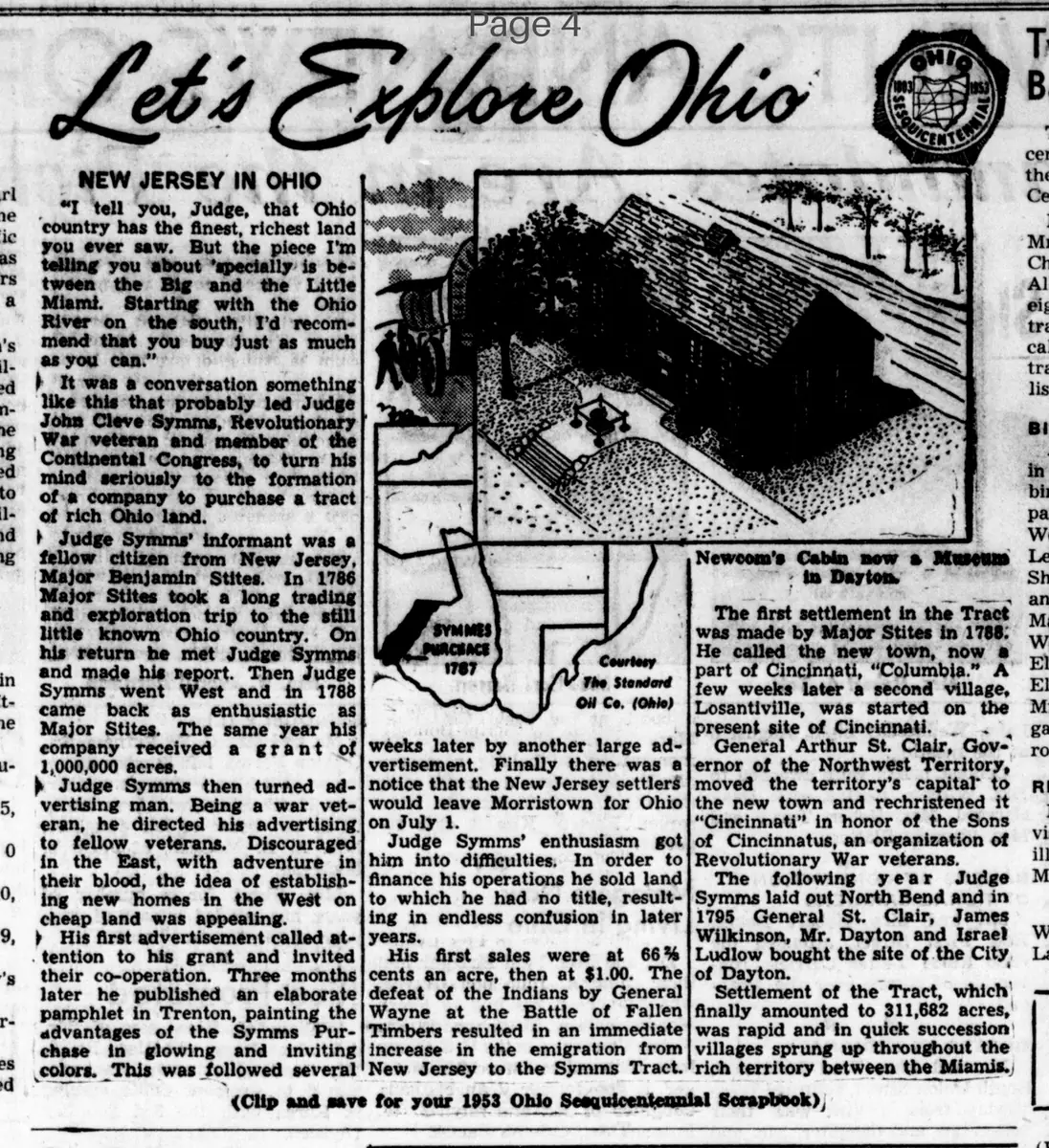
It was a conversation something like this that probably led Judge John Cleve Symmes, Revolutionary War veteran and member of the Continental Congress, to turn his mind seriously to the formation of a company to purchase a tract of rich Ohio land. Judge Symmes' informant was a fellow citizen from New Jersey, Major Benjamin Stites. In 1786 Major Stites took a long trading and exploration trip to the still little known Ohio country. On his return he met Judge Symmes and made his report. Then Judge Symmes went West and in 1788 came back as enthusiastic as Major Stites. The same year his company received a grant of 1,000,000 acres. Judge Symmes then turned advertising man. Being a war veteran, he directed his advertising to fellow veterans, discouraged in the East, with adventure in their blood. The idea of establishing new homes in the West on cheap land was appealing. His first advertisement called attention to his grant and invited their co-operation. Three months later he published an elaborate pamphlet in Trenton, painting the advantages of the Symmes Purchase in glowing and inviting colors. This was followed several weeks later by another large advertisement. Finally there was a notice that the New Jersey settlers would leave Morristown for Ohio on July 1. Judge Symmes' enthusiasm got him into difficulties. In order to finance his operations he sold land to which he had no title, resulting in endless confusion in later years. His first sales were at 66 2/3 cents an acre, then at $1.00. The defeat of the Indians by General Wayne at the Battle of Fallen Timbers resulted in an immediate increase in the emigration from New Jersey to the Symmes Tract.
The first settlement in the Tract was made by Major Stites in 1788. He called the new town, now a part of Cincinnati, "Columbia." A few weeks later a second village, Losantiville, was started on the present site of Cincinnati. General Arthur St. Clair, Governor of the Northwest Territory moved the territory's capital to the new town and rechristened it "Cincinnati" in honor of the Sons of Cincinnatus, an organization of Revolutionary War veterans. The following year Judge Symmes laid out North Bend and in 1795 General St. Clair, James Wilkinson, Mr. Dayton and Israel Ludlow bought the site of the City of Dayton. Settlement of the Tract, which finally amounted to 311,682 acres, was rapid and in quick succession villages sprung up throughout the rich territory between the Miamis.
(Clip and save for your 1953 Ohio Sesquicentennial Scrapbook)
New Jersey In Ohio
"I tell you, Judge, that Ohio country has the finest, richest land you ever saw. But the piece I'm telling you about specially is between the Big and the Little Miami. Starting with the Ohio River on the south. I'd recommend that you buy just as much as you can."
It was a conversation something like this that probably led Judge John Cleve Symmes, Revolutionary War veteran and member of the Continental Congress, to turn his mind seriously to the formation of a company to purchase a tract of rich Ohio land. Judge Symmes' informant was a fellow citizen from New Jersey, Major Benjamin Stites. In 1786 Major Stites took a long trading and exploration trip to the still little known Ohio country. On his return he met Judge Symmes and made his report. Then Judge Symmes went West and in 1788 came back as enthusiastic as Major Stites. The same year his company received a grant of 1,000,000 acres. Judge Symmes then turned advertising man. Being a war veteran, he directed his advertising to fellow veterans, discouraged in the East, with adventure in their blood. The idea of establishing new homes in the West on cheap land was appealing. His first advertisement called attention to his grant and invited their co-operation. Three months later he published an elaborate pamphlet in Trenton, painting the advantages of the Symmes Purchase in glowing and inviting colors. This was followed several weeks later by another large advertisement. Finally there was a notice that the New Jersey settlers would leave Morristown for Ohio on July 1. Judge Symmes' enthusiasm got him into difficulties. In order to finance his operations he sold land to which he had no title, resulting in endless confusion in later years. His first sales were at 66 2/3 cents an acre, then at $1.00. The defeat of the Indians by General Wayne at the Battle of Fallen Timbers resulted in an immediate increase in the emigration from New Jersey to the Symmes Tract.
The first settlement in the Tract was made by Major Stites in 1788. He called the new town, now a part of Cincinnati, "Columbia." A few weeks later a second village, Losantiville, was started on the present site of Cincinnati. General Arthur St. Clair, Governor of the Northwest Territory moved the territory's capital to the new town and rechristened it "Cincinnati" in honor of the Sons of Cincinnatus, an organization of Revolutionary War veterans. The following year Judge Symmes laid out North Bend and in 1795 General St. Clair, James Wilkinson, Mr. Dayton and Israel Ludlow bought the site of the City of Dayton. Settlement of the Tract, which finally amounted to 311,682 acres, was rapid and in quick succession villages sprung up throughout the rich territory between the Miamis.
(Clip and save for your 1953 Ohio Sesquicentennial Scrapbook)
What sub-type of article is it?
Historical Event
Journey
Adventure
What themes does it cover?
Exploration
Triumph
What keywords are associated?
Symmes Purchase
Ohio Settlement
Cincinnati Founding
New Jersey Emigrants
Land Speculation
What entities or persons were involved?
Judge John Cleve Symmes
Major Benjamin Stites
General Arthur St. Clair
Where did it happen?
Ohio Country Between The Big And Little Miami Rivers
Story Details
Key Persons
Judge John Cleve Symmes
Major Benjamin Stites
General Arthur St. Clair
Location
Ohio Country Between The Big And Little Miami Rivers
Event Date
1786 1795
Story Details
Major Stites explores Ohio and convinces Judge Symmes to purchase land; Symmes advertises to veterans, leading to settlements including Columbia and Cincinnati in the Symmes Tract.