Thank you for visiting SNEWPapers!
Sign up free
Will Maupin's Weekly
Lincoln, Lancaster County, Nebraska
What is this article about?
Mrs. Perry Starkweather, first woman on a U.S. labor commission, leads Minnesota's department for women and children workers. A wealthy mill owner turned advocate, she improves labor conditions, aids girls seeking work, and promotes keeping young women at home until 18. Her efforts have inspired other states.
Clipping
OCR Quality
Full Text
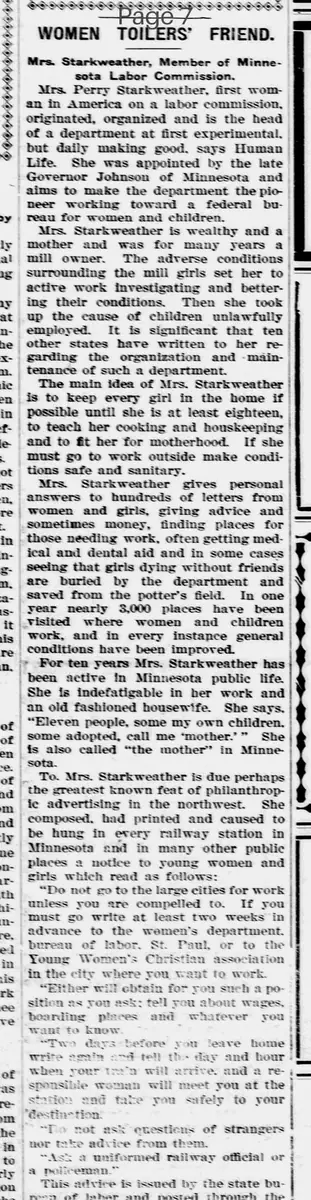
Mrs Starkweather, Member of Minnesota Labor Commission.
Mrs Perry Starkweather, first woman in America on a labor commission, originated, organized and is the head of a department at first experimental, but daily making good, says Human Life. She was appointed by the late Governor Johnson of Minnesota and aims to make the department the pioneer working toward a federal bureau for women and children.
Mrs Starkweather is wealthy and a mother and was for many years a mill owner. The adverse conditions surrounding the mill girls set her to active work investigating and bettering their conditions. Then she took up the cause of children unlawfully employed. It is significant that ten other states have written to her regarding the organization and maintenance of such a department.
The main idea of Mrs. Starkweather is to keep every girl in the home if possible until she is at least eighteen, to teach her cooking and housekeeping and to fit her for motherhood. If she must go to work outside make conditions safe and sanitary.
Mrs Starkweather gives personal answers to hundreds of letters from women and girls, giving advice and sometimes money, finding places for those needing work, often getting medical and dental aid and in some cases seeing that girls dying without friends are buried by the department and saved from the potter's field. In one year nearly 3,000 places have been visited where women and children work, and in every instance general conditions have been improved.
For ten years Mrs. Starkweather has been active in Minnesota public life. She is indefatigable in her work and an old fashioned housewife. She says, "Eleven people, some my own children, some adopted, call me mother."
She is also called "the mother" in Minnesota.
To Mrs. Starkweather is due perhaps the greatest known feat of philanthropic advertising in the northwest. She composed, had printed and caused to be hung in every railway station in Minnesota and in many other public places a notice to young women and girls which read as follows:
"Do not go to the large cities for work unless you are compelled to. If you must go write at least two weeks in advance to the women's department, bureau of labor, St. Paul, or to the Young Women's Christian association in the city where you want to work. Either will obtain for you such a position as you ask; tell you about wages, boarding places and whatever you want to know.
"Two days before you leave home write again and tell the day and hour when your train will arrive, and a responsible woman will meet you at the station and take you safely to your destination.
"Do not ask questions of strangers nor take advice from them.
"As a uniformed railway official or a policeman."
This advice is issued by the state bureau of labor and posted through the courtesy of the railway officials of this road.
-New York Sun.
What sub-type of article is it?
What themes does it cover?
What keywords are associated?
What entities or persons were involved?
Where did it happen?
Story Details
Key Persons
Location
Minnesota, St. Paul
Story Details
Mrs. Starkweather, appointed by Governor Johnson, heads a pioneering labor department for women and children in Minnesota. As a former mill owner, she investigates and improves working conditions, aids girls with jobs and advice, promotes domestic training, and distributes safety notices at railway stations. Her work has influenced other states and assisted thousands.