Thank you for visiting SNEWPapers!
Sign up free
Alexandria Gazette
Alexandria, Alexandria County, District Of Columbia
What is this article about?
In the U.S. Senate in 1834, Mr. Chambers proposed amending a harbors and rivers appropriations bill to provide $250,000 to the insolvent Chesapeake and Ohio Canal Company as a loan for completing contracts and free transport of commodities. Opponents like Messrs. Wright, Frelinghuysen, Black, Benton, and Preston argued against it as improper charity, citing prior aid and risks of endless demands. The amendment was modified but ultimately withdrawn.
Clipping
OCR Quality
Full Text
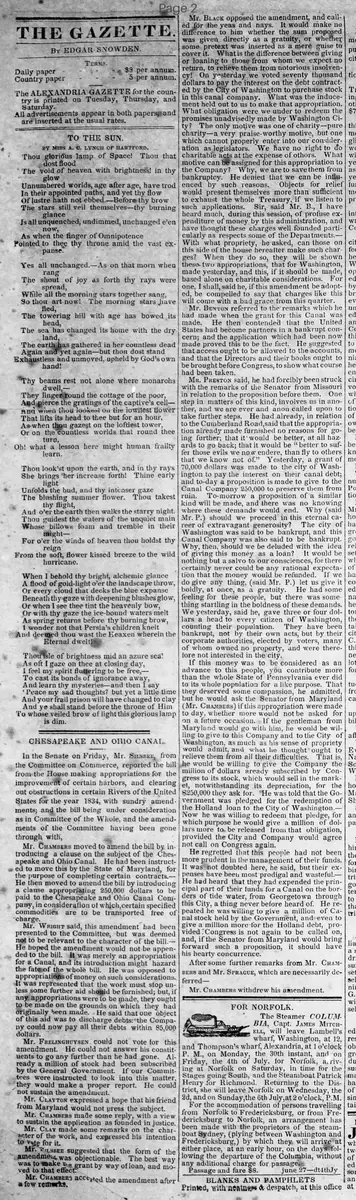
In the Senate on Friday, Mr. Silsbee, from the Committee on Commerce, reported the bill from the House making appropriations for the improvement of certain harbors, and clearing out obstructions in certain Rivers of the United States for the year 1834, with sundry amendments; and the bill being under consideration as in Committee of the Whole, and the amendments of the Committee having been gone through with,
Mr. Chambers moved to amend the bill by introducing a clause on the subject of the Chesapeake and Ohio Canal. He had been instructed to move this by the State of Maryland, for the purpose of completing certain contracts.—
He then moved to amend the bill by introducing a clause appropriating 250,000 dollars to be paid to the Chesapeake and Ohio Canal Company, in consideration of which, certain specified commodities are to be transported free of charge.
Mr. Wright said, this amendment had been presented to the Committee, but was deemed not to be relevant to the character of the bill.— He hoped the amendment would not be appended to the bill. It was merely an appropriation for a Canal, and its introduction might hazard the fate of the whole bill. He was opposed to appropriations of money on such considerations.
It was represented that the work must stop unless some further aid should be furnished; but, if any appropriations were to be made, they ought to be made on the grounds on which they had originally been made. He said that one object of this aid was to discharge debts: the Company could now pay all their debts within 85,000 dollars.
Mr. Frelinghuysen could not vote for this amendment. He could not answer his constituents to go any further than he had gone. Already a million of stock had been subscribed by the General Government. If our Committees were instructed to look into this matter they would make a proper report. He could not sustain the amendment.
Mr. Clayton expressed a hope that his friend from Maryland would not press the subject.
Mr. Chambers made some reply, with a view to sustain the application as founded in justice.
Mr. Clay made some remarks on the character of the work, and expressed his intention to vote for it.
Mr. Silsbee suggested that the form of the amendment was objectionable. The best way was to make the grant by way of loan, and moved to that effect.
Mr. Chambers accepted the amendment after a few remarks.
Mr. Black opposed the amendment, and called for the yeas and nays. It would make no difference to him whether the sum proposed was given directly as a gratuity, or whether some pretext was inserted as a mere guise to cover it. What is the difference between giving or loaning to those from whom we expect no return, to relieve them from notorious insolvency! On yesterday we voted seventy thousand dollars to pay the interest on the debt contracted by the City of Washington to purchase stock in this canal company. What was the inducement held out to us to make that appropriation? What obligation were we under to redeem the promises unadvisedly made by Washington City? The only motive was one of charity—pure charity—a very praise-worthy motive, but one which cannot properly enter into our consideration as legislators. We have no right to do charitable acts at the expense of others. What motive can be assigned for this appropriation to the Company? Why, we are to save them from bankruptcy. He denied that we can be influenced by such reasons. Objects for relief would present themselves more than sufficient to exhaust the whole Treasury, if we listen to such applications. Sir, said Mr. B., I have heard much, during this session, of profuse expenditure of money by this administration, and have thought these charges well founded particularly as respects some of the Departments.— With what propriety, he asked, can those on this side of the house hereafter make such charges? When they do so, they will be shown these two appropriations, that for Washington made yesterday, and this, if it should be made, based alone on charitable considerations. For one, I shall, said he, if this amendment be adopted, be compelled to say that charges like this will come with a bad grace from this quarter.
Mr. Benton referred to the remarks which he had made when the grant for this Canal was made. He then contended that the United States had become partners in a bankrupt concern; and the application which had been now made proved this to be the fact. He suggested that access ought to be allowed to the accounts, and that the Directors and their books ought to be brought before Congress, to show what course had been taken.
Mr. Preston said, he had forcibly been struck with the remarks of the Senator from Missouri in relation to the proposition before them. One step in matters of this kind, involves us in another, and we are ever and anon called upon to take further steps. He had already, in relation to the Cumberland Road, said that the appropriation already made furnished no reasons for going further; that it would be better, at all hazards to go back; that it would be better to suffer those evils we now endure, than fly to others that we know not of. Yesterday, a grant of 70,000 dollars was made to the city of Washington to pay the interest on their canal debt; and to-day a proposition is made to give to the Canal Company 250,000 to preserve them from ruin. To-morrow a proposition of a similar kind will be made, and there was no knowing where these demands would end. Why (said Mr. P.) should we proceed in this eternal career of extravagant generosity? The city of Washington was said to be bankrupt, and this Canal Company was also said to be bankrupt. Why, then, should we be deluded with the idea of giving this money as a loan? It would be nothing but a salvo to our consciences, for there certainly never could be any rational expectation that the money would be refunded. If we do give any thing, (said Mr. P.) let us give it boldly, at once, as a gratuity. He had some feeling for these people, but there was something startling in the boldness of these demands. We yesterday, said he, gave three or four dollars a head to every citizen of Washington, counting their population. They have been bankrupt, not by their own acts, but by their corporate authorities, elected by voters, many of whom owned no property, and were therefore not interested in the city.
If this money was to be considered as an advance to this people, you contribute more than the whole State of Pennsylvania ever did to its whole population for a like purpose. That they deserved some compassion, he admitted, but he would ask the Senator from Maryland (Mr. Chambers) if this appropriation were made to day, whether more would not be asked for on a future occasion. If the gentleman from Maryland would go with him, he would be willing to give to this Company and to the City of Washington, as much as his sense of propriety would admit, and what he thought ought to relieve them from all their difficulties. That is, he would be willing to give the Company the million of dollars already subscribed by Congress to its stock, which would sell in the market, notwithstanding its depreciation, for the $250,000 they ask for. He was told that the Government was pledged for the redemption of the Holland loan to the City of Washington.— Now he was willing to redeem that pledge, for which purpose he would give a million of dollars more to be released from that obligation, provided the City and Company would agree not call on Congress again.
He regretted that this people had not been more prudent in the management of their funds. It was not doubted here, he said, but their expenses have been most prodigal and wasteful.— He had heard that they had expended the principal part of their funds for a Canal on the borders of tide water, from Georgetown through this City, a thing never before heard of. He repeated he was willing to give a million of Canal stock held by the Government, and even to give a million more—for the Holland debt, provided Congress is not again to be called on, and, if the Senator from Maryland would bring forward such a proposition, it should have his hearty concurrence.
After some further remarks from Mr. Chambers and Mr. Sprague, which are necessarily deferred—
Mr. Chambers withdrew his amendment.
What sub-type of article is it?
What themes does it cover?
What keywords are associated?
What entities or persons were involved?
Where did it happen?
Story Details
Key Persons
Location
U.S. Senate
Event Date
1834
Story Details
Debate in the Senate on a proposed amendment to appropriate $250,000 to the Chesapeake and Ohio Canal Company to complete contracts and provide free transport, amid concerns of insolvency and prior government aid; opposed as charitable rather than justified expenditure; amendment withdrawn after discussions.