Thank you for visiting SNEWPapers!
Sign up free
National Gazette
Philadelphia, Philadelphia County, Pennsylvania
What is this article about?
A satirical letter critiques the hypocrisy of religious citizens who opposed theater performances but eagerly attended a circus benefit for the poor by Mr. Ricketts, questioning their inconsistent moral standards on amusements and charity.
Merged-components note: The dateline 'July 16.' precedes and belongs to the letter on Mr. Ricketts' performance; the letter continues across pages from reading order 7 to 9, split due to page boundary; resulting label is letter_to_editor as dominant content.
Clippings
1 of 2
OCR Quality
Full Text
For the NATIONAL GAZETTE.
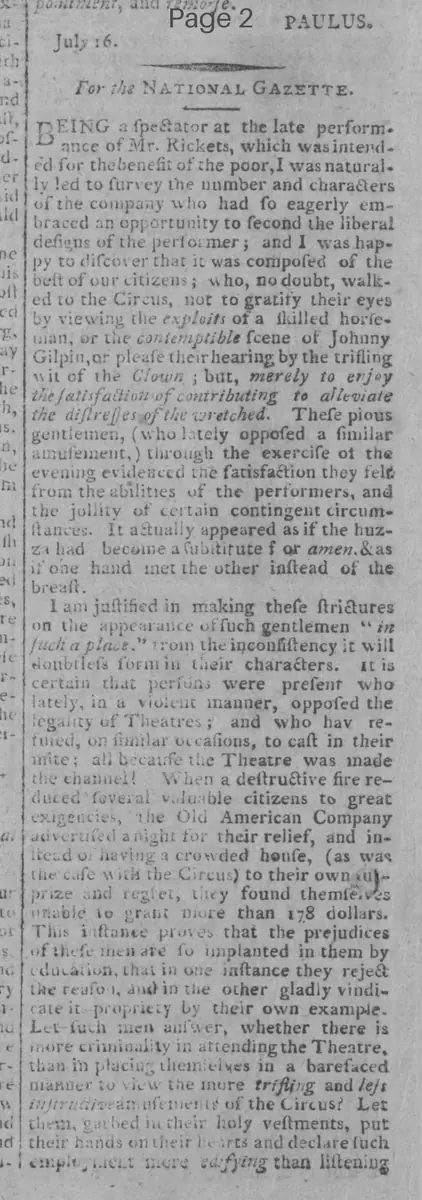
B EING a spectator at the late performance of Mr. Ricketts, which was intended for the benefit of the poor, I was naturally led to survey the number and characters of the company who had so eagerly embraced an opportunity to second the liberal designs of the performer; and I was happy to discover that it was composed of the best of our citizens; who, no doubt, walked to the Circus, not to gratify their eyes by viewing the exploits of a skilled horseman, or the contemptible scene of Johnny Gilpin, or please their hearing by the trifling wit of the Clown; but, merely to enjoy the satisfaction of contributing to alleviate the distresses of the wretched. These pious gentlemen, (who lately opposed a similar amusement,) through the exercise of the evening evidenced the satisfaction they felt from the abilities of the performers, and the jollity of certain contingent circumstances. It actually appeared as if the huzza had become a substitute for amen, as one hand met the other instead of the breast.
I am justified in making these strictures on the appearance of such gentlemen "in such a place," from the inconsistency it will doubtless form in their characters. It is certain that persons were present who lately, in a violent manner, opposed the legality of Theatres; and who have refused, on similar occasions, to cast in their mite; all because the Theatre was made the channel! When a destructive fire reduced several valuable citizens to great exigencies, the Old American Company advertised a night for their relief, and instead of having a crowded house, (as was the case with the Circus) to their own surprise and regret, they found themselves unable to grant more than 178 dollars.
This instance proves that the prejudices of these men are so implanted in them by education, that in one instance they reject the reason, while in the other gladly vindicate its propriety by their own example.
Let such men answer, whether there is more criminality in attending the Theatre, than in placing themselves in a barefaced manner to view the more trifling and less instructive performances of the Circus? Let them, clad in their holy vestments, put their hands on their hearts and declare such temple noise more edifying than listening
to the divine precepts that Haswell inculcates, or the more rational amusements of the stage.
I would now observe, that in saying what I have, I do not aim at discountenancing the employment of Mr. Ricketts. On the contrary, I think he has received no more encouragement than his proficiency in his occupation deserves. Besides being a manly exercise, horsemanship is a profession for which I have always had a respect; and which, I think, ought to be cultivated in the United States. I hope, therefore, Mr. Ricketts, or any of his company, will not conceive that I wish to reflect on their occupations; for if nothing else, the late charitable performance would place them out of the reach of slander. I only mean to remind the religious part of the community of the uniformity it would be proper they should preserve in their actions.
A FRIEND TO CONSISTENCY.
July 18.
What sub-type of article is it?
What themes does it cover?
What keywords are associated?
What entities or persons were involved?
Letter to Editor Details
Author
A Friend To Consistency
Recipient
For The National Gazette
Main Argument
the letter exposes the hypocrisy of religious individuals who opposed theater benefits for charity but attended a circus performance for the poor, arguing for consistency in their moral opposition to public amusements.
Notable Details