Thank you for visiting SNEWPapers!
Sign up free
Story
June 6, 1927
The Daily Worker
Chicago, Cook County, Illinois
What is this article about?
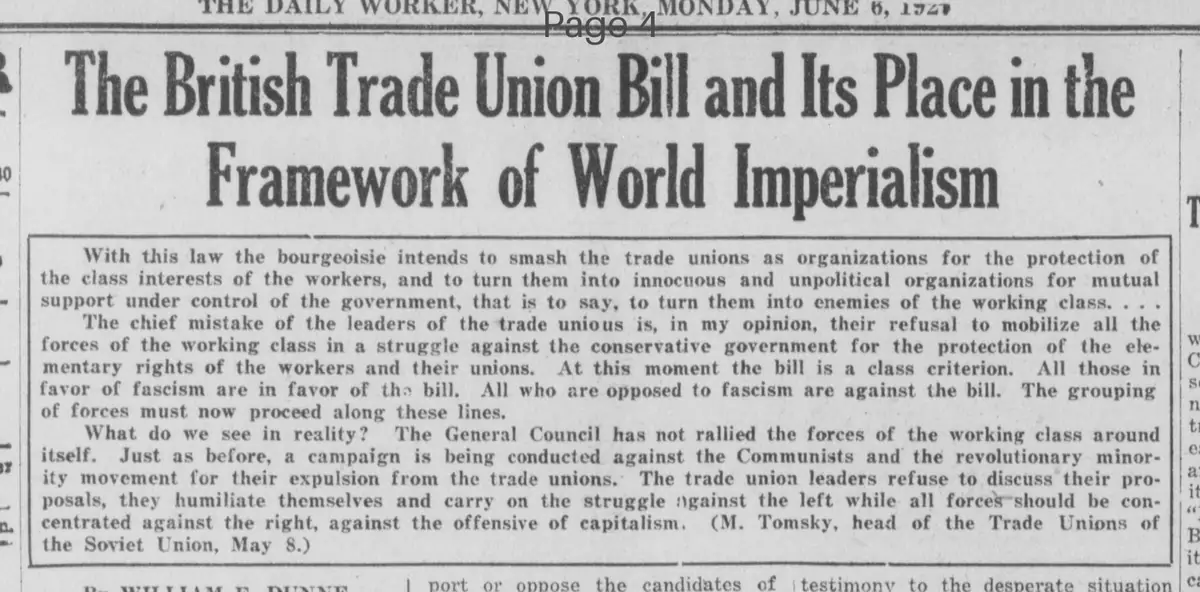
William F. Dunne critiques a British trade union bill before parliament that mandates instant discharge for civil servants joining non-exclusive unions, isolating them from broader labor affiliations and political influence, as outlined by W. J. Brown.
Clipping
OCR Quality
98%
Excellent
Full Text
By WILLIAM F. DUNNE
ARTICLE II.
The penalty provided by the trade union bill that is now before parliament for a civil servant who dares to join any union other than one composed entirely of similar civil servants is instant discharge.
WRITING in "The Labor Monthly," W. J. Brown, general Secretary of the Civil Service Association, has the following to say about this section of the bill:
"If the bill goes thru, Service Associations will either have to become outlaw organizations or alter their constitutions to conform to the bill. If they choose the latter course (as the only alternative to sheer impotence) the results would be:
1. To destroy the postal and Civil Service Internationals.
2. To destroy the affiliation between Civil Service Organizations and the Federation of Professional workers.
3. To destroy the affiliation of 30,000 Civil Servants with the Labor Party and the Trade Union Congress.
4. To destroy the political funds of the Association.
5. To make it impossible for Civil Service Associations to promote their own parliamentary candidates.
6. To make it impossible for Civil Service Associations to support or oppose the candidates of other people—friendly or hostile to the service.
7. To put every Civil Servant and the Civil Service Association at the mercy of the "regulations" to be issued by the Treasury (and not to be submitted to the House of Commons).
In short the bill says to Civil Servants:
You have already no right to strike.
Hereafter you shall not influence the House of Commons, which is your employer.
You shall not associate with outside workers, even tho their conditions are cited against you whenever you try to improve your own.
You must place yourself completely in the hands of the government, which will do with you precisely as it pleases.
THE Civil Service, if it can be controlled properly, is a valuable, in fact an almost indispensable part, of the capitalist machine. Like the army and navy, the civil servants constitute a permanent section of the capitalist state and it is a striking commentary on the instability of British capitalism that the ruling class finds it necessary to attempt to enact such stringent measures for separating these workers from the rest of the working class and the labor movement. That it does not hesitate to make this attempt, at the price of a rousing widespread opposition, is
ARTICLE II.
The penalty provided by the trade union bill that is now before parliament for a civil servant who dares to join any union other than one composed entirely of similar civil servants is instant discharge.
WRITING in "The Labor Monthly," W. J. Brown, general Secretary of the Civil Service Association, has the following to say about this section of the bill:
"If the bill goes thru, Service Associations will either have to become outlaw organizations or alter their constitutions to conform to the bill. If they choose the latter course (as the only alternative to sheer impotence) the results would be:
1. To destroy the postal and Civil Service Internationals.
2. To destroy the affiliation between Civil Service Organizations and the Federation of Professional workers.
3. To destroy the affiliation of 30,000 Civil Servants with the Labor Party and the Trade Union Congress.
4. To destroy the political funds of the Association.
5. To make it impossible for Civil Service Associations to promote their own parliamentary candidates.
6. To make it impossible for Civil Service Associations to support or oppose the candidates of other people—friendly or hostile to the service.
7. To put every Civil Servant and the Civil Service Association at the mercy of the "regulations" to be issued by the Treasury (and not to be submitted to the House of Commons).
In short the bill says to Civil Servants:
You have already no right to strike.
Hereafter you shall not influence the House of Commons, which is your employer.
You shall not associate with outside workers, even tho their conditions are cited against you whenever you try to improve your own.
You must place yourself completely in the hands of the government, which will do with you precisely as it pleases.
THE Civil Service, if it can be controlled properly, is a valuable, in fact an almost indispensable part, of the capitalist machine. Like the army and navy, the civil servants constitute a permanent section of the capitalist state and it is a striking commentary on the instability of British capitalism that the ruling class finds it necessary to attempt to enact such stringent measures for separating these workers from the rest of the working class and the labor movement. That it does not hesitate to make this attempt, at the price of a rousing widespread opposition, is
What sub-type of article is it?
Historical Event
What themes does it cover?
Justice
Misfortune
What keywords are associated?
Trade Union Bill
Civil Servants
Labor Movement
Parliament
Civil Service Association
Political Affiliation
What entities or persons were involved?
William F. Dunne
W. J. Brown
Where did it happen?
British Parliament
Story Details
Key Persons
William F. Dunne
W. J. Brown
Location
British Parliament
Story Details
A trade union bill before parliament imposes instant discharge on civil servants joining non-exclusive unions, forcing associations to isolate from broader labor groups, destroying international ties, political affiliations, and influence, as critiqued by W. J. Brown and analyzed in context of capitalist control.